
Zone Echo-7: Abyss of Silence
A small online record once caused subtle ripples. Though quickly deleted by moderators as an 'unverified claim,' the content left by user 'BlackLotus71' was undeniably special. He claimed to be a former operational logistics expert, detailing a 'special extraction point' operating deep within the Golden Triangle from the late 1960s to early 70s. This place, used for 'high-value asset transfer' and personnel recovery, was described as where "sound was swallowed by silence and time distorted." Shortly after the post vanished, a heavily redacted 1972 CIA declassified memo briefly resurfaced on public record sites. It mentioned "Zone Echo-7," documenting "unpredictable atmospheric anomalies" observed near opium cultivation areas within Myanmar's Shan State. These two fragmented pieces of information caught the eye of independent researcher M. Dubois, a man who had dedicated his life to tracking the spectral lines between official history and whispered truths.
Cross-referencing the coordinates hinted at in the forum post with decades-old topographical maps, Dubois embarked on a long, clandestine journey into a remote and forgotten region of Shan State. His objective: to find 'Zone Echo-7' and its rumored extraction point. The approach was agonizing, plagued by suffocating humidity and the cloying scent of decaying flora. The triple-canopy jungle swallowed light and distorted sound. The air itself felt heavy, laced with a distinct, metallic aroma of unfamiliar plants. Even before reaching his target, Dubois noted an abnormal weakening of ambient sounds. The vibrant, ceaseless chorus of insects usually present in such regions was eerily muted, a premonition of silence.
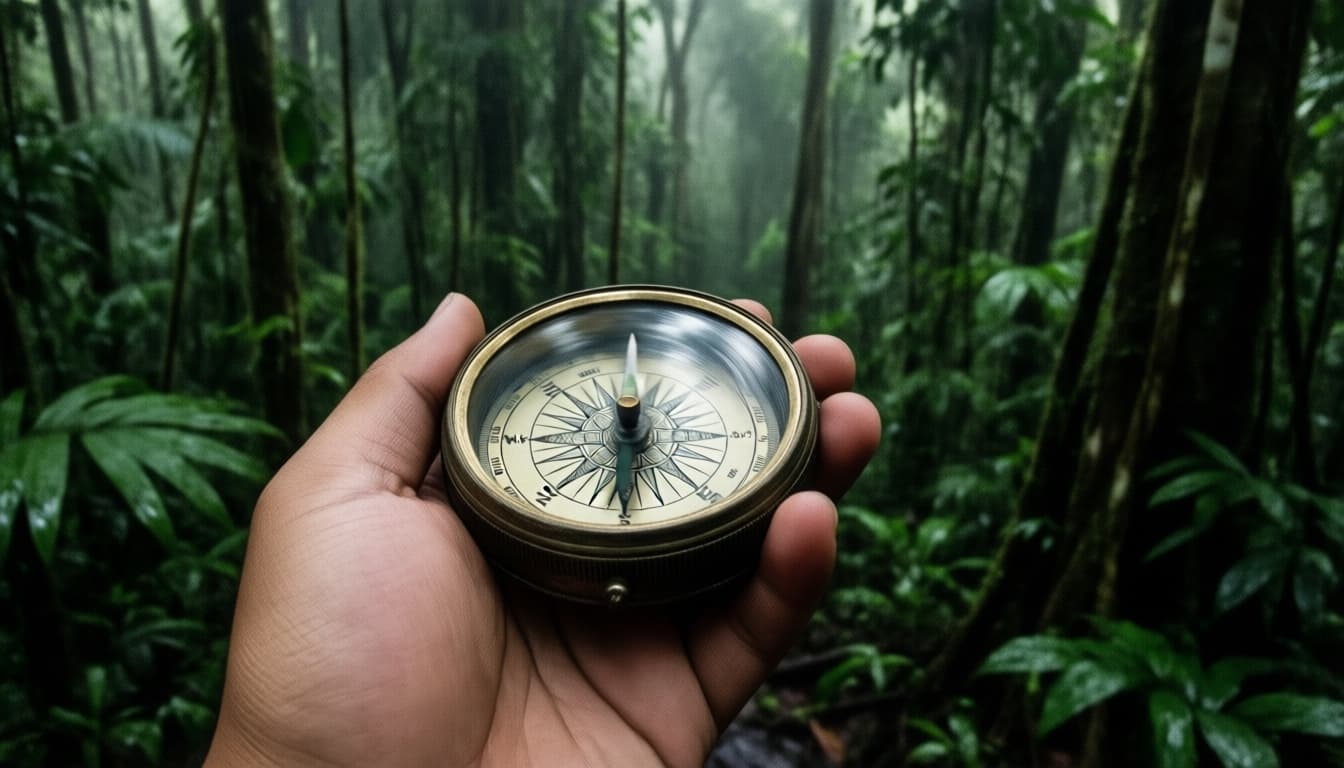
As Dubois drew closer to the approximate coordinates, the faint silence of the jungle morphed into an unnatural, profound stillness. The constant hum of insects vanished, and the distant cries of birds ceased. Only the squelch of his wet boots on the soil and his own ragged breathing remained. His compass needle spun uncontrollably, and his GPS either failed to find a signal or displayed preposterous locations, hundreds of meters off, or even placing him at sea. Ahead, a small, stagnant pool of water lay, its dark surface beneath the canopy rippling with distorted reflections. He caught fleeting movements of amorphous shadows at the edge of his vision, only for them to vanish when directly observed. Occasionally, an almost imperceptible, faint, high-pitched hum vibrated not in his ears, but deep within his teeth, instilling an instinctive sense of unease. A barely visible, overgrown path, more an intimation than a trail, finally led him to a small, isolated plateau. The ground there was subtly
strange.
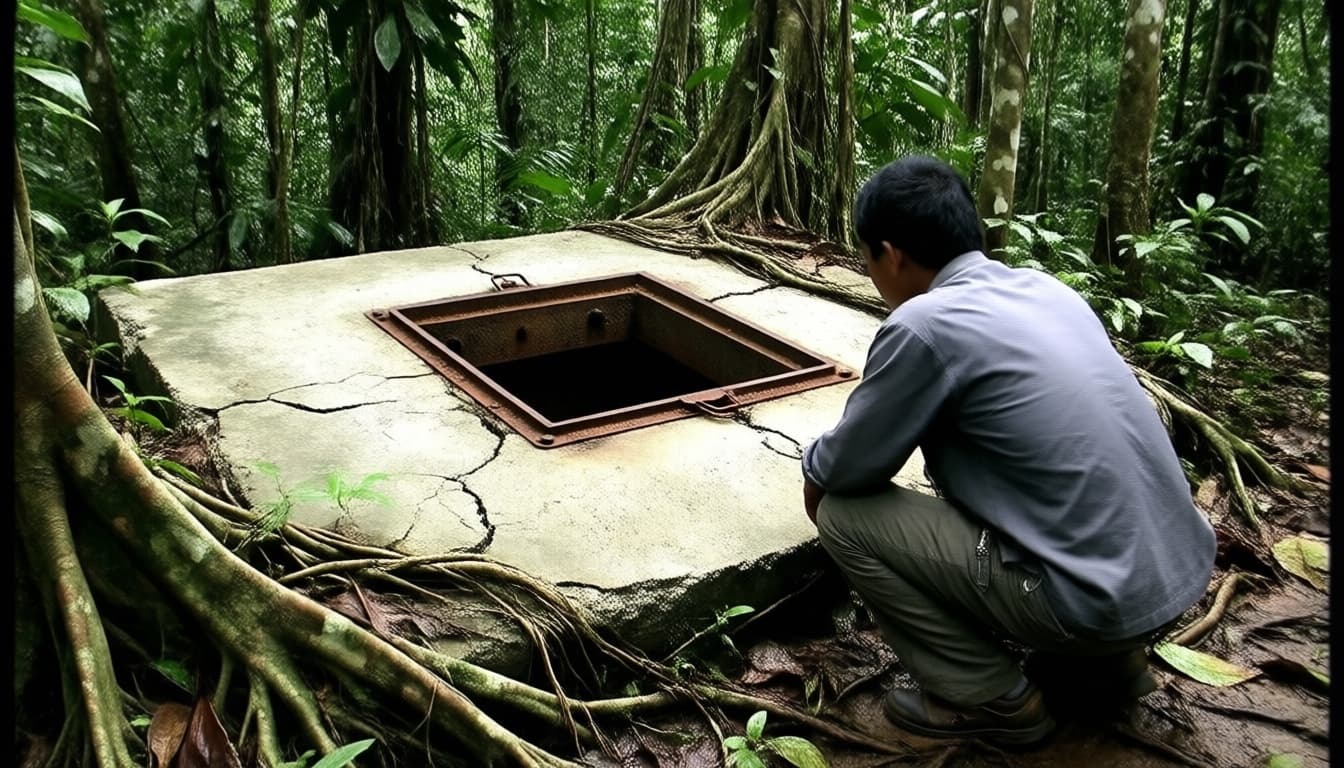
In the center of the plateau, Dubois discovered a large rectangular concrete slab, partially consumed by ceaselessly growing jungle roots. Embedded within its cracked surface was a heavy, rusted metal hatch. It was unmistakably artificial, out of place. With considerable effort, he wrenched it open, revealing a dark, claustrophobic vertical shaft leading into a small, partly collapsed underground bunker. The air inside the bunker was impossibly cold and still, carrying a faint, sour chemical odor of unknown origin. Rusted communication gear and broken radios lay scattered on the mold-encrusted floor. In one corner, partially obscured, rested an old, water-logged, and mold-covered logbook.
The moment Dubois carefully unfolded the brittle pages of the logbook, the air pressure inside the bunker dropped sharply and violently, making his ears pop agonizingly. The subtle hum from outside now intensified into an ear-splitting, skull-shattering shriek that seemed to resonate from the very walls. The surrounding concrete began to
vibrate,
they
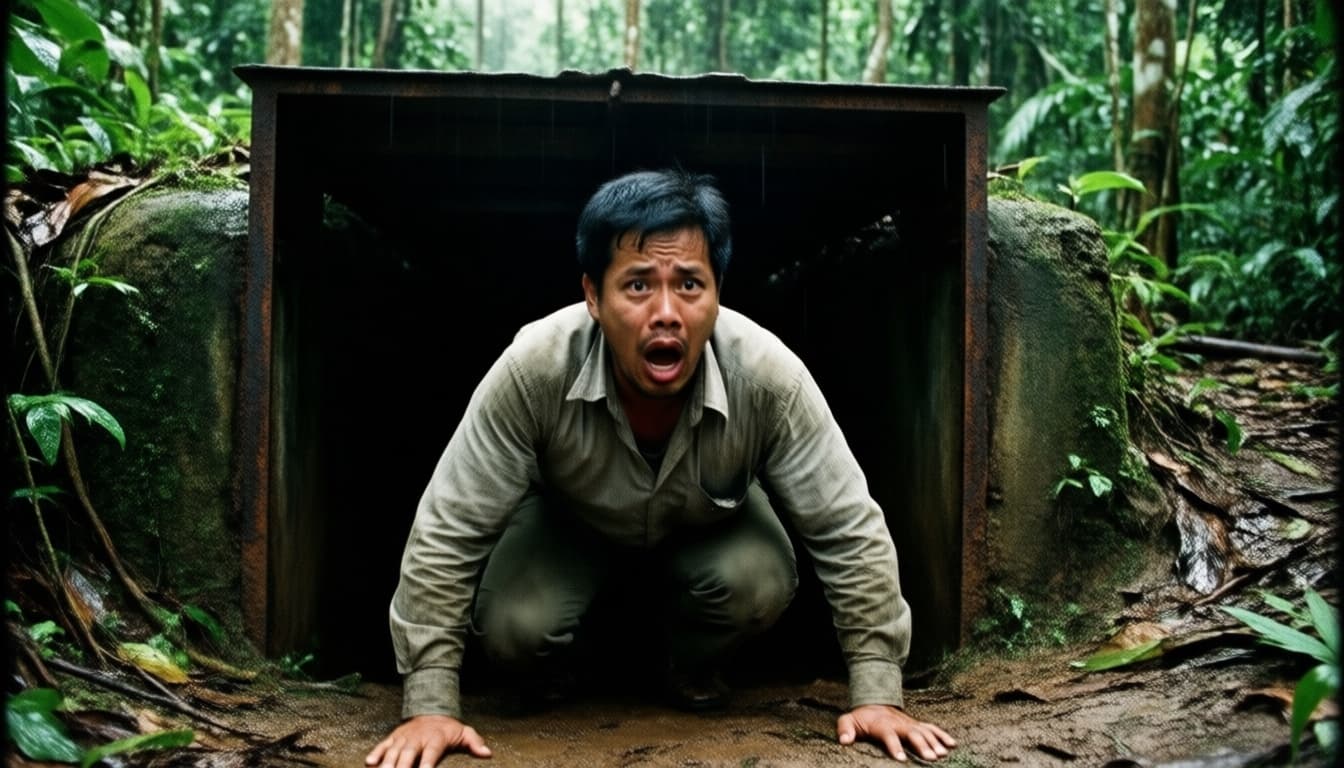
Suddenly, the heavy metal hatch overhead slammed shut with a terrible, resonant clang. There was no wind, no mechanical device, no visible force. There was only a vast, invisible
will.
thick,
trapped.
M. Dubois escaped the bunker. Not by skill, but by sheer, desperate luck. In a moment when the environmental chaos inexplicably paused, he managed to wrench the hatch open. He gasped, scrambling out into the jungle, disoriented and in profound shock.
Weeks later, he returned from Shan State, physically intact but utterly unstrung, gripped by a pervasive terror. The logbook pages he’d clutched during his escape were smudged beyond deciphering by sweat and tearing. Camera footage from the bunker site contained nothing but static and impossible light distortions.
Months passed. Back in his study, Dubois exhibited a severe, debilitating sensitivity to silence. He found deep quiet profoundly unsettling, often experiencing hallucinatory ear pressure drops, or hearing faint, overlapping whispers in the deep stillness of his study. These sounds quickly faded once perceived, but left only the chilling certainty of their existence. He became obsessively meticulous, constantly cross-referencing old maps, searching for similar 'anomalous zones.'

One evening, a forgotten online news article briefly flickered across his study's secondary monitor. It spoke of unconfirmed 'anomalous seismic activity' detected by a local monitoring station. The epicenter was a remote, uninhabited area of Shan State – precisely matching the coordinates of 'Zone Echo-7.' The incident occurred
just weeks
Dubois, eyes wide and fixed on the subtle details, knew some history wasn't merely buried; it was
active.
[ CLASSIFIED VERDICT ]
[ACCESS LOG - SOURCE FILE]
This story is set in a mysterious place called 'Zone Echo-7,' hidden deep within the remote jungles of Southeast Asia, particularly the Golden Triangle. It draws inspiration from a fictional urban legend combining a declassified CIA document mentioning 'unpredictable atmospheric anomalies' where sound is swallowed by silence and time is distorted, and the testimony of a former operational logistics expert. It's based on rumors of a mysterious 'silent zone' where unknown forces distort natural laws, disturb human perception, and consume presences.