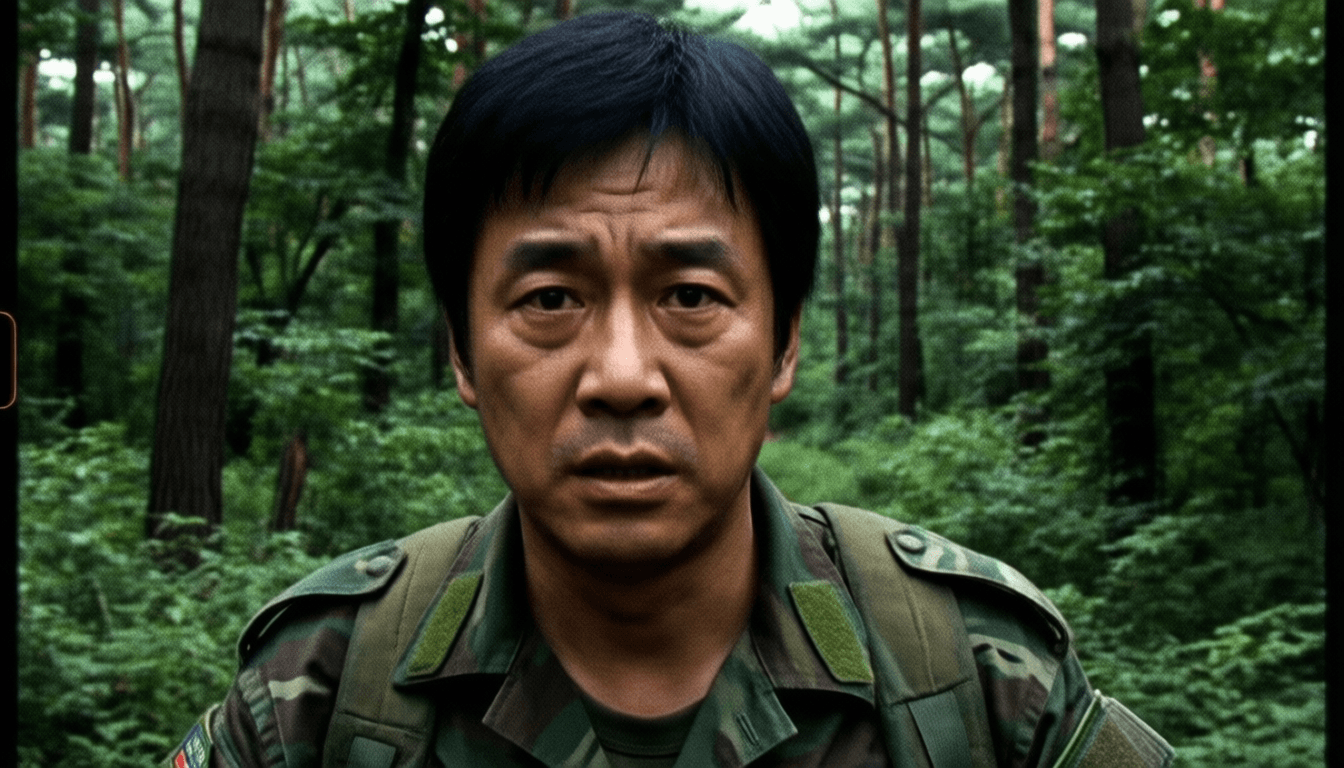
Whispers of the DMZ: The Forgotten Outpost
Among geopolitical strategists and former military intelligence operatives, persistent, chilling anomalies within the Demilitarized Zone (DMZ) are often whispered about. Beyond official infiltration attempts and propaganda reports, hushed accounts of inexplicable equipment malfunctions surface deep within specific historically contested sectors. Scrutiny of satellite imagery occasionally picks up transient, inexplicable thermal signatures, invariably dismissed as sensor error or atmospheric interference. Even more unnerving are the unofficial, personal testimonies shared among Republic of Korea (ROK) and Democratic People's Republic of Korea (DPRK) soldiers patrolling the armistice line: tales of disembodied whispers carried on the wind where no one should be, shapeless shadows moving along razor wire, or compasses wildly spinning without known magnetic interference. These are not isolated incidents; their consistency is too high, geographically concentrated around specific areas, particularly forgotten outposts or suspected collapsed tunnels that claimed the lives of soldiers from both sides decades ago. This is a land stained by forgotten conflict, an eternal wound on the earth. And some believe it is an unwilling witness to a darker, more permanent presence.
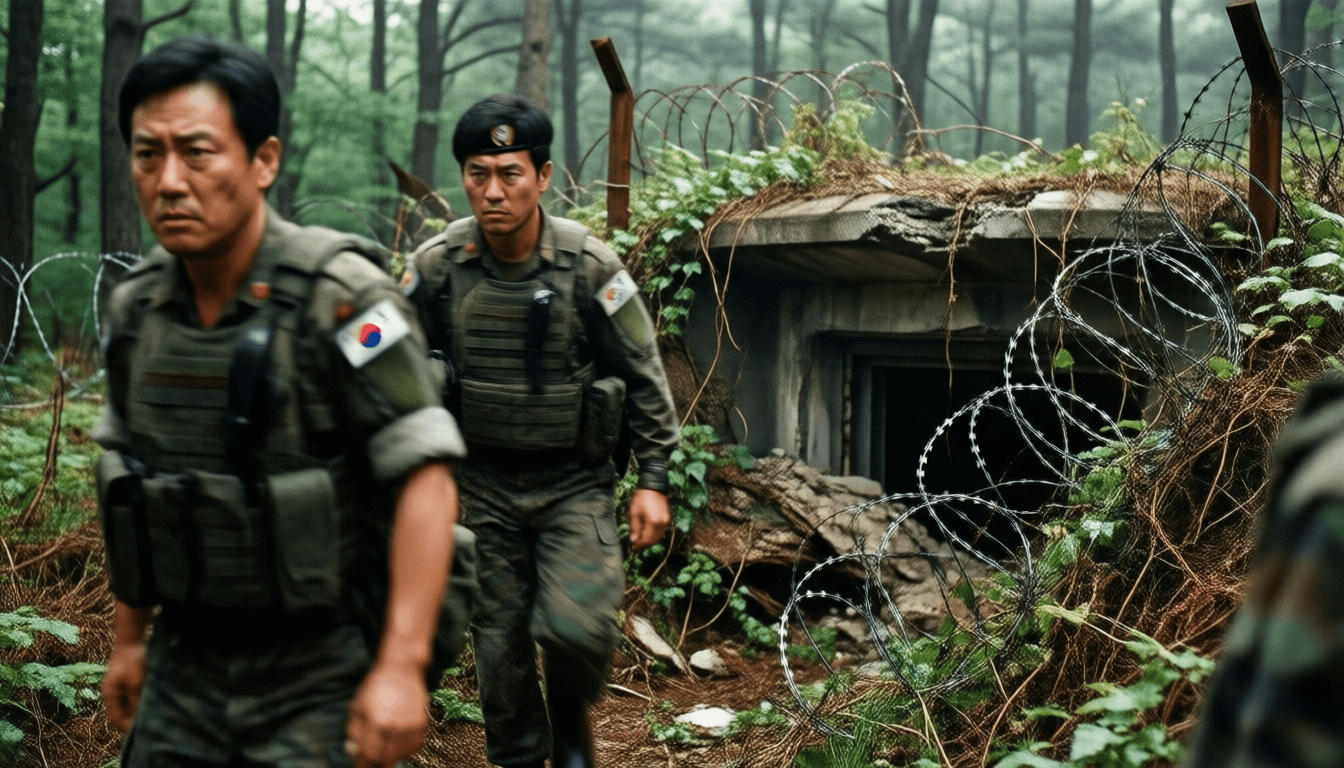
Dr. Aris Son, a former ROK military cartographer and independent geospatial anomaly researcher, secured unprecedented access to a restricted sector in the DMZ's central corridor. His official pretense was a geological survey, investigating potential geothermal activity. His true intent, however, was to unearth the nexus between historical casualty data and recurring 'environmental disturbances' reported in this specific grid square. Escorted by two taciturn, constantly vigilant armed ROK soldiers, Dr. Son navigated the dense, overgrown forest that had reclaimed the land since 1953.
The first thing that struck him was the suffocating silence. Not the natural quiet of a forest, but a vacuum, as if sound itself were suppressed. Birds were present, but unnervingly mute. The air, heavy with humidity, also held pockets of cold, stagnant air, like winter morning breaths, despite the scorching mid-summer heat. Ahead, barely visible beyond tangled vines and rusty barbed wire, lay the collapsed remains of a concrete bunker, a former forward observation post, half-buried in the earth. This was Dr. Son’s primary target. A location with numerous recorded, unidentified 'incidents.' The previously stoic soldiers visibly tensed as they approached, their movements stiffening. One soldier pointed to a faint metallic glint barely protruding from the ground near the bunker entrance: a rusted helmet, half-buried, its owner long forgotten.
Inside the partially collapsed bunker, the air was thick with the smell of damp earth and a metallic tang, like old blood mixed with ozone. Dr. Son deployed his portable seismic sensors and thermal imager. The data was immediately erratic. Seismic readings showed minute tremors inconsistent with known geological activity or distant artillery testing. The thermal imager picked up pockets of extreme cold, flickering in and out of existence, emanating from no discernible source.
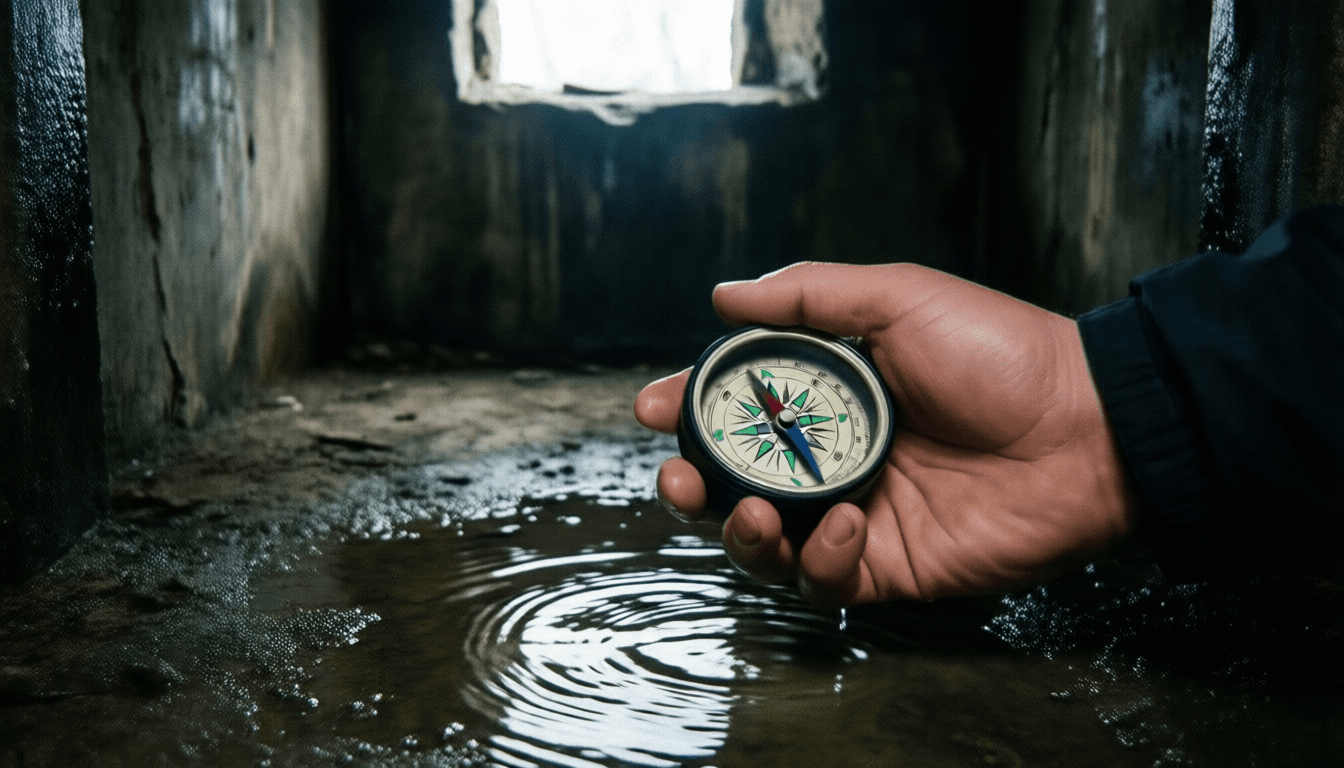
Then came the sound. Or rather, the absence of it. Dr. Son called out to his escorts, but his voice seemed absorbed, barely echoing. When one of the soldiers spoke in a low tone, his words sounded faintly delayed and distorted, as if passing through thick water. Dr. Son noticed a small stream of water seeping from a crack in the concrete ceiling, pooling on the uneven floor. As he watched, transfixed, the water in the shallow puddle began to move. Not flowing towards the lowest point, but subtly, inexplicably, moving against the slope, forming small concentric ripples that expanded and contracted, as if breathing.
The compass clipped to his vest began to spin wildly. Not a frantic vibration, but a slow, deliberate rotation. It would stop at arbitrary directions, then resume its bizarre dance. The cold pockets of air intensified, making his breath visible even in the humid air. He felt a distinct pressure on his chest, as if a colossal weight was pressing down, making it hard to draw a full breath. He glanced at the soldiers. Their faces were pale, eyes fixed on an unidentifiable point in the empty air. Their weapons were held stiffly, not aimed, but paralyzed by something unseen and insensate. A low, raspy groan seemed to emanate from the walls themselves. Not a sound entering the bunker, but one born within it, vibrating through his bones. A sound of ancient, raw agony, layered with decades of silence.
Suddenly, the air in the bunker compressed. Dr. Son gasped. His lungs burned, the invisible weight on his chest unbearable. The pressure felt like being submerged in deep water, yet he was in a dry, enclosed space. The light from his headlamp flickered violently, then died, plunging them into complete darkness. A strangled scream erupted from one soldier, followed by a thud.
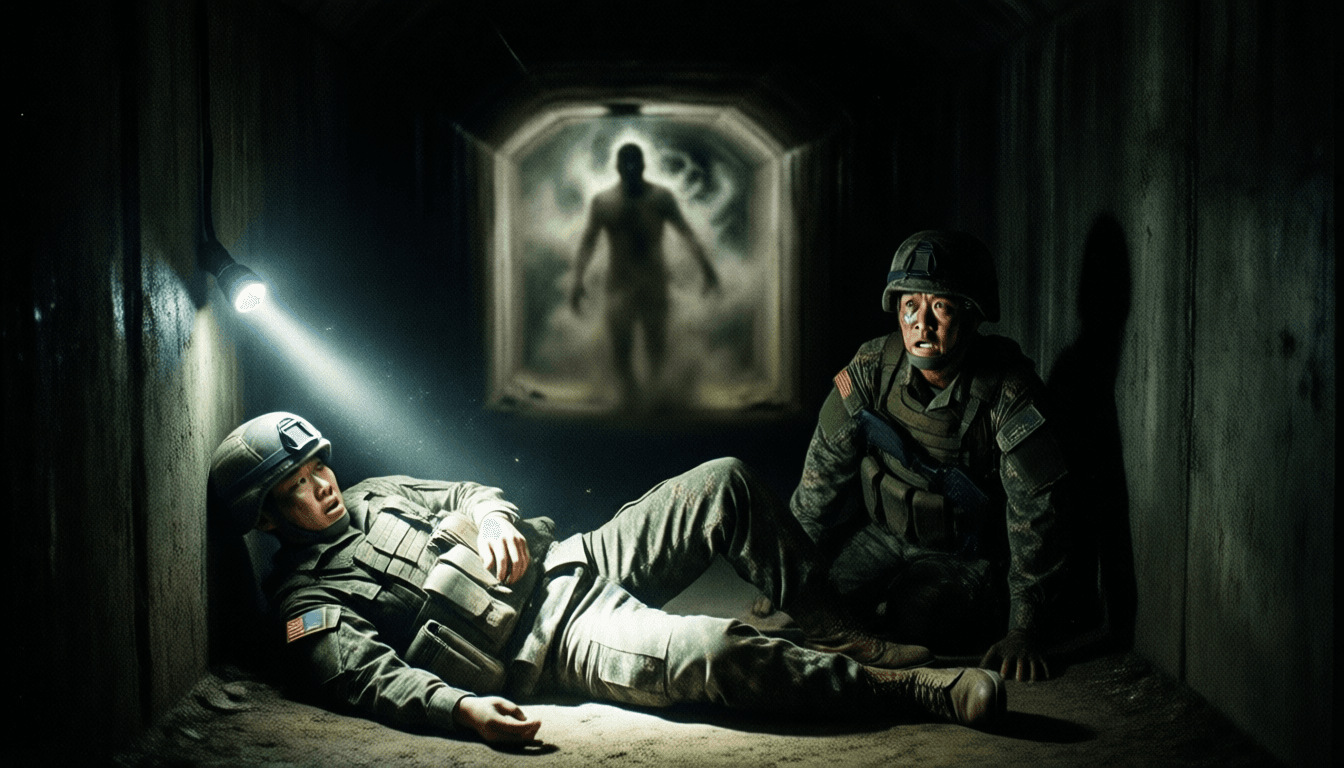
Panic seized him. He fumbled for his backup light with numb fingers. When it finally clicked on, it revealed a horrifying scene. One soldier lay motionless on the ground, a thin trickle of blood from his nose. The other stood frozen, eyes wide, staring at a point over Dr. Son's shoulder. Dr. Son spun around, directing his light into the deepest part of the bunker, a narrow, unstable passage leading deeper into the earth – an unregistered infiltration tunnel.
And then he saw it. Not a creature, nor a ghost. It was the air itself. Not random dust motes scattered in the beam. They were coalescing, forming an impossible vortex at the center of the tunnel entrance, congealing into a blurry, featureless, but distinctly present human-like form. A thought, not a whisper, embedded itself in his mind: “You will not leave.”
The tunnel passage began to shake. Not an earthquake, but a localized, impossible stress. Concrete groaned, metal screamed. A section of the ceiling directly above the entrance collapsed with a deafening roar. Not falling downwards, but imploding inward, as if pulled by an unseen, immense gravity well, sealing their only exit. Thick, black water erupted from the solid rock walls of the tunnel itself. Not a trickle, but a torrent. Carrying rusted metallic shrapnel and fragments of bone, it was fiery hot one moment and icy cold the next, seemingly defying thermodynamic laws. He stumbled back, his feet tangling, but the water seemed to pursue him, wrapping around his ankles, rising to his knees, his waist, its unnatural current trying to pull him deeper into the swirling darkness of the tunnel entrance.
He was trapped. The air was thick with ozone and damp earth, the water pulled at him, the pressure crushed his chest, and the silent, shapeless presence advanced, drawing him into an impossible abyss. He fought desperately, instinctively realizing this was not merely a place of death, but one that consumed it, now intending to add him to its impossible collection.
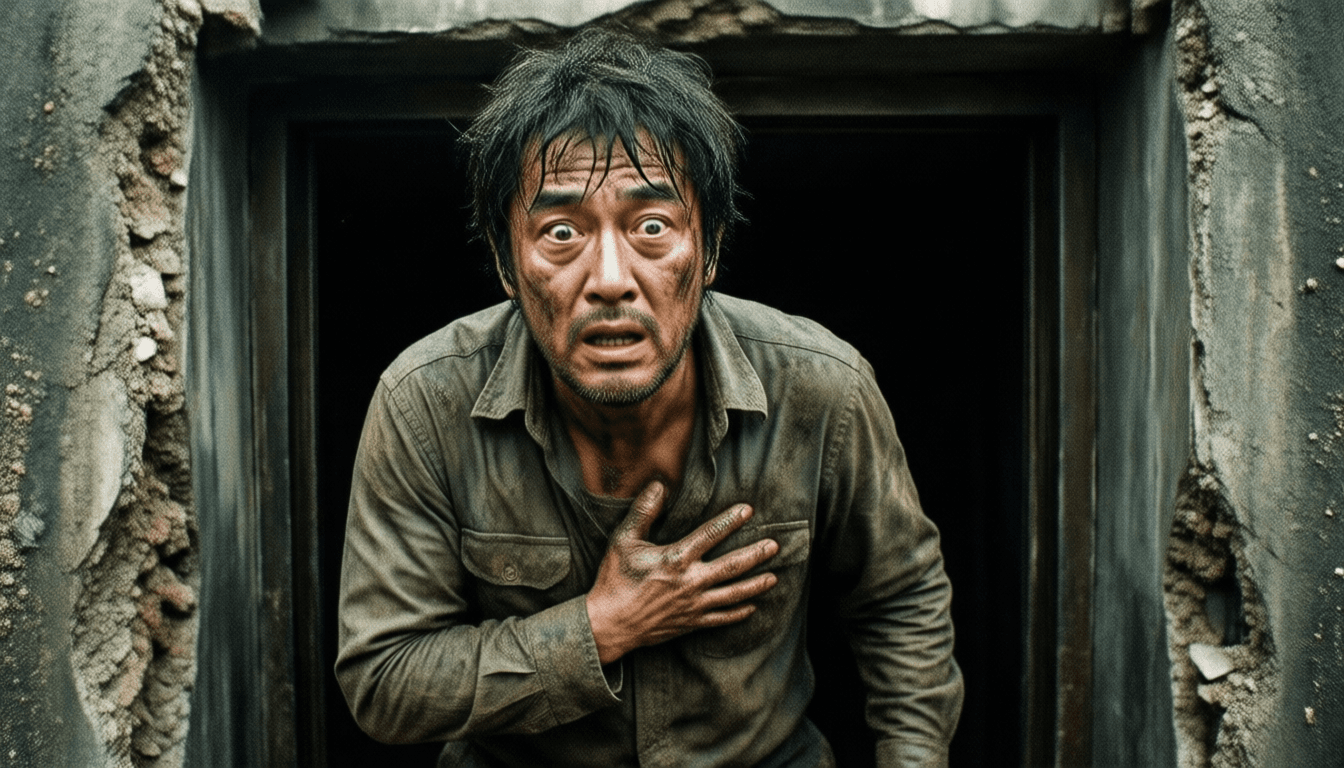
Dr. Son stumbled out of the bunker hours later, half-submerged, mud-caked, and gripped by an unspeakable, adrenaline-fueled terror. He had vague memories of a desperate struggle, a small, unrecorded ventilation shaft, and the sudden, inexplicable disappearance of the crushing pressure the moment he was beyond the immediate confines of the collapsed bunker. He collapsed in a daze, barely able to explain how he had been separated from his escorts, who were later miraculously found alive but unresponsive, staring blankly ahead, their equipment scattered.
Medically cleared, he suffered from hypothermia, severe contusions, and what was officially diagnosed as acute stress psychosis. He tried to explain the impossible physics – water flowing uphill, compressed air, the anomalous collapse – but his words were met with clinical skepticism. His portable seismic data was completely corrupted, showing only static. His thermal imager showed nothing but a blank screen. But when he finally downloaded the audio recording from his chest-mounted device, amidst his ragged breathing and the chaos of the collapse, there was a consistent low-frequency hum, just below human auditory threshold. And at the precise moment of the deepest collapse, an ancient, guttural whisper, neither Korean nor English, but hundreds of lost voices speaking one chilling phrase: “We are still here.”
Days later, examining his mud-stained equipment in his pristine lab, Dr. Son found it. Embedded deep within the intricate mechanisms of his broken compass, a rusted piece of metal smaller than a fingernail. It wasn't iron. It didn't belong to his equipment. But it bore a single, faint, corroded, almost unreadable character: part of a serial number from the Korean War. He later learned the number belonged to a soldier listed as missing in action 70 years ago, from the exact grid square Dr. Son had investigated. The compass, now utterly non-functional, still pointed stubbornly, unsettlingly, not north, or true north, but towards the impossible heart of the DMZ. A silent, permanent testament that what is broken can never truly be fixed, and some places, stained by conflict, never truly let go.
[ CLASSIFIED VERDICT ]
[ACCESS LOG - SOURCE FILE]
The Demilitarized Zone (DMZ) is a place scarred by the Korean War, a painful historical space where countless lives were sacrificed. For decades, there have been persistent unofficial rumors and urban legends about unexplained phenomena such as equipment malfunctions, unidentified whispers, and formless shadows witnessed in this area. This leads to the belief that the DMZ is not merely a divided border but a land of permanent wounds where forgotten souls linger.