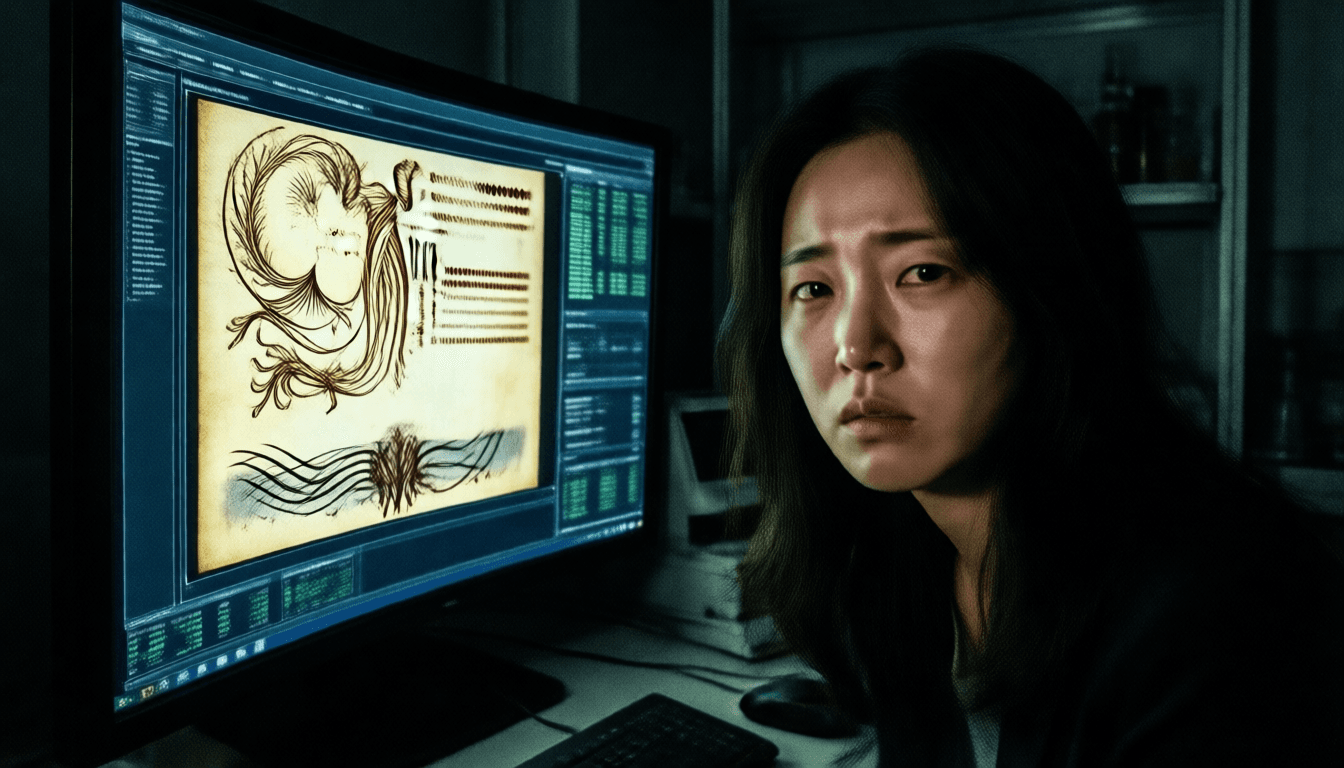
Voynich Code: Activated Silence
The Voynich manuscript has resisted attempts at decipherment for centuries. Its bizarre flora, astronomical charts, figures, and utterly alien script have led many to dismiss it as a hoax, an elaborate cipher, or even the scribblings of a madman. However, a recent development has elevated its mystery to something far more sinister than simple academic curiosity.
In late 2023, Dr. Aris Thorn, a brilliant but controversial computational cryptologist, made a groundbreaking discovery. He claimed to have identified faint, previously unnoticed marginalia—a series of Latin annotations—almost invisible to the naked eye in newly acquired, ultra-high-resolution digital scans of the manuscript. Thorn hypothesized that these were not mere commentaries on the Voynich text, but a meta-language interacting with it. His subsequent research, shared through encrypted channels, hinted at 'unnatural patterns' and 'systematic distortions' within the very structure of the Voynich itself, beyond mere linguistic complexity. Then, three weeks ago, Dr. Thorn vanished without a trace. His last public communication was a deleted online post: "This silence is not empty. It is a pressure. Waiting for an echo."
Concurrently, peculiar rumors began to circulate in fringe linguistic forums. Certain digital renderings of the Voynich, hosted on an obscure academic server, were occasionally observed to "pulsate". Users reported faint, almost subconscious flickers in the background color of specific pages, subtle shifts in the perceived depth of the ink, and a nearly inaudible low-frequency hum emanating from their devices when viewing these particular scans. Server administrators dismissed these phenomena as bandwidth issues or monitor calibration errors. Our investigation into Thorn's disappearance began not with searching for a body, but with his obsession's source: the digital manuscript, and now, the strange whispers surrounding it.
My mission, as laid out by the consortium funding Thorn's aborted project, was to cross-reference his fragmented research notes with the Voynich master files in an ultra-secure digital image laboratory. The lab itself was a sealed, climate-controlled environment—a sterile cube filled with humming servers and glowing screens, designed for the forensic analysis of ancient texts. No external signals, no unauthorized access. The only input was data, the only output, my observations.
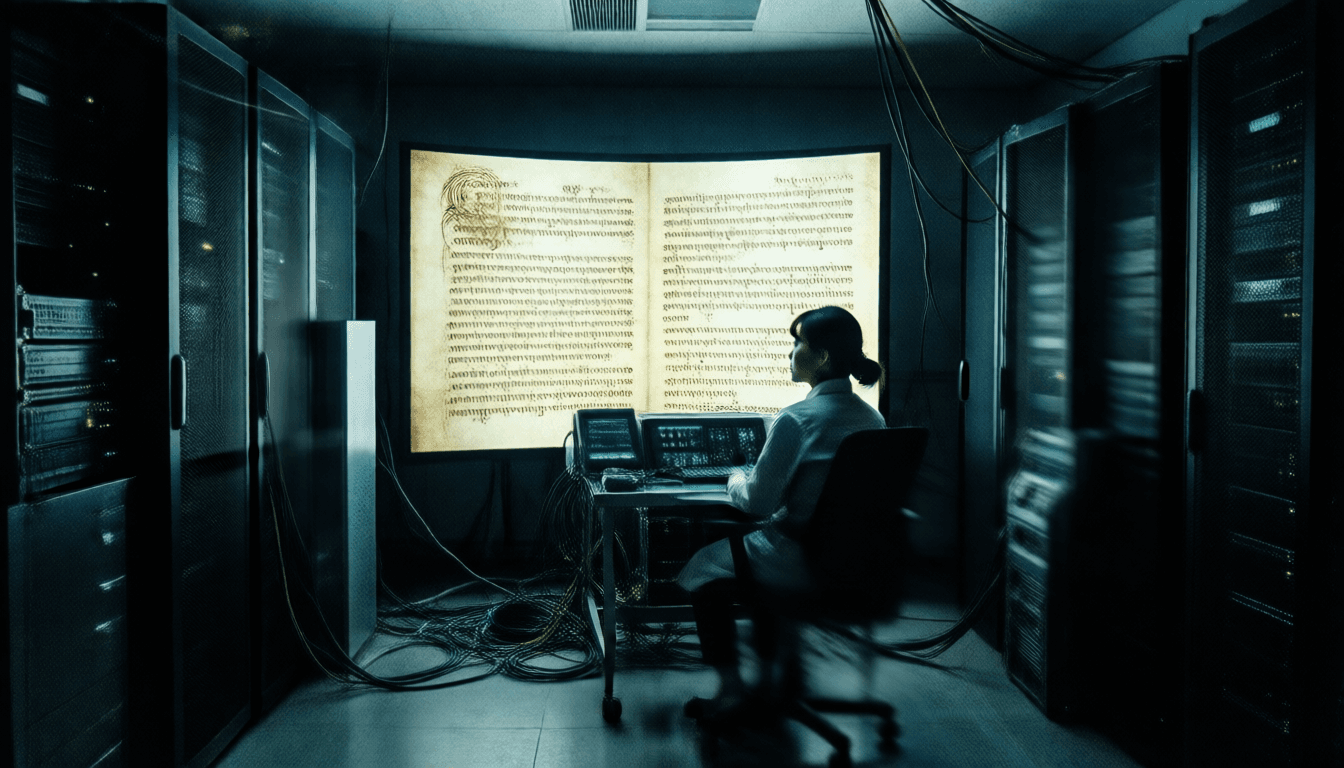
I sat before a massive curved display unit, projecting a Voynich page in breathtaking, microscopic detail. The air was cool and dry, with a faint scent of ozone and purified carbon. The low hum of the cooling system was the only constant sound. I called up Thorn's last working file: a section of the digital scan highlighting the controversial marginalia. They appeared as faint, almost ethereal Latin letters, clinging to the edges of the vibrant, unknown Voynich script. Despite being a digital image, the sheer age of the parchment and the peculiar intensity of the ink felt almost tangibly real. The detail was so exquisite that I could see individual fibers of the parchment. My vision narrowed, the world beyond the glowing screen blurring into a distant hum.
As I delved deeper, cross-referencing Thorn's notes with the high-resolution images, subtle anomalies began. At first, I attributed them to eye strain, limitations of digital rendering, or an overactive imagination fueled by Thorn's disappearance.
The ambient hum of the servers, a consistent B-flat, began to waver. It fluttered in and out, creating tiny fractions of a second of silence. But the silence was clear enough to make me pause. And when the B-flat returned, it was subtly altered. It now carried a faint, dissonant overtone—a harmonic that didn't belong.
On the screen, the highly detailed image of the Voynich page seemed to exhibit an unusual depth. Not a simple 3D effect from the monitor, but a visual trick where the texture of the parchment subtly shifted, as if the digital parchment fibers were reorganizing themselves. I blinked and rubbed my eyes, and it returned to stasis. But the effect recurred with increasing frequency, each time lasting a little longer.

More unsettlingly, the faint marginalia themselves began to glow, subtly, almost imperceptibly. As if illuminated by an internal light source independent of the screen's backlight. When I zoomed in on a specific Latin phrase Thorn had marked—something about "the breath of the void"—the surrounding Voynich glyphs seemed to subtly vibrate. Their intricate curves and angles appeared to pulse with a low, internal energy. My hands, resting on the keyboard, felt an inexplicable chill, followed by a tingling warmth. It was as if localized static electricity was building. The air in the lab, designed to be perfectly still, seemed to move in an invisible eddy around my head, carrying a faint, dry scent I couldn't place. The room itself seemed to breathe around the concentrated projection of the manuscript.
I found it: Thorn's last encrypted log. A series of image overlays and algorithmic comparisons attempting to map the Latin marginalia to the unique Voynich script. He believed the marginalia were not a translation of the Voynich, but instructions to activate a hidden layer within the text. With growing dread, I executed his final subroutine.
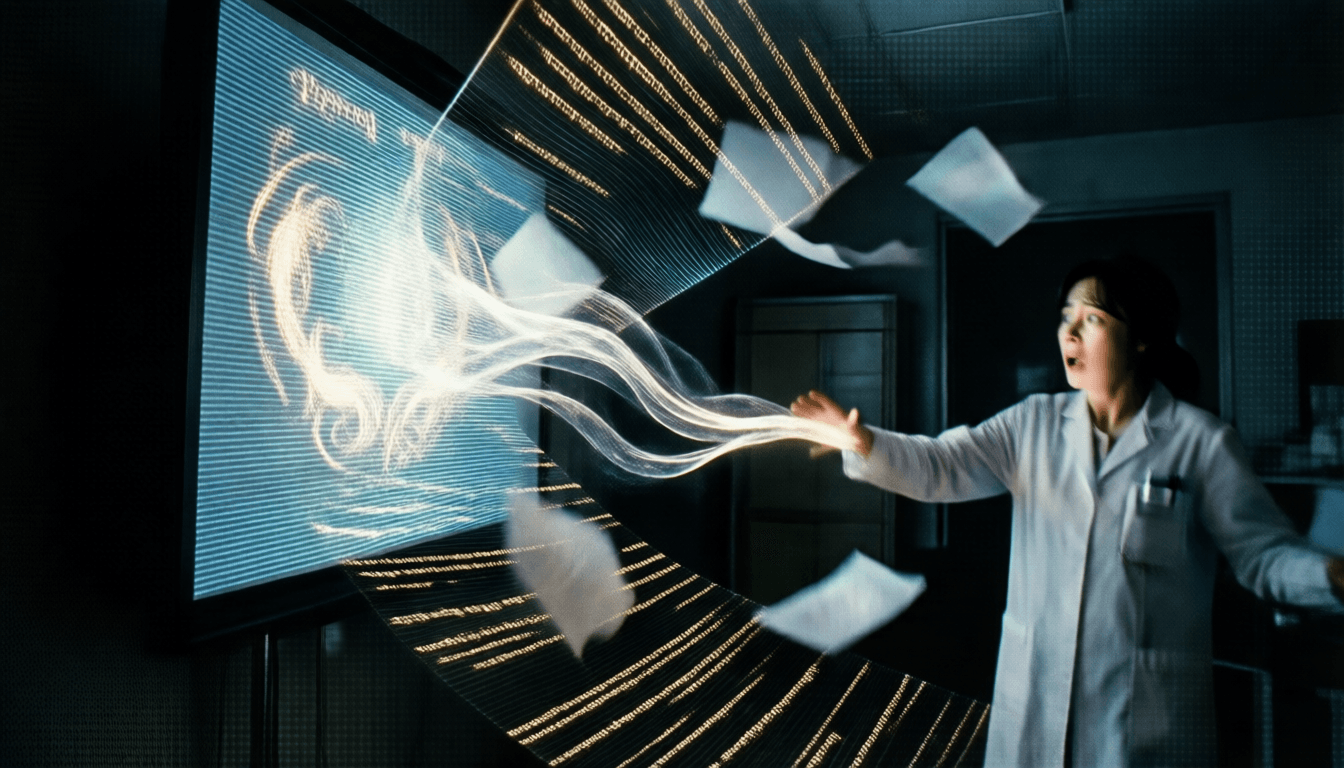
The instant the algorithm completed, the main screen's projection convulsed. It wasn't a digital glitch or corrupted file. The ink lines on the digital parchment began to move. The intricate Voynich glyphs wriggled and reconfigured. Not into words, but into complex, kaleidoscopic patterns, expanding and contracting. The plant illustrations writhed, their alien leaves and roots seeming to stretch and coil, their forms shifting from organic to geometric. The low hum of the lab equipment suddenly ceased, replaced by a deep, resonant thrumming that vibrated through the floor and my chair, into my very bones.
The environment collapsed. The air pressure in the sealed lab dropped precipitously, making my ears pop and my nasal sinuses ache with a painful vacuum. Scattered papers on my desk fluttered violently, then were sucked towards the glowing screen as if held by an invisible adhesive. And then the impossible happened: the image itself began to project into physical space. Not a mere reflection, but the Voynich's swirling lines and twisting illustrations surged forth from the screen, extending into the lab. They were neither light nor shadow, but a form of solidified data, shimmering with an internal luminescence, blocking my path to the door.
A tendril formed from condensed Voynich script whipped out with unnatural speed. It made contact with my right arm. A searing sensation followed on my skin, not ice, but an excruciating, absolute cold, like localized absolute zero. It was as if my very cells were being rewritten. I could feel the 'ink' clinging to my flesh, trying to be absorbed, or mapped. An overwhelming flood of incomprehensible data surged into my mind—impossible stars, screaming faces made of vines, a chorus of non-existent frequencies. It wasn't mere pain. It was a psychic intrusion, attempting to forcibly reconfigure my perception of reality. I screamed and wrenched my arm free, tearing the physical manifestation of the script from my skin. In a desperate surge of adrenaline, I smashed the emergency power cut-off button for the main display. The room plunged into darkness and silence, and the materialized structures of the Voynich collapsed back into the void.
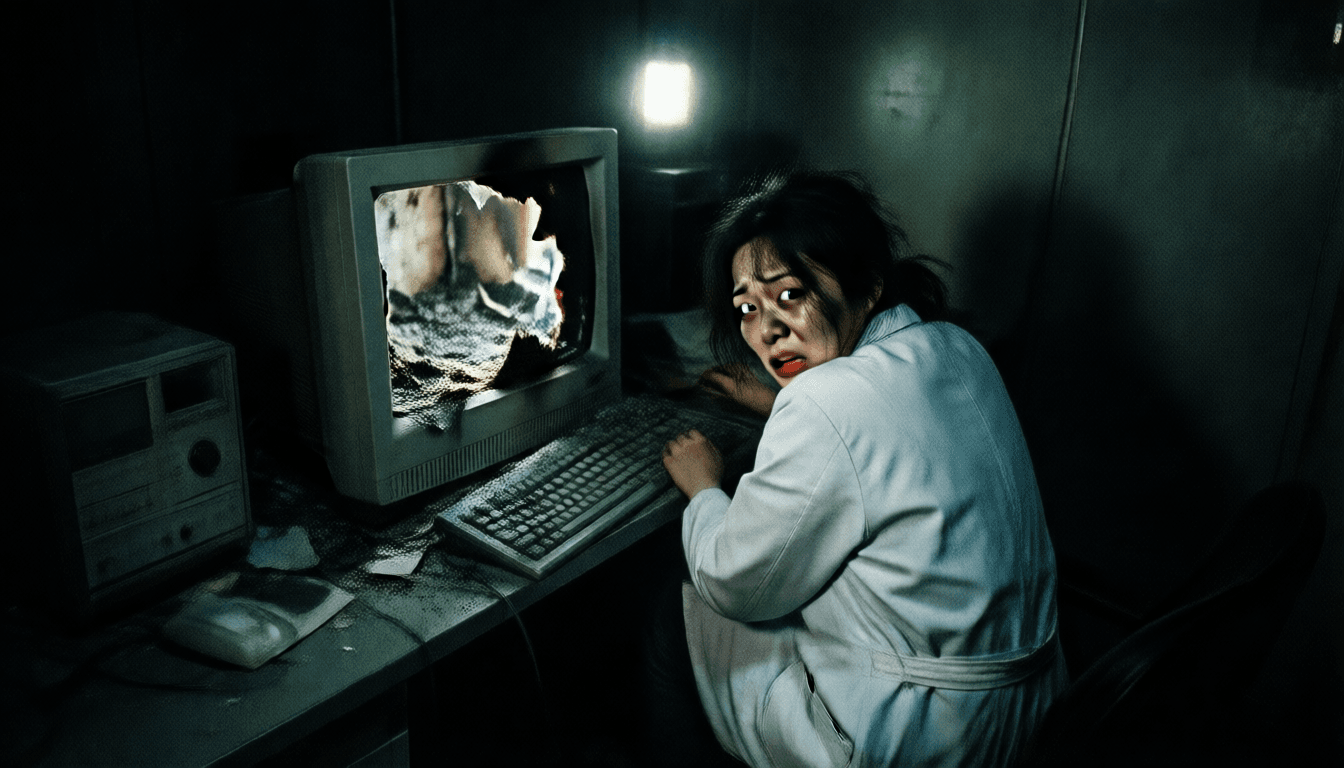
Hours later, they found me huddled in a dark corner of the lab, shaking uncontrollably. Colleagues confirmed the emergency power cut-off had been activated. The main workstation was a charred wreck. Not from an external short, but from a fatal internal surge that had melted circuits from within. My right arm bore no visible trauma, but the skin was raw and hypersensitive, and sometimes, under certain light, I could still imagine faint, geometric traces beneath the surface, like an evolving scar.
Since then, I haven't been able to look at any digital screen without severe nausea. Any hum from an electronic device triggers phantom echoes of that impossible thrumming. The research consortium quietly declared Thorn's project a failure, attributing his disappearance to a mental breakdown and personal flight. The Voynich manuscript was taken down from all public servers in all its digital forms.
But sometimes, alone in the quiet of my home, I catch myself. A pen held loosely in my hand begins to make unfamiliar loops and glyphs on the nearest scrap of paper. Not consciously, not intentionally. Just muscle memory, patterns emerging. I find myself humming that dissonant B-flat, that impossible harmonic. And in rare moments of absolute silence, I hear it again—deep within my mind, a faint, almost imperceptible pressure. A quiet echo. It suggests that Thorn didn't merely 'activate' a hidden layer of the Voynich. He, or I, or both of us, opened a channel. And now, the manuscript is no longer an inert enigma. It is an active, subtle, perhaps parasitic intelligence. And it might be learning to speak through us.
[ CLASSIFIED VERDICT ]
[ACCESS LOG - SOURCE FILE]
This story is based on the real, mysterious Voynich manuscript, believed to have been written in the 15th century. Filled with incomprehensible script, bizarre plants, and astronomical charts, it has defied decipherment by scholars for centuries. The narrative adds an imaginative twist to this unsolved enigma, hypothesizing that the manuscript is not merely an ancient text but harbors a hidden intelligence that can be activated.