The Negative Reflectance of Uyuni: The Mirror That Lags by Three Seconds
In the calibration logs of NASA’s Landsat 8 and the European Space Agency’s Sentinel-2, there exists an unexplained omission that has lingered without an official scientific answer for years. The anomaly is localized at 20°18'44" S, 67°38'12" W, in the southwestern sector of Bolivia's Salar de Uyuni. In this salt flat, where seasonal rainwater transforms the terrain into the world’s largest natural mirror, satellite spectral reflectance sensors frequently register negative (-) values. This anomaly implied something impossible: photons were not merely reflecting off the surface from sunlight above, but were being actively emitted vertically toward the satellites from deep within the subterranean crust. An internal report leaked in 2023 from Yacimientos de Litio Bolivianos (YLB) included reports of drilling crews experiencing perceptual latency, accompanied by cases of focused laser-like retinal burns that occurred under dense cloud cover.
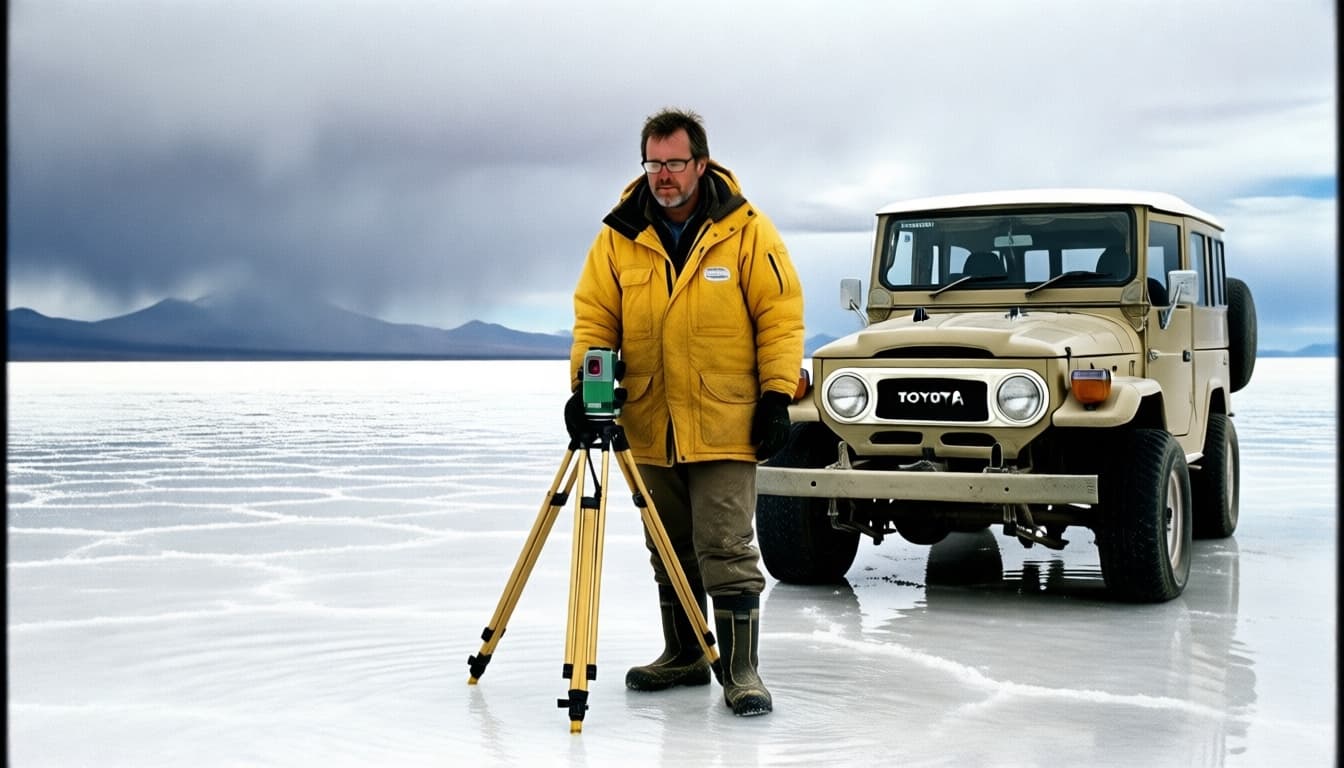
Dr. Raymond Vance, an optical physicist, entered the designated coordinates under the pretext of setting up a ground-truth calibration station. His Land Cruiser, driven by Mateo, a veteran local driver familiar with the harsh terrain, cut across the salt flats at an altitude of 3,656 meters. There was no visible horizon. The low, ash-colored overcast sky blended seamlessly with the two-inch layer of hypersaline brine beneath their wheels, trapping them in what felt like a sealed, vacuum-sealed white sphere. Vance erected a polarized LiDAR tripod at the epicenter of the anomalous reflectance and fired low-frequency laser pulses into the subterranean salt crust.
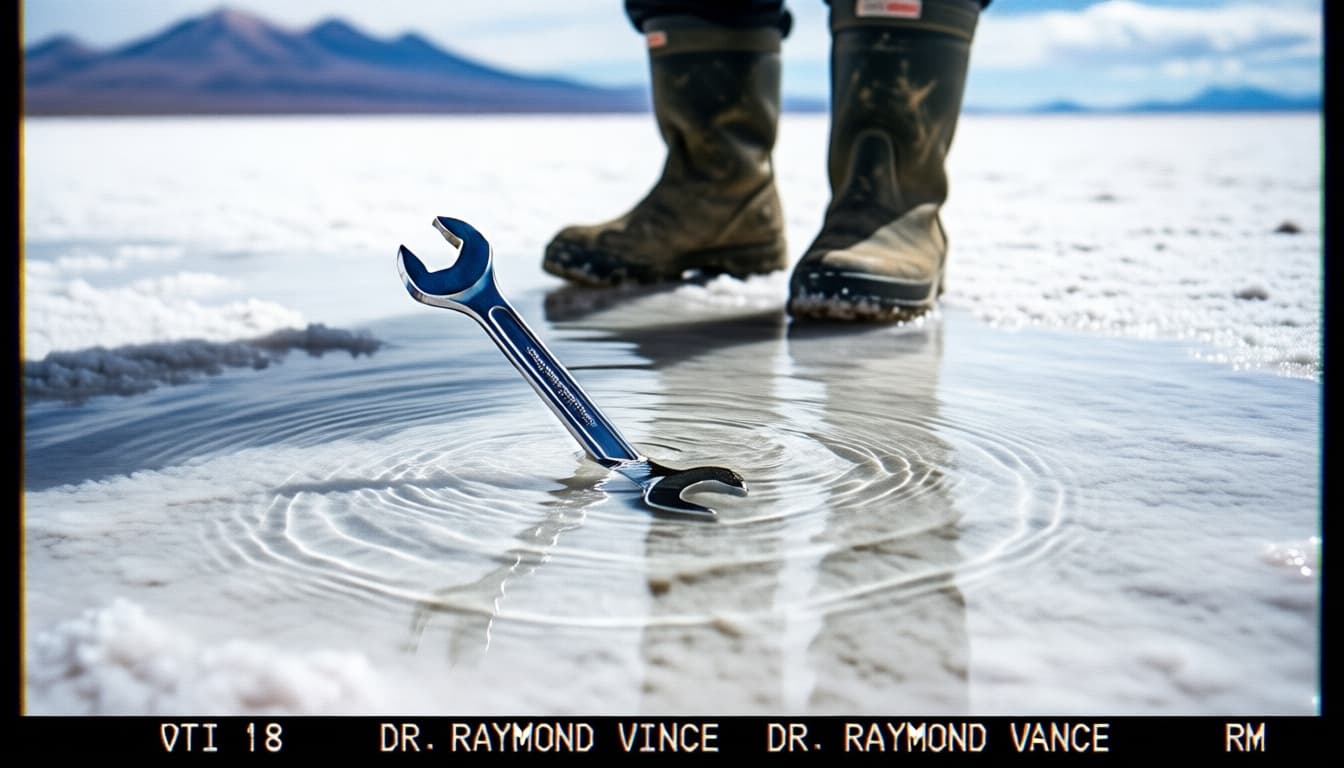
Sensory friction manifested almost immediately. Vance fumbled while tightening an optical cable, dropping an aluminum wrench into the shallow water. The physical ripples on the surface splashed instantly, but the dull clinking sound of metal striking the salt pan took exactly three seconds to reach his ears. It was as if the acoustic waves were not traveling through thin Altiplano air, but fighting their way upward through thousands of meters of hyper-dense glass. A cigarette butt flicked aside by Mateo also exhibited a bizarre stutter, creating unnatural, sharp-edged ripples seconds after touching the water. A cold dread crept along Vance's spine.
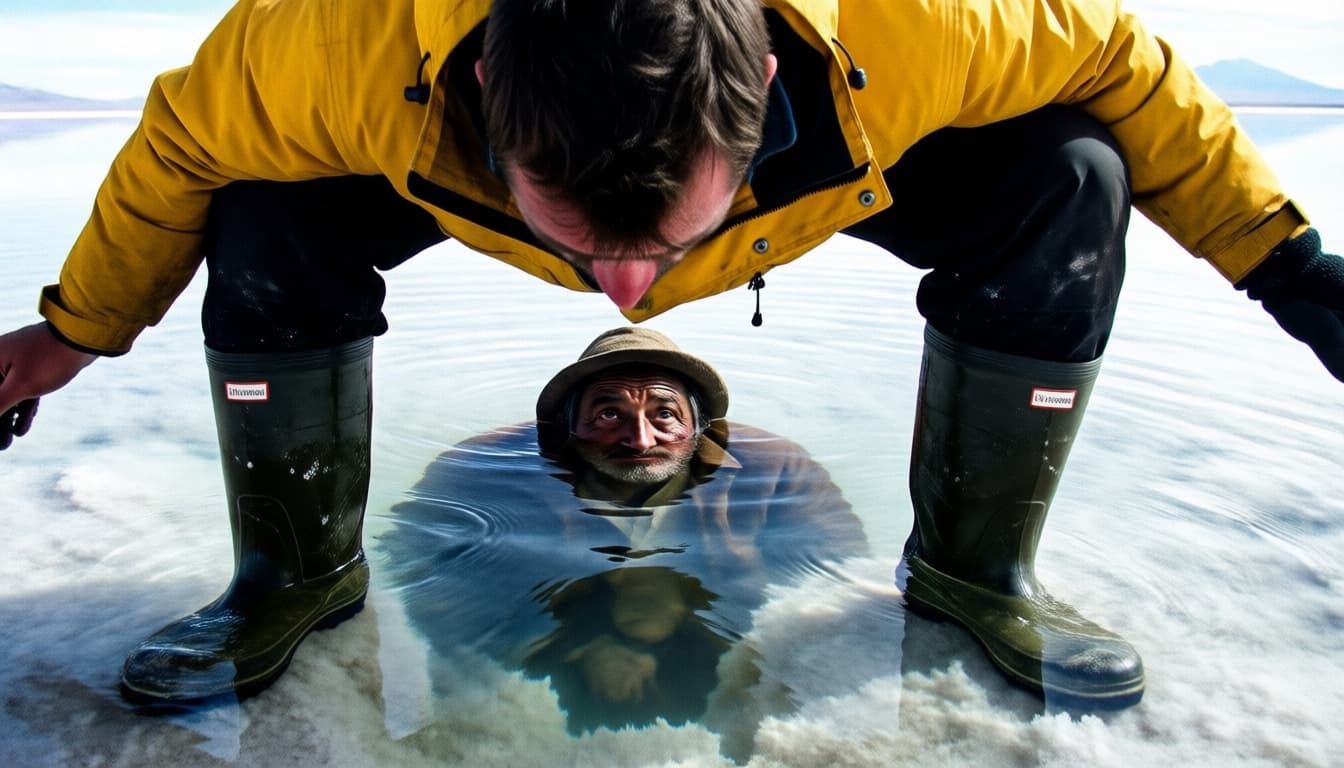
The handheld sensor terminal flashed frantic red warnings. The incoming photon count surged into exabytes, vastly exceeding the laser pulses the equipment had fired. The sensor was not picking up a simple reflection; it was intercepting a massive, continuous stream of data pulsing upward from deep within the vertical crystalline halite lattice. Vance lowered his chin, gazing down between his heavy waterproof boots. His reflection—wrapped in a bulky yellow expedition parka—was mirrored on the surface with razor-sharp clarity. Yet something was fundamentally wrong.
The man in the reflection was not looking down. Mirrored in the brine, the reflection of Vance held its head high, staring straight ahead. Vance froze, breath caught in his throat, and slowly raised his left arm. The figure beneath the water remained completely motionless for precisely three seconds before sluggishly lifting its right arm in delayed mimicry. When Vance turned to check Mateo’s reflection, his heart plummeted. Mirrored beneath Mateo’s boots was not Mateo at all; it was a stranger clad in the tattered mining garb of the 19th century, thrashing and silently drowning inside an expanse of water barely two inches deep.
The dying sun breached the cloud layer at a steep angle, striking the salt flat. It hit Brewster’s angle—the critical threshold where lithium brine absorbs specific optical wavelengths and violently alters polarization states. Instantly, the liquid lost its fluid properties. As though charged with high-voltage electricity, the water's viscosity spiked, hardening into an epoxy-like resin that locked their boots in place. Mateo shrieked in terror and twisted toward the vehicle. The moment he tore his foot free, the ice-like crust fractured open.
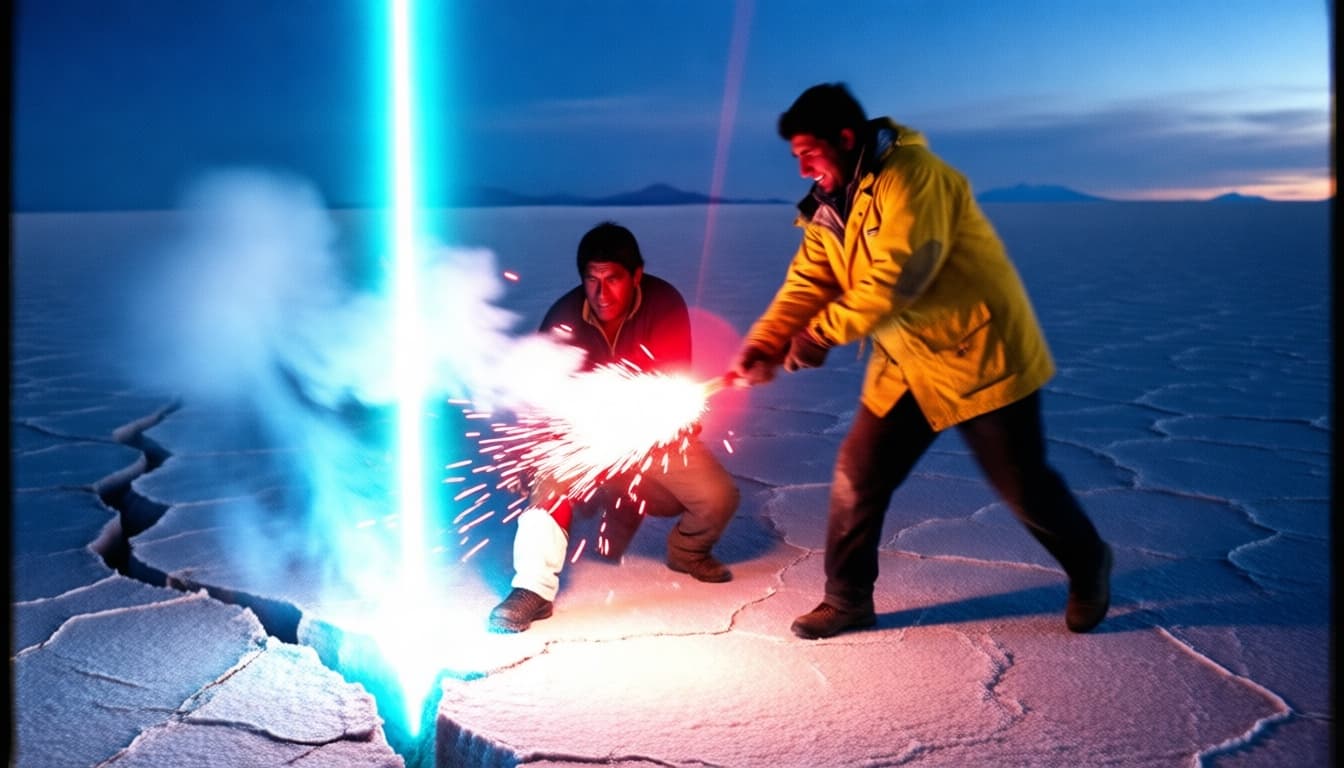
Instead of muddy brine, a column of pure, bottomless blue laser light erupted from the rift. Mateo’s right leg was pulled violently into the vertical conduit. The vast salt flat was not merely a mineral expanse; it was a planetary-scale optical recording medium that had refracted and preserved the quantum states and organic memories of everything that crossed its surface for hundreds of millions of years. And now, the crust was commencing an overwrite cycle. Beneath the crystalline floor, thousands of inverted, upside-down silhouettes from ancient epochs surged toward the surface on waves of blinding coherence.
Mateo’s flesh began to bleach paper-white. It was not the pallor of blood loss; his pigmentation, cellular structure, and physical mass were being systematically extracted and translated into pure optical data. His skin faded to chalky pulp as bundles of photons unraveled his leg, pulling him deeper into the fissure. Mateo’s agonizing screams tore through the thin air, but the suction force defied human strength. Vance, his fingers numb with panic, snatched an emergency magnesium flare from his utility vest, struck the primer, and thrust the uncontainable white-hot chemical flame directly into the optical rift surrounding Mateo's leg.
The chaotic, unpolarized thermal energy shattered the delicate optical interferometry of the salt prisms. A deafening roar—like miles of reinforced structural glass rupturing simultaneously—shook the Altiplano. The vacuum pull abruptly collapsed. Vance grabbed Mateo by the collar of his burning jacket and dragged him violently onto the vehicle’s steel running board. In an instant of hyper-heated release, the brine beneath them detonated into a blinding wall of steam.
Mateo survived, but his lower body exhibited anomalies that defied modern medicine. There was no trace of thermal burn damage on either leg. Instead, the melanin and cellular pigments within the dermis had been extracted entirely. The synthetic fibers of his trousers were physically undamaged, yet bleached into a pristine, chalky white as though stripped by industrial solvent. Across the entire tread of the Land Cruiser’s tires, microscopic optical barcoding patterns, spaced mere micrometers apart, were etched permanently into the rubber.
When Vance recovered his LiDAR recorder, the operating system was wiped clean. In its place remained a single intact 14-terabyte binary file. When rendered through imaging software, it displayed an impossibly sharp, black-and-white aerial photograph. The image had been captured from kilometers beneath the salt crust, looking upward toward the surface. In the center of the frame, Vance’s own terrified face gazed downward into the lens. The cryptographic timestamp in the metadata indexed the photograph to 22,000 BCE.
Hours later, inside a dim motel bathroom in the town of Uyuni, Vance splashed freezing tap water over his face. He rubbed his eyes with a coarse towel and looked up into the mirror. He slowly lowered his hands. In the glass above the cracked sink, his reflection remained motionless, face still buried behind the damp cloth. Vance stood petrified. Only after he flicked off the bathroom switch, plunging the room into absolute darkness, did the coarse scraping sound of a towel moving downward break the silence. In the dark, resting directly beneath his discarded boots on the cold tiled floor, the faint, rhythmic blue laser afterglow of a subterranean scanner continued to pulse, quietly awaiting the next cycle.

[ CLASSIFIED VERDICT ]
[ACCESS LOG - SOURCE FILE]
In reality, space agencies like NASA and the ESA routinely use Bolivia's Salar de Uyuni—the flattest geographical expanse on Earth—as a primary ground reference target to calibrate satellite optical sensors and altimeters. This story builds upon fringe rumors regarding electromagnetic calibration anomalies and negative reflectance errors in remote sensing, weaving a cosmic horror tale in which this ancient salt flat is actually a colossal, planetary optical storage device that records and overwrites quantum data from everything on the surface.