The Metronome of Dome C: The Heart Beneath 3,100 Meters of Antarctic Ice
In late November 2018, the European Space Agency's (ESA) ice observation satellite CryoSat-2 detected an anomalous high-frequency thermal flare deep within Antarctica's Wilkes Basin. Dismissed officially as cosmic ray interference, the raw telemetry was leaked onto an invite-only geophysics forum before being wiped without a trace 48 hours later. The cross-sectional radar altimetry profiles were baffling: situated beneath 3.1 kilometers of ice that had been isolated from atmospheric exchange for 2.7 million years, there lay a perfectly symmetrical, 800-meter-wide vacuum cavity. Accompanying hydrophone recordings captured near Dome C were dubbed 'The Metronome of Dome C' among researchers. It was not the chaotic grinding of shifting crust or fractured ice shelves. It was an extraordinarily precise hydraulic displacement pulse repeating at intervals of exactly 1.4 seconds. Something inside the basal ice, which should have been frozen rock-solid under incomprehensible lithostatic pressure, was operating on a rhythm.
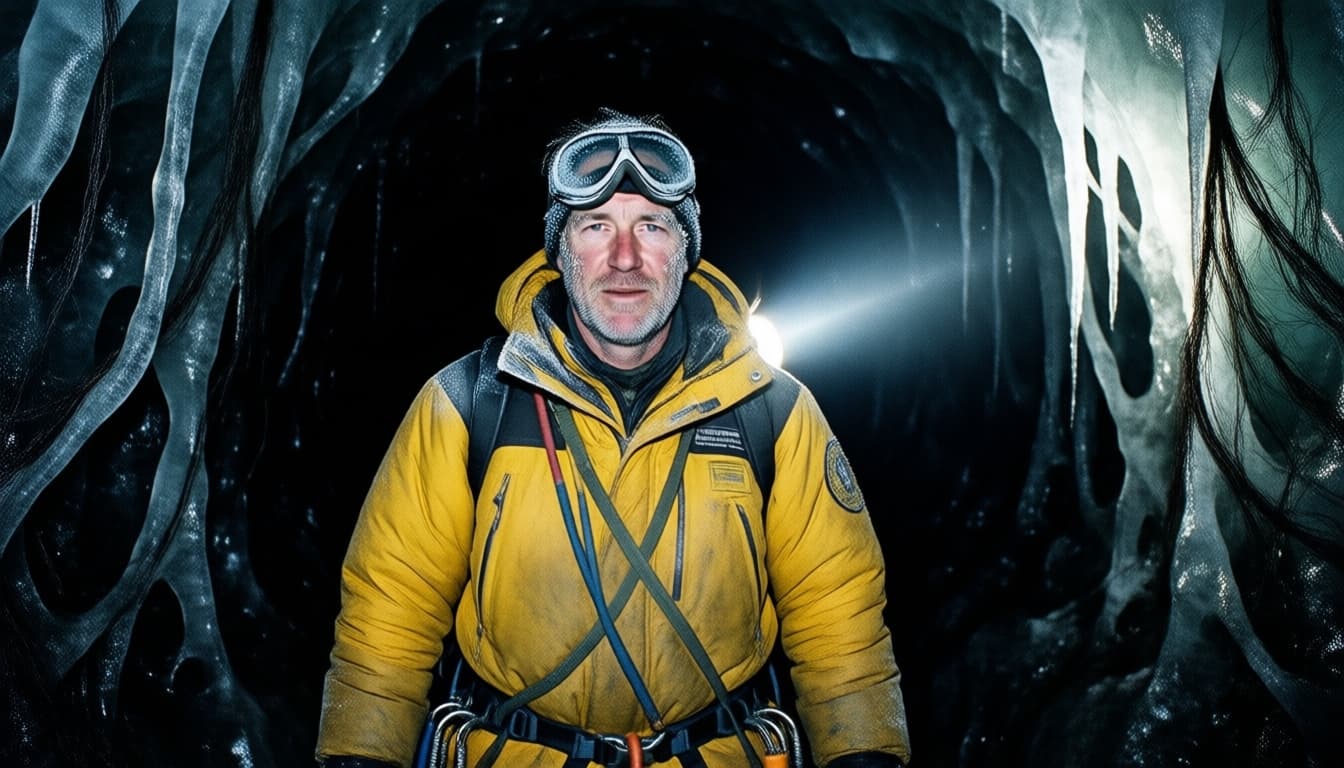
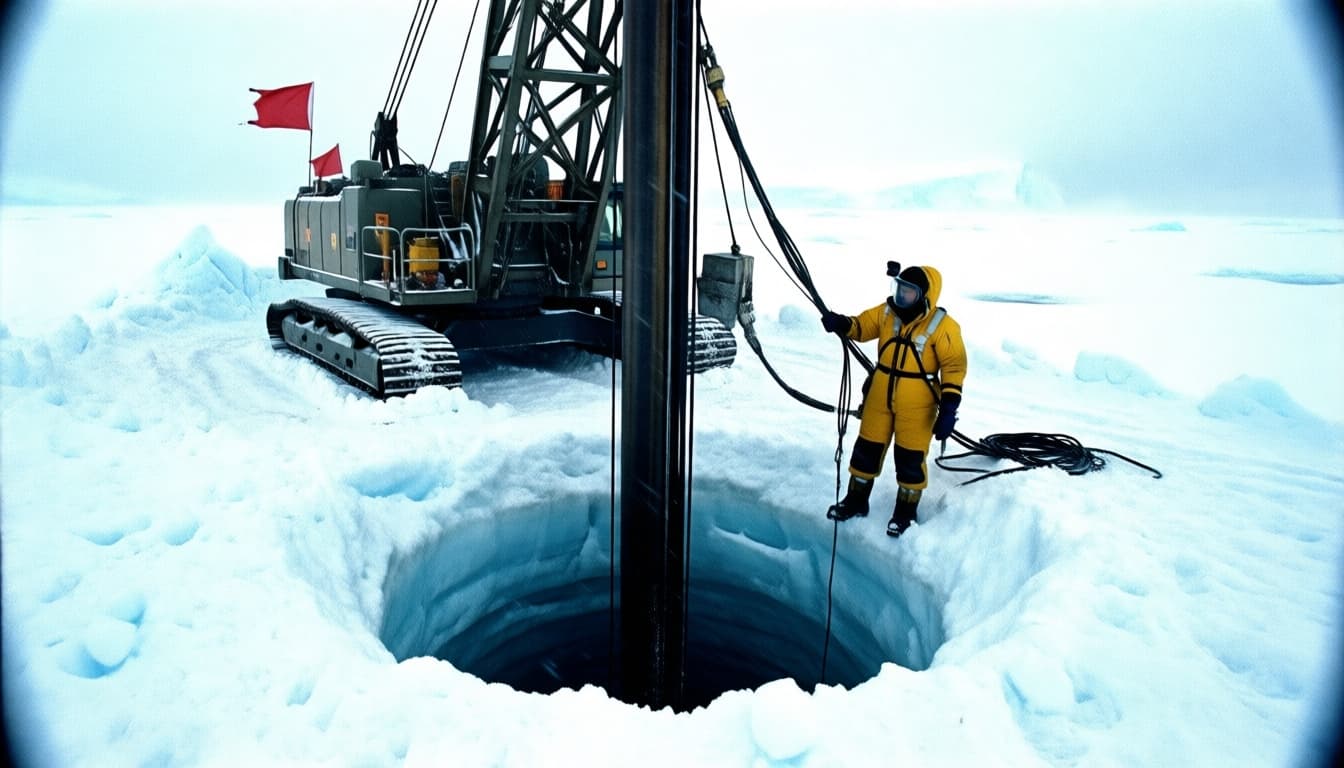
Dr. Alistair Finch, a veteran paleoclimatologist formerly with the British Antarctic Survey, was summoned on a classified emergency deployment by a multinational consortium to drilling outpost Echo-7. The high-pressure hot-water drill head, after penetrating an anomalous non-aqueous layer, had plunged four meters into sheer empty void without a trace of hydrostatic backflow. In sub-zero gale conditions of minus 54 degrees Celsius where the air was half as dense as sea level, Finch and structural engineer Thorne prepared to descend the narrow vertical sleeve. Suspended from a winch rig inside an ice conduit barely one meter wide and slick with industrial lubricants, the descent alone took over four hours. The lantern beams sweeping downward gradually turned from brilliant snow-white to an all-consuming, basaltic dark-cyan as the depth increased.
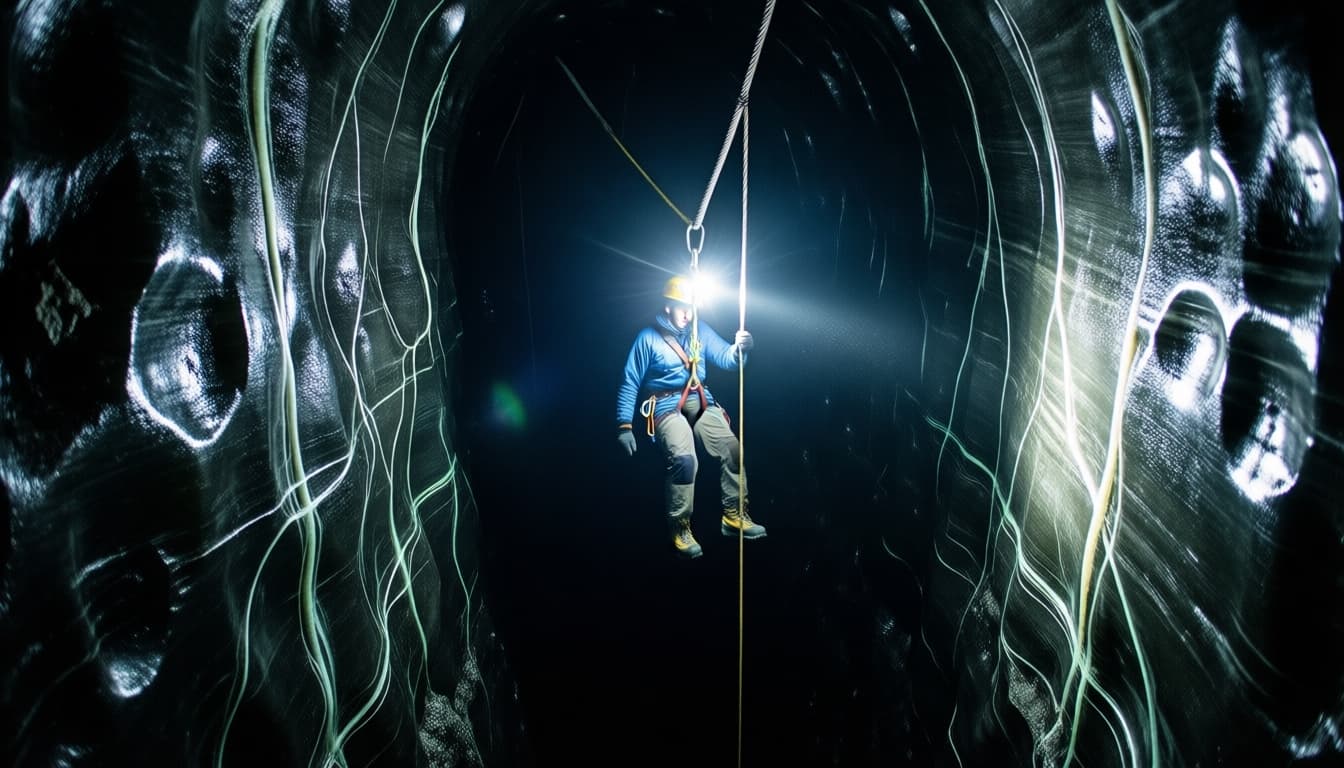
At a depth of 2,900 meters, the rough, jagged cut of the thermal drill abruptly gave way to a flawlessly smooth, polished cylindrical conduit. When the hoist cable clattered to a sudden halt, the two men hung suspended in vast, empty darkness beneath an immense ceiling. The air passing through their respirators was excruciatingly dry, and an oppressive barometric pressure—nearly double that of sea level—pressed hard against their rib cages. Finch ignited a high-output halogen floodlight. What emerged from the gloom was neither bedrock nor a natural subglacial cavern. Massive vaulted corridors shaped like titanic organic rib cages arced across the expanse, gleaming with a slick, pitch-black sheen. It was not natural ice. It was a hyper-dense lattice woven from carbon-fiber filaments and calcified organic sinew: 'Structural Black Ice.'
The moment their boots touched the floor, an eerie dissonance traveled up their legs. Thorne fumbled while trying to anchor a sensor rig, dropping a titanium wrench onto the surface—yet it made no sound. The sharp impact was completely swallowed by the porous floor material, yielding absolute silence. Exactly four seconds later, from the empty air behind their backs, the metallic clatter of the dropped wrench resonated with unnatural, amplified clarity. The architecture was absorbing acoustic energy, buffering it, and playing it back. A cold shiver crawled down Finch's neck.
The laws of thermodynamics here seemed completely decoupled from the surface. The ambient temperature inside this chamber, 3,000 meters beneath the ice where geothermal heat should have caused liquefaction, remained fixed at precisely minus 1.8 degrees Celsius—the critical freezing threshold of hypersaline water under extreme pressure. Threaded along the walls like microscopic capillaries, millimeter-thin conduits pulsed with faintly bioluminescent, high-density fluid, actively absorbing the colossal compressive heat of the overlying ice sheet to prevent the chamber from caving in. Encased within glassy strata along the corridor walls were bands of atmospheric bubbles containing volcanic ash from the 74,000-year-old Toba super-eruption alongside Middle Miocene pollen, preserved like rings on an ancient tree. This was no abandoned ruin. It was a massive biomechanical library regulating the thermodynamic equilibrium of the polar cap while logging the planet's atmospheric history.
The 1.4-second metronomic beat picked up by the hydrophones was not originating from the air. Finch looked down at his crampons in horror. Beneath the translucent black ice, a sprawling web of calcified sinews was contracting and dilating in rhythmic unison like myocardial tissue. The entire subterranean floor was twisting and flexing, actively dispersing hundreds of millions of tons of shear stress exerted by the colossal glacier above. The realization that this was not an engineered 'building' but a living, pulsating organ made Finch's breath catch in his throat.
The catastrophe struck when Thorne engaged a portable diamond core-drill against one of the wall's primary conduits. The instant the bit breached the outer membrane, it was not ice chips that sprayed out. High-pressure cryogenic viscous fluid and shredded carbon filaments erupted into the chamber with a shrill, shrieking hiss. In that exact fraction of a second, the rhythmic 1.4-second pulse in the floor stopped dead. In the suffocating silence, the sound of countless bone-like joints clicking and snapping into place echoed from every corner of the void.
Lifting his floodlight toward the vault, Finch froze. Hanging from the ceiling were not structural struts. Multi-jointed armatures forged from bone-dense titanium lattices and frozen muscle tissue were scrambling down the vertical walls. They had no eyes, no faces, no biological markers. They did not crawl or walk; instead, by flash-melting the microscopic contact zone on the ice and instantly refreezing it, they skipped through space on non-inertial trajectories. They were not monsters. They were purely mechanical antibodies deployed to eradicate a localized thermal contamination.
Thorne's death scream lasted less than a second. An articulated limb impaled the chest of his thermal suit with surgical accuracy, and instantly, a fast-freezing chemical slurry sprayed over the puncture wound, sealing off Thorne's body heat and atmosphere from bleeding into the chamber. The void's pressure systems initiated an emergency depressurization purge, sending the atmosphere plummeting toward a vacuum. Finch's eardrums ruptured, warm blood trickled down into his neck seal, and his suit billowed outward under explosive decompression. With trembling hands, Finch ripped a high-yield magnesium flare from his harness and jammed it into the flexing titanium joint of the antibody lunging toward him. The 2,000-degree-Celsius white-hot blast boiled the hydraulic fluids within the limb, sending the construct shuddering backward.
Desperate, Finch lunged for the manual hoist lever. He took his hand away—the winch cable on the motorized head was already spinning in reverse on its own, dragging him upward into the ceiling before he even touched the controls. As he was sucked violently back into the narrow cylindrical bore, Finch glanced downward. The circular aperture through the black ice floor was twisting and knitting together like the closing scar of a living creature, sealing the wound shut.

Finch reached the surface alive, but collapsed into unconsciousness with severe barometric pulmonary trauma and permanent deafness. The international consortium immediately aborted all research. In less than twenty-four hours, the Echo-7 station was bulldozed flat, and seven tons of fast-setting hydrophobic cement were poured directly into the borehole. The official public report blamed the incident on an accidental blowout of a deep-seated subterranean methane pocket.
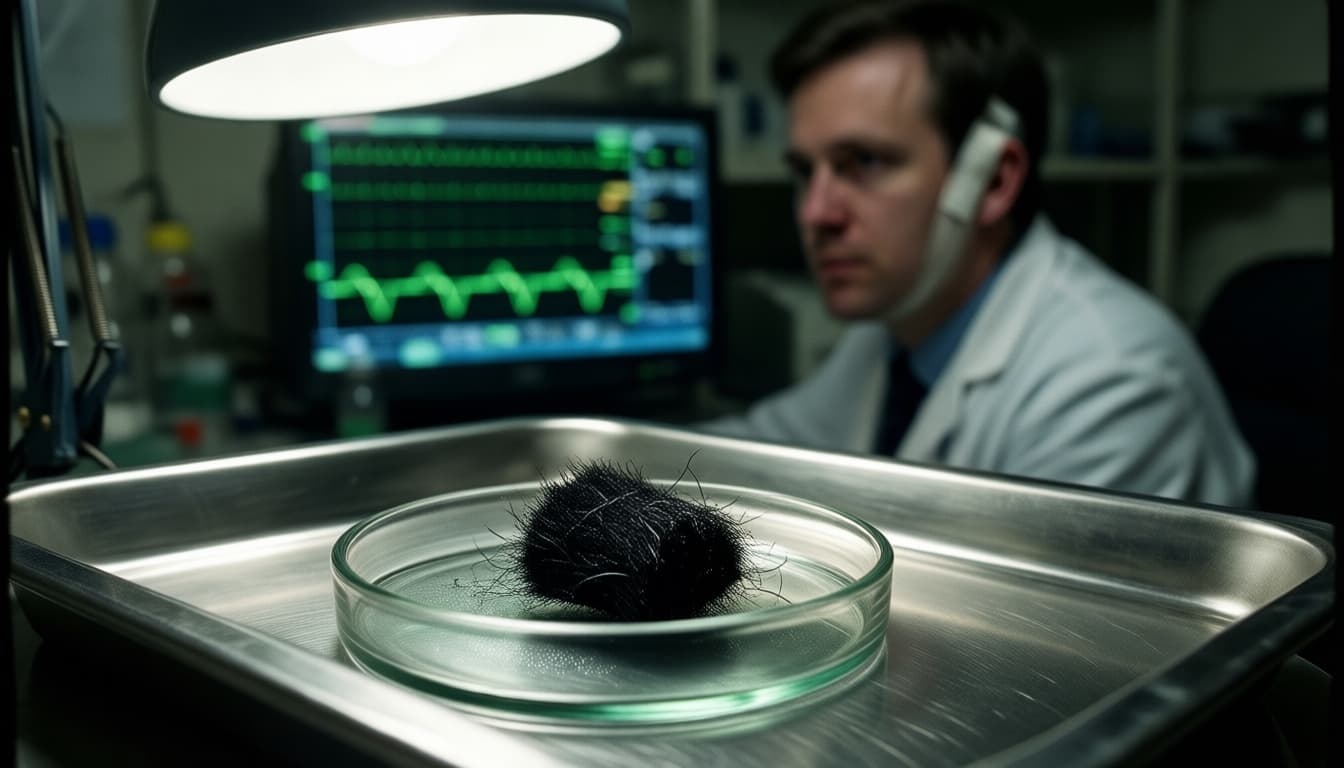
Today, inside an ultra-low temperature freezer in Finch's private basement laboratory in Aberdeen, Scotland, sits a single composite core sample that had chipped off Thorne's drill bit and lodged inside Finch's parka pocket. Even when removed from the minus 20-degree storage vault and placed at room temperature, the black crystalline fragment does not melt. Instead, beneath an optical microscope at 150x magnification, microscopic muscle cells interwoven between pitch-black carbon fibers continue to contract and expand on a faint, rhythmic cycle.
Five years of digital logging revealed a terrifying correlation. Whenever global carbon emissions spiked or massive Antarctic ice shelves disintegrated into the southern ocean, the minuscule contractions of the sample grew violent and erratic. And the clandestine acoustic sensor Finch had secretly anchored along the Antarctic perimeter recently began transmitting a modified acoustic signature. The 1.4-second metronome echoing from 3.1 kilometers down in the black ice no longer pulses at 1.4 seconds. Like an accelerating heartbeat under stress, the interval is growing dangerously, inexorably faster.
[ CLASSIFIED VERDICT ]
[ACCESS LOG - SOURCE FILE]
This cosmic eco-horror story is inspired by the mysterious real-world Wilkes Land gravity anomaly beneath Antarctica's ice sheet, anomalous geothermal pulses and seismic readings recorded near subglacial Lake Vostok and Dome C, and enduring fringe theories alleging ancient biomechanical structures buried miles beneath the polar ice.