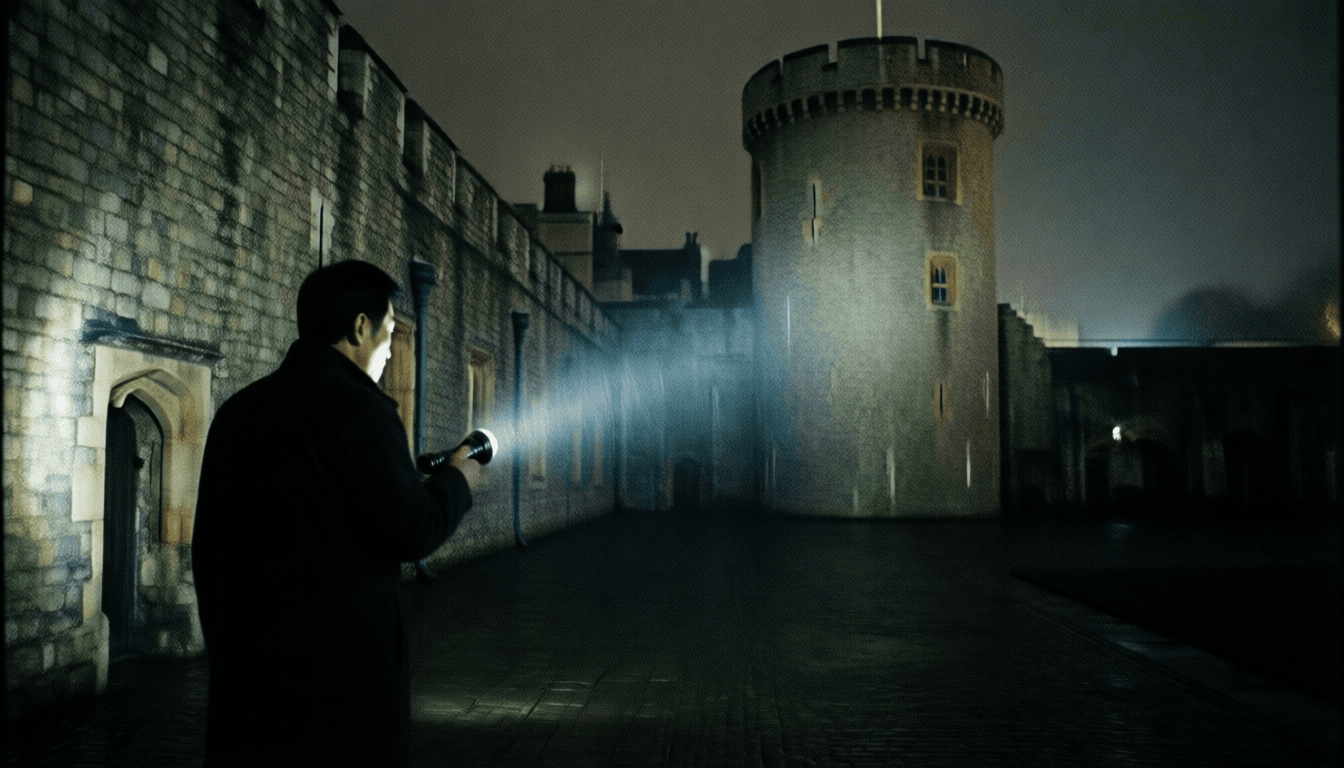
The Sound-Devouring Stone of the Tower of London
For decades, the Yeoman Warders of the Tower of London have officially and unofficially reported something more than mere residual hauntings. Beyond famous specters like Anne Boleyn or Lady Jane Grey, a consistent and unsettling anomaly manifests in the wall passage adjacent to Beauchamp Tower, particularly at twilight after all visitors have departed. This phenomenon is a localized 'sound vacuum'. Guards patrolling this section experience a complete, momentary cessation of all ambient city hum, their own footsteps, and even radio static. It’s not merely quiet; it's a profound silence that actively absorbs sound itself. Often, this is accompanied by a drastic temperature drop defying the enormous thermal mass of the entire structure, and several warders have informally reported a physical pressure during these events, as if breathing thin air or submerged underwater. This is no mere folklore; it's a measurable, recurring environmental phenomenon that security and maintenance staff struggle to explain, often coinciding with inexplicable equipment malfunctions.
Dr. Elias Thorne, an independent archivist and phenomenon investigator, was known for his systematic approach to 'unexplained phenomena'. He secured a rare night access permit under the guise of conducting historical acoustics research for a specialist academic journal, focusing on the reverberation patterns of ancient stone structures. As he entered the Tower after all visitors had departed, he was accompanied by a single, skeptical guard. He carried precise equipment designed to detect subtle environmental shifts: calibrated audio recorders, thermal cameras, seismographs, atmospheric pressure sensors, and electromagnetic field (EMF) detectors.
As he began setting up his equipment in Beauchamp Tower, the sheer scale of the ancient stone edifice and its oppressive silence were immediately palpable. The air was heavy, still. Initial readings were normal, befitting a quiet, ancient building. The guard leaned against the entrance, looking bored, but glanced around frequently.
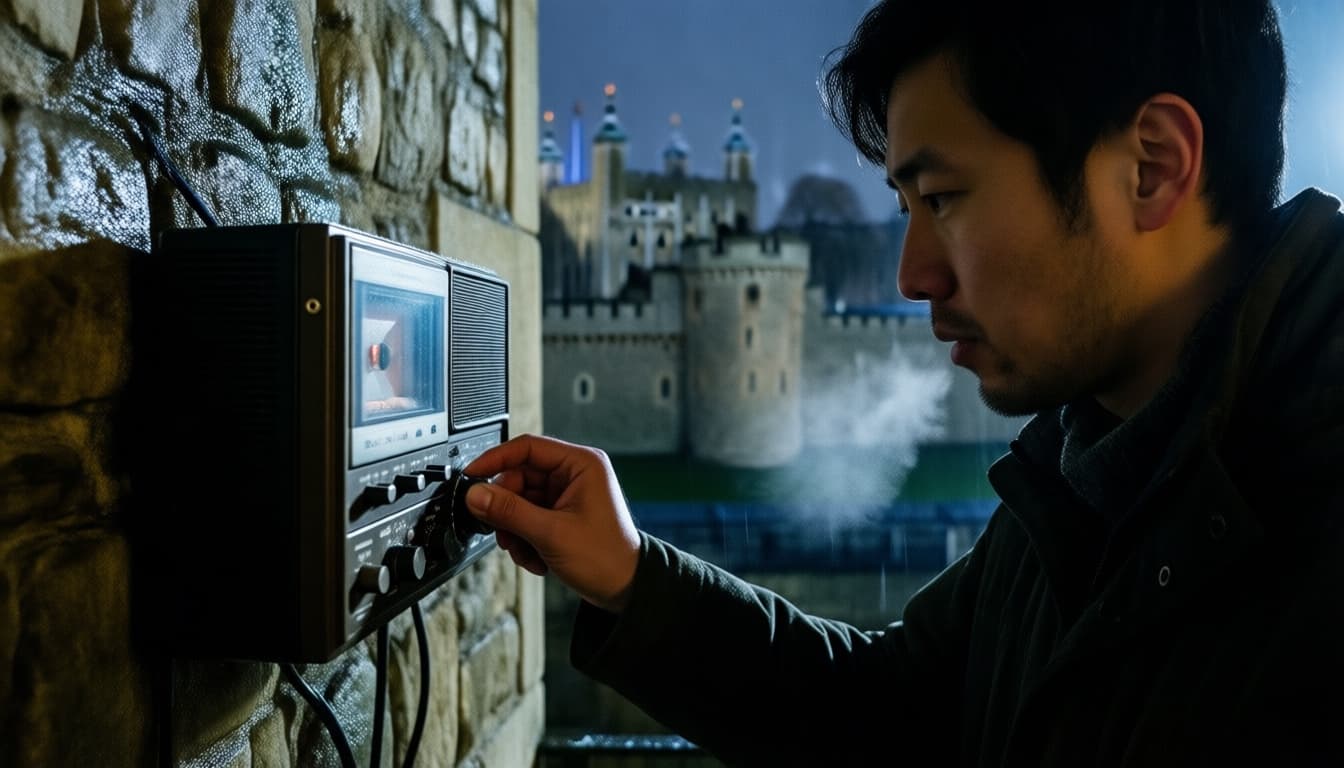
While examining prisoner graffiti etched into a small alcove, the faint hum of the city of London, distant until then, abruptly vanished. His audio recorder registered a flatline, even for small, intentional noises. The temperature plummeted several degrees within seconds, his breath visibly misting in the frigid air. The guard, initially leaning against the wall, suddenly straightened, a flicker of unease in his eyes.
Dr. Thorne checked his equipment. The EMF detector briefly spiked, then flatlined. The atmospheric pressure sensor showed a sudden, inexplicable rise, then plummeted. He tried to speak, but his voice sounded muffled and thin, as if the very stone was swallowing the sound. The silence was no longer passive; it was active, oppressive. From the narrow, winding stairwell leading deeper into the Tower, a faint, almost imperceptible metallic 'scraping' sound echoed. It was too heavy for rats, too deliberate for settling old stone.
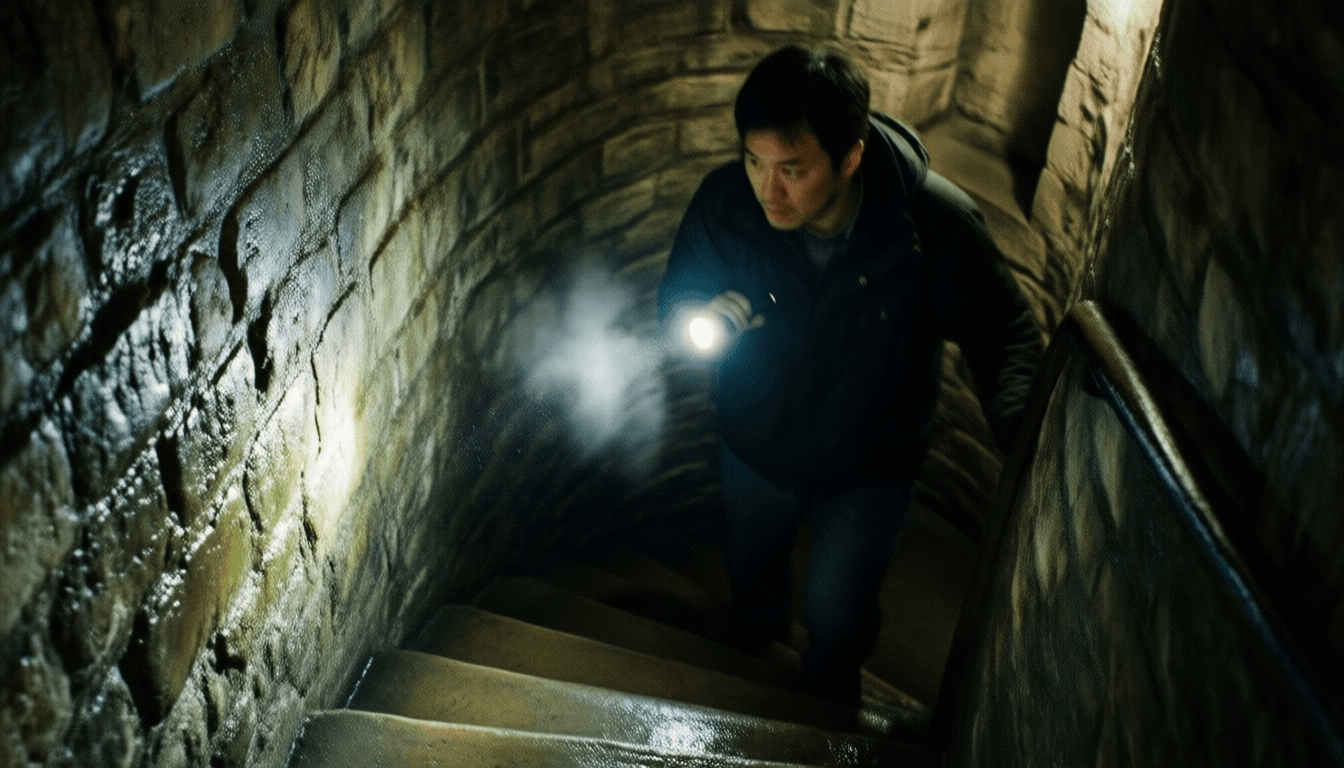
He moved towards the stairs. His flashlight beam diffused weakly into the profound darkness. The air became impossibly cold, condensation forming on the stone walls. His footsteps, which should have echoed, produced only dull thuds. The pressure in his ears intensified, accompanied by a physically induced dizziness, not born of fear. He felt the presence of something not just watching him, but actively 'manipulating' the environment itself. The guard shouted, "Doctor, are you alright?" but his voice sounded eerily distant, and then a sudden, profound silence swallowed even that faint sound. Dr. Thorne was now alone.
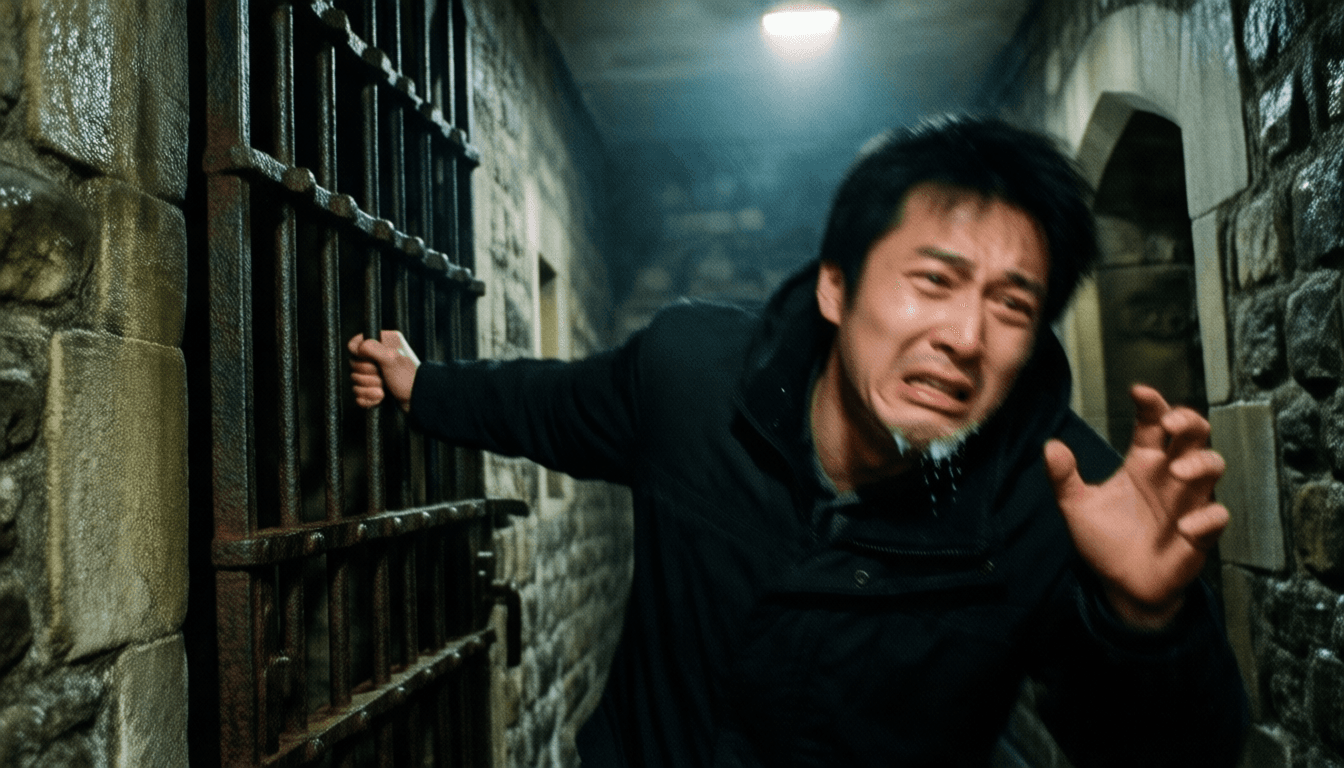
Dr. Thorne descended deeper, drawn by a faint clanking, a heavy dragging of chains, defying the prevailing silence. He reached a narrow, dead-end corridor blocked by a heavy, rusted iron gate—a portcullis—that once guarded an ancient arched entrance. As he approached, the portcullis, which had been held open by ancient, corroded chains, crashed down with a deafening clang, kicking up a cloud of ancient dust. The sound was impossibly loud, shattering the silence only to plunge the area into an even more absolute, oppressive stillness. He was trapped.
The surrounding air turned critically cold; the moisture in the air visibly froze on his equipment. The walls of the narrow corridor rapidly 'sweat', not just condensation, but as if the stone itself was exuding a cold perspiration. His own breathing, the sounds of his frantic movements, were utterly nullified. He could 'feel' himself scream, but heard nothing.
A sudden, immense pressure crushed his chest, forcing the air from his lungs. He stumbled back, instinctively reaching for something to brace himself. His hands found nothing but cold stone. Then, a distinct, icy cold, incredibly strong grip closed around his wrist. It wasn't merely the chill of the air; it was the pressure of an unseen hand, bone-deep. He felt a coldness to his very bones, seeping into his flesh. He struggled to pull away, but the grip was relentless, pulling him forward. The grinding pressure of the unknown force, dragging him towards the now-closed portcullis, felt like it would break his bones. He saw a flicker of movement in the absolute darkness beyond the portcullis—not a form, but a 'distortion' in the air, a ripple, a void that seemed to suck in residual light.
Dr. Thorne does not precisely remember how he escaped. One moment, the crushing grip, the suffocating pressure, the agonizing cold. The next, he was frantically scrambling up the spiral staircase, and as he gasped for breath, the profound silence suddenly lifted, replaced by the faint, welcome hum of the city. The guard found him minutes later, pale and shaking at the entrance to Beauchamp Tower. The guard claimed he heard Dr. Thorne scream, but Dr. Thorne had no memory of it.
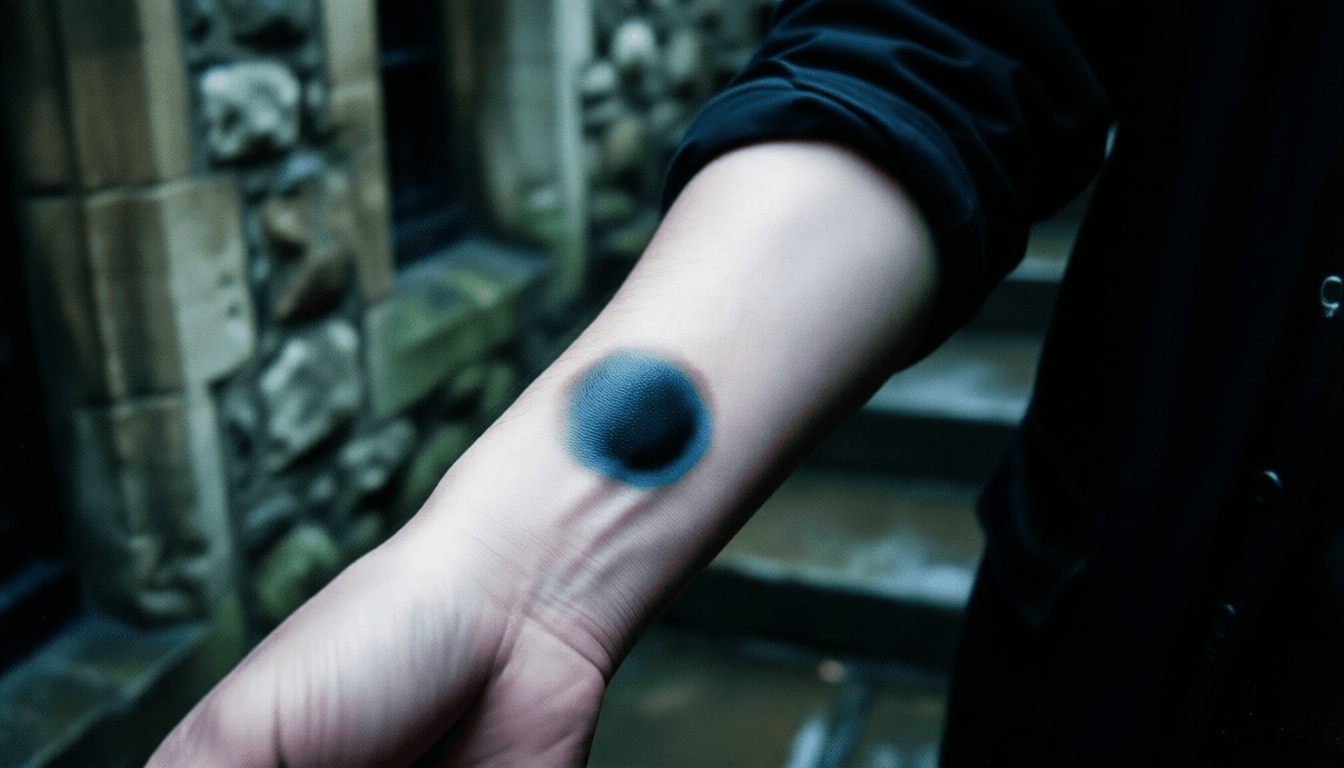
Later investigation showed no structural damage to the portcullis. The chains appeared intact, still corroded, as if they had never fallen. Dr. Thorne's right wrist bore a distinct, perfectly circular black-and-blue bruise, too uniform and deep to be accidental. His thermal camera had one single frame, captured in the center of that trapped corridor, registering an impossible cold (below -50°C). His main audio recorder had only static throughout the event, but a backup recorder in his coat pocket contained a single corrupted file. When painstakingly recovered, the file produced only a deep, resonant, unintelligible roar, beyond human vocalization—a sound that seemed to emanate from the very stone itself. He shared none of this with the authorities.
He realized the Tower of London was not merely haunted by the echoes of the dead. There was something far more ancient, far more primal there. A living, malevolent force. It did not 'inhabit' the stone; it 'was' the stone itself. A sentient prison, actively feeding on the fear and suffering trapped within its walls, bending the very laws of physics to consume its next victim. The rational archivist, Elias Thorne, now understands why some stories must remain only whispers. Because the truth is not merely terrifying, but fundamentally incomprehensible. And sometimes, the most dangerous discovery is not evidence, but a certainty that can never be shared.
[ CLASSIFIED VERDICT ]
[ACCESS LOG - SOURCE FILE]
The Tower of London is a place where countless deaths and tortures have occurred over centuries, leading to legends of numerous ghost sightings, including famous figures like Anne Boleyn and Lady Jane Grey. This story is based on an urban legend reported by the Tower's long-serving warders about the 'sound vacuum' phenomenon—an extreme silence where even city noises vanish—and inexplicable physical phenomena like drastic temperature drops. This suggests the possibility of a more powerful, malevolent entity that manipulates the environment itself, rather than mere residual hauntings.