The Stone's Silent Design
Rumors about the Georgia Guidestones have long been a persistent subject in certain online forums and esoteric publications. Erected in 1980 by an anonymous patron operating under the pseudonym 'R.C. Christian,' this granite monument presents ten guidelines for humanity in eight modern languages, advocating for population control, a new world language, and global governance. For decades, it stood as a silent, enigmatic oracle. Then, in July 2022, an explosive device shattered one of its capstones, transforming a monument of abstract dread into a tangible flashpoint. While the act was officially condemned as vandalism, whispers resurfaced. Not about who destroyed it, but about what it truly represented, and what forces were actually at play.
My own interest began years before, with a single, blurry, low-resolution photograph posted on a now-defunct conspiracy theory archive in the mid-1990s. The image, purportedly taken by a local farmer in the early morning fog, showed the Guidestones emitting an abnormally distorted light. What caught my eye wasn't the fog, but the subtle, almost imperceptible shimmer around the capstone and a shadow at the base of the central gnomon that defied the sun's angle. More unsettling was the dimly legible handwritten note on the back of the accompanying, now digitized, print: it simply read, "It listens. It moves." Existing long before widespread internet speculation, this single piece of unverified amateur evidence transformed the Guidestones from a mere curiosity landmark into a truly unsettling object of inquiry.
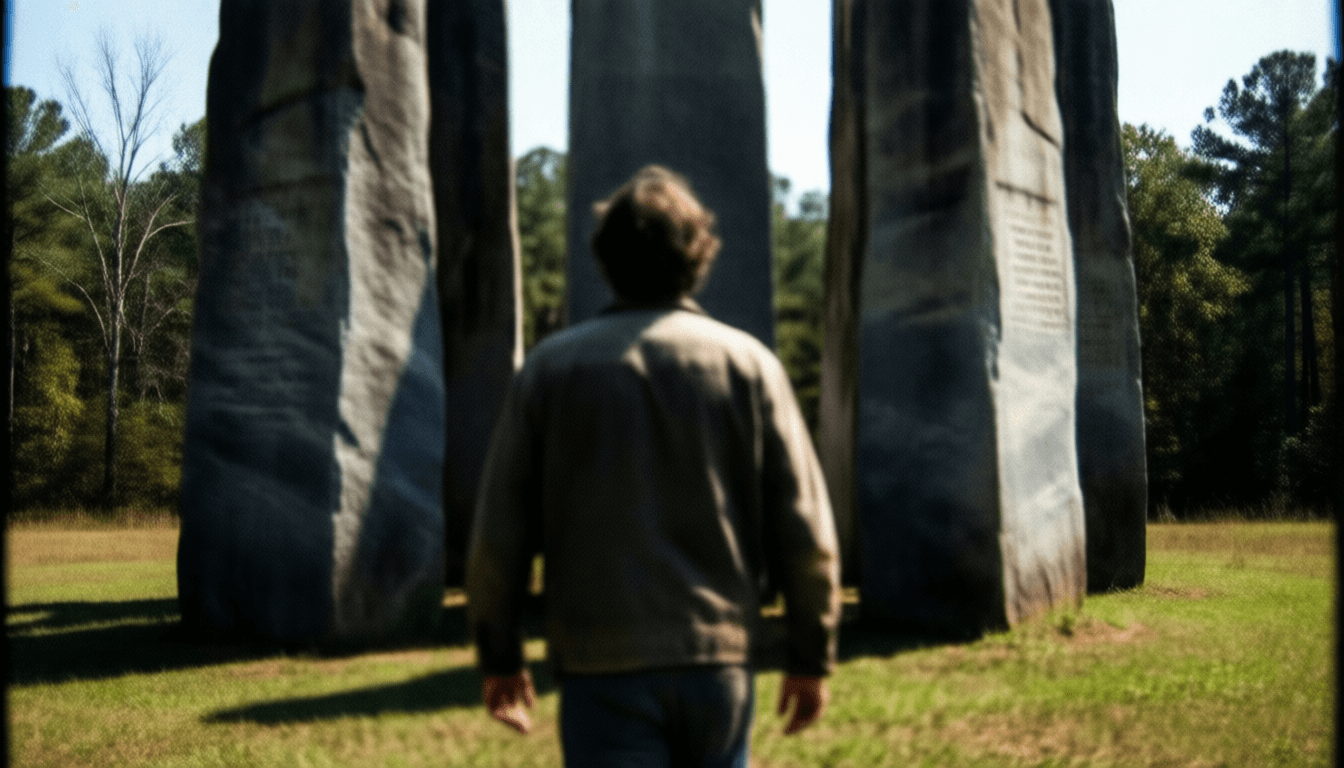
Driven by that cryptic photograph and the persistent, ominous undercurrent surrounding the monument's true purpose, I arrived at the Guidestones site months before the explosion, on a scorching late summer afternoon. The air was thick and still, and the red Georgia dust clung to everything. The monument itself was even more imposing in person than in the photograph; five massive granite slabs, precisely cut and aligned, piercing the flat landscape. Their sheer scale and precision were immediately unsettling, an unnatural geometry in a rural setting. I began my investigation systematically, first walking the perimeter, then moving closer, running my fingertips along the cold, smooth granite of the engraved text. My field kit included a digital voice recorder, a sensitive thermometer, and a custom-built Geiger counter. Initial recordings captured only the dry chirping of cicadas and the distant hum of traffic. The thermometer indicated consistent, oppressive heat. The Geiger counter remained silent. For a time, it was just stone, heat, and silence.
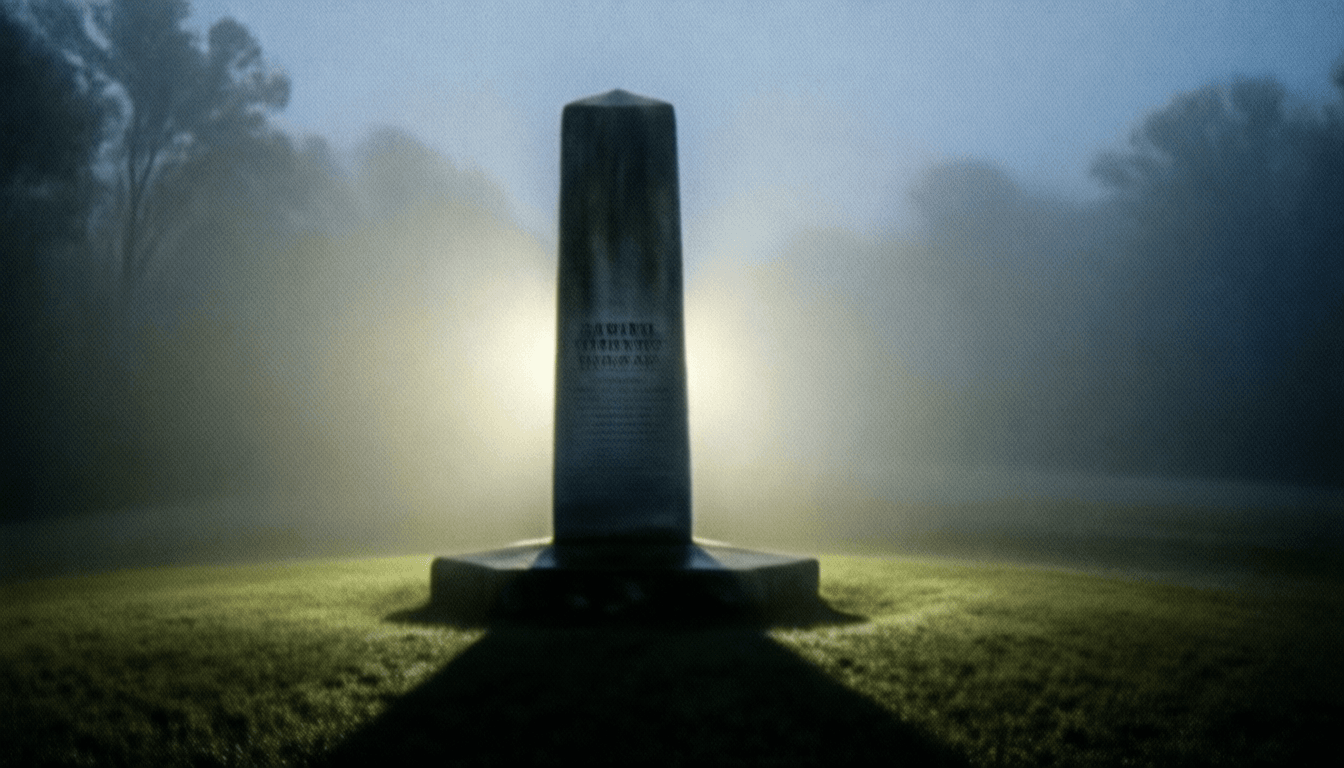
As the sun dipped lower, casting long, distinct shadows, the environment around the Guidestones began to subtly shift. The previously fierce chorus of cicadas gradually faded, giving way to an unnatural, profound stillness. My audio recorder, which had previously picked up distant highway noise, now registered only a low, almost imperceptible hum. It wasn't a sound that resonated through the air, but rather a vibration felt through the soles of my feet, perceived more with the body than the ears. Upon reviewing the recorded files, ambient sounds had almost completely vanished, with this deep, resonant frequency barely detectable just below the threshold of conscious hearing.
The previously stable thermometer showed erratic fluctuations. Localized cold spots, impossible in the oppressive heat, appeared and vanished like lightning, particularly near the English inscription, "Maintain humanity under 500,000,000." The compass I carried spun slowly, then rapidly, finally settling on a vector pointing not to magnetic north, but *inward* towards the central gnomon. The Geiger counter, still stubbornly silent regarding background radiation, began to emit a faint, rhythmic clicking when held directly against the smooth surface of the capstone. It wasn't a typical radiation signature; the clicks were too uniform, too deliberate, almost like a heartbeat. Light also seemed to bend around the granite, rendering the shadows within the narrow passages between the slabs into near-absolute darkness. The sensation of being watched, not from outside, but *from within the stones themselves*, grew increasingly distinct, a cold, calculating pressure pressing against the inside of my skull.

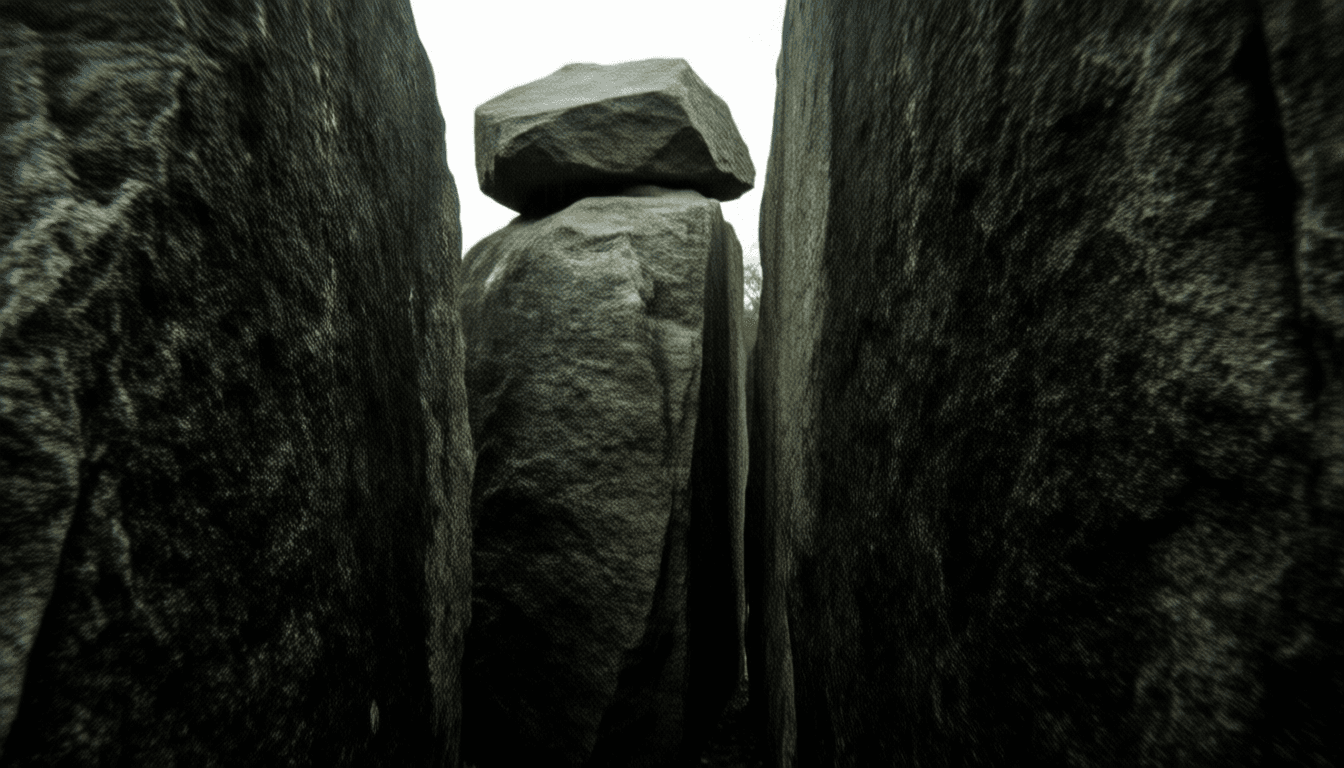
Consumed by a growing, irrational certainty that the capstone held the key to the photograph's anomaly, I positioned myself within a narrow passage between two main slabs, aiming my camera upwards at the capstone's astronomical alignment hole. The hum was now louder, transforming into a grinding vibration that rattled my teeth. As I adjusted the lens, the air around me suddenly grew heavy, like wading through thick molasses. The space between the massive granite slabs began to subtly, but distinctly, narrow. It was a barely noticeable pressure against my shoulders at first, then the hard granite pushed inward, crushing me. I struggled, but the stone was unyielding, slow, and utterly immovable.
A sharp, burning cold emanated from the granite against my skin, quickly transforming into an agonizing, deep heat, as if my flesh was being branded. The inscriptions on the surrounding slabs seemed to flash, letters blurring and reforming, not into a new language, but into a single, overwhelming phrase that bypassed my ears entirely and appeared directly in my thoughts: "Balance through reduction. Order through pain. The design is eternal." It was not a whisper, but a resonant directive, cold, precise, and imbued with an ancient, alien authority. My breath grew shallow, my chest squeezed not just by the crushing stone, but by an unseen, immense pressure, like being submerged miles deep in water. The Geiger counter, trapped with me, no longer clicked, but emitted a continuous, high-pitched shriek. I could feel the stone's purpose, its alien will, attempting to download itself into my consciousness. With a primal, desperate surge of adrenaline, I twisted, narrowly extracting myself, my jacket tearing and my digital voice recorder permanently wedged in the impossibly narrow gap. Gasping for air, my skin screamed from the invisible burns.
I escaped, physically intact but fundamentally altered. My most crucial piece of equipment, the voice recorder, remained a silent witness, sealed within the Guidestones. Weeks later, reviewing partial footage from my camera, I noticed a peculiar, almost imperceptible distortion in the final frames: a faint, superimposed grid-like pattern over the capstone, mirroring the monument's own structure. It wasn't a camera glitch. It was a phantom, embedded within the image.
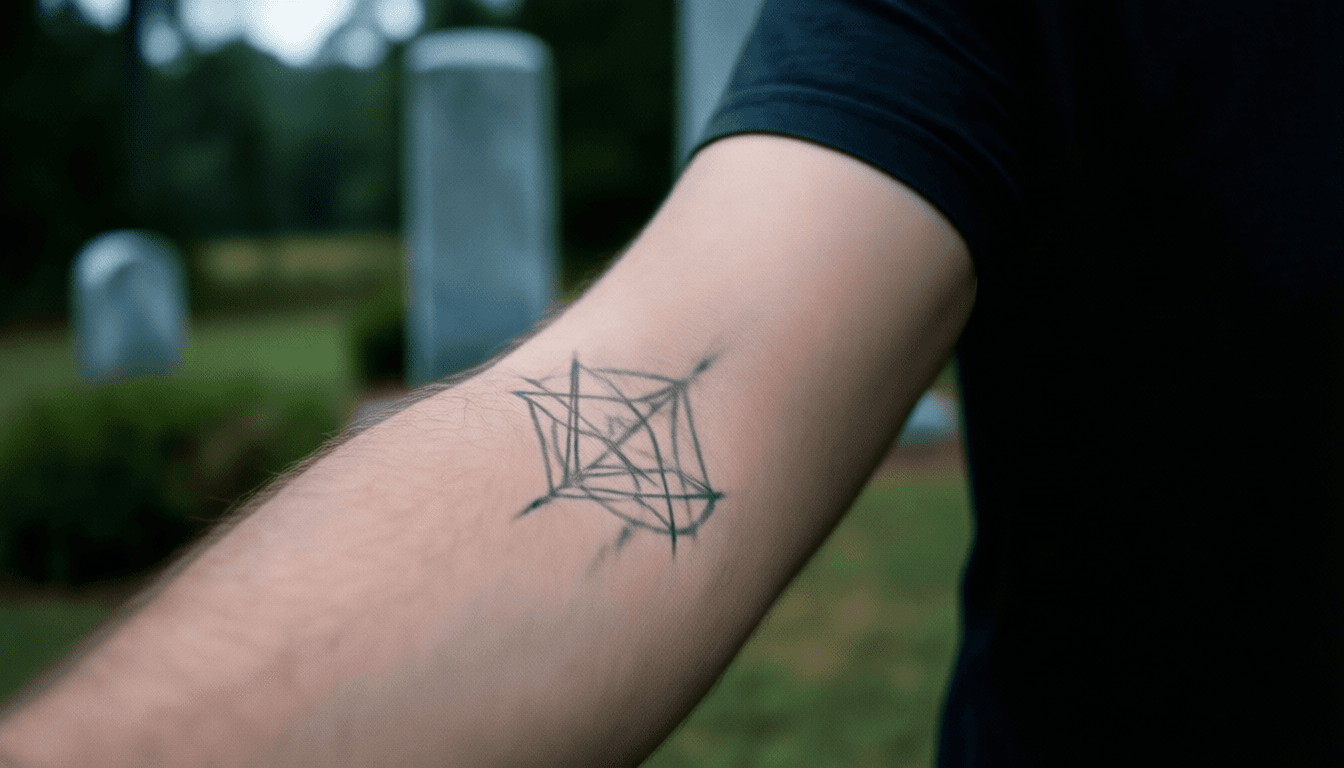
The persistent hum I had felt at the Guidestones never fully left me. It now manifested as a low thrumming vibration behind my right eye, a constant reminder. More unsettling was the faint, stylized mark that slowly appeared on my forearm where the granite had pressed. It wasn't a blister or a burn scar, but a precise geometric pattern, reminiscent of obscure symbols sometimes found in alchemical texts, visually echoing the eerie geometry of the stones.
But the greatest burden was the directive: "Balance through reduction. Order through pain. The design is eternal." This phrase, once an invasive thought, now echoed with chilling clarity whenever I read headlines about global resource scarcity, population growth projections, or political instability. The Guidestones were not merely a collection of granite slabs inscribed with unsettling declarations. They were a monumental conduit, an active participant, quietly shaping the world towards their engraved "wisdom." I finally understood that the explosion, which ultimately shattered one of those slabs, was not an end, but either a desperate act against an already activated mechanism, or perhaps an intended, secondary stage of that eerie, monumental design. I often find myself staring at maps and demographic charts, searching for patterns, for subtle shifts, now terrified by the stone's silent, unyielding will echoing in my mind.
[ CLASSIFIED VERDICT ]
[ACCESS LOG - SOURCE FILE]
The Georgia Guidestones were a granite monument erected in 1980 under the pseudonym 'R.C. Christian,' featuring ten guidelines for humanity in eight modern languages, advocating for population control and global governance. It stood for decades in enigmatic silence before its destruction in 2022, a constant subject of conspiracy theories surrounding its origins and purpose.