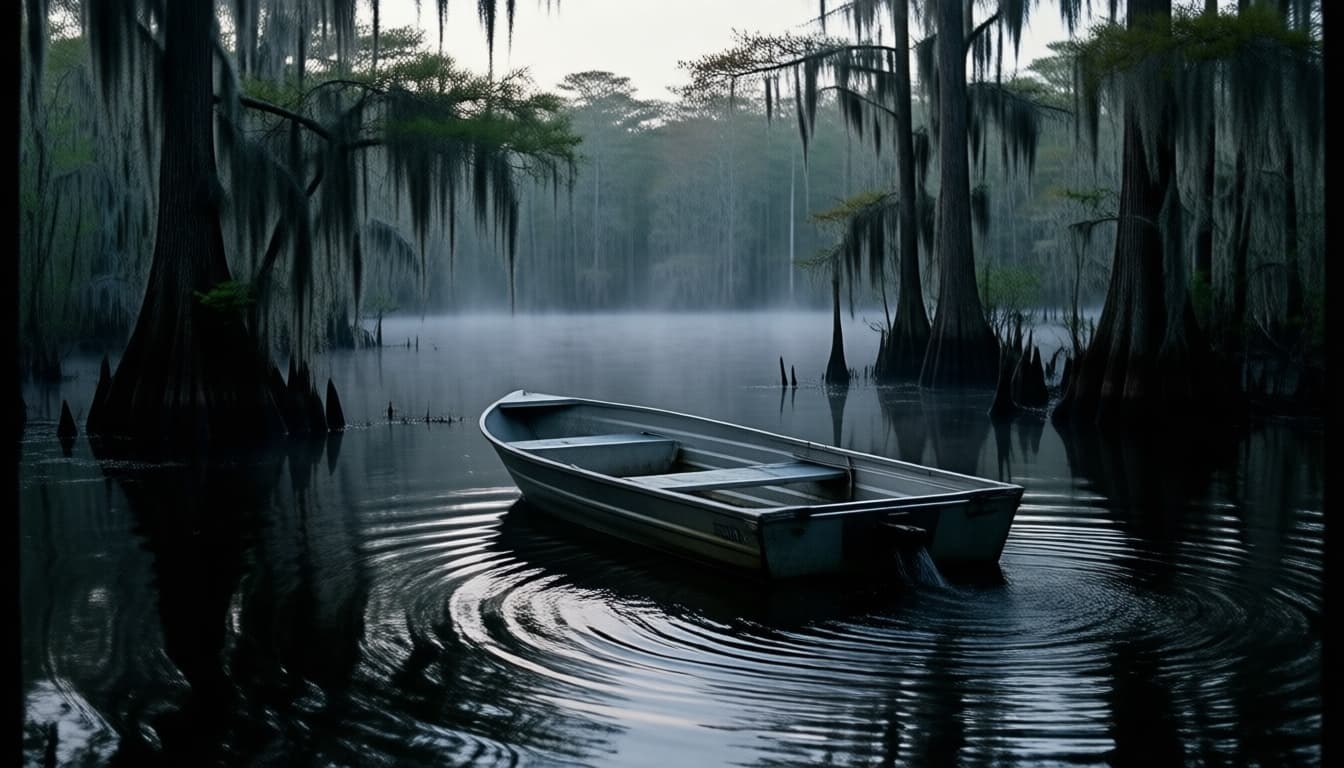
The Rougarou of Spanish Lake: The Unredacted Salvage Report
Records surrounding an aluminum skiff dredged from the wetlands east of Spanish Lake by the Louisiana Department of Wildlife and Fisheries (LDWF) in November 1998 remain strictly classified. Officially closed as a simple drowning accident involving missing hydrologist Marc Caille, the original recovery log documented traces at the scene that defy rational physics. Three holes, each 4.5 centimeters in diameter, pierced the bottom of the hull—the sheet metal torn outward, not inward. Furthermore, an audio recorder retrieved from the thick silt contained a chilling 34-second clip of something distinctly non-human wading through waist-deep swamp water at a speed of 14 kilometers per hour.
Instead of the sound of splashing water, the tape captured a dull, ruptured thud, reminiscent of heavy leather sacks being repeatedly slammed against dry flour. It matched the centuries-old whispers of the Cajun locals: the 'Rougarou.' Not the Hollywood werewolf of cinema, but a living pestilence—a phenomenon said to occur where solid earth rots into stagnant water, rotting human flesh alive and cursing it with a ravenous, bestial hunger. Following Caille's final recorded coordinates, I steered my boat out from a nameless dock at the far edge of Route 182.
The moment I entered the flotant—dense floating mats of marsh reeds—the idling hum of my outboard motor turned unnervingly muffled. Passing into an expanse of dead cypress draped in thick Spanish moss, the very atmosphere altered. I raised an oar and struck the aluminum gunwale hard, but the metallic chime failed to carry. Before the sound could even register in my ears, it vanished as if sliced clean by a razor. It was a suffocating vacuum, deadening any echo within eighty meters.
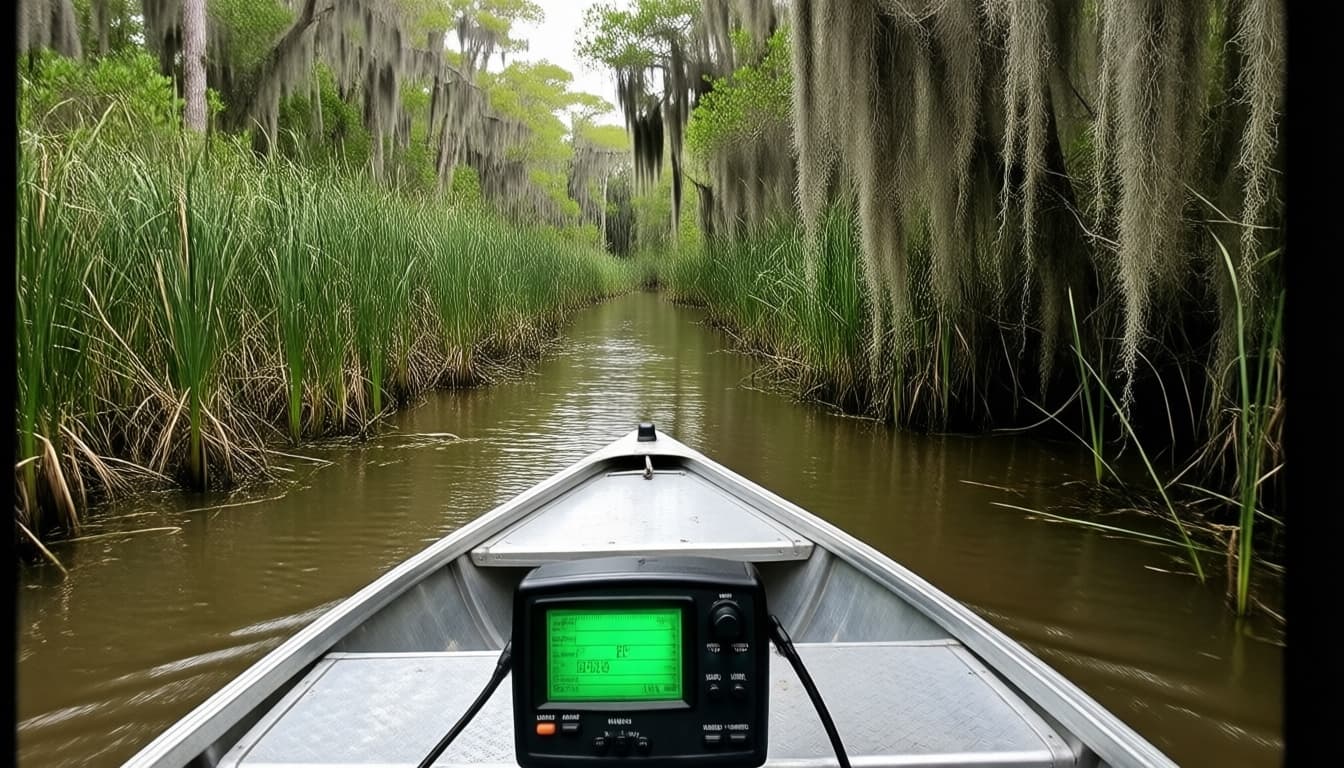
Staring down at the water, a chill gripped the base of my neck. The wake spreading outward behind the propeller wasn’t pushing away—it was being pulled backward, funneled inward toward the stern. Such a fluid dynamic reversal was impossible unless something of colossal displacement beneath the surface was actively drawing the water in. Stranded in the roots of a dead cypress hung the carcass of a three-foot alligator; devoid of rot, its ribs were entirely crushed inward, its hide marked by distinct, circular bite indentations that resembled human dentition enlarged by more than forty percent.
A rhythmic waveform flickered onto the screen of my low-frequency acoustic sounder mounted to the hull. Exactly seventy beats per minute. A mass weighing hundreds of kilograms crushing through the silt bed reverberated directly into the soles of my feet through the aluminum floorboards. Not a single reed stalk swayed above, yet the muddy depths squirmed as if the bed itself were alive. My fingertips grew numb and icy.
With a violent shudder, the motor died. Tightly choked inside the cooling intake was a dense tangle of greasy gray fur reeking of raw sewage and rancid animal fat. The skiff slid to a dead halt atop a bank of decaying submerged roots. I jammed a carbon-fiber push pole into the bed to shove the boat free, but the supposedly firm bottom gave way endlessly, swallowing the pole down into an ice-cold abyss. There was nothing solid underneath.
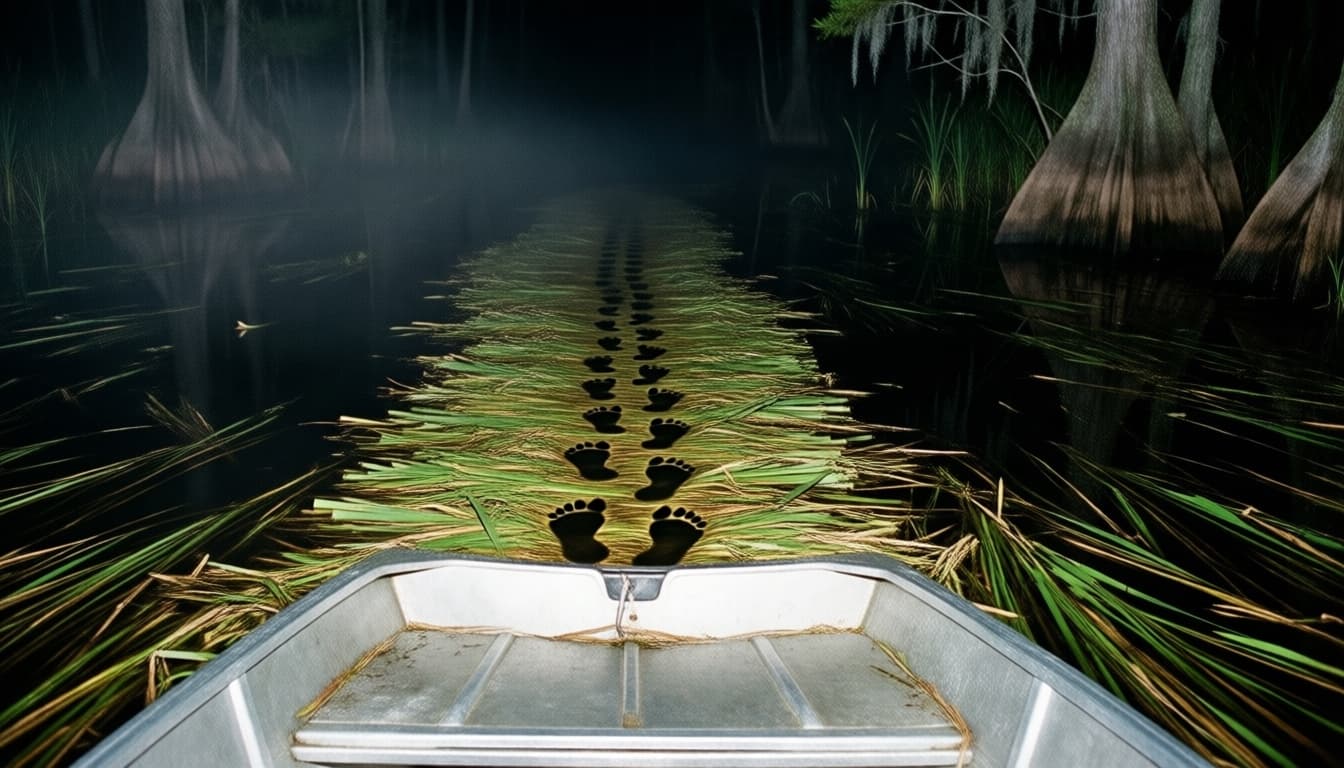
Fifteen meters off the port side, the floating reed mat began to sink. As though pressed by the stride of massive, unseen feet, depression marks over forty centimeters deep plunged into the vegetation, marching in a straight line directly toward the boat. Black swamp water welled up into each print, yet nothing walked upon the surface. Within three seconds, the ambient temperature plummeted, and a foul, rotting stench that seemed to freeze my lungs slammed into my face. The absolute invisibility of the stalker was suffocating.
Then, without breaking the surface tension of the water, it rose silently ten meters ahead, emerging like oil seeping up from the depths. Before my brain could classify it as an animal, it recognized the silhouette of an abnormally distended human body. A dislocated pelvis twisted for quadrupedal locomotion, limbs elongated and caked in black mire. The fingertips had calloused into layered, horn-like talons of shattered nails, and milky, rotting pupils devoid of light reflection looked straight down at me.
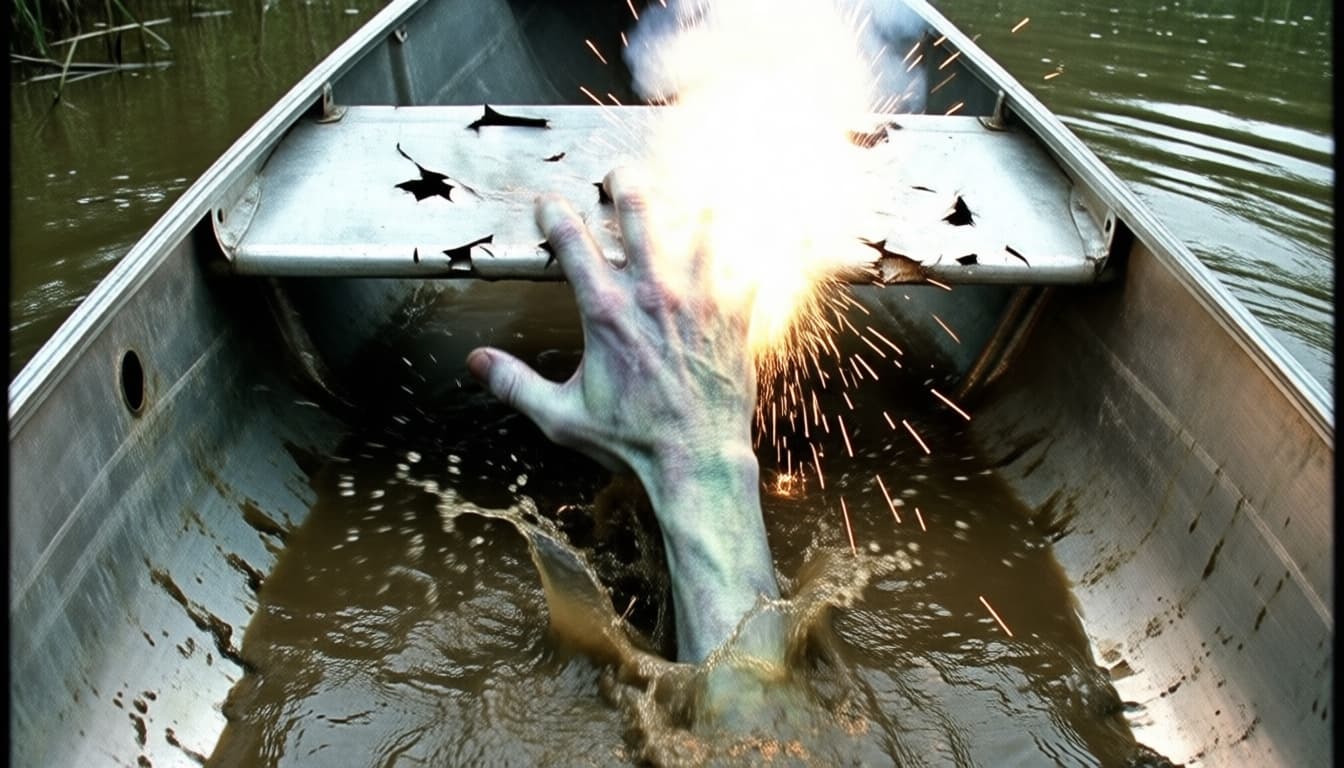
In the blink of an eye, the figure on the water vanished. A deafening metallic crack split the air as the aluminum floor beneath my boots buckled upward. Bursting through the 3/16-inch thick metal plate from below was a massive, pale human hand scarred by ancient, crude suture marks. Groping wildly through the torn breach, its jagged fingers tore at the toe of my rubber boot. Without thinking, I wrenched the safety pin from the magnesium flare in my fist and rammed it straight into the opening.
As the magnesium flared with blinding white light, it illuminated a human lower jaw lodged between the shredded metal shards. From crowded rows of jagged teeth jammed along narrow gums, a wet, rattling gasp erupted as if its lungs were drowning in marsh water. The stern collapsed with a heavy groan, and muddy water poured over the deck. Lunging onto the treacherous floating reeds in ankle-deep silt, I scrambled away as the sound of the hull being torn apart and dragged into the bottomless mud echoed behind me.
Rescued from the levee in a state of severe hypothermia and exhaustion, the scrap of tissue lodged in my torn boot was sent to a research lab in Baton Rouge. The cellular analysis unequivocally identified human DNA. However, its telomeres exhibited an impossible mutation—defying any natural biological lifespan, endlessly dividing and decaying over what seemed like an eternity.
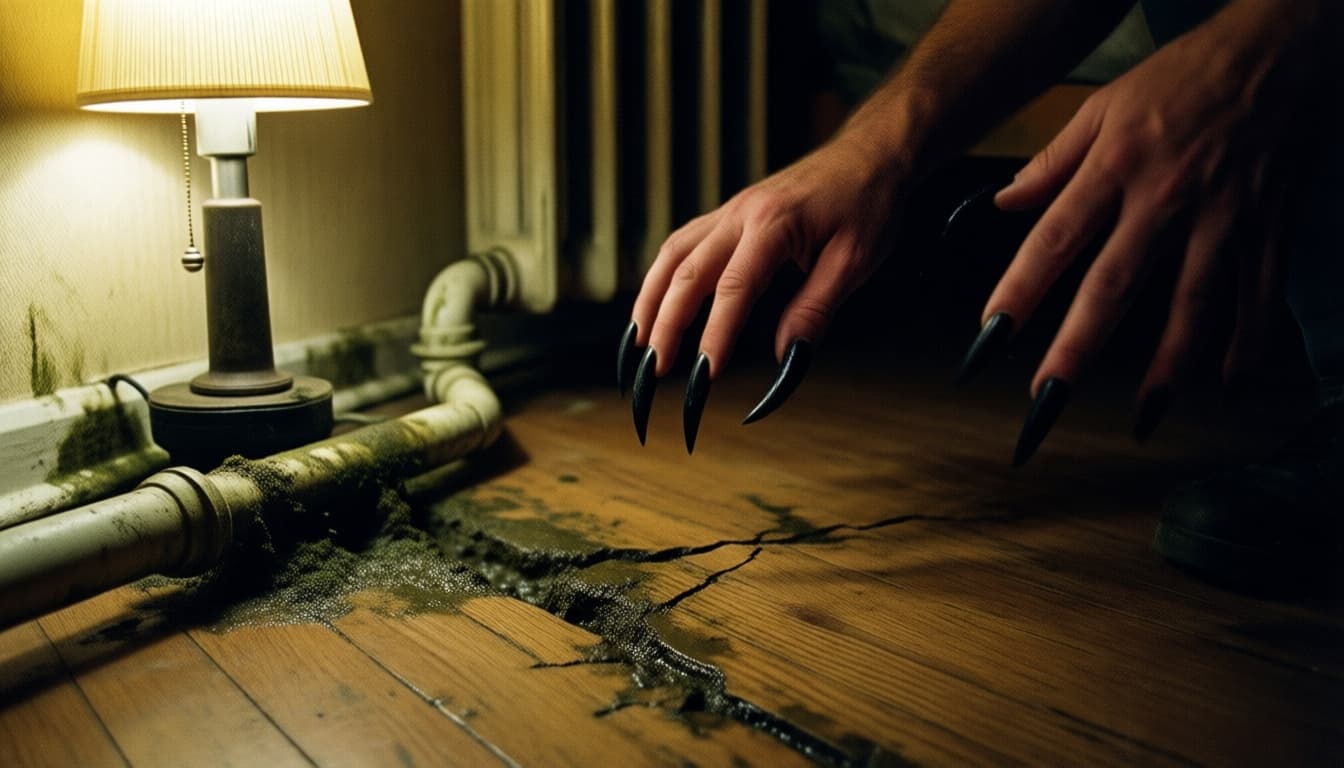
In my apartment bedroom miles away from the swamp, between 2:00 and 4:00 AM every night, a steady vibration rises through the plumbing beneath the floorboards. Exactly seventy beats per minute. Thud, thud, thud. A few days ago, the beds beneath my fingernails began splitting vertically, hardening into black, jagged horn. The water running from my bathroom sink now drains counter-clockwise in a frantic vortex, and from deep within the pipes, the cold, metallic stench of Louisiana swamp silt never fades.
[ CLASSIFIED VERDICT ]
[ACCESS LOG - SOURCE FILE]
Rooted in Louisiana's Cajun folklore, the 'Rougarou' is a terrifying cryptid said to haunt the deep bayous—a cursed human transformed into a rotting, ravenous beast after violating Catholic Lent or falling under a swamp curse. Unexplained vanishings, mutilated remains, and violently battered boats found throughout the impassable Mississippi delta wetlands are often attributed by locals to this enduring swamp legend.