
The Soundless Abyss of Lake Michigan
Among commercial fishing fleets and ship operators traversing Lake Michigan, there exists a persistent, hushed whisper regarding a specific area off the coast of Ludington, Michigan. While not a large-scale disappearance phenomenon like the Bermuda Triangle, it’s a localized “dead zone” that those who work on the water secretly refer to as ‘The Still Point.’
The moniker signifies more than just intermittent calm. For decades, intermittent reports have surfaced of vessels passing through this particular quadrant experiencing moments of inexplicable navigational disorientation. Compasses would spin wildly, GPS signals would drop out entirely, and radio communications would be replaced by a sudden, profound static. More unsettling were the auditory anomalies: engine hums would fade, the lapping of waves would diminish into an unnatural silence, as if the air itself refused to transmit sound.
Cross-referencing NOAA buoy data with these localized reports occasionally captured unexplained sudden temperature inversions or localized, intense current shifts at this exact point. While usually dismissed as sensor errors, their correlation with distress calls citing minor vessel malfunctions or severe disorientation was unsettlingly consistent. The most chilling anecdotes involved the discovery of small pleasure crafts found adrift, their engines stalled, but their occupants often vanished, or suffering from extreme psychological distress and fragmentary amnesia. The crucial detail? The absence of clear debris or wreckage piles. The vessels themselves were left as if gently released, their cargo or crew simply evaporated. The lake took something, but often left an empty shell behind.
Dr. Elias Thorne, a retired hydrologist renowned for his rigorous empirical research and an almost pathological aversion to unverified claims, became captivated by The Still Point due to the statistical improbability of its recurrent data anomalies. He dismissed the concept of ‘mystery,’ framing his exploration as an investigation into a potentially unknown localized geophysical phenomenon.
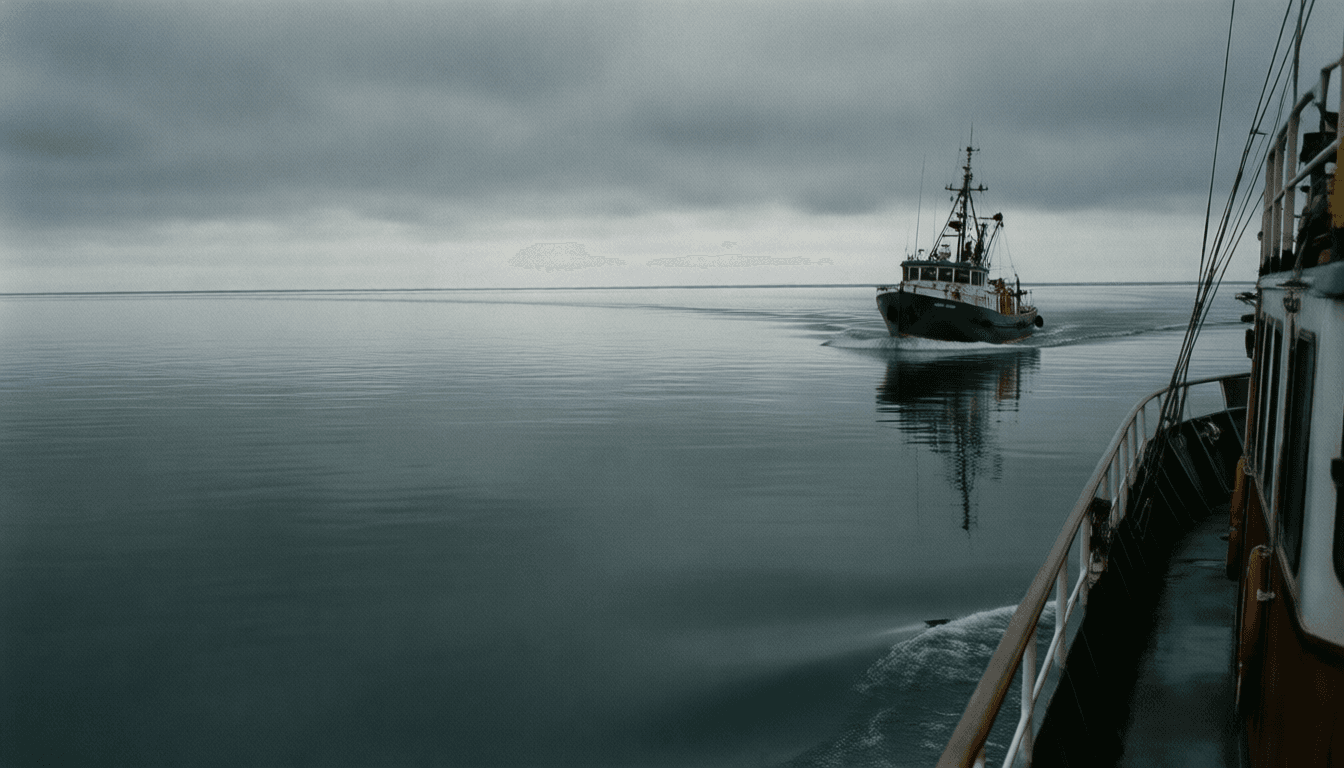
He set out early one mid-September morning in his small but impeccably equipped research vessel, the Anemone. The lake was vast and deceptively calm, a slate-grey mirror under a cloudy sky. Elias, as always, methodically checked his sonar, reviewed weather patterns, verified GPS coordinates, and triple-checked all instrumentation against known reference points. He noted the ordinary sounds: the familiar slap of waves against the hull, the steady thrum of the diesel engine, the crisp crackle of the marine radio. The quiet hum of the Anemone's systems was a sanctuary, a testament to order amidst the expanse of the massive, indifferent Lake Michigan. His skepticism was his anchor. He had crossed The Still Point's exact latitude and longitude countless times on paper; now he was crossing it in reality.
The change was not sudden, but gradual. Elias, preoccupied with his sonar, first noticed that the sound of waves hitting the hull began to diminish. He initially attributed it to the boat's speed or a subtle change in the water's texture. But as he continued, the engine's hum seemed to recede, as if the sound itself was being drawn inward. He ran a diagnostic on the sound dampeners; they were functioning normally. An unnatural, invasive silence began to settle. He rapped his fist on the steel hull. The sound was muffled, dead, instantly absorbed as if the air or water had become a dense auditory sponge.
Then, the instruments began to betray him. The GPS signal began to flicker erratically, displaying impossible speeds, then cut out entirely. His normally robust dual satellite navigation system showed only indecipherable data. A cold unease settled over Elias as his magnetic compass, stable for hours, began a slow, deliberate rotation, stopping at random directions before starting its hypnotic spin again.
He turned his gaze to the water itself. Minutes ago gently rippling, the surface was now unnervingly flat, like polished obsidian, reflecting the grey sky in an eerie, perfect stillness. Just beneath the surface, he noticed a faint, unsettling shimmer, a visual distortion of light. It made the depth seem unfathomable, infinite, like looking into an abyss through a faulty lens. He lowered a weighted sounding line to check the exact depth. The line went taut for a moment, then, impossibly, was pulled sideways by an unseen, powerful force before suddenly going slack. Despite the sonar indicating a reasonable depth, the lead weight never touched bottom. The current wasn't merely strong; it was pulling the line laterally, independent of the boat's drift, as if defying the very laws of hydrodynamics.
A localized chill descended, dropping the temperature several degrees abruptly, yet the sun was still a faint presence above the cloud layer. The air grew heavy, carrying a damp, metallic scent, like cold iron. The silence deepened further, pressing in on him, taking on a physical presence.
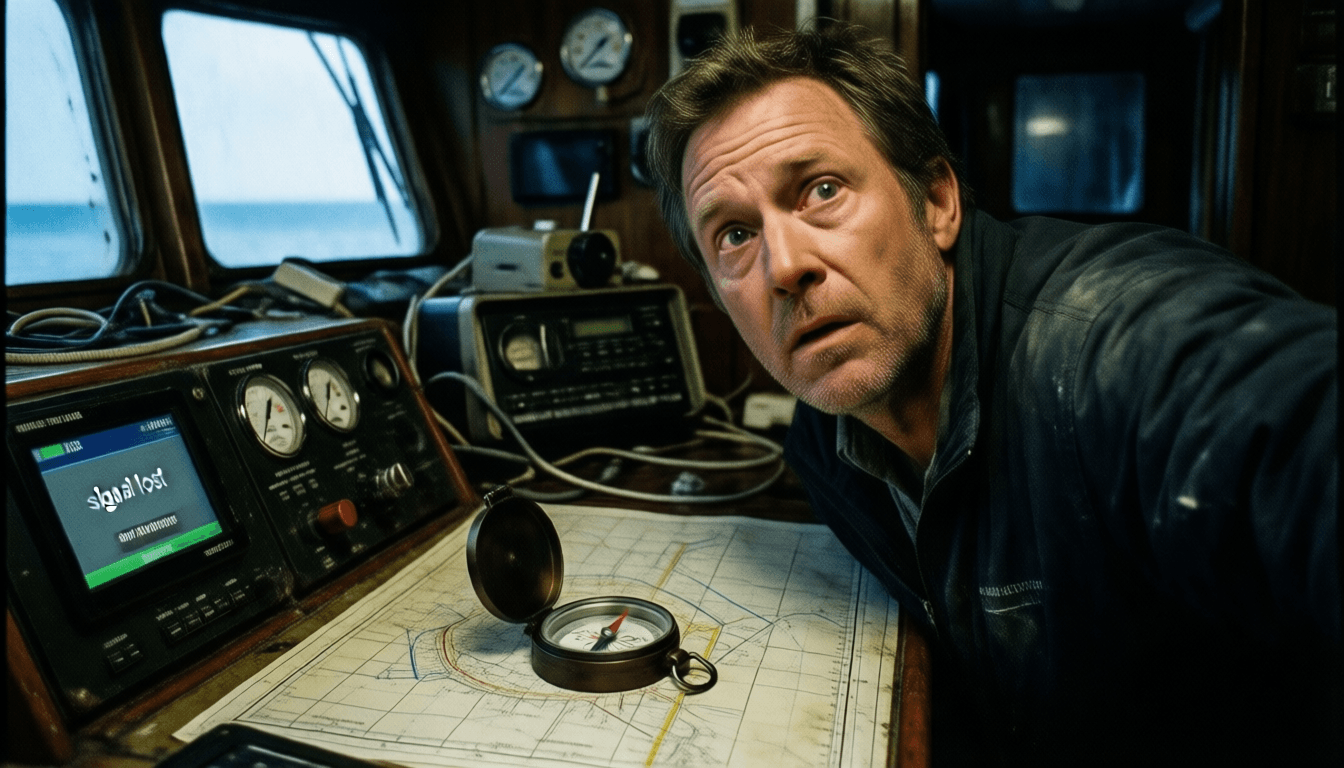
Deeply unsettled, Elias moved to the main cockpit, intending to engage the auxiliary engine and retreat. He cranked the ignition. The engine gave one weak, dying shudder, then was swallowed by the encompassing silence, dying completely. All the electronics that had merely malfunctioned were now utterly dead. Not just signal loss, but a complete power cut to everything. The Anemone drifted silently, a metallic ghost in the heart of an unknown entity.
The unnatural silence deepened further, becoming physically oppressive. Elias felt a profound pressure in his ears, and then across his entire chest. It was as if the air itself was becoming denser, heavier. He tried to shout, to break the suffocating quiet, but his voice was a thin, reedy whisper, barely audible even to himself, quickly absorbed and eaten by the void.
Then, the water began to respond. The glass-like surface around the Anemone began to ripple, but not from wind. Concentric circles spread outward from beneath the boat, growing larger and more violent, yet still utterly soundless. The Anemone suddenly lurched downwards, then violently upward. It wasn't waves; it was the water itself rising with an impossible, silent force.
Impossibly, a column of perfectly still, glass-like water briefly erupted directly beneath the boat, stretching perhaps ten feet into the sky before collapsing back down, creating a localized, destructive void. The Anemone slammed downwards into this cavity, and the pressure in Elias's ears became excruciating. He was violently thrown across the cockpit, his head striking hard plastic. He struggled to reach for his emergency satellite beacon, but the cabin itself began to groan, the steel hull protesting against unseen, unimaginable stresses. The boat was not capsizing from waves; it was being crushed and torn apart by an internal, directional force within the water itself.
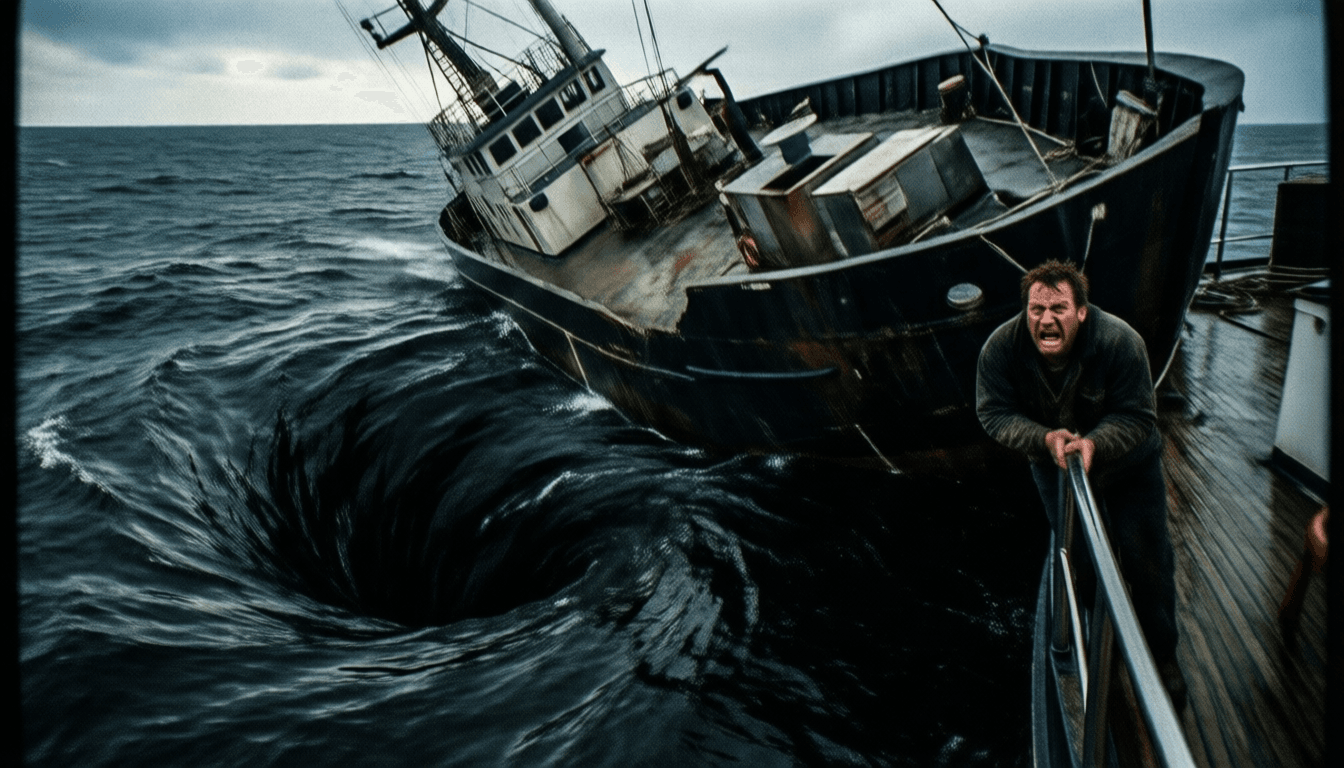
As the hull began to creak, buckle, and split, Elias scrambled onto the deck. The tearing of metal was soundless. The water around the boat had become a vortex of black, glass-like movement. He felt a colossal, overwhelming pull from below—an aggressive current designed to drag him directly into the center of the soundless maelstrom. He clung to a railing, knuckles white, muscles screaming, watching parts of the Anemone twist and tear away. Not broken by impact, but by pure directional force, as if the water was precisely deconstructing the vessel. He slipped, almost losing his grip, but managed to brace himself as the boat tilted precariously, its bow rising, its stern sinking. The 'pull' was immense, trying to drag him into the silent abyss opening beneath the vessel. He flung himself towards the emergency life raft, severing its tether with a utility knife. At that instant, the Anemone began its final, vertical descent. It wasn't sinking; it was being swallowed. He plunged into the black, swirling water. The 'pull' followed him. In the water, a tangible, physical force tried to prevent him from reaching the surface. He fought, his lungs burning, feeling immense, crushing pressure on his chest, as if the water itself wasn't merely drowning him but squeezing the life out of him with a pure, impossible, soundless force. He gasped, breaking the surface, only to see the Anemone vanish without a trace, without a ripple, swallowed whole into the glass-still maw.
Elias Thorne was found hours later, miles from The Still Point, by a passing fishing vessel. He was unconscious, suffering from severe hypothermia and acute acoustic trauma. He remembered nothing of his rescue, nor how he had drifted so far, so fast, but the entire bottom of his small rubber life raft, miraculously intact, bore faint, impossibly uniform scratches. As if it had been dragged across a vast, frictionless surface.
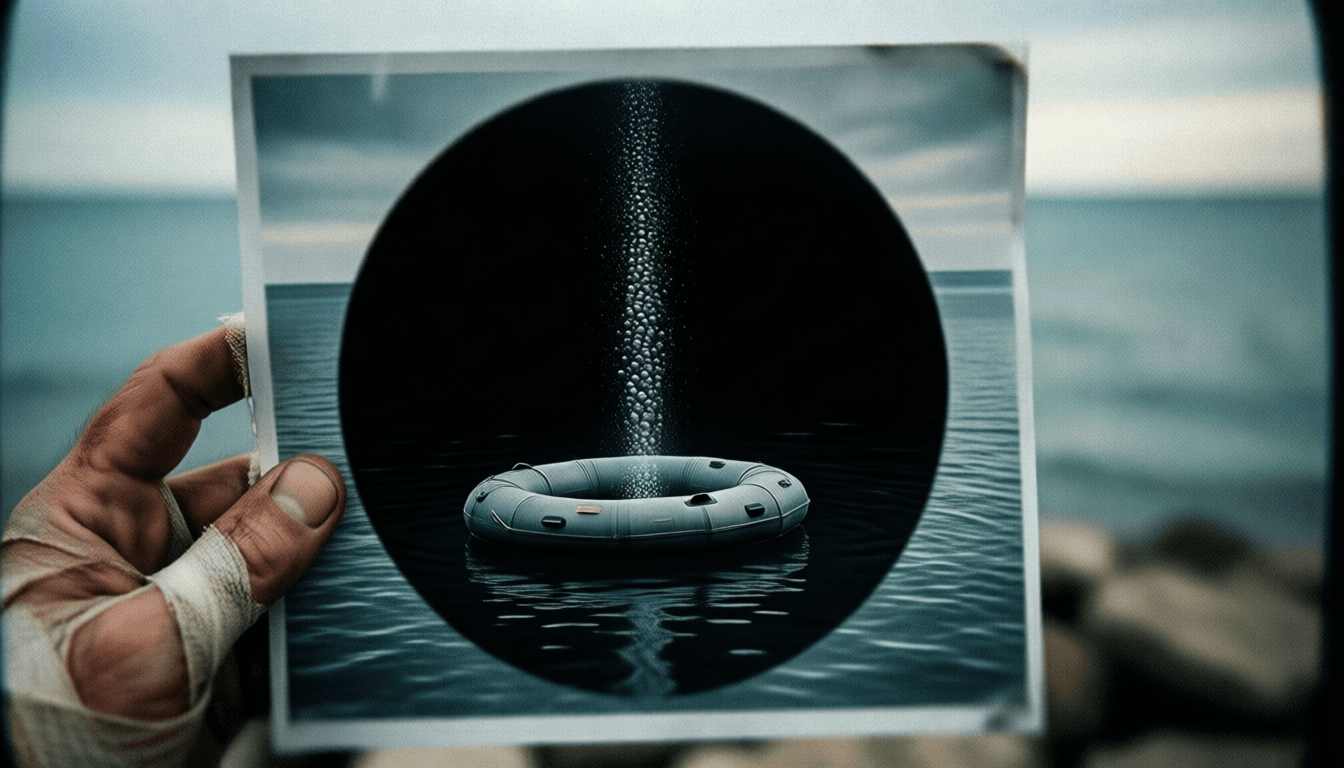
Medical examination revealed that Elias's waterproof satellite phone, though completely dead and unresponsive, held a single, impossible photograph in its internal memory. It was taken from inside the life raft, moments after its deployment. The photo showed only the glass-black surface of the water, but directly in front of the raft was a perfectly, impossibly circular patch of utterly still, deep black water. From its exact center, reflecting no sky, a single, ethereal ring of tiny bubbles rose vertically, in complete defiance of any natural current or turbulence. The image was hyper-realistic, yet utterly alien. A perfect anomaly, captured in a moment of terror.
Elias himself suffered from severe aphasia and an intense, debilitating phobia of large bodies of water, particularly black ones. He spoke little, but sometimes, in moments of lucidity, he would whisper about “the pressure” and “the silence.” He began to compulsively, meticulously draw perfect circles on every available surface, each with a single, unbroken vertical line within it.
Official reports attributed the loss of the Anemone to sudden, severe weather (unobserved by any other vessel in the area) and Elias's condition to extreme hypothermia and trauma. The photograph found on his phone was dismissed as a corrupted file, an image error, or a hallucination. But the fishing community still whispers about The Still Point, and nobody willingly goes there. And sometimes, in the deeper parts of Lake Michigan, sailors report their sonar detecting nothing but a massive, perfect silence. As if something beneath the waves absorbs all sound, all echo, all data. Elias, despite his condition, sometimes stares at the faded printout of the impossible photograph. His eyes reflect a deep, primal fear. It was a fear that had nothing to do with storms, or currents, or mechanical failure. It was a fear born of the impossible geometry of absence, the crushing force of silence, and the chilling realization that some things, in the Great Lakes, are not merely lost, but taken.
[ CLASSIFIED VERDICT ]
[ACCESS LOG - SOURCE FILE]
In Lake Michigan, there's a chilling rumor among commercial fishermen and vessel operators about a local "dead zone" known as "The Still Point." Ships entering this area reportedly experience bizarre phenomena like compass malfunctions, communication blackouts, and the absorption of sound, often leaving behind empty vessels with missing occupants. It's a mysterious tale possibly linked to unknown geophysical phenomena or an interdimensional anomaly.