
The Script of Silence
In 1977, the US Senate Intelligence Committee, the 'Church Committee Report,' acknowledged that the CIA had utilized journalists and media organizations in the past but downplayed its scale, claiming the practice had largely ceased. However, whispers persisted. Online forums and some history blogs intermittently mention 'The Bellwether Observer,' a small-town newspaper in upstate New York that abruptly closed its doors in late 1978. The official reason for its closure was financial difficulties, but recent digital scans of archived microfilms from other local newspapers have revealed a surprising anomaly. 'The Bellwether Observer' was scheduled to publish a four-part investigative series titled 'The Silent Architects: Unpacking Narrative Cohesion in National Reporting' just weeks before its closure. Not even the first installment saw the light of day. The two-story brick building on Elm Street has remained abandoned ever since, its windows boarded up, its story lost to local memory and administrative records. This pattern, where independent small voices are silenced when they begin to ask uncomfortable questions, is the clue we are pursuing.
My interest in 'The Bellwether Observer' wasn't merely academic curiosity; it was a chilling lead. The digital scans showing the unfinished series were too precise, too coincidental. I secured limited access to the abandoned building—a concession from the city council, eager to clear the site for redevelopment. Inside, it was a time capsule filled with dust and decay. Rotting linoleum floors, overturned chairs, and non-functional printing presses stood grotesquely on the first floor. My real target was the editorial room on the second floor. It was a large space, desks cluttered with yellowed papers, typewriters rusted, and the smell of mold and old news overwhelming. The first thing that struck me was the silence. Despite creaking floorboards and wind whistling through broken windows, the overall acoustics of the space were unnaturally deadened. Sounds didn't carry; even my own footsteps were absorbed too quickly, as if the air itself was thick with unspoken words. I focused on the editor's desk, specifically a locked steel filing cabinet beside it.
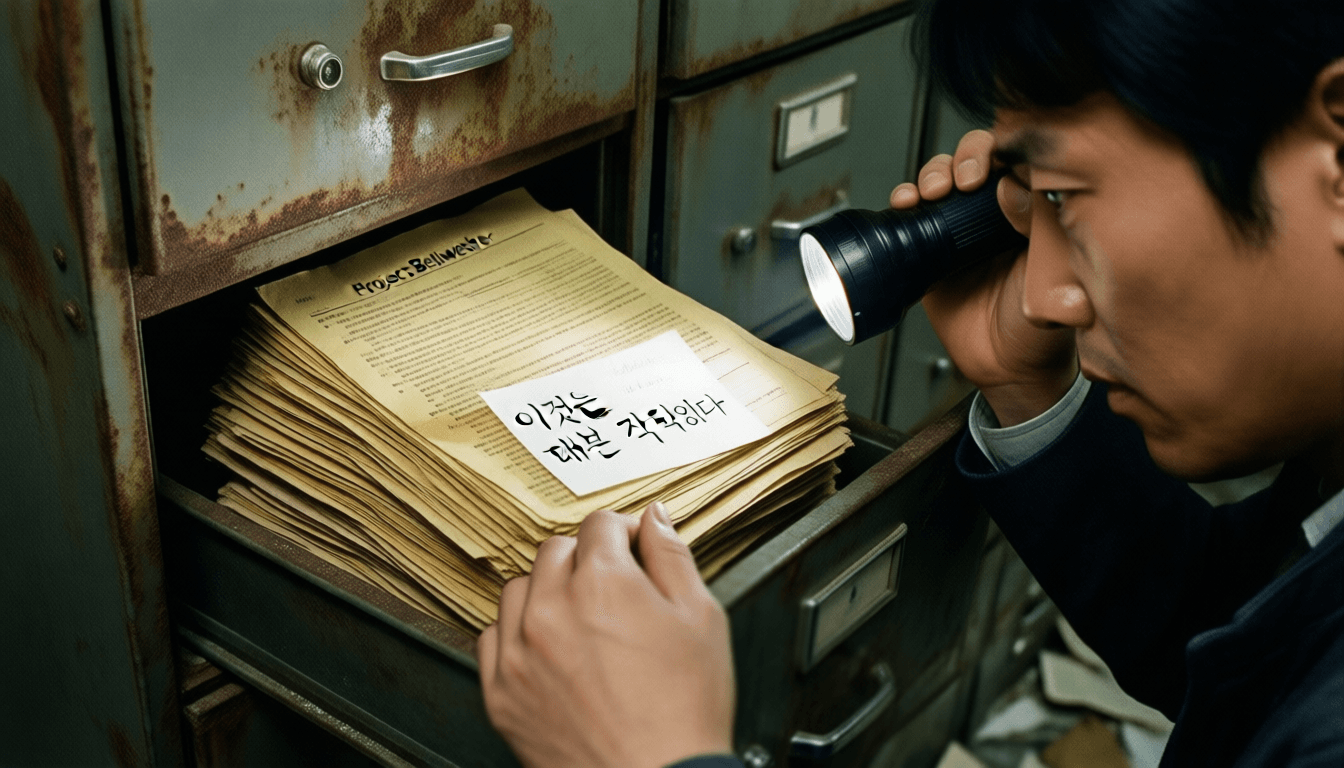
Prying open the rusted filing cabinet was a test of patience. Inside, amidst decades of mundane city council minutes and advertisements, I found three bound stacks of editorial notes labeled 'Project Bellwether.' These weren't drafts for print; they were the editor's personal research logs. As I delved deeper, the pattern grew more unsettling. There were typed documents comparing and analyzing major national news outlets' coverage of specific political events in the mid-1970s. Pages detailed instances where seemingly independent reports from even rival news agencies used identical, bizarrely specific tones—even particular adjectives—when describing the same event or figure. Entire paragraphs were highlighted, cross-referenced with underlined dates and source names. As my flashlight beam swept over an annotated article discussing a particular foreign policy decision, a handwritten marginal note caught my eye: "This isn't just framing. This is scripting."
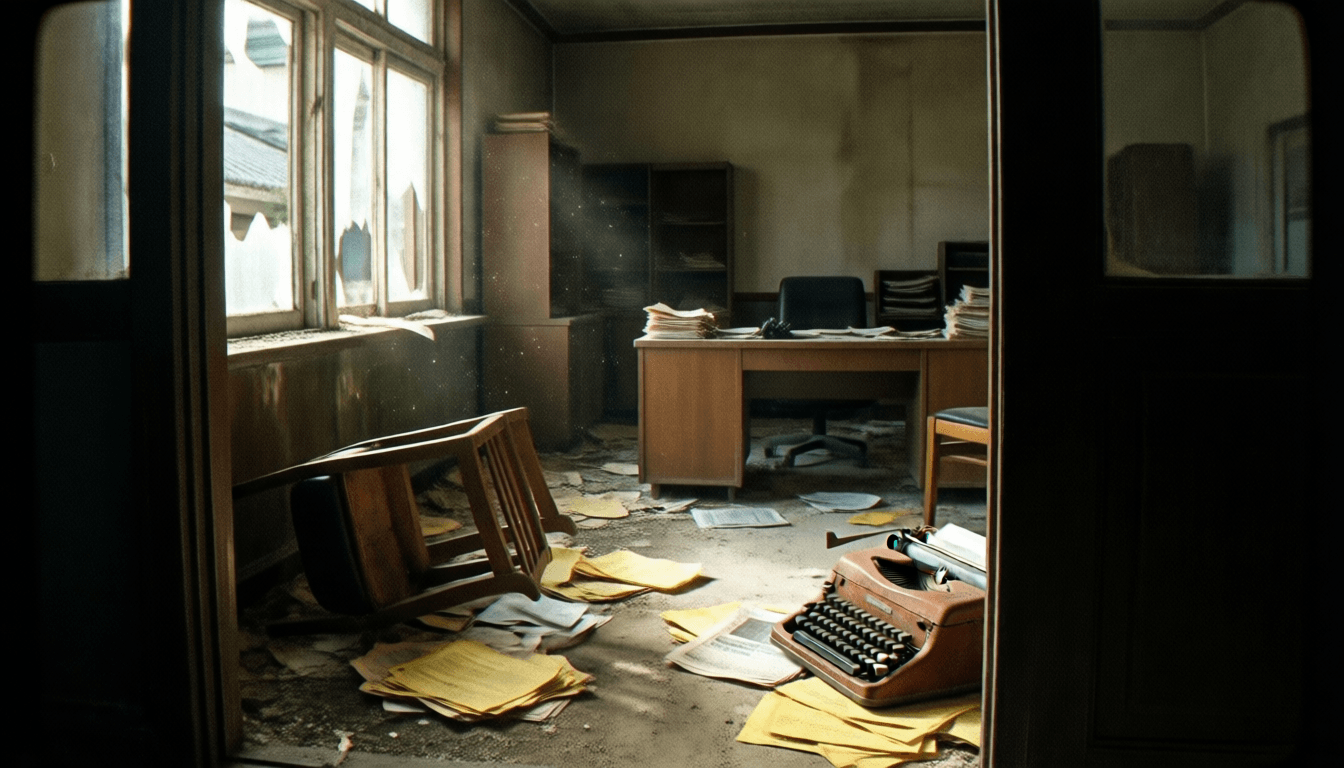
As I burrowed deeper into the files, the surroundings seemed to react subtly. A faint, almost subliminal hum began to emanate from the old, disconnected telephone line leading to the editor's desk. It wasn't electrical static; it was like blurry voices from a distance, below the threshold of comprehension, a murmuring of disembodied speech. I kept my digital recorder on, but later playback yielded only flat, featureless white noise. As I attempted to photograph a particularly damning page of comparison notes, the light from a long-dead, old fluorescent tube flickered once, briefly illuminating the room in a cold, sickly green before dying again, leaving me in deeper darkness than before. The deathly silence returned, heavy and oppressive. It was as if the building itself held its breath. The air grew noticeably colder, and I began to feel a distinct, prickling sensation at the back of my neck. It wasn't a physical presence, but an undeniable feeling of being observed by some unseen, pervasive mechanism.
I found it on the last page of the third booklet. Not quite a smoking gun, but a detailed, handwritten schematic. A network diagram of media outlets, academic institutions, and ostensibly innocuous public relations firms, all with interlocking board members and obscure funding sources, leading back to a single cryptic acronym and an offshore postbox. A master blueprint for narrative influence. The editor hadn't merely suspected; he had mapped the system.
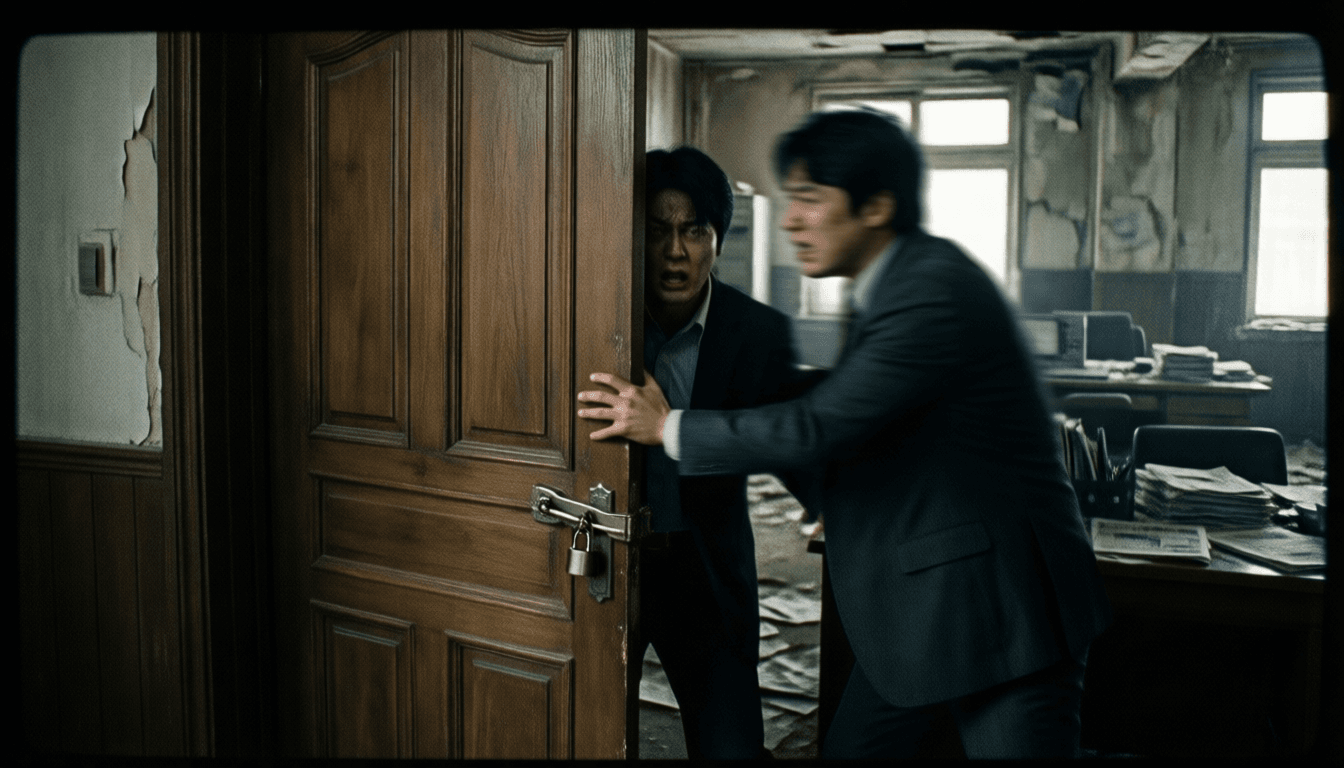
As my finger traced the intricate web, the room plunged into instantaneous, absolute darkness. It wasn't just the faint light from the window disappearing, but a complete, impenetrable void, as if every photon had been extinguished. The hum from the telephone line was no longer distant but immediate, transforming into a cacophony of jumbled, incomprehensible voices that filled my head, pressing against my eardrums and resonating in the too-still air. The heavy oak door, which I had propped open with a broken chair, slammed shut with a tremendous impact. The rusted latch clicked, impossibly loud, followed by the clunk of a second internal lock engaging. I was trapped.
A cold, sharp terror pierced through the noise. I rushed to the door, fumbling at the wood, straining. It was unyielding, locked tight. From the other side of the door came a faint, rhythmic thump-thump-thump. Not footsteps, but deliberate, heavy impacts, like a measured heartbeat. A low, resonant hum began to permeate the entire room. Coming from everywhere and nowhere simultaneously, it was a tangible pressure in my chest. My digital camera, which I had just used to photograph the schematic, didn't fall from my hand; it flew across the room, bouncing off the far wall and shattering. A sudden, sharp pain lanced into my hand. A burning heat spread across my palm and up my arm, though I had touched nothing. The air itself seemed to congeal around me, heavy and suffocating, making it hard to breathe. The voices grew louder, becoming a chaotic wave of noise that threatened to swallow me whole. This wasn't frayed wiring or the settling of an old building. This was deliberate, active suppression. The silence of the abandoned office had been a deceptive cloak, and now the system within it was closing in.
I don't remember the exact sequence of my escape. The details are fragmented: a desperate scramble across the printing room, the discovery of a loose cellar door hidden amidst debris, a frantic crawl through a narrow, dark tunnel smelling of earth and pungent chemicals. I emerged into the pre-dawn air behind the building, covered in dirt, my palms still stinging with the acrid burn.
The few photos I managed to take before the camera shattered are saved on a backup drive. Most are rough, distorted images of yellowed paper, but the last few, containing the network schematic, are subtly corrupted. Lines are blurred, names pixelated, and some connections seem to unravel into meaningless static. The entire image, once so clear in my mind, is now an abstract jumble with critical pieces missing. The voices from the office are gone, yet a persistent low-frequency ringing remains in my ears like a phantom sound, making even quiet spaces feel oppressive.
Now, whenever I read major news reports, especially those phrased with concise, unambiguous language, a chill runs down my spine. I see the pattern everywhere: the consensus, the narrative cohesion, the specific phrases that seem to echo across different media outlets. It’s not tangible proof, but a feeling. A deep, unsettling intuition that the hum from the old telephone line never stopped, that the system isn't just out there, but always adjusting, always whispering, all around us. The silence of that abandoned office wasn't empty; it was filled with a deafening hum of control, a frequency I can now almost perceive. And sometimes, late at night, I feel the faint, phantom warmth of the burn left on my palm. A chilling reminder that some truths are not meant to be uncovered, and the architects are still building.

[ CLASSIFIED VERDICT ]
[ACCESS LOG - SOURCE FILE]
This story draws inspiration from the long-standing conspiracy theory that media can be manipulated or controlled by external forces. It specifically builds on urban legends where independent news outlets are mysteriously silenced when they attempt to uncover inconvenient truths, hinting at a vast underlying system. Historical references like the 'Church Committee Report' lend a chilling layer of reality to these suspicions.