The Oak Ridge Beta Deficit: What Lurks Beneath Building 9204
Among the declassified records of the Manhattan Project lies an indelible blank space that nuclear physicists refer to as the 'Beta Deficit.' Between October 1944 and June of the following year, the Y-12 National Security Complex in Oak Ridge, Tennessee, operated 1,152 calutron mass spectrometers around the clock to enrich uranium for the Hiroshima bomb. The balance sheet (Form MD-402) compiled right before the war's end recorded a discrepancy of exactly 4.12 kilograms. The Department of War quietly closed the matter, attributing it to mere rinse residue clinging to interior wash pipes. However, a handwritten memorandum dated August 14, 1945—mistakenly uploaded to the Department of Energy's residue remediation database in October 2019 and purged within forty-eight hours—pointed toward a far more unsettling truth.
"The product from Track 4 never reached the wash basins. It seeped through floor fractures in Building 9204-1 straight into the underground sump pit. It is not inert. It is actively absorbing pipe sludge and gaining mass. It does not respond to hydrostatic pressure; pumping is impossible. I have sealed the bulkhead with an eighteen-inch-thick lead-bismuth alloy. Do not drill. Do not ventilate. It draws surrounding ambient heat toward itself." Attached to the leaked memo was a single grainy photograph revealing silver-white slurry climbing vertically 'against gravity' up a concrete bulkhead stamped with the seal of the Manhattan Engineer District.
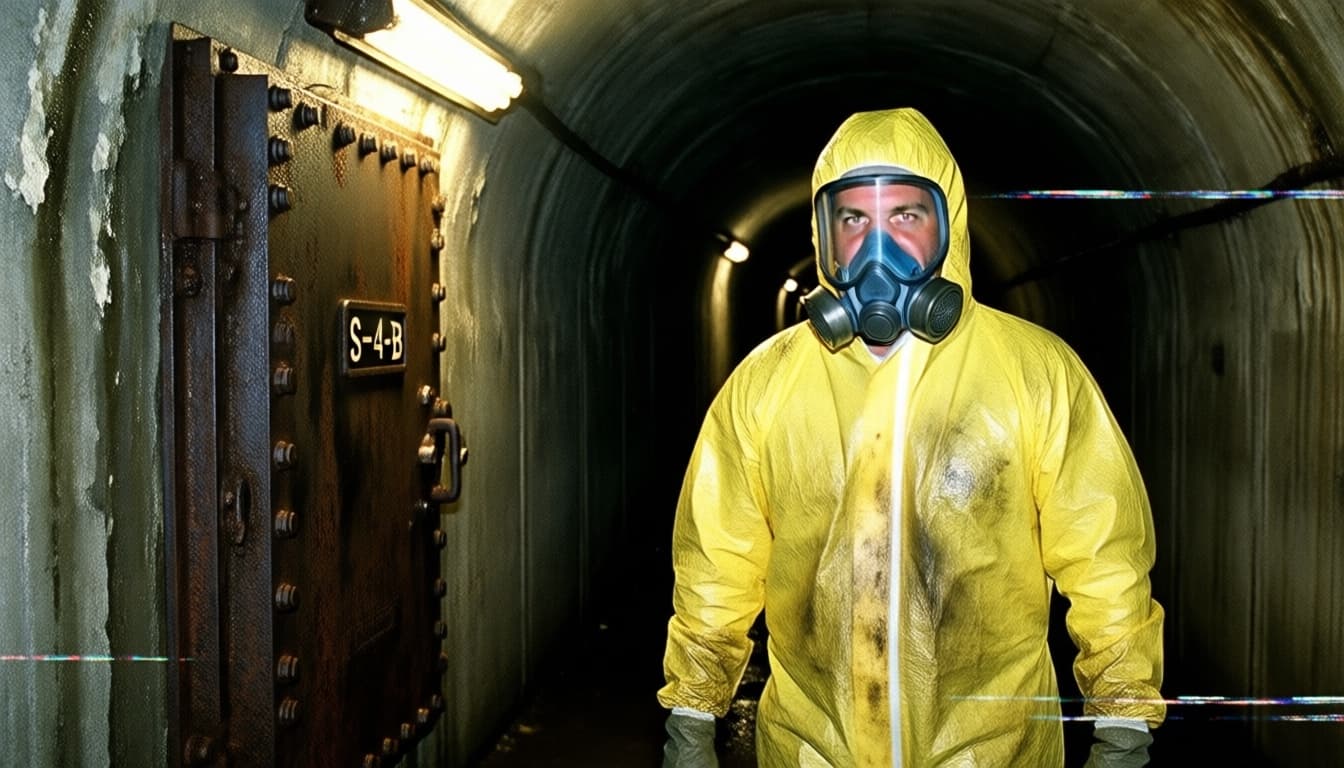
In late autumn of 2021, health physicist Ellis Burns was assigned to conduct a preliminary gamma survey before injecting cement grout into the Cold War subterranean structure to seal it permanently. His mission was to non-destructively measure radiation levels in the pipe gallery running twenty-five meters beneath the demolished calutron site. The stale stench of seventy-year-old lime powder, damp lead shavings, and a coppery metallic taste like sucking on copper coins penetrated the particulate filters of his respirator. Walking along an unmapped blind culvert, Burns halted before a reinforced steel bulkhead labeled 'Hatch S-4-B.' Two of the eight one-inch hexagonal bolts had sheared outward, violently twisted as if forced by immense internal hydraulic pressure.
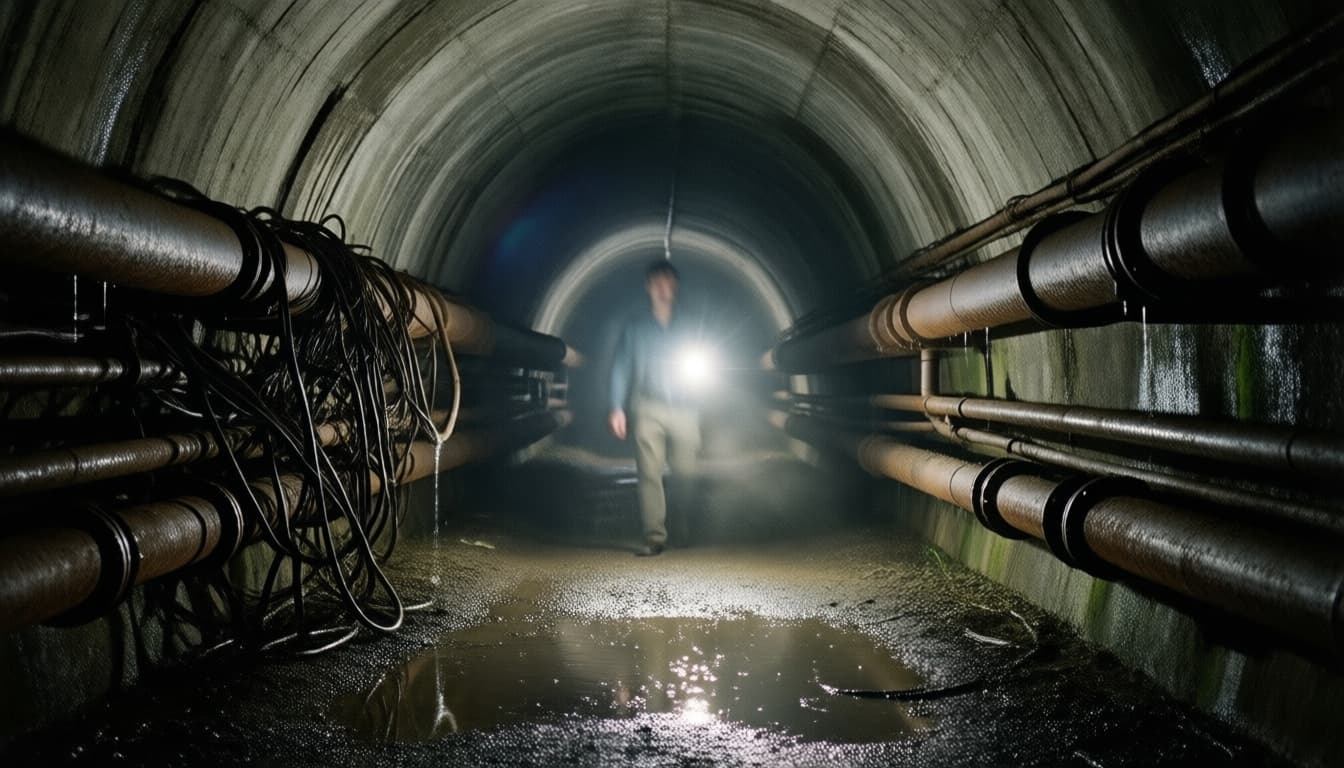
To check the interior moisture conditions, Burns tapped the steel plate lightly with a brass drift punch. No echo returned. Only after three agonizing seconds did a heavy, muffled metallic resonance rise—not from the hatch, but from deep within the concrete floor beneath his boots. The unnatural delay made the hair on his neck bristle. With trembling hands, he cracked the inspection plug half a turn. Instead of trapped volatile gases venting out, a violent vacuum hissed, ravenously sucking in outside air. Yet his vane anemometer stubbornly read zero. It was not pulling air. It was swallowing temperature. The tunnel atmosphere of eighteen degrees Celsius plummeted instantly below freezing. Condensation on Burns's face visor froze into dendritic frost needles that pointed directly toward the hatch gap.
Burns thrust the scintillation probe of his survey meter into the icy gap. Instead of spiking from the natural background baseline of twelve counts per minute, the digital display collapsed to an impossible '0'. The device had not malfunctioned; even the circuit's internal thermal resistance had fallen completely silent. Whatever lay beyond was not emitting radiation—it was devouring and erasing the background radioactivity inherent to the earth itself.
To prevent an underground steam explosion during grout injection, visual confirmation of the bulkhead was mandatory. The moment Burns backed out the remaining top bolts with a pneumatic wrench, the multi-ton steel door did not fall forward. It collapsed straight downward, swallowed vertically into a fissure in the floor slab. Simultaneously, the immense negative pressure reversed, vomiting forth an oily, foul-smelling black slurry. It was neither water nor crude oil; it was a gelatinous morass of concentrated uranyl nitrate, liquefied lead shielding, and heavy motor oils that had fermented in darkness since 1945. The liquid rose to Burns's thighs in seconds.
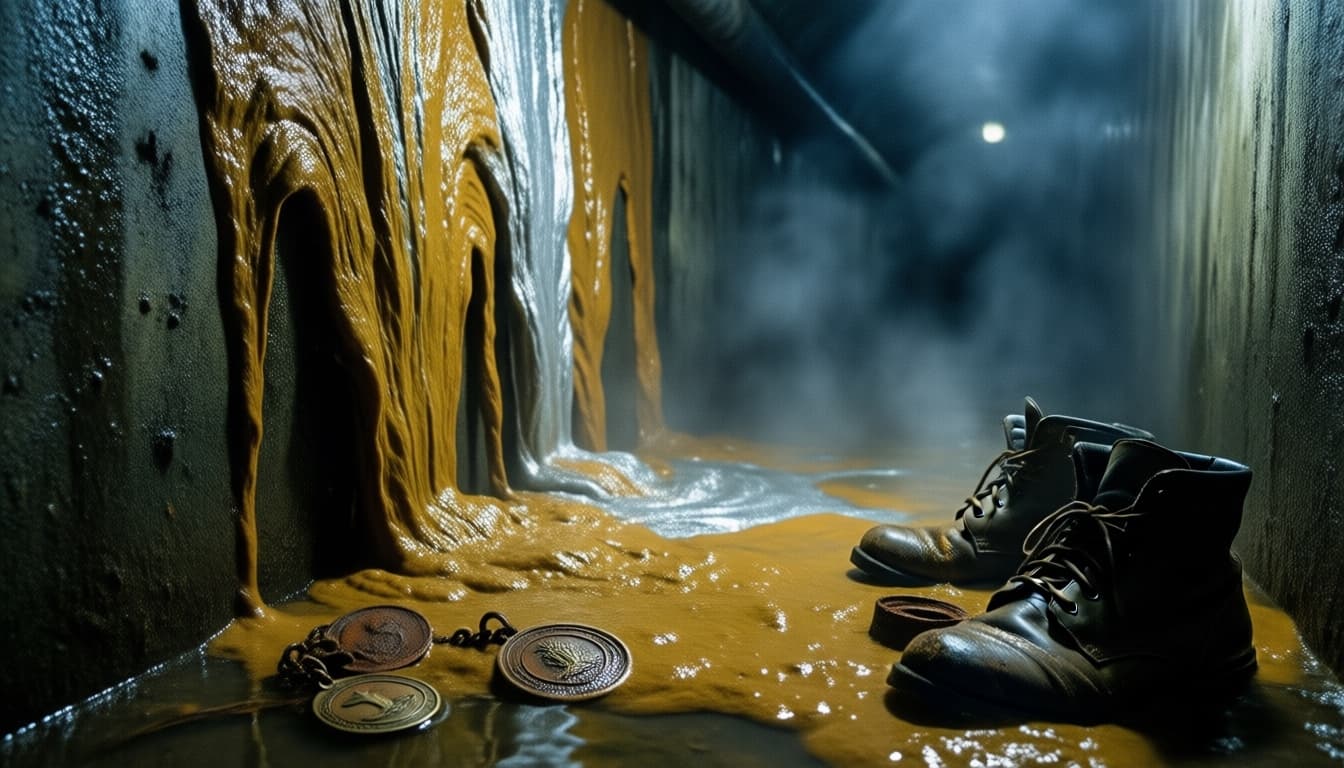
The fluid did not drain into floor sumps. Defying surface tension, it crawled up the ribbed concrete walls in veins that flickered with sickening crimson and cerulean sheen. The amalgam fillings in Burns's teeth throbbed with blinding neural agony. Looking down, he realized that what gripped his ankles was no simple fluid. Suspended within the viscous, amber-tinged uranium slurry were rotten leather boot soles, corroded brass identification badges, and the pulverized skeletal remains of two workers entombed in 1940s canvas dust suits. The fluid shifted the articulated bones like a purposeful organism, its crest rising toward the lithium battery pack strapped to Burns's chest.
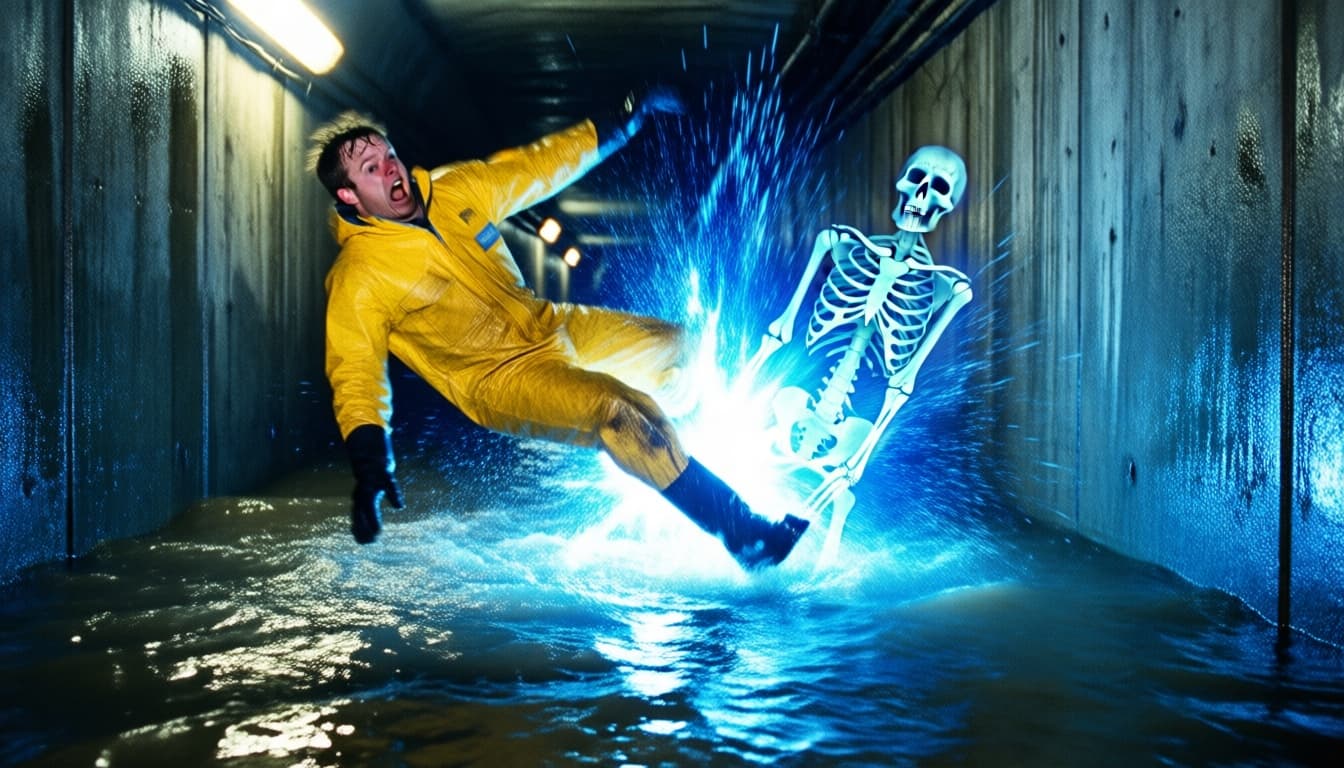
Before he could scramble back, a thick tendril of the mass struck his left shin. There was no blunt trauma. Instead, an agonizing burst of blinding blue Cherenkov radiation flared through his flesh and leather boot, casting the radiographic silhouettes of his leg bones sharp against the tunnel walls. It was an atrocious heat—not flame, but instantaneous microwave gamma and beta radiation severing molecular bonds at the cellular level. Suffocated by panic, he could not even scream. Driven by pure instinct, he smashed the hardened housing of his ground-penetrating radar into the hyper-dense sludge coiled around his limb.
With a sickening tear of flesh, Burns tore his leg free and hurled himself up the emergency escape ladder. His severed boot and suit trousers dissolved instantaneously into the muck below. His left leg dangled completely numb, an icy dead weight. Scrambling through the surface manhole, he threw all his weight onto the heavy steel cover. Clang! The lid shut. Exactly three seconds later, something wet, heavy, and vicious slammed against the underside of the iron plate.
The accident never appeared in any official environmental remediation report. The Department of Energy field office issued an expedited stop-work order citing 'unanticipated groundwater ingress and ground subsidence risks.' Within thirty-six hours, concrete pump trucks entombed the entire gallery under three thousand tons of high-early-strength expanding concrete. Burns's radiological credentials were quietly revoked. He was transferred to a secure naval hospital ward in Bethesda, Maryland, isolated under the diagnosis of 'severe industrial chemical burns.'
The medical chart hidden from Burns contained an incomprehensible pathology: his left tibia had not decayed or fractured. Through an unidentified isotopic substitution, all calcium had been leached out, converting his bone into an ultra-fine, porous vitreous matrix. There was no gangrene, nor did healthy tissue regenerate. Regardless of ambient room temperature, the leg permanently registered an icy 6.6 degrees Celsius.
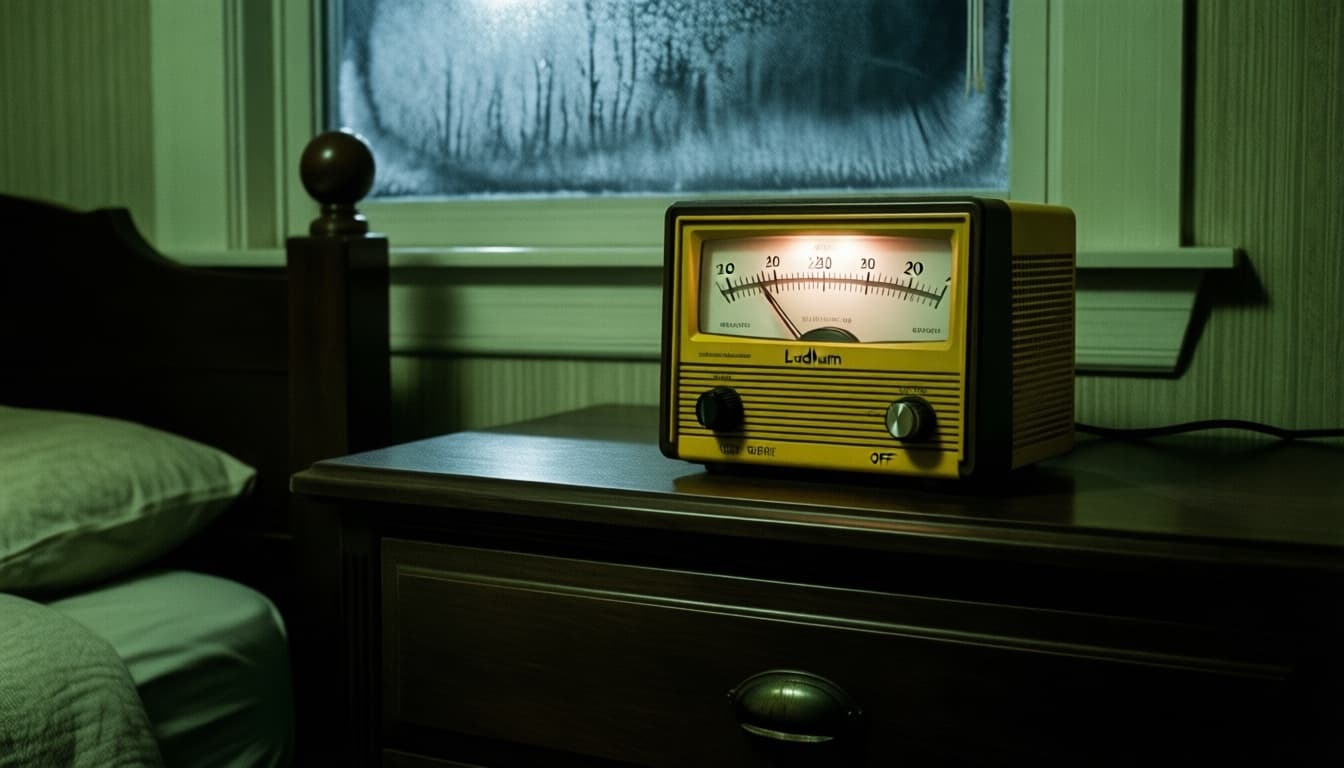
Today, Burns resides in a nondescript Knoxville apartment thirty kilometers east of Oak Ridge. Atop his hallway cabinet sits an obsolete Ludlum Model 3 survey meter he managed to keep. Its power toggle remains switched permanently off. Yet every morning at precisely 2:15 AM—the graveyard shift change at the wartime calutrons—the instrument's speaker stirs to life. Instead of random radiation clicks, it hums with a steady, high-tension electronic drone. And until 2:18 AM, the needle of the unpowered meter slowly creeps backwards, recharging itself on the cold, dark air of the room.
[ CLASSIFIED VERDICT ]
[ACCESS LOG - SOURCE FILE]
This story is inspired by historical discrepancies and unaccounted-for enriched uranium losses recorded at the Oak Ridge Y-12 Complex during the Manhattan Project. It weaves real Cold War secrecy with urban legends surrounding predatory radioactive waste accumulation in abandoned subterranean drainage vaults.