The Hydraulic Seal of Oak Island Lot 18
Hydrological Survey Report 'Memorandum No. 44-B', drafted in 1988 by the Nova Scotia Department of Mines, was permanently destroyed without explanation in the provincial archives in 1994. At the time, engineers had injected fluorescent dye into the drainage channels of Smith's Cove on Oak Island to trace seawater flow, but the dye never rose up the vertical shafts during high tide. Four minutes before peak high tide, underground water-level gauges recorded a violent reverse-siphon event that vastly exceeded theoretical calculations. This was no crude pirate booby trap. It was the intake valve of a colossal hydraulic apparatus designed to harness tidal pressure differentials to swallow thousands of gallons of seawater per minute. An unyielding subterranean flood-control mechanism engineered before the 18th century was still operating on its own.
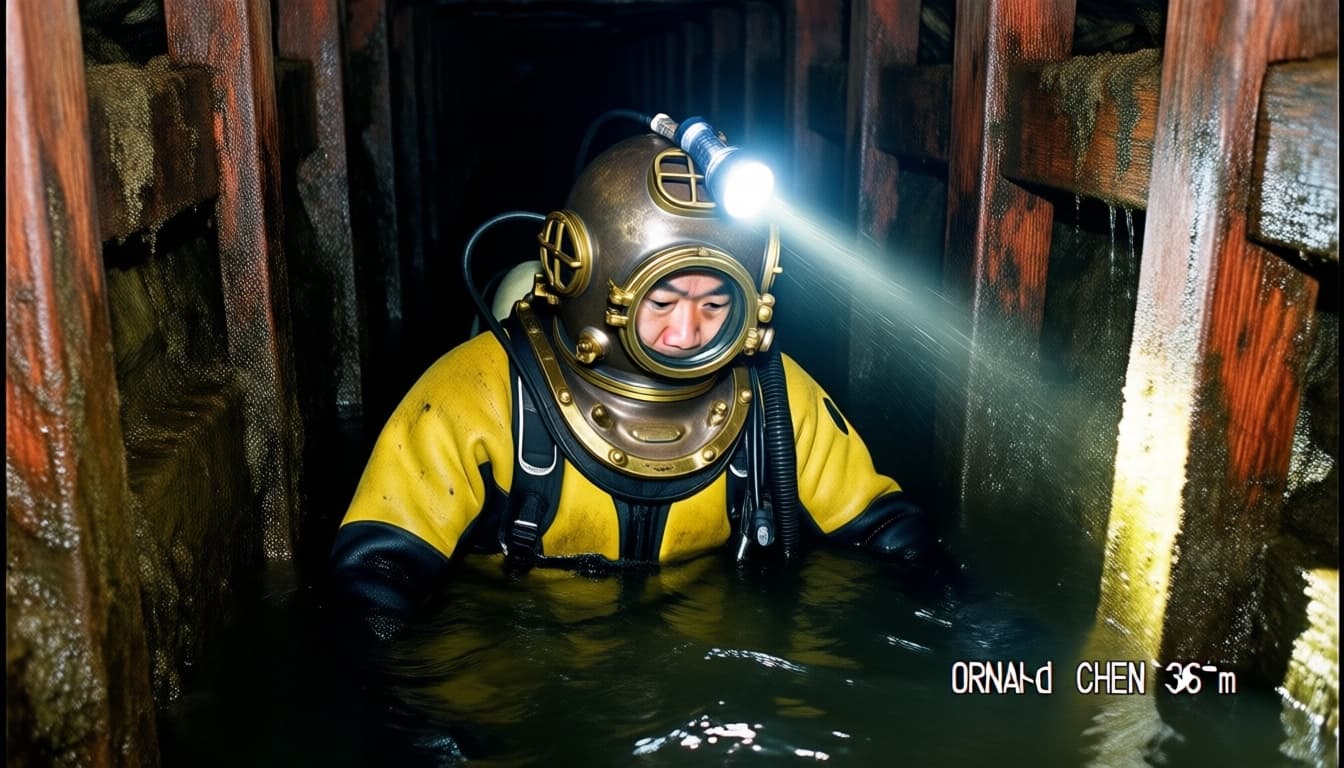
In mid-November, beneath the brittle glaze of early winter frost and only after all commercial film crews and treasure-hunting teams had vacated the island, an unofficial survey began. Ronald Chen, a deep-sea saturation diver and hydraulic surveyor contracted by a private historical trust, squeezed his body into a 36-inch steel caisson secretly sunk into Lot 18. Descending 48 meters underground, the rhythmic thrum of surface diesel pumps vibrated through the steel pipe into the marrow of his bones.
At the bottom edge of the caisson, the texture of the air changed entirely. Every breath dragged deep into his lungs the stench of ancient tidal mud, rotting peat, and thick whale oil slathered across heavy timber joints. Square-hewn red oak beams were fitted with masterfully crafted mortise-and-tenon joinery—free of a single iron nail—and remained as solid as fresh timber, defying three centuries within the 3-degree Celsius, hypersaline, anoxic muck. His exhaled breath froze into pale clouds wherever the helmet-mounted halogen light cut through the dark.
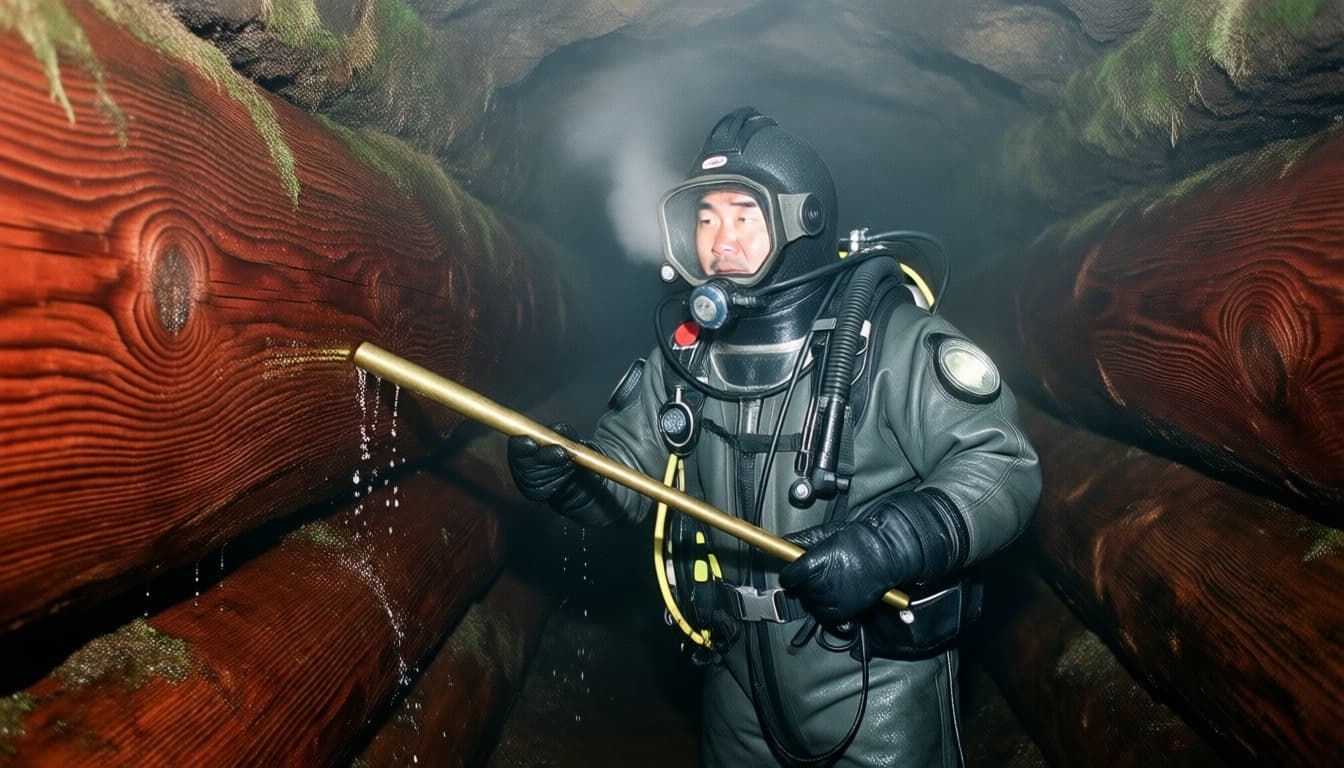
Chen struck the oak wall with a brass acoustic sounding rod. Clang. Instead of reverberating down the shaft, the crisp metallic ping vanished into nothingness. Exactly three seconds later, the faint echo bounced back not from beneath his boots, but from the dense limestone bedrock directly above his head. The acoustic geometry and physical volume defied standard subterranean engineering.
The eerie dissonance turned into certainty at a slate sluice gate wedged into a bedrock fissure. Seawater droplets seeping from the rock fracture did not fall downward. They slid horizontally across the red oak lintel, tracing unnatural paths as though a bronze grating mounted on the side wall were drinking the moisture. His handheld digital manometer plunged by exactly five millibars every two minutes. It was as if an invisible, colossal lung were methodically inhaling the air from a hidden vault below.
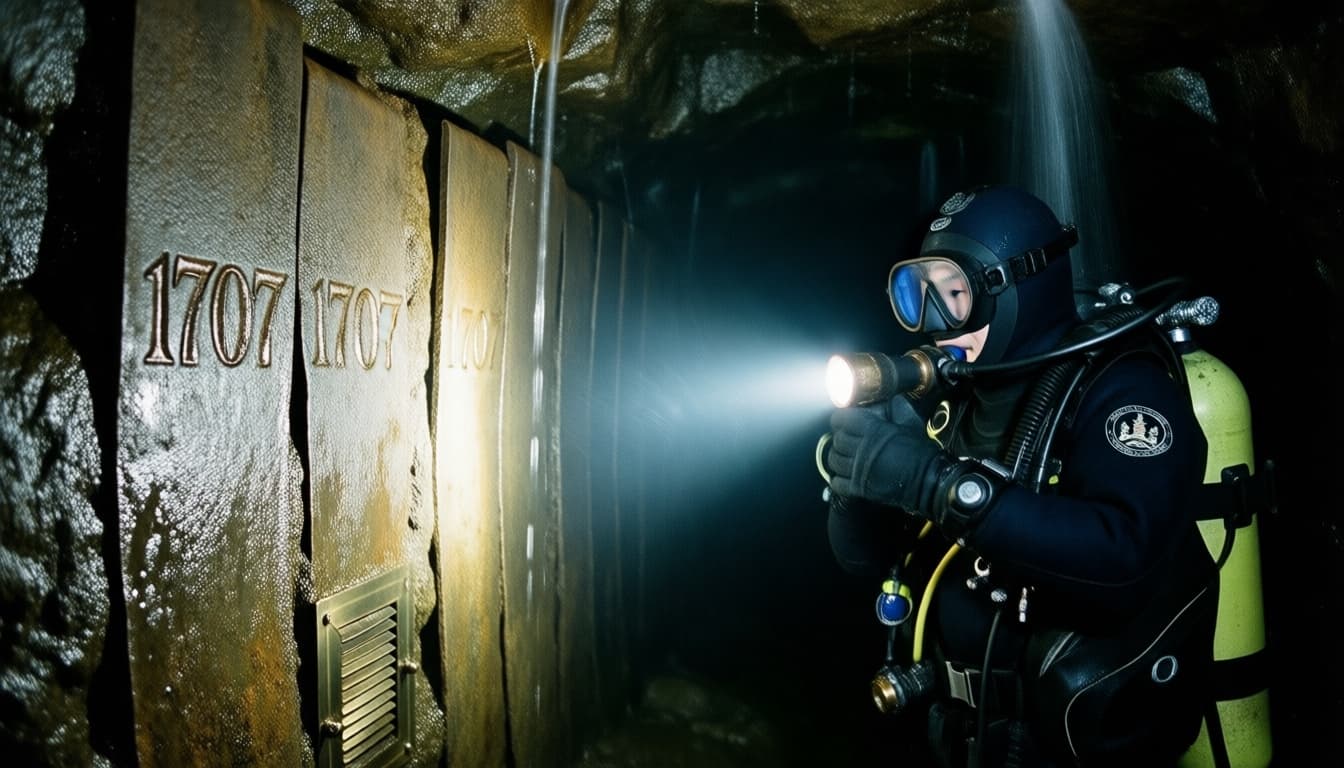
Chen’s gloved fingertips froze against the wall. Embedded in the pitch-black darkness was neither pirate gold nor jewel-laden chests. Massive lead plates hermetically sealed the entirety of the stone face, each surface stamped cleanly with the year 1707 and the Royal Ordnance Broad Arrow insignia. This excavation had never been a vault to hide plunder. It was an imperial containment chamber—built with the highest engineering prowess of the British Empire—to submerge and entomb forever something unearthed in the deep limestone caverns that should never have seen the light of day.
Beneath his boots, a packed layer of coconut fiber and slaked lime yielded. The floor sagged by barely an inch, and then—CLACK. A dull, mechanical shockwave hammered his eardrums as a colossal stone counterweight dislodged deep within the timber skeleton.
The distant hum of the surface diesel pumps cut out like a severed scream. What followed was not a simple flood. The slate flagstones beneath his feet split outward, opening downward into an abyss that birthed an unfathomable vacuum. Millions of gallons of churning seawater began to waterfall into the void.
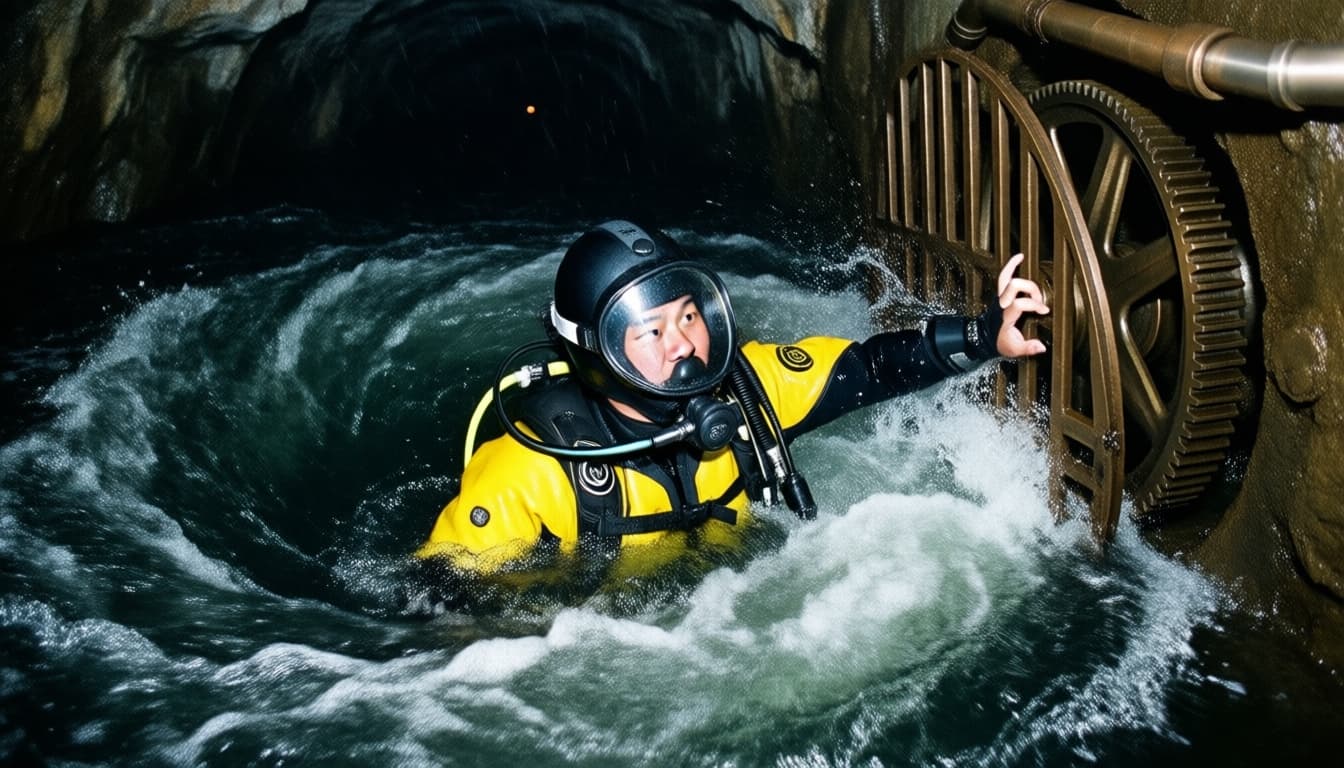
Chen was violently dragged under. His safety line snapped with a gunshot-like crack beneath the weight of hundreds of tons of hydrostatic pressure. In the churning, mud-blinded deluge against his visor, Chen's chest slammed against a massive bronze grate at the lower drainage sluice. Through his fogged faceplate, a grotesque sight materialized. Immense cast-iron cogwheels, preserved without a fleck of rust under coats of thick whale oil, were turning with terrifying precision, powered by the sheer mass of falling seawater. Jammed between the churning bronze teeth was no 18th-century skeleton, but a modern steel drill casing left behind by a 1971 expedition—crushed and mangled like tinfoil.
With his ribs cracking under unbearable pressure, Chen reached with numbed fingers and yanked the emergency high-pressure inflator lever on his drysuit. The suit ballooned violently, tearing him from the maw of the vacuum. Jagged slate edges shredded the neoprene and his flesh, but the sudden buoyancy propelled him upward through the surging vortex.
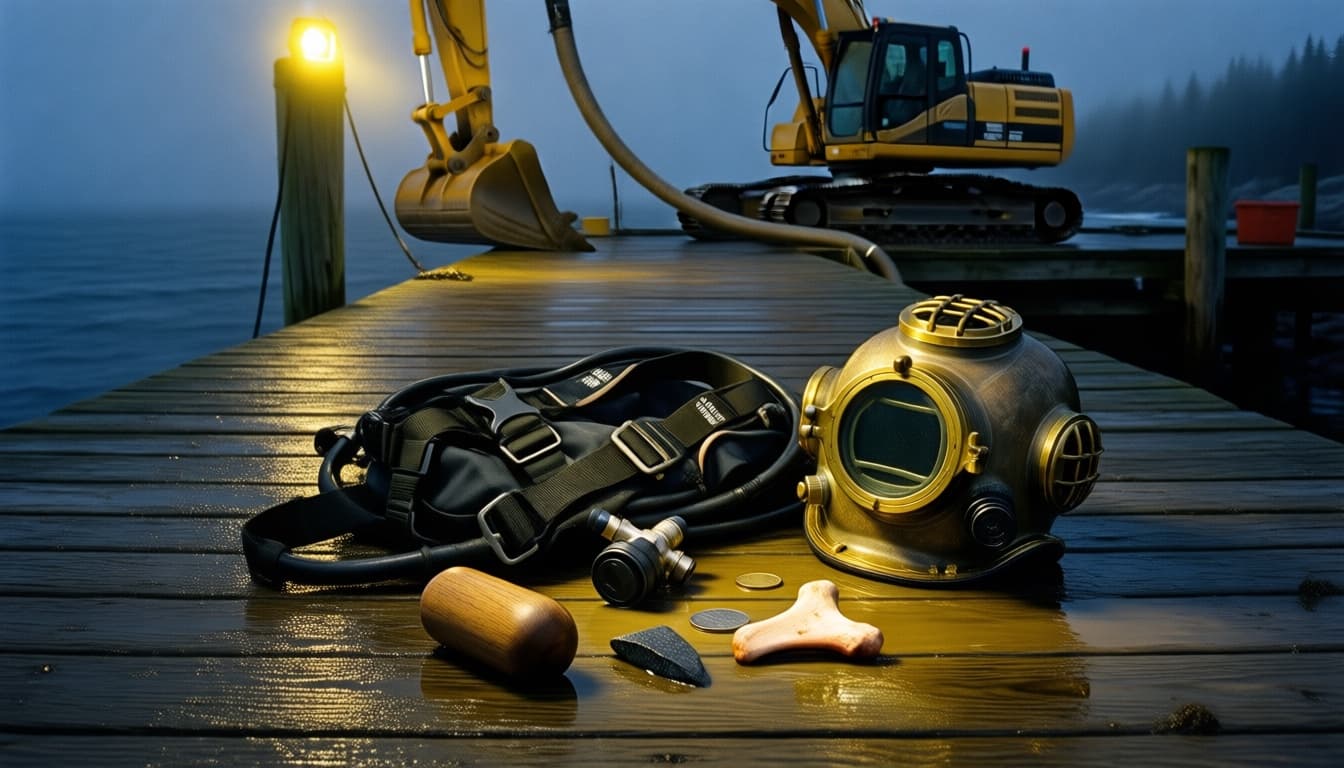
Chen was hauled to the surface in the recovery cage with a ruptured left eardrum and three broken ribs. Tangled inside his regulator exhaust valve were a water-smoothed oak peg rounded like river gravel by centuries of high-velocity currents, a flint shard, and a human pelvic fragment worn down to the size of a coin. That very night, the trust ordered 400 tons of fast-setting bentonite slurry pumped directly into Lot 18, sealing the shaft permanently and dismissing the incident as a mechanical equipment failure.
Recovered from Chen’s harness was an autonomous low-frequency acoustic recorder that had captured the event underwater. At the end of the audio track, once the roar of rushing water was filtered out, a rhythmic metallic sound echoed from deep within the bedrock once every 24 seconds: the heavy, leaden fall of a cast-iron check valve. Thud-clack. Waiting for the next tidal surge to fill the chamber, the machine's heart was still beating.
[ CLASSIFIED VERDICT ]
[ACCESS LOG - SOURCE FILE]
The 'Money Pit' on Oak Island, Nova Scotia, is a centuries-old mystery site that has defeated countless treasure hunters with its intricate booby-trapped flood tunnels and layers of imported coconut fiber. While popular legends attribute the underground maze to pirate treasure or the Knights Templar, persistent urban legends suggest that the complex subterranean hydraulic structure was actually designed as an imperial containment trap to perpetually flood and bury something dangerous.