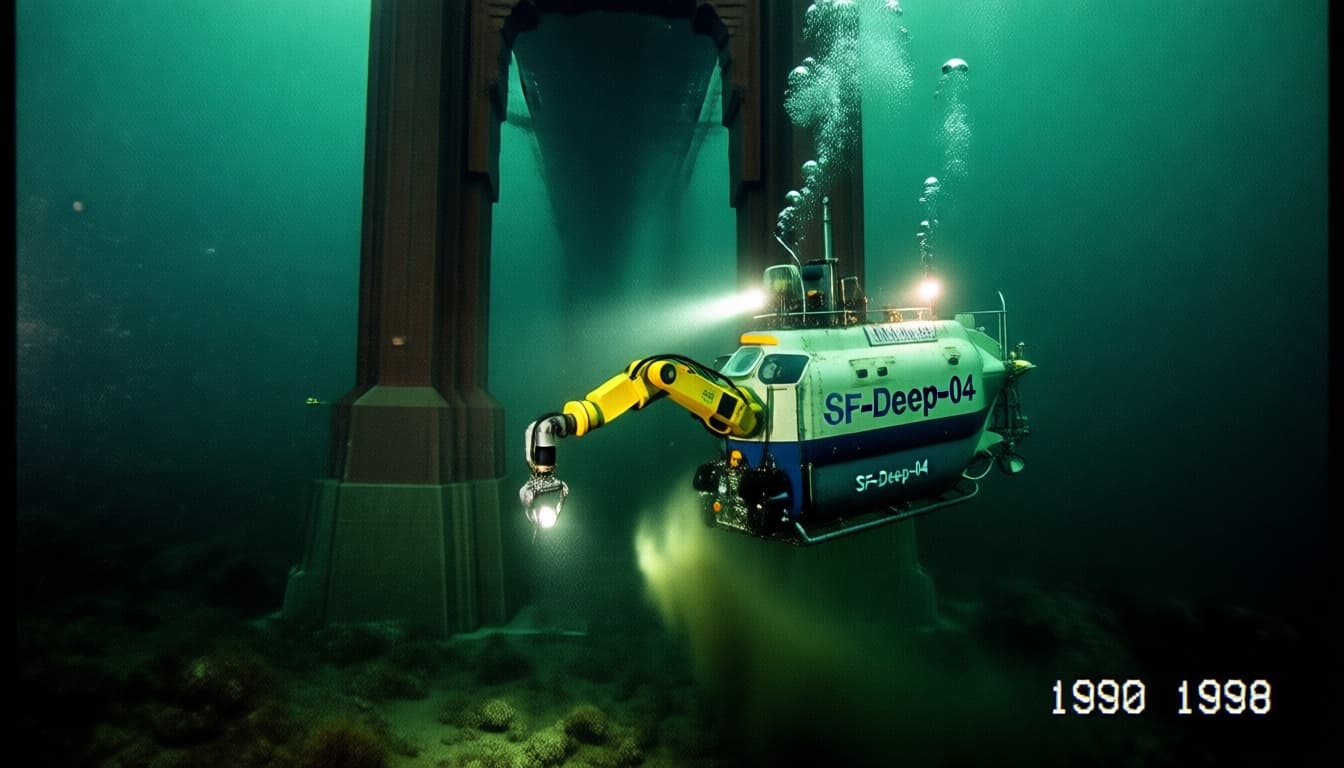
The Nine-Hertz Ghost Hull Beneath the Golden Gate Bridge
At 3:00 AM on October 14, 1998, an anomalous acoustic waveform was recorded by NOAA hydrophone SF-04, anchored 97 meters deep near the southern pier of the Golden Gate Bridge in San Francisco. It was neither an earthquake nor the sound of tectonic faulting. It was a rhythmic, mechanical cavitation noise pulsing at exactly 9 Hertz (Hz), characteristic of a colossal multi-cylinder marine engine driving thousands of tons of displacement through deep water. Yet, maritime logs confirmed that not a single vessel had entered or departed the bay at that hour. Since the 1940s, local crab fishermen and commercial salvage divers had whispered rumors of a 'rusted hull' resting beneath the harbor's anti-submarine nets, but the U.S. Navy consistently dismissed these accounts as topographic turbulence caused by extreme tidal shear. That official silence held firm until a modern bathymetric survey, conducted ahead of seismic retrofitting on the bridge pylons, revealed a freshly gouged 70-meter-wide cylindrical trench sliced cleanly into the granite bedrock—a trench that had not existed in scans taken merely three weeks prior.
Marine acoustic investigator Marcus Vance descended into the pitch-black channel aboard an atmospheric research submersible during a brief 40-minute slack tide. Each time the deadweight of forty thousand vehicles crossed the Golden Gate Bridge high above, the heavy, metallic friction resonated through the seawater, vibrating straight into his skull. Past a depth of 85 meters, the submersible’s halogen floodlights scattered uselessly against thick, suspended silt, swallowed by an oil-slick darkness. Hydrostatic pressure outside the hull had already surpassed 120 pounds per square inch, rendering the view beyond the narrow acrylic viewport a freezing, turbid soup utterly devoid of organic life.
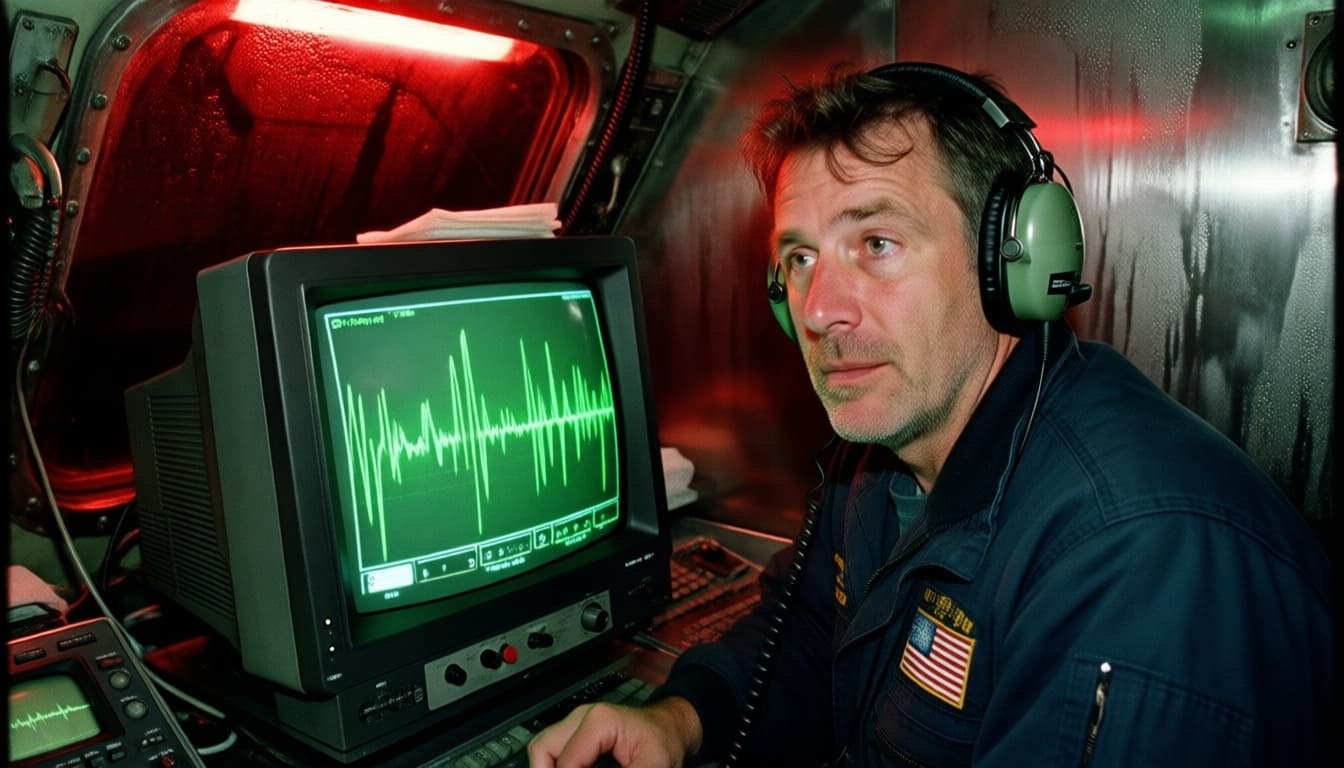
Vance engaged the directional high-frequency sonar toward the crushed bedrock fissure. But the returning acoustic signal warped erratically through the cabin speakers. Sound waves that should have bounced instantly off solid shale were somehow caught and dragged, returning with an abnormal five-second delay. The fundamental physics of underwater acoustic velocity—normally 1,500 meters per second—were being violently distorted. Vance's fingers stiffened as he worked the diagnostic console.
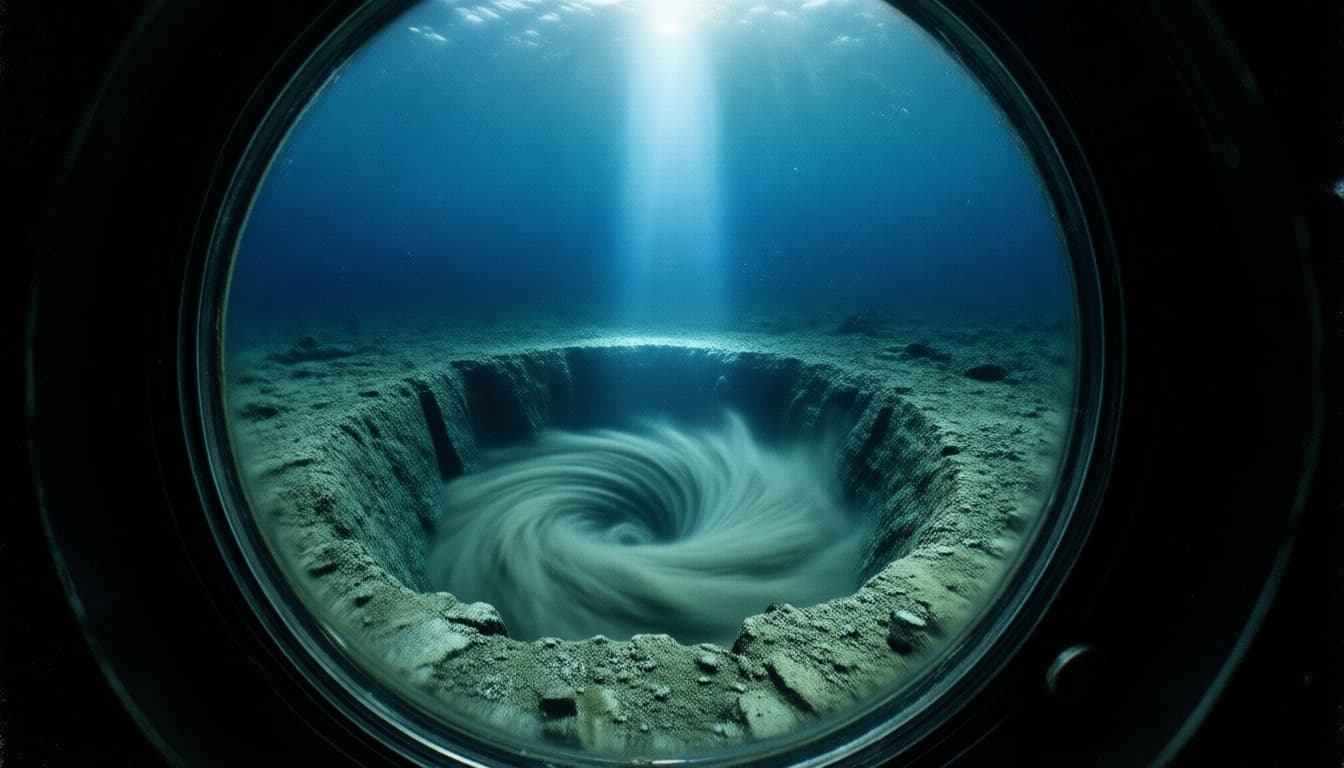
The anomaly was not merely digital. Just beyond the acrylic viewport, the chaotic drift of black sediment suddenly halted. Caught within the fierce tidal cross-current, the suspended grains hung frozen in mid-water, only to begin spiraling downward in a tight, unnatural vortex against the natural flow of the tide. Inside the submersible, despite the heating system running at maximum draw, the external temperature gauge plummeted to -1.6 degrees Celsius, causing thick white frost to bloom across the interior steel retaining ring of the observation port.
It was not the sonar gear that broke the silence. Transmitted straight through two inches of rolled armor steel, a low-frequency shudder climbed through the floor plates directly into the crew's ribcages: a rhythmic thud-grate-hum. The pressure wave matched the exact 9-Hertz signature preserved in NOAA's 1998 archives. The needle on the ballast depth gauge swung erratically. Without producing a single ripple on the surface above, the entire water column overhead was being violently compressed by an impossible mass.
Fifteen minutes of slack tide remained on the dive schedule. Yet the sea floor’s bottom current was ripped apart in a violent convulsion that tilted the submersible forty degrees downward. Tearing through the blinding wall of silt just six meters ahead, it was not a granite wall that emerged. It was a towering, curving iron hull blackened by sulfides and suffocated in rotten tube-worm colonies. It was sliding against the six-knot undertow at catastrophic speed. There was no propeller wash, no wake, no engine exhaust. Instead of displacing water and muck, the surrounding fluid was being pulled inward, collapsing against its flanks into a crushing void.
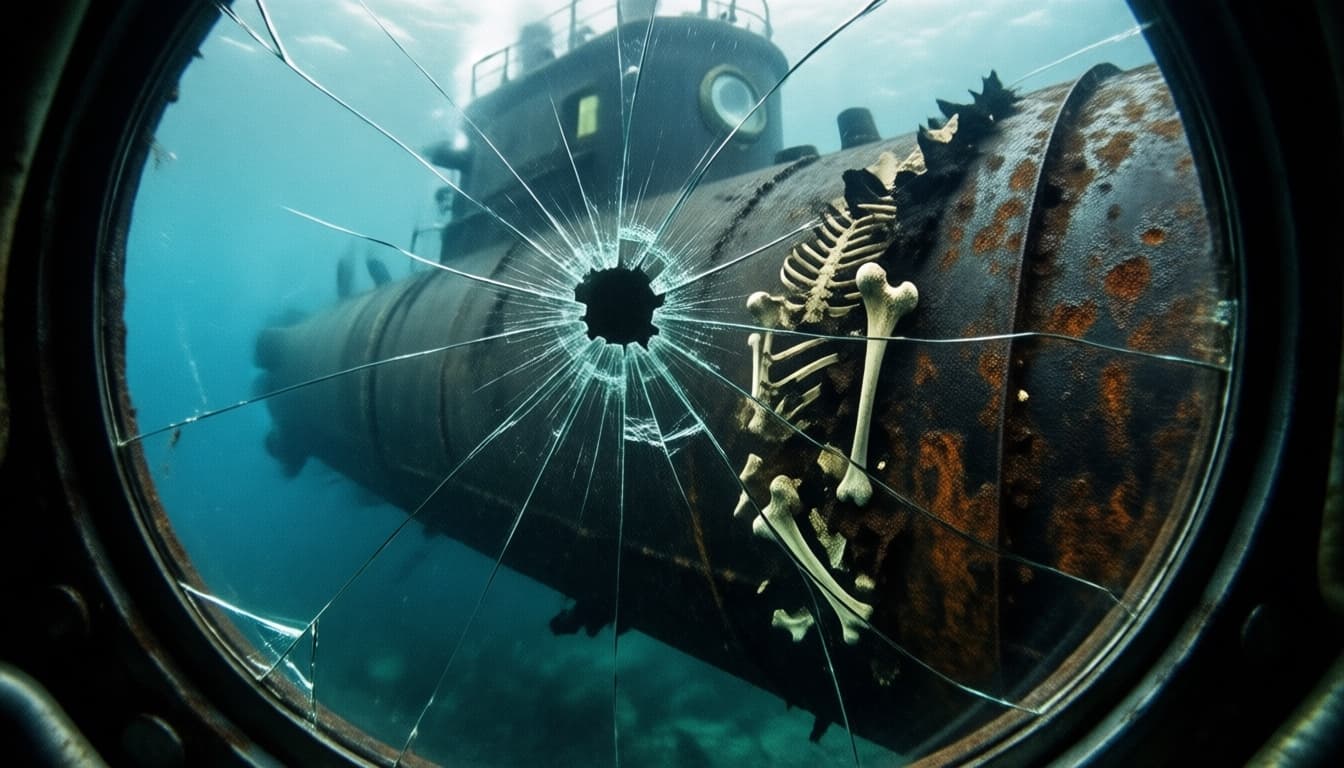
The submersible’s umbilical tether was caught in the anomalous slipstream. The steel-braided line wedged violently between the submerged bedrock and the monolithic hull, slamming the research craft broadside into the moving behemoth. With a deafening, bone-shattering screech of shearing metal, spiderweb fractures crawled across the acrylic viewport, and freezing seawater began hissing through the crushed gaskets in high-pressure needles.
Through the splintering glass, merely inches from his face, Vance stared directly at the hull's jagged skin. These were not the rivets or weld seams of any conventional shipyard. Wedged tightly into the fractured steel plates, crushed and fused under decades of immense pressure, were countless fragments of human bone. There were no access hatches, no conning tower, no rudders. It was a blind, monolithic slab of compressed iron, radiating deafening infrasonic vibrations and pure mechanical violence.
The pilot, Keller, smashed the safety seal on the explosive bolts and yanked the emergency release. With a concussive pop, the umbilical severed and the emergency ballast bags inflated violently, yet the horrific negative pressure trailing the monstrous stern dragged the submersible back down toward the abyss. Amid the agonized buckling of titanium framing, the craft was violently spit from the creature's wake, tumbling toward the surface.
The submersible surfaced five kilometers west of the Golden Gate, drifting in open ocean swells. Keller had lost consciousness from the rapid pressure spike, while Vance was retrieved with ruptured eardrums and broken ribs. When salvage teams hoisted the vessel, the external sensor mount was found sliced clean through as if sheared by an industrial guillotine. Jammed within the buckled titanium frame was a twisted fragment of black metal torn from the colliding hull.
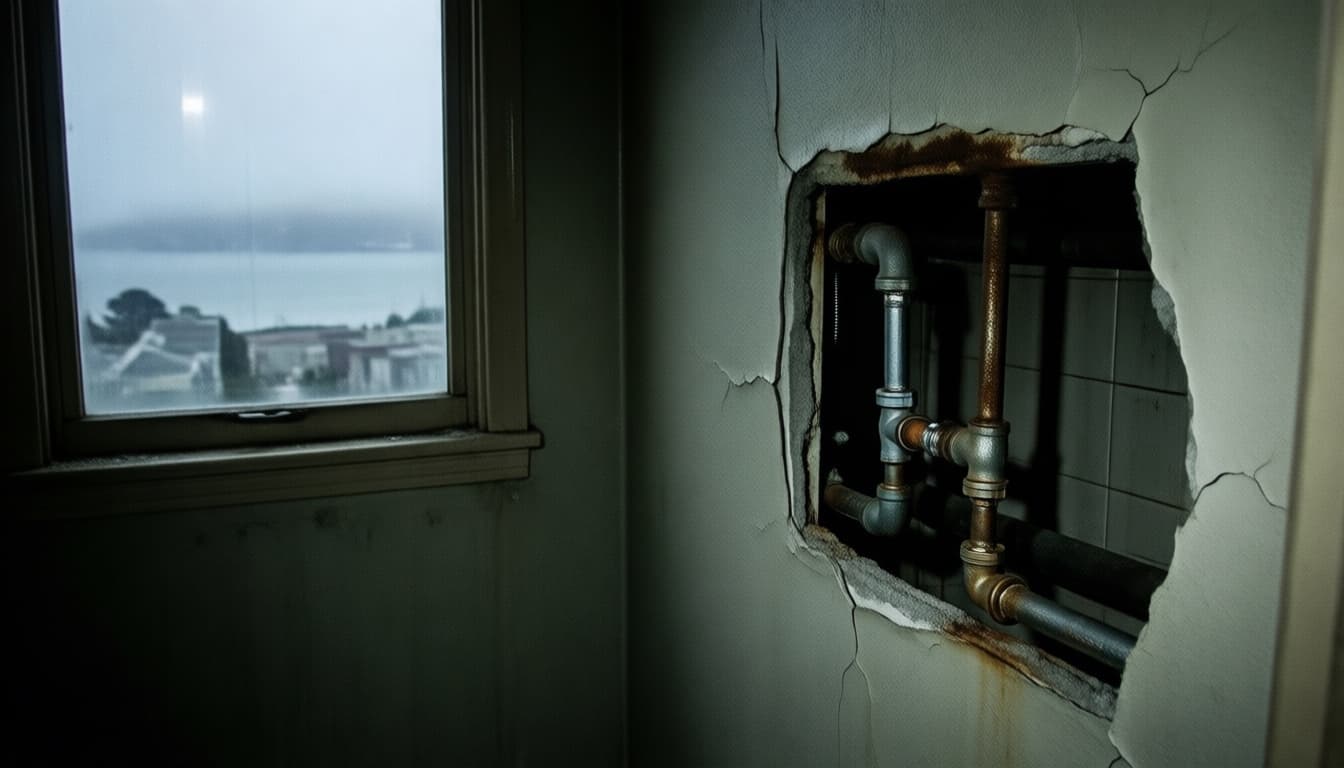
The subsequent spectroscopic analysis by the Naval Research Laboratory was classified under immediate national security orders. The core material was cryogenic-extruded steel, yet bound at the molecular level with high concentrations of biological carbon and deep-sea benthic organic deposits dating back twelve thousand years—a fusion impossible under any known metallurgical process. Following the incident, seismic reinforcement on the Golden Gate's southern foundation was sealed permanently without further excavation, and all dive logs were destroyed. Vance returned to his residence on the Presidio hills overlooking the bay, but sleep no longer comes during slack tide. In the quiet hours of dawn when municipal water pressure drops, the old cast-iron pipes running through his bathroom wall begin to vibrate with a dull, rhythmic resonance. It is not running water. It is a 9-Hertz grinding pulse, reverberating up through the granite bedrock, steadily closing the distance along the wet shoreline.
[ CLASSIFIED VERDICT ]
[ACCESS LOG - SOURCE FILE]
This story is inspired by real-world marine urban legends surrounding the fierce currents beneath San Francisco's Golden Gate Bridge, where NOAA hydrophones and Naval SOSUS arrays periodically record unidentified low-frequency mechanical hums. It blends tales of World War II anti-submarine defense nets with harbor conspiracies about ghost hulls and anomalous military salvage operations hidden in the bay's abyssal granite trenches.