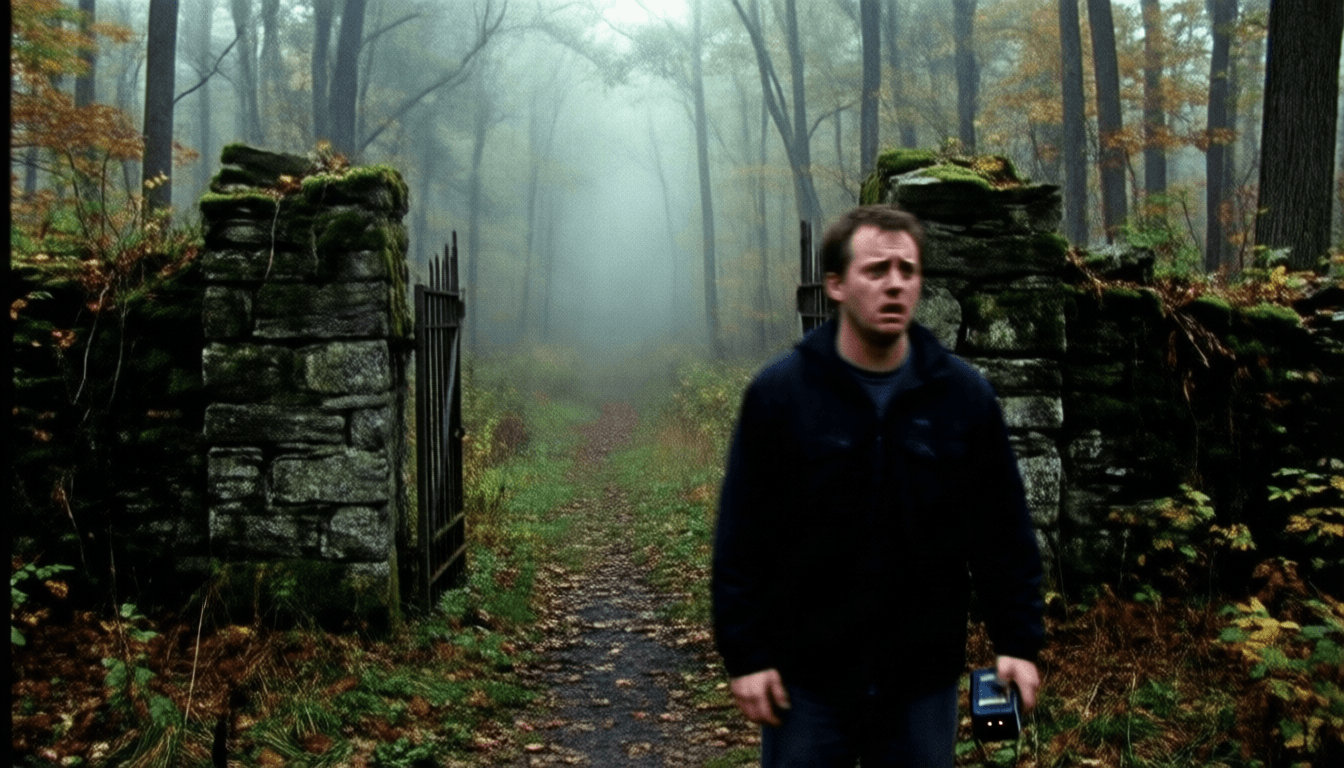
The Hessian's Trace: Terror of Sleepy Hollow
Community online forums in Sleepy Hollow and Tarrytown, New York, began filling with unsettling posts from late autumn. These weren't the usual ghost stories for tourists; they were firsthand, ominous experiences from residents. Initially, there were reports of inexplicable equestrian accidents. A top-tier show jumping horse was found disoriented and wandering in an unusual pasture, with a deep, precise wound on its flank. A local riding instructor's trail horse bolted without provocation and was later found trembling uncontrollably, despite no visible injuries. The common consensus among stable owners was that the horses weren't merely spooked; they were terrified to the point of extreme panic by some physical presence, a terror that left an indelible unease.
Then, disappearances began. Not widely reported cases, but quiet vanishings. An amateur historian who enjoyed solitary walks on historical trails never returned home. Weeks later, a seasoned long-distance runner, who had navigated the local woodlands expertly for years, was found unconscious near Patriot's Park. He claimed he was chased by 'something without a head' and 'hoofbeats like cannon fire.' While local authorities dismissed these incidents as unfortunate accidents or exposure-induced delirium, the whispers circulating in the community were clear: these incidents were concentrated around a lesser-known, deeply overgrown section of the old Albany Post Road, dubbed 'The Hessian's Trace.' This stretch, extending deep into the woods north of Sleepy Hollow Cemetery, was said to be the very path where the legendary Hessian mercenary took his fateful ride. Recent, all too specific and physical events were adding a chilling weight to this ancient tale, previously relegated to folklore.
For someone like me, who chronicles such phenomena, the transformation of a harmless myth into a tangible, terrifying reality was intriguing. I decided to focus on the last reported incident, the runner's chilling testimony. I located 'The Hessian's Trace' through old topographical maps and local rumors. The path was almost indistinguishable, choked by dense wilderness. As soon as I entered, the temperature was noticeably colder than the surrounding autumn woods, and the air was thick with the scent of damp earth and decaying leaves. The path itself was a faint trough, bordered by crumbling stone walls, half-swallowed by ivy.
I was equipped not for myth-chasing, but for data collection: a high-resolution camera, a thermal imager, a directional microphone, an EMF detector. Tools to record anything concrete, no matter how anomalous. The initial stretch of the Trace was silent. Almost eerily so. The rustle of my jacket and the crunch of my boots on fallen leaves sounded unnaturally loud. No bird calls, no distant vehicle hum. Only the profound, almost palpable silence of an ancient forest. The ground underfoot was soft in places, and despite recent dryness, some spots were damp, making an ominous squelching sound. Ancient trees lining the path stretched bare branches against the pale sky, adding to the sense of deep age and isolation. This was not a place for a casual stroll; it felt like stepping into a piece of an older, forgotten world.
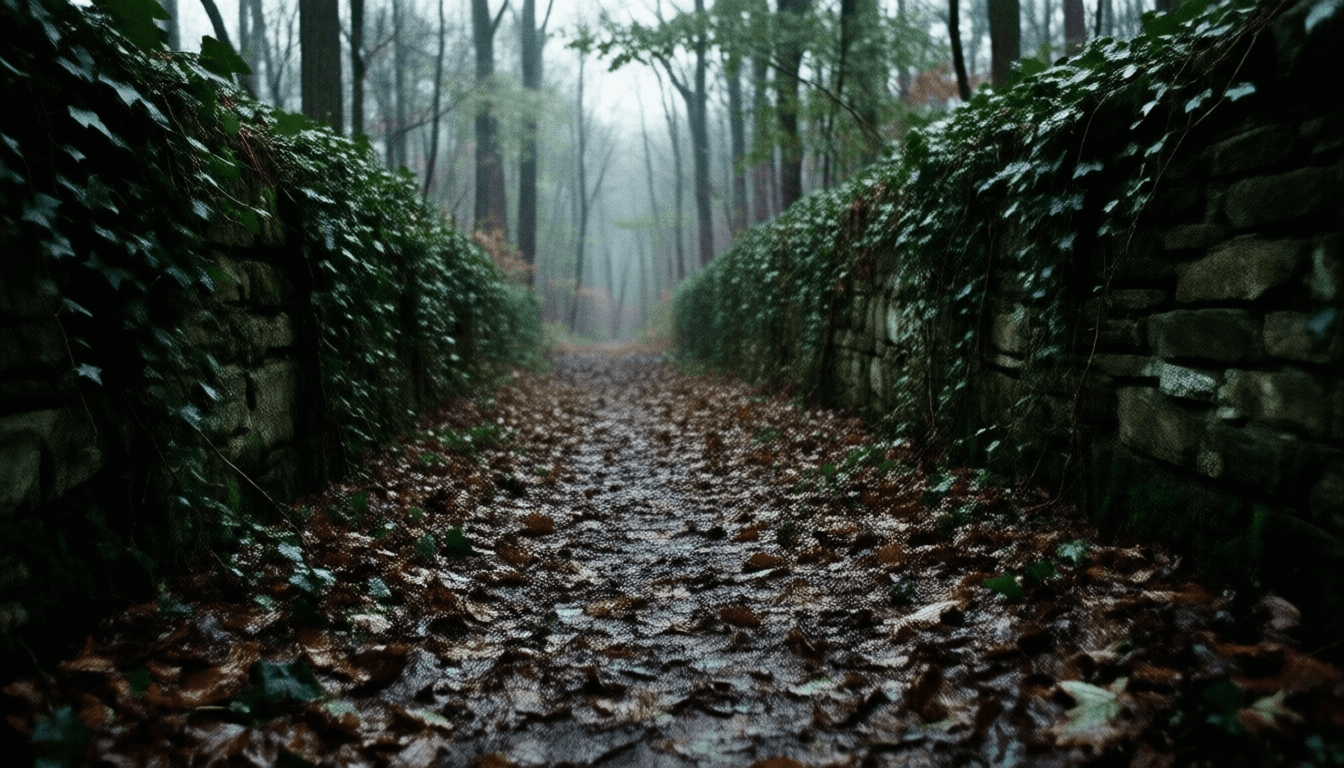
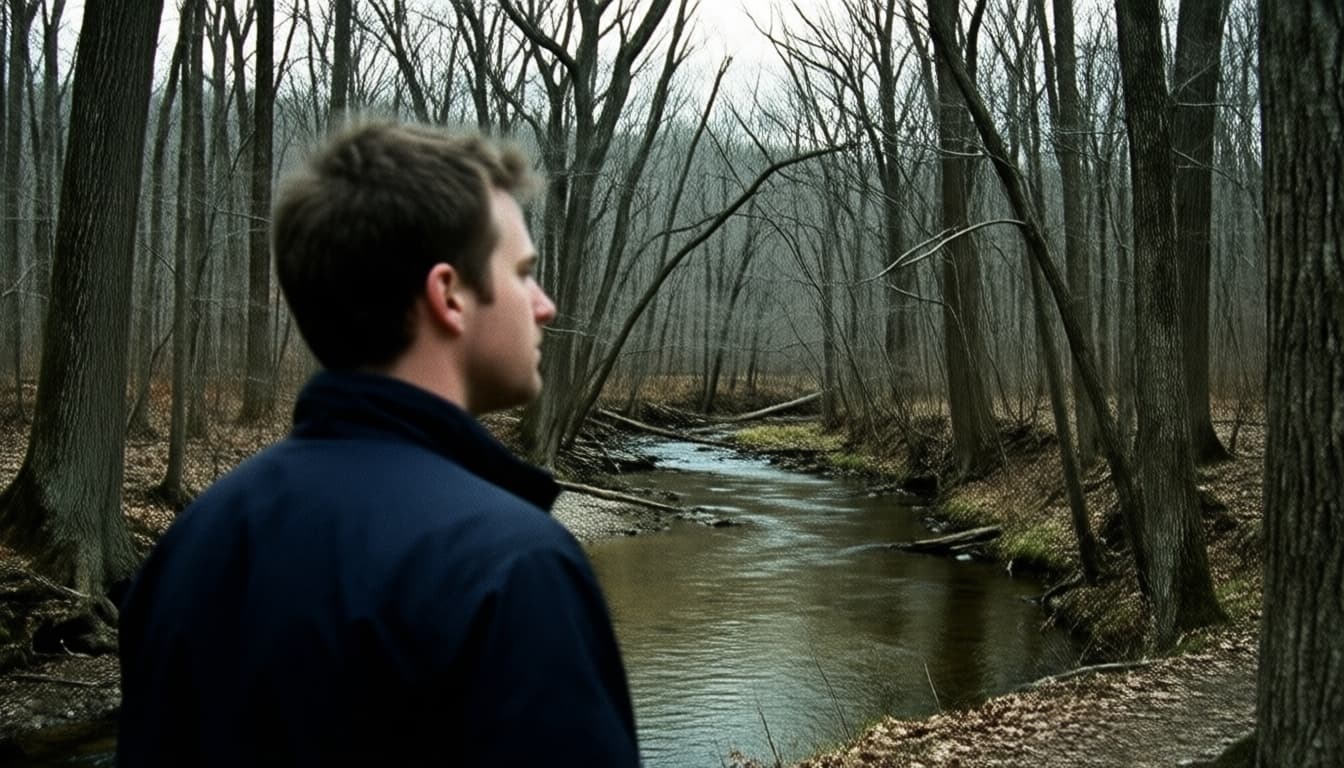
Deeper in, subtle environmental anomalies began to accumulate. A small stream, barely a trickle elsewhere in the woods, flowed along the Trace. Here, its surface was unnervingly still, almost viscous, reflecting the faint light with an odd, oily sheen. I dropped a fallen twig into the stream. Instead of being carried downstream by a barely perceptible current, it drifted erratically, even seeming to resist the flow for moments before finally moving slowly. The usually quiet EMF detector showed intermittent, erratic, and meaningless readings before suddenly flatlining.
The silence of the woods deepened to an unbearable extent. My own breathing sounded like gasps, and my heart hammered violently in the stillness. I stopped, straining to hear any sound beyond my own body. Then I heard it. A low, resonant thump-thump-thump. Deep and rhythmic. It seemed to emanate from all directions at once, too heavy to be natural. It lasted for a few seconds, then vanished, leaving an even profounder silence in its wake. I checked my audio recorder; it had only registered static during that time.
A localized cold enveloped me. A sharp, biting chill, completely out of proportion with the ambient temperature. It pierced through my insulated jacket, raising goosebumps on my skin, then vanished as quickly as it appeared. Even in the faint afternoon light, shadows lengthened and deepened unnaturally fast, twisting into ominous forms. The air grew heavier, denser, pressing against my eardrums. I tried to rationalize: temperature inversion, auditory hallucination, electromagnetic interference. But the accumulating phenomena instilled a primal, animalistic sense of dread. A rustle of a squirrel, the snap of a twig—any natural sound would have been a comfort. Instead, the complete absence of life became the most terrifying presence. And then, far off, deep within the brush, a low, guttural whinny echoed. Unlike any horse sound I had ever heard. Too long, too unnatural.
I reached an ancient, crumbling stone bridge, almost obscured by moss and encroaching roots, barely recognizable. This was likely the significant landmark from the runner's testimony. The thick, localized fog that had gathered in pockets throughout the woods now swirled densely, obscuring my vision. The thumping returned. Closer now, and clearer. Not just a thump. Distinct, ponderous thump-thump-thump. Unmistakable hoofbeats. Growing louder and faster, approaching from the obscured path ahead.
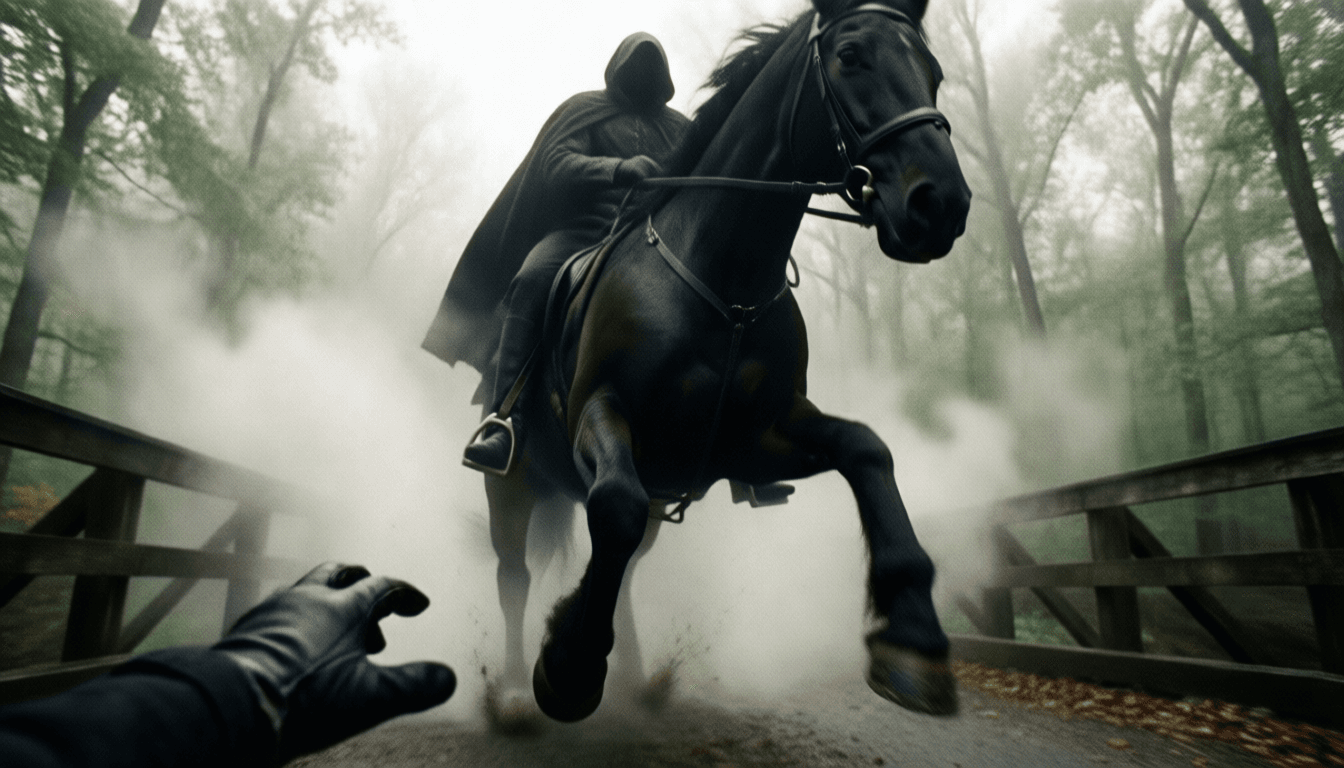
My reason screamed, but my body responded with pure, paralyzing terror. Out of the swirling mist, an enormous, impossibly black horse materialized. Its coat was like obsidian, seemingly absorbing even the faint light that pierced through the fog. The figure astride it was cloaked and hunched, but the most horrifying detail was the absolute absence where a head should be. No shadowed face, no obscured head. Just a grotesque void, a negative space that drew the eye and repulsed the stomach.
The horse moved with an impossible, ominous grace. At a distance, its approach was preternaturally quiet, drawing nearer like a colossal shadow. But as it closed in, the hoofbeats escalated into an ear-splitting, bone-jarring thunder, vibrating through the very earth. The surrounding trees, I swear, seemed to stretch and distort, reaching out like skeletal fingers. The ground beneath my feet felt unstable, shifting and pulling, actively hindering my escape.
The rider was not merely passing by. Its trajectory was precise and unwavering. It was aimed at me. A sudden, unnatural gust of wind, seeming to originate not from the air but from the rider's charge, threw me off balance. I slipped and fell onto the damp earth. The horse was upon me in an instant. This was no spectral passage. This was physical impact. The horse's immense flank slammed into my side, cold as graveyard earth, a raw, percussive pain radiating through my body. I felt a bone-deep chill at the point of impact, a profound cold that seemed to penetrate cloth and flesh.
As I lay disoriented and gasping, the rider's 'head'—that chilling void—craned downward towards me with a deliberate, predatory motion. It wasn't searching for a head. It was seeking contact, an horrific act of possession. A gaunt, unnaturally pale and aged gloved hand extended, fingers splayed, grasping. I instinctively rolled and scrambled into the dense undergrowth. The horse thundered past, its momentum carrying it over the bridge, but then it wheeled around, the relentless hoofbeats circling, growing closer again. The chilling, guttural whinny echoed once more. This time, it seemed a blend of triumph and ancient, insatiable hunger. I wasn't witnessing a ghost. I was its prey.
I don't remember how I got out of the Trace. Fragmented memories surface: clawing through thorny bushes, falling into shallow, icy ravines, the constant, echoing hoofbeats fading as I stumbled out, bloody and disoriented, onto a logging road miles from where I'd entered. Just before dawn, I staggered out of the woods hours later, covered in mud, scratches, and a pervasive, unnatural cold.
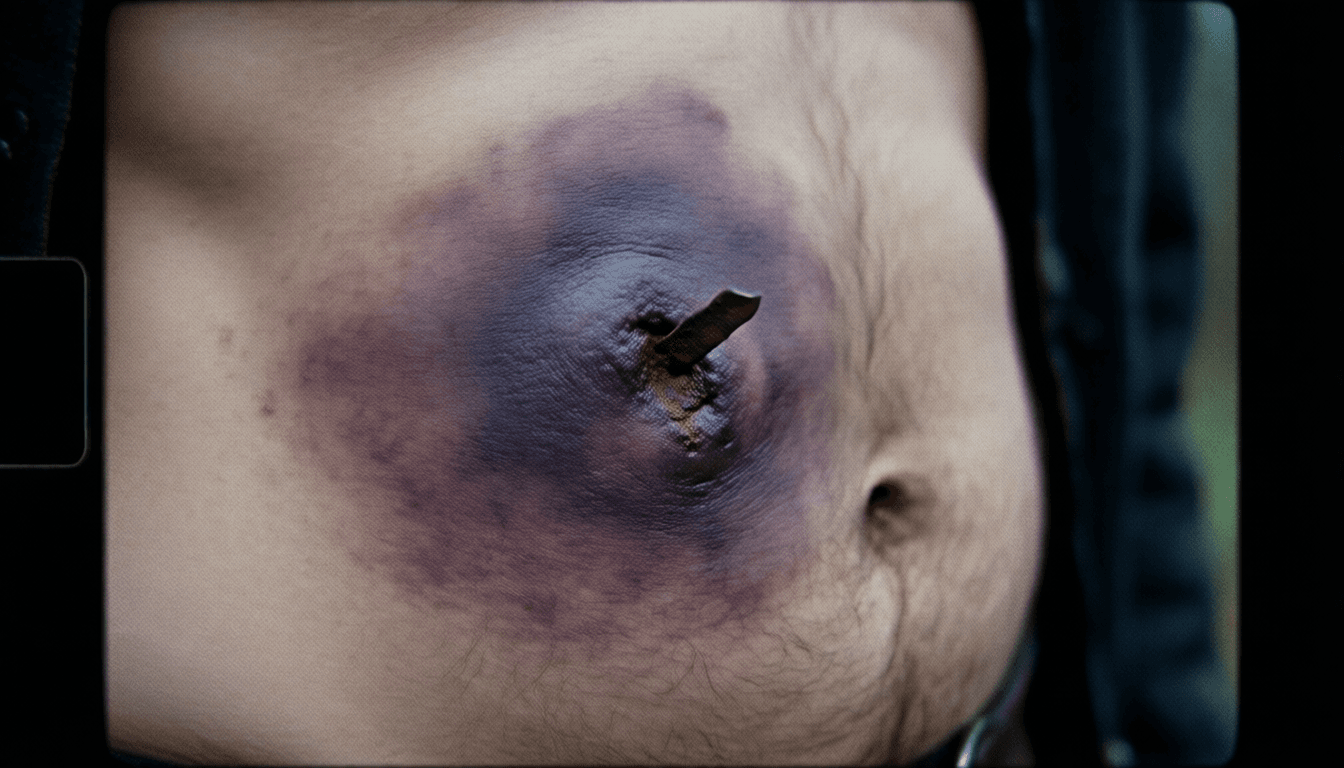
Paramedics found me near Route 9, semiconscious and muttering about a headless rider. They attributed my injuries—a deep, severe bruise on my left flank consistent with being struck, lacerations from thorns, and severe hypothermia—to a fall and exposure. I didn't correct them. I didn't speak directly of the true events.
The bruise on my side never fully healed. It remained an angry purplish-gray discoloration, always unnaturally cold to the touch. A patch of dead skin defying all medical explanation. Doctors were baffled. Sometimes, in the dead of night, I still feel that deep cold radiating from it. A phantom trace left by the horse's impact.
My equipment yielded almost nothing. My camera only recorded blurry stills and corrupted data at critical moments. The EMF detector had completely flatlined. The audio recordings contained only distorted wind sounds and a brief, guttural, deep resonance—a sound unidentifiable by any software.
There was, however, one inexplicable, chilling piece of evidence. Weeks later, as the bruise began to fade into a permanent, ominous hue, a small, almost imperceptible sliver of rusty, ancient metal protruded from the center of the discoloration. No larger than a grain of rice, unnaturally old and cold to the touch, it was embedded in my flesh as if driven deep by impact. It resembled no modern object I carried, and certainly nothing I owned. I kept it. A cold, sharp memento.
I no longer investigate such phenomena in the Sleepy Hollow area. I now understand that some things are not meant to be understood, only survived. The cold patch of skin is a constant, subtle reminder. I morbidly scan local news, looking for new 'equestrian accidents' or 'disappearances,' seeking chilling confirmation that the ride continues. Sometimes, when the wind howls just right through the bare trees outside my window, I almost hear it. The rhythmic thud of distant hoofbeats, followed by an ominous silence.
[ CLASSIFIED VERDICT ]
[ACCESS LOG - SOURCE FILE]
The Sleepy Hollow region is famous for the urban legend of the Headless Horseman. This tale recounts the ghost of a Hessian mercenary, decapitated during the American Revolutionary War, who rides nightly in search of his lost head. Specifically, a section of an old road called 'The Hessian's Trace' is believed to be the site of his fateful last ride.