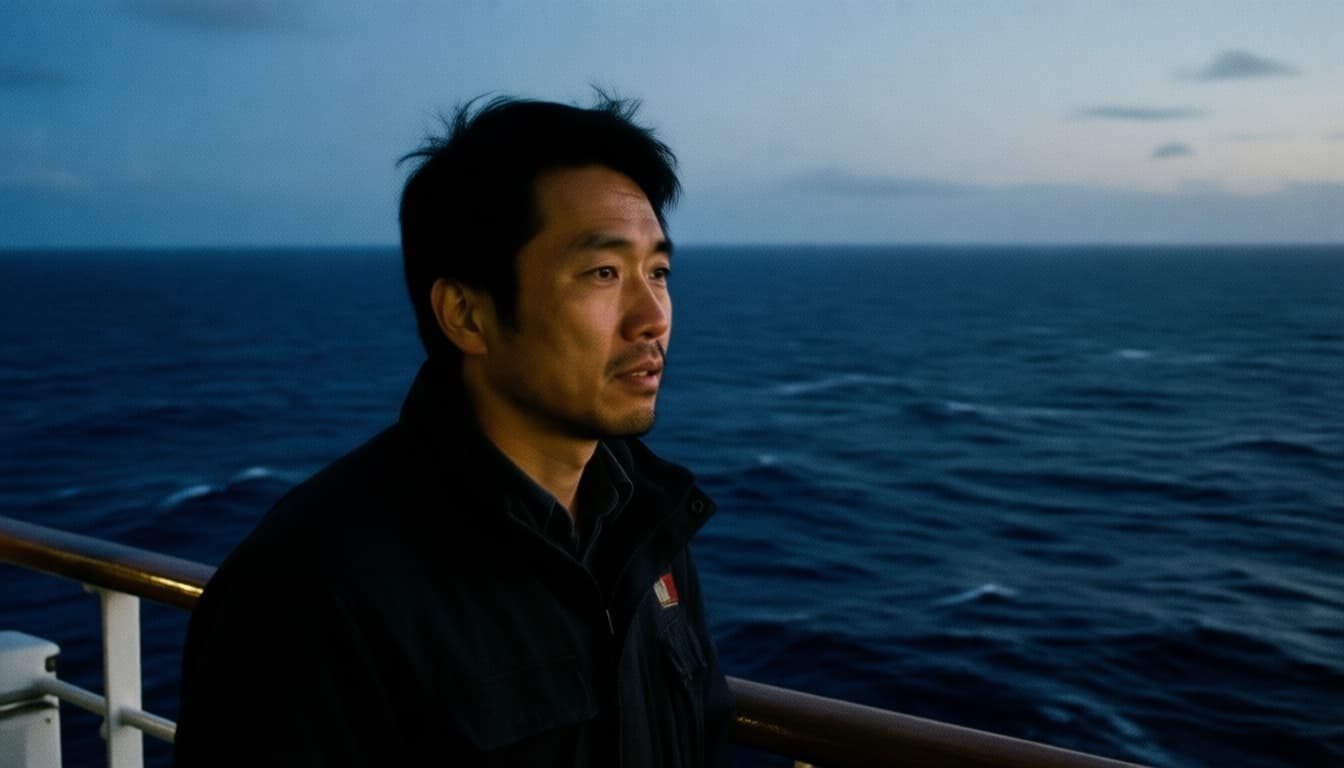
The Collectors of the Sea
In 1872, the Mary Celeste, found adrift in the middle of the Atlantic, remains one of maritime history's most baffling enigmas. The hull was intact, and its cargo untouched, yet not a single crew member or passenger was on board. Only one lifeboat was missing; there were no signs of struggle, piracy, or sudden storms. Countless theories abounded, but none fully explained the absence of evidence. However, during a recent investigation into 19th-century maritime insurance claims and local police reports released by the Portuguese National Archives, a chilling pattern emerged. Within a 200-nautical-mile radius west of Santa Maria Island in the Azores, at least seven cases of small fishing boats or merchant ship tenders were found deserted both before and after the Mary Celeste incident, spanning several decades. Always in calm waters, and always with a common, peculiar detail: a 'Fisherman's Bend' knot was found in the ship's lines or fishing nets, tied with an impossible precision and mechanical form, beyond human capability. The Mary Celeste's final log entry recorded its last known position approximately 150 nautical miles west-southwest of Santa Maria Island. This subtle, recurring clue suggested a far more intricate and cold-blooded 'collection' operation was taking place at sea, beyond mere piracy or misfortune. The Mary Celeste was merely the largest, most dramatic example.
As an independent maritime historian and archivist, I embarked on the exploration vessel 'Triton', funded by a private research grant. My official mission was to survey an unknown submarine volcanic ridge located within the 200-nautical-mile 'disappearance zone' west of Santa Maria Island, but my true objective was to directly investigate the point where the newly discovered historical pattern intersected with the Mary Celeste's final course. The Triton was an ordinary research vessel, equipped with modern instruments.
The Atlantic here was endlessly vast, asserting a massive, overwhelming presence over humanity. The incessant roar of the waves was a constant companion, and the salty sea spray perpetually dampened my face. The Triton's hull vibrated continuously with the low hum of its engines. The sea was deep, a nearly inky blue, curving away to an infinite horizon. Most striking was its deceptive outward calm. The ocean appeared placid, yet felt unfathomably deep, holding ancient secrets, and utterly indifferent to human existence. The air was crisp and sharp, but a bone-chilling cold permeated it, regardless of the ambient temperature. Even within the modern confines of the ship, an intense sense of isolation slowly began to crush me.
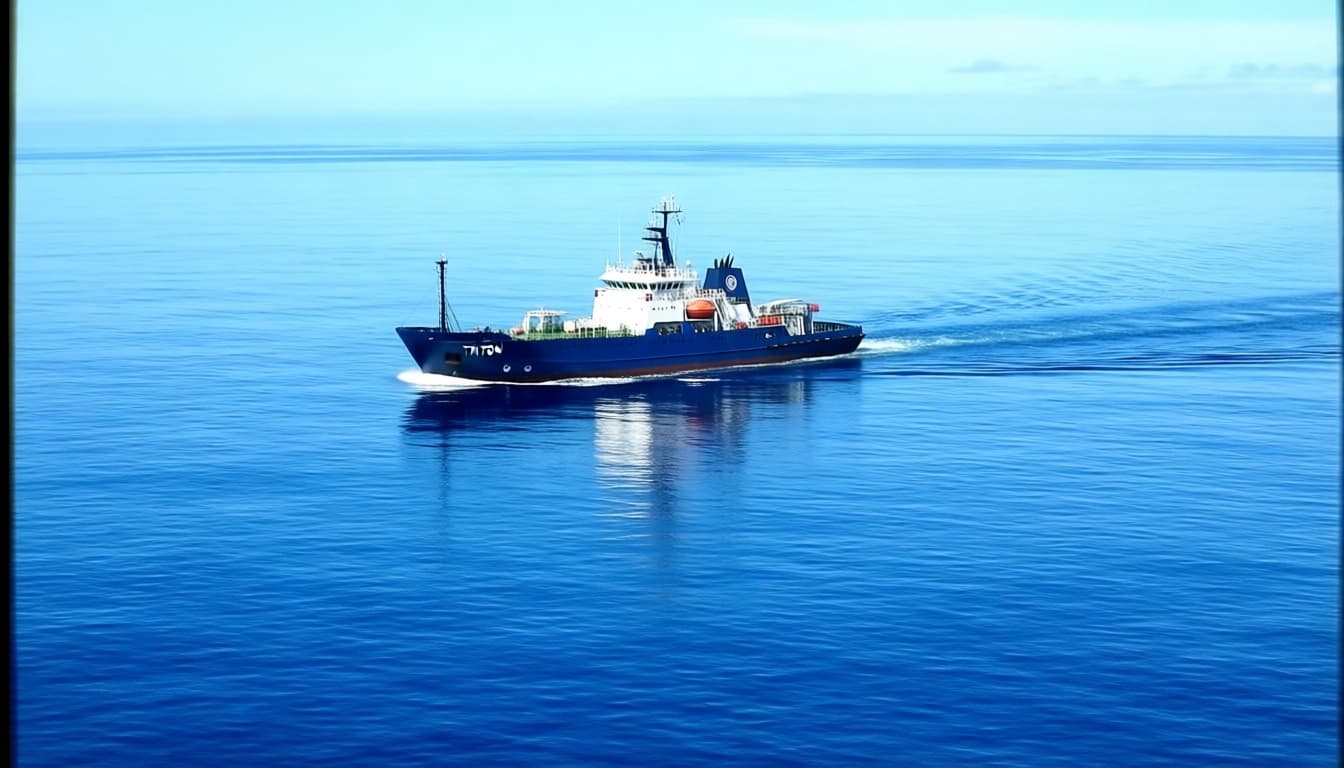
On the third day after entering the specific zone, subtle changes began to be detected. The ship's advanced sonar, meticulously mapping the seabed, picked up inexplicable phantom signals. Massive forms were repeatedly detected beneath the hull, only to vanish like flashes beyond the clear resolution range. The GPS intermittently lost signal, then recalibrated its position by several meters without any apparent reason. Most unnerving was the seawater itself. Previously predictable currents suddenly became erratic, creating small, silent eddies that ran counter to the main current, subtly diverting the Triton from its automated course. Furthermore, a faint, rhythmic 'humming' sound, seemingly emanating from deep within the seabed, was felt as low-frequency vibrations throughout the hull.
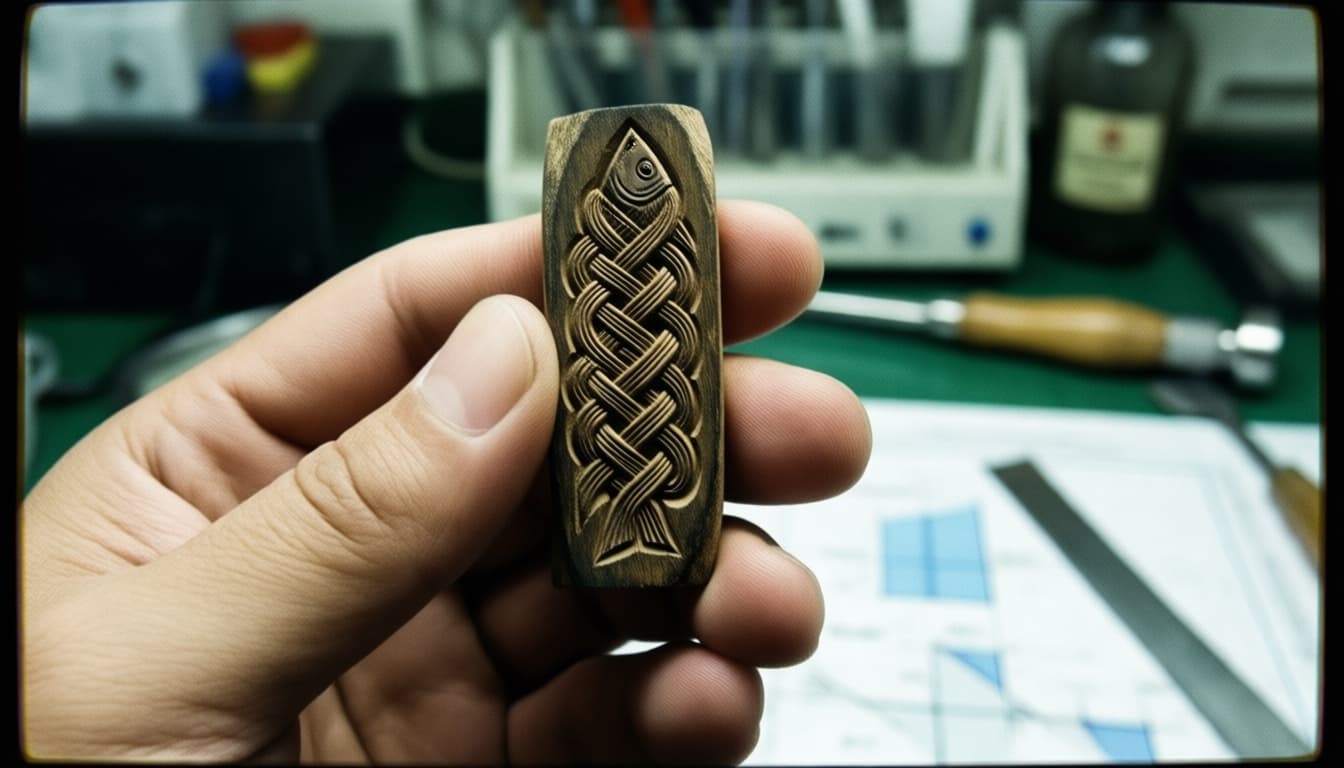
The initially cheerful conversations among the crew grew increasingly terse, their gazes often fixed on the horizon. Sleep was frequently interrupted by the ship's creaks and the unidentified 'hum'. I obsessively re-examined the collected historical records, and in the irregular currents outside the window, I began to find patterns described in old sailors' logbooks. The presence of the vast, silent sea cast a thick sense of unease over the Triton. One evening, we retrieved a small wooden fragment from the net of a recovered scientific buoy. It was ancient oak, etched with geometric patterns. On closer inspection, it was the exact form of that impossible 'Fisherman's Bend' knot. Its smooth, time-worn, polished surface further emphasized the fact that such an object should not have been there.
On the fifth night, a localized weather phenomenon struck without warning. It wasn't a storm, but rather a suffocating stillness enveloped the ship. The sea was abnormally calm, reflecting the stars with an eerie clarity, like polished obsidian. All communications abruptly ceased. The Triton's main engine sputtered and died, and soon even the auxiliary engine fell silent. The power system flickered before going out completely, leaving us adrift in an absolute, suffocating silence. Now, the 'humming' sound intensified, feeling as if it resonated directly within my heart.
The seawater around the Triton began to rise. It wasn't waves, nor a swell. The ocean surface slowly ascended, forming a perfect circular pool approximately 50 meters in diameter, as if it possessed a will of its own. Our ship lay at the center of this pool. The risen water regularly pulsed up and down in perfect rhythm with the deep 'humming', creating the illusion of the sea breathing. The air above us seemed to thin. A localized pressure drop created a subtle yet overwhelming sensation of constriction in my chest, making breathing shallow and difficult. Then, the rhythmic pulse of the water created incredibly perfect concentric circles, accelerating as they propagated outwards from the ship's hull, generating a low, resonant thrumming that echoed through the ship's structure.
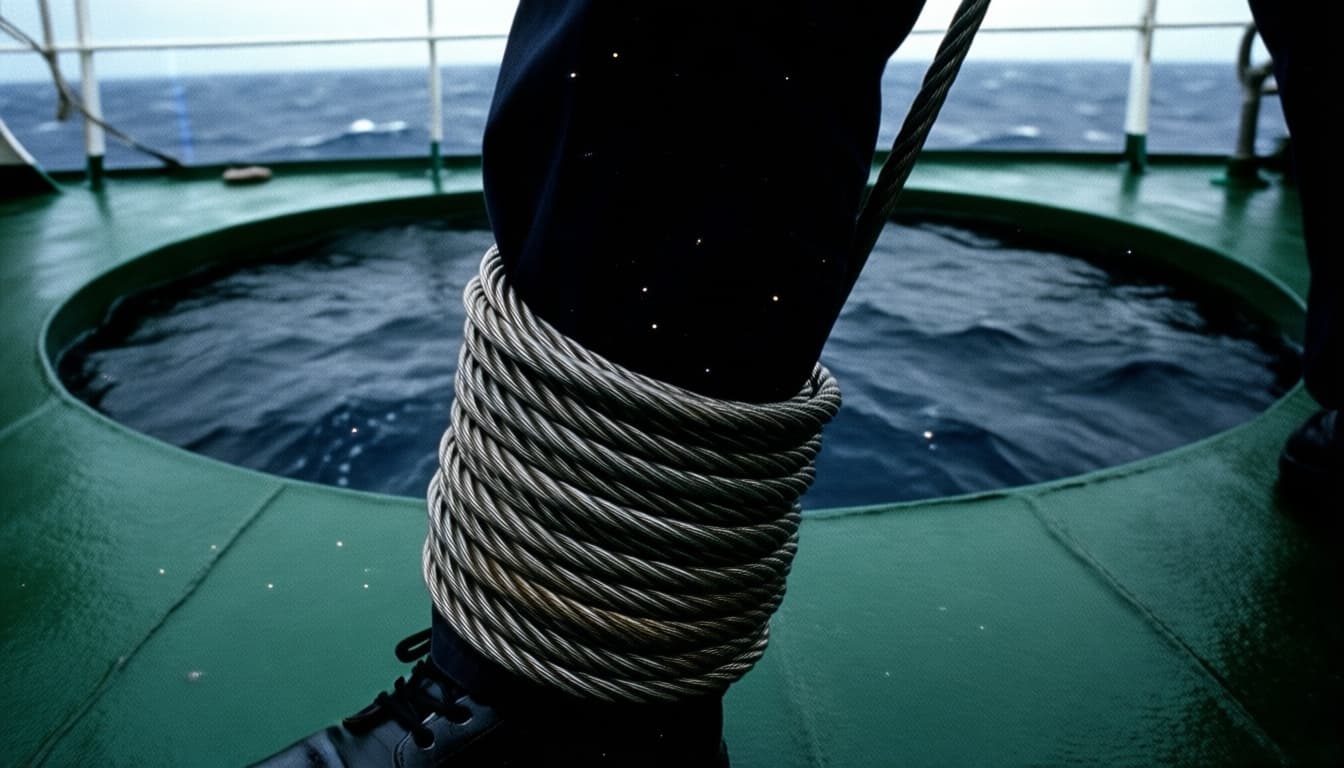
Within the inky abyss of the risen water, forms began to coalesce. They were not organic. Long, segmented structures moved with a precision utterly inhuman, reflecting the faint starlight with a dark, metallic sheen. They were not swimming. They were manipulating the water itself, creating the localized vacuum above and the rising surface. The rhythmic 'humming' reached a deafening crescendo. The securely locked stern deck hatch, for a horrifying instant, buckled inwards and then exploded. It looked as if it had been twisted and torn by immense internal water pressure. A thick steel cable, neatly coiled on the deck for scientific sensor deployment, was pulled taut with incredible speed and accuracy.
The cable moved ferociously, as if intelligent, coiling around my right leg like a boa constrictor. It dragged me with tremendous force towards the newly torn opening. I felt the cold, hard steel digging into my flesh, the horrifying sensation of tendons being stretched. Desperately, I caught sight of a discarded flare gun. It was loaded. In a surge of adrenaline, I blindly fired it at the cable wrapped around me. The flare ignited, severing a section of the cable with a shriek of burning metal and a shower of sparks. The constricting force instantly vanished, but the wound was deep, cutting to the bone. I collapsed, gasping in the thinned air, watching as the risen pool of water slowly, but irresistibly, receded, and the metallic forms withdrew into the abyssal darkness. The humming ceased, and a deep, absolute silence returned.
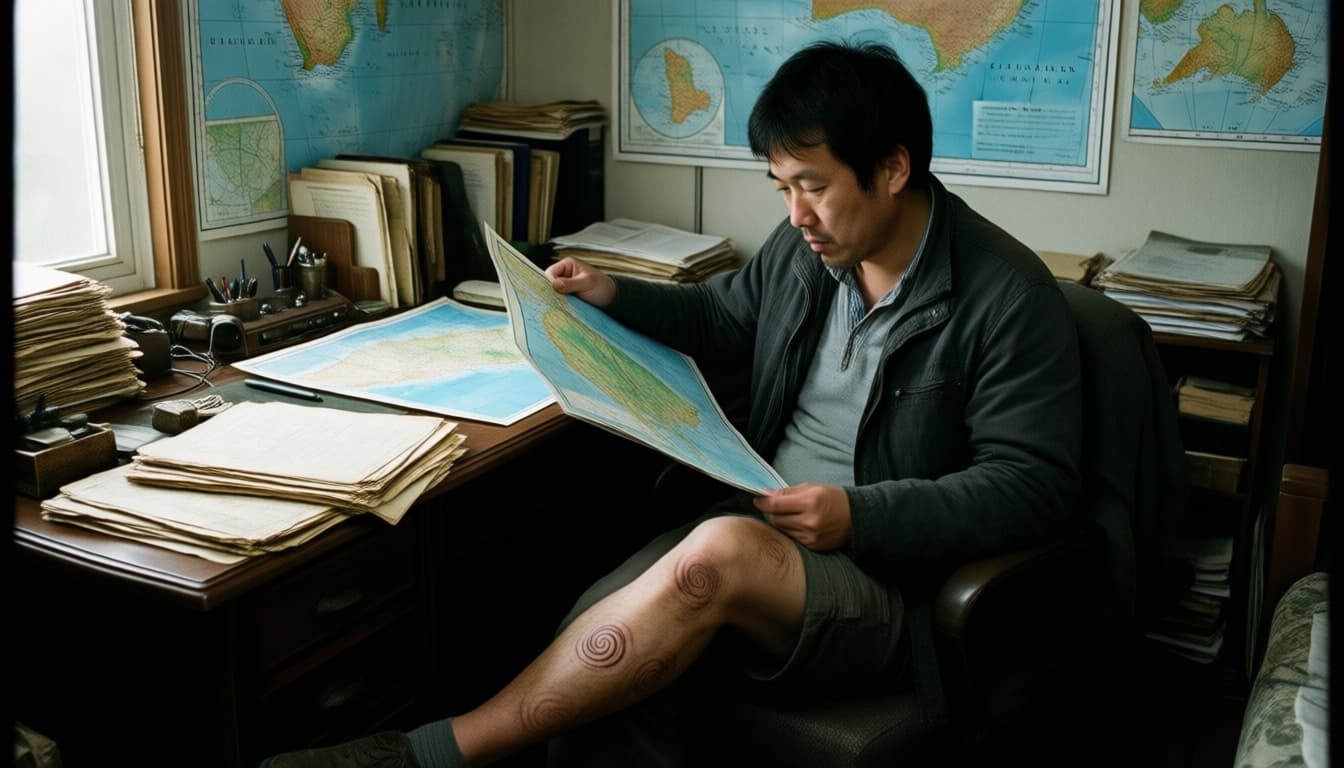
The Triton was found adrift two days later by the Portuguese coast guard. Severely damaged but not sunk. The official report attributed the incident to an unprecedented 'localized anomalous weather phenomenon' and critical engine failure. My account of the impossibly rising water, the atmospheric pressure changes, and the intelligently moving cable led to polite skepticism and psychological evaluations, all dismissed as trauma and hypothermia. My leg was saved, but the indelible scar left by the cable was clear. Unlike typical injuries, it was a perfectly spiraling burn and laceration, intricately etched.
I kept the carved wooden knot fragment; it became my only tangible proof. Back in my archives, I discovered a microscopic, almost invisible inscription on the fragment's underside: a series of minute parallel lines, spaced with unnerving mathematical precision. These lines, almost undetectable to the naked eye, perfectly matched peculiar scratch patterns on the underside of a specific brass navigational instrument recorded in the original inventory of the Mary Celeste – patterns I had previously dismissed as manufacturing defects or wear. No one else had made this connection. The sea, once a space of wonder, was now a source of deep and persistent dread. Every news report of a distressed vessel, every unexplained maritime disappearance, took on a chilling new weight. I compulsively check weather patterns in the Azores, searching for subtle, anomalous calmness. Sometimes, late at night, I see it on screen, in documentaries or news reports, just for a fleeting moment: a momentary, almost imperceptible shimmer on the vast ocean surface, a ripple moving with a logic entirely alien to the natural world. It is the intricate, mechanical trace. The pattern has never been broken. It is still there, unseen and unheard, perpetually collecting from the deep.
[ CLASSIFIED VERDICT ]
[ACCESS LOG - SOURCE FILE]
This story is based on the real-life mystery of the Mary Celeste, a ghost ship discovered in the mid-Atlantic in 1872 with its entire crew missing. The author traces a pattern of other vessels found deserted in a similar manner to the Mary Celeste, proposing a chilling hypothesis of an intelligent 'collection' operation behind these incidents, rather than mere accidents.