The Beale Cipher: Shaft Number Four
Among the internal memos of the National Security Agency (NSA) declassified in 1987, there exists an unsettling marginalia found within cryptanalyst William F. Friedman’s personal dossier. In the frayed corner of an analysis worksheet for Cipher No. 1—one of the three infamous Beale ciphers that remains officially unsolved—an unidentified analyst had violently scrawled a desperate warning: “Cease all substitution attempts using the Declaration of Independence immediately. This numerical sequence is not a book cipher; it is an acoustic periodicity and displacement log. Cave 4 is not empty. It is venting.” The legend of Bedford County, Virginia, long believed to conceal thousands of pounds of buried gold and silver, had been largely dismissed as an elaborate nineteenth-century hoax until 1934, when the field journal of a Civilian Conservation Corps (CCC) surveyor resurfaced at an estate auction in Roanoke. At the end of an entry detailing the dynamiting and permanent sealing of a subterranean fissure near Goose Creek, just outside Montvale, lay a graphite rubbing of an abraded, fibrous grey mineral retrieved from a lead-iron joint—accompanied by an array of numbers that matched Beale’s third cipher with mathematical perfection.
Arthur Vance, a geophysical engineer specializing in structural acoustics, located the blasted shaft beneath a tangle of second-growth briars along the slopes of the Blue Ridge Mountains last autumn. The vertical breach opening into the earth was no natural limestone sinkhole. The shaft walls displayed definitive pre-industrial chisel marks, and through shattered slabs of greenstone slate, the subterranean air plunged from a balmy 22 degrees Celsius at the surface to a frigid 3 degrees within ten paces. There was no foul stench of guano or stagnating pool water. Instead, the air carried an overwhelming stench of ozone—the sharp, electric odor usually reserved for ungrounded high-voltage sub-stations—accompanied by a bone-dry, metallic tang that coated the back of the throat like powdered zinc.
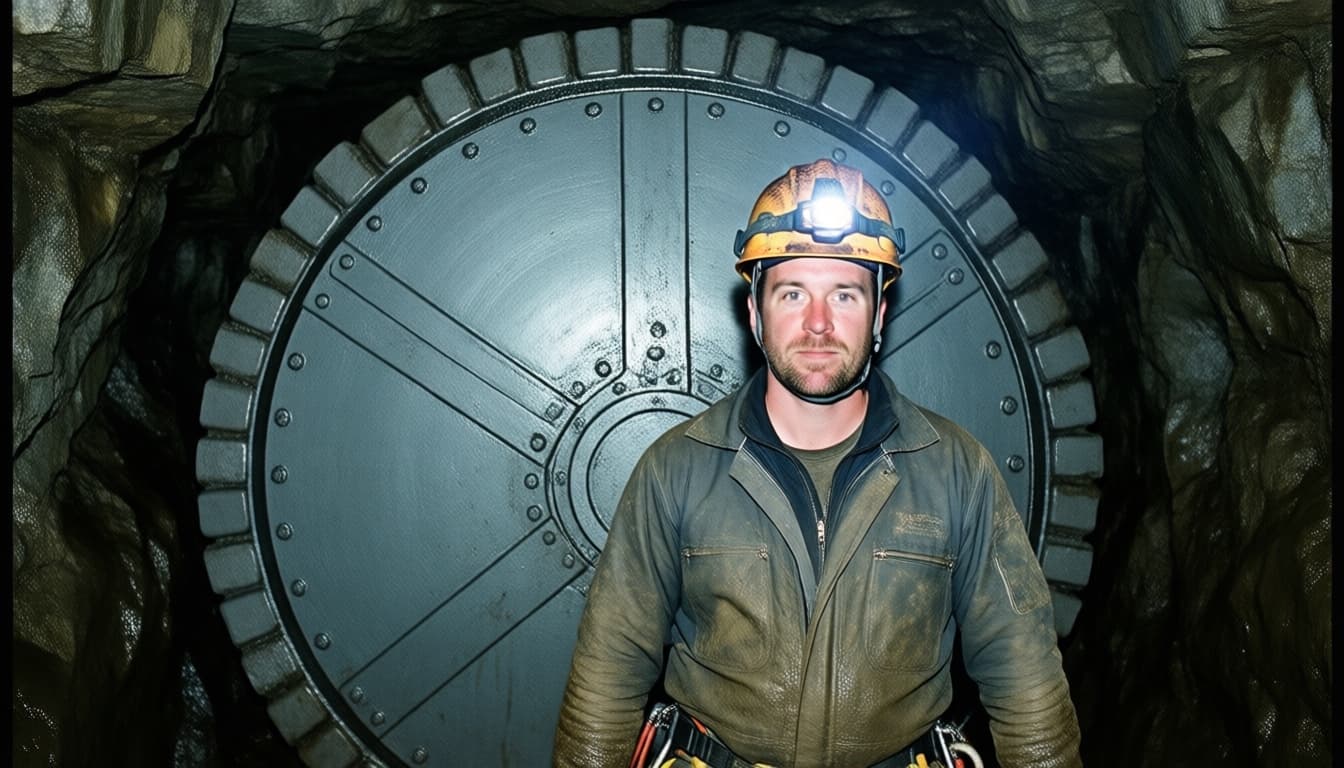
Descending sixty meters into the vertical throat, the beam of Vance's mining lantern caught an artificial bulkhead that folklore had foolishly romanticized as ‘iron pots filled with silver and gold.’ It was no hoard. Enormous blocks of an unidentifiable, non-magnetic grey alloy were fitted together with micro-millimeter precision, ringing the circumference of a titanic, circular conduit that plunged downward into utter nothingness. The surface of these blocks bore no tooling marks; rather, they carried the distinct, engineered texture of industrial damping plates designed solely to absorb catastrophic pressure.
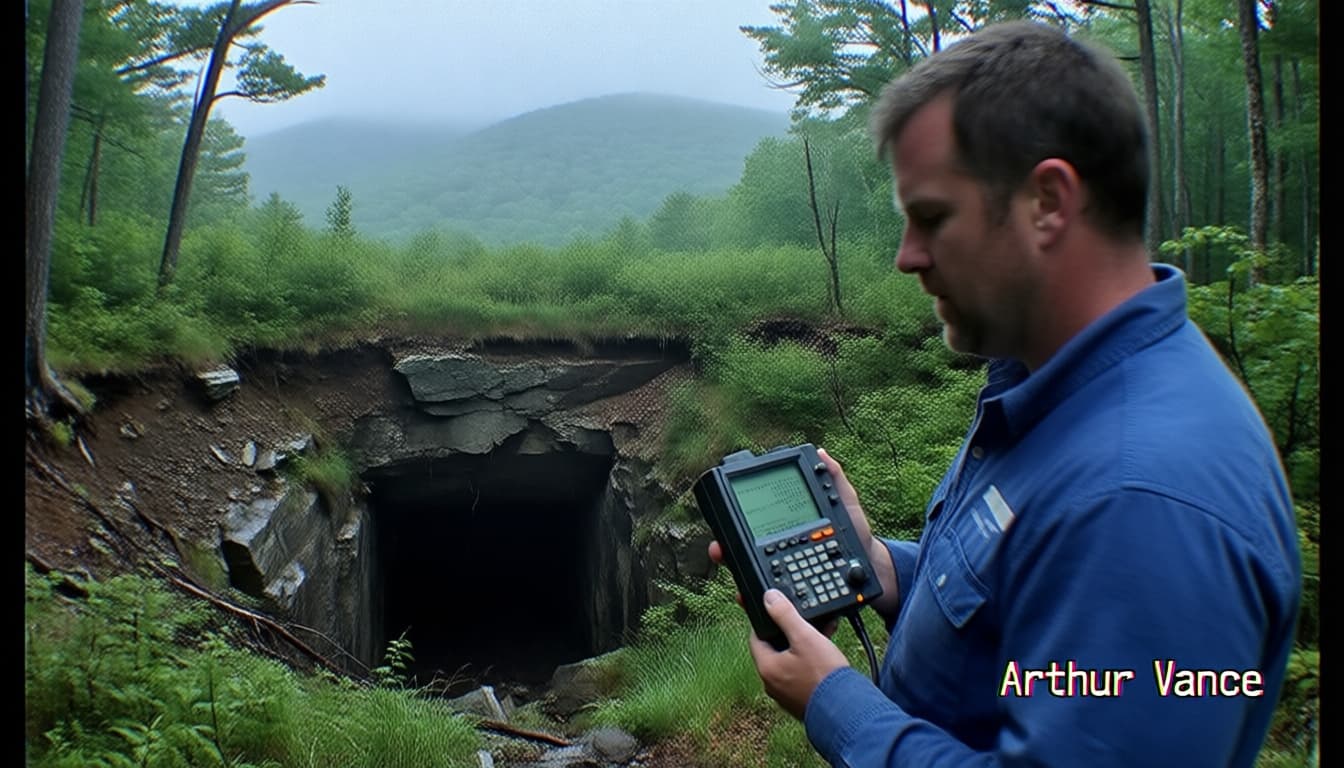
To measure the sheer drop beneath, Vance triggered a standardized acoustic reflection pulse. The returning telemetry, however, broke the fundamental laws of wave mechanics. The echo registered on his receiver precisely 0.5 seconds later than the volume of the space dictated. Stranger still, the waveform relayed through his spectral amplifier had pitch-shifted downward by exactly three semitones. It was as if the acoustic wave had not traveled through atmospheric air, but had dragged itself through an invisible medium of unfathomable, suffocating density.
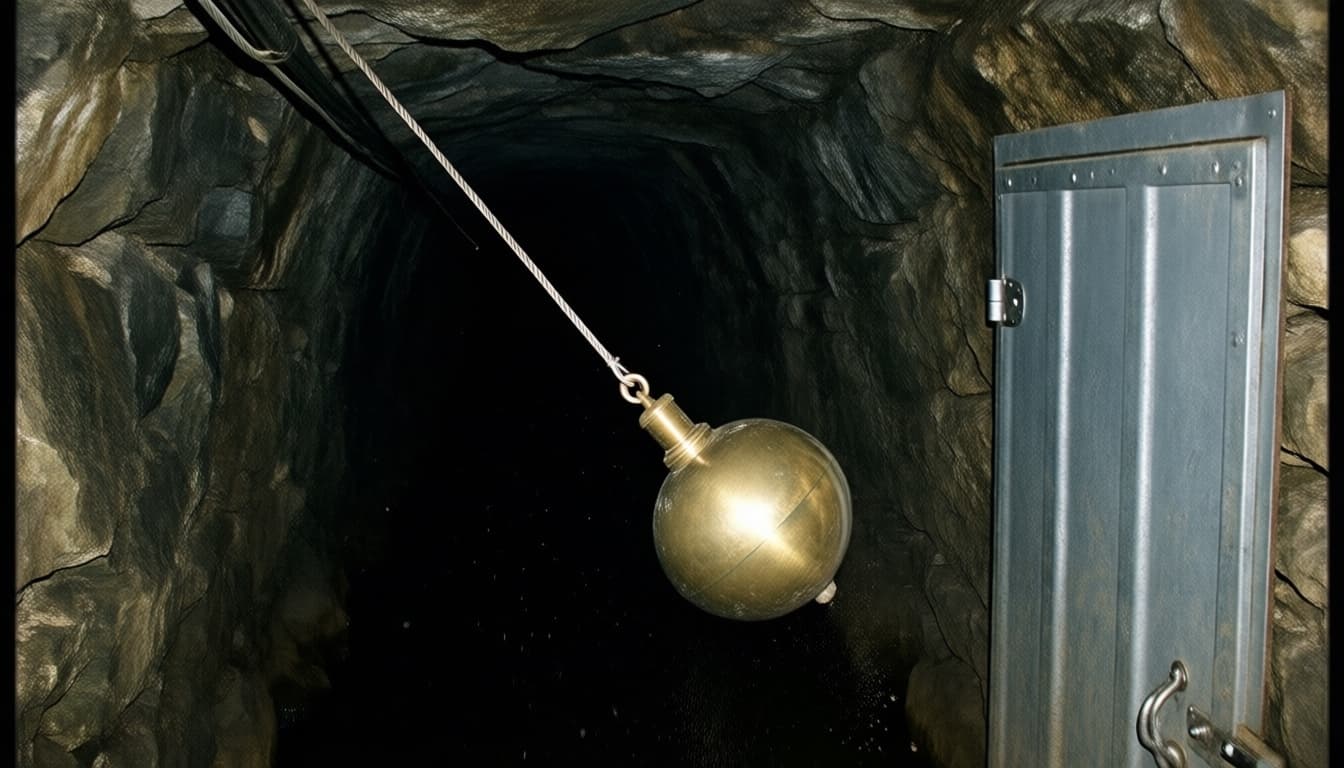
A cold dread crept up his spine. Vance lowered a heavy brass plumb bob toward the dark center of the conduit. The weight did not hang vertical. Held by an unseen lateral force, it hovered rigidly at an eleven-degree deflection toward the eastern rock face. A drop of condensation trickled from the slate ceiling above; instead of falling downward, it traced a slow, sickening arc across the dead air before striking the dry wall in a cluster of concentric rings. The spacing of those ripples matched the cluster intervals of the numerical groupings in Beale’s first cipher. Within the vacuum-like quiet, where even the scrape of his heavy canvas jacket failed to produce a discernible echo, high-frequency sound waves were being steadily sheared away and devoured by the hole.
Needing an assay sample, Vance drove a non-conductive pry bar into a hairline fracture along the edge of an alloy block and applied leverage. The fragile equilibrium shattered instantly. As the seam widened by barely a fraction of an inch, the ambient barometric pressure inside the chamber imploded. A wet, concussive snap ruptured both of his eardrums, washing his vision in crimson as the capillaries across his eyes burst under the sudden shockwave. The subterranean atmosphere did not rush upward to escape; rather, a gale-force vacuum materialized instantly, dragging everything toward the abyss.
Yet while the air tore downward, something monstrous was swelling upward against the current. The direct halogen beam from his headlamp bent unnaturally in midair, shattering into warped refractions. It was not illuminating an empty void. The light was contorting around an immense, cryogenic, convex boundary layer that neither reflected nor absorbed the spectrum. As he watched the light curve along that impossible geometry, Vance realized with paralyzing clarity that a massive, invisible displacement was expanding upward through the conduit, defying the vacuum.
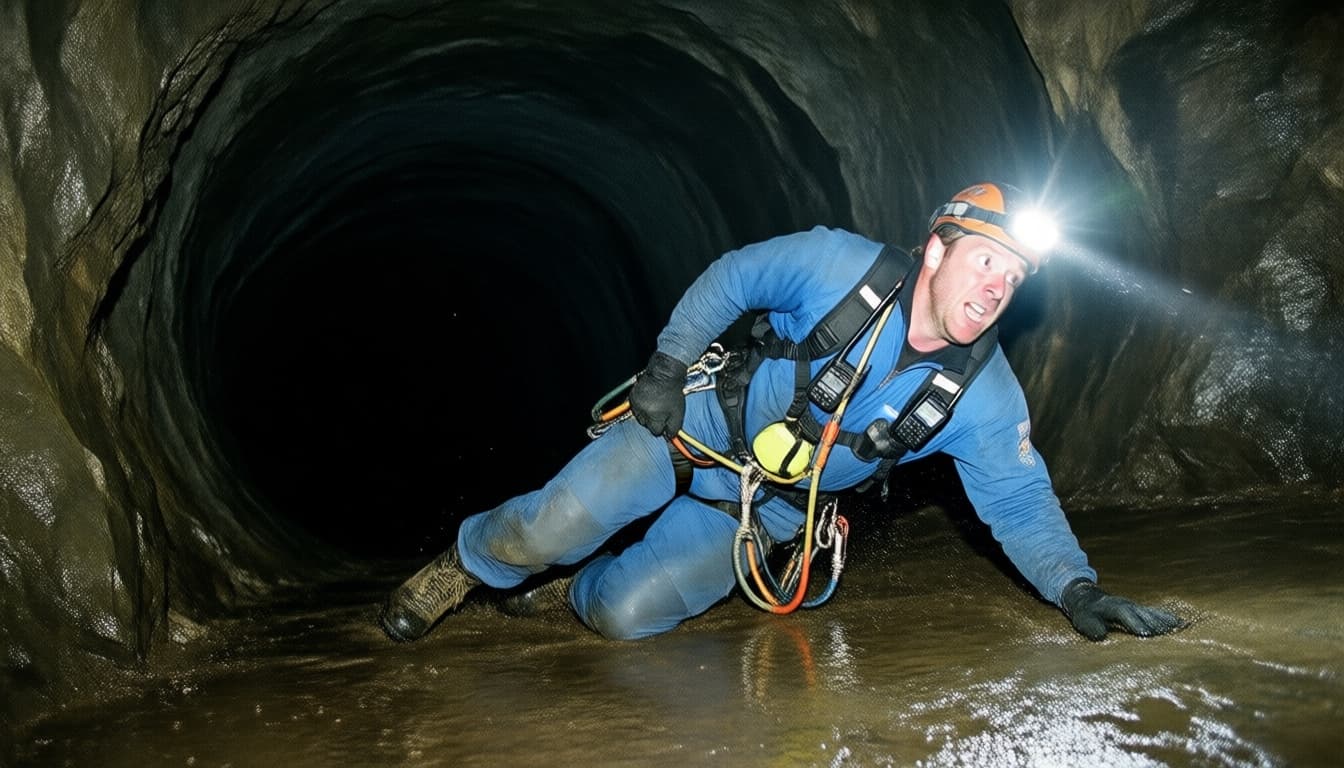
A localized shear of gravity seized his body, dragging him across the floor toward the mouth of the drop. His steel-shank boots skidded uselessly across the slick slate. Above him, the high-tensile wire of the brass plumb bob snapped like a gunshot, its tether vanishing into the dark. An invisible pressure comparable to liquid nitrogen crushed down upon his ribcage. It possessed mechanical mass and unmistakable intent, folding his sternum inward with a sickening crunch and expelling every scrap of air from his lungs. An inhuman chill seeped through his parka as his steel wristwatch bezel, two-way radio, and the digital seismograph mounted to his chest imploded into jagged scrap, crushed inward against his flesh. The anomaly was violently crushing the metals on his body, using them as magnetic purchase.
Choking on his own blood, Vance rammed a non-conductive fiberglass bar into a crevice in the natural rock wall and kicked back with every ounce of adrenaline left in his mangled body. Skin peeled from his palms as he rolled violently over a limestone outcrop. An instant later, the shifted alloy plates snapped shut with a deafening, metallic crash that reverberated through the stone. In that exact fraction of a second, the violent vacuum ceased. A graveyard silence smothered the cavern once more.
The medical intake records at Roanoke Memorial Hospital classified Vance’s condition well beyond the scope of any ordinary cave-in. He exhibited extreme decompression barotrauma typically reserved for deep-sea divers suffering catastrophic ascents, alongside an array of spiral micro-fractures spanning his left forearm caused not by blunt impact, but by rotational gravitational torque. The attending trauma surgeons could not comprehend how a man with a shattered sternum and collapsed lung had managed to drive himself down the winding mountain roads to the emergency bay.
From the wreckage of his crushed field kit, four minutes of intact telemetry were successfully extracted from the seismograph’s solid-state buffer. When Vance later cross-referenced the recovered acoustic frequencies against the decoded Beale Cipher transcripts, the truth unraveled. The ciphers were never an inventory of hidden bullion. They were a mechanical stress log—a calculation of the containment alloy’s functional lifespan under the strain of the subterranean mass sealed beneath the Blue Ridge. And according to the cipher’s mathematical limits, the structural integrity of the 1820 seal had officially expired years ago.
Convalescing in his bedroom twenty miles away from Goose Creek, Vance still cannot hear the rhythm of his own pulse through his scarred ears. On the nightstand beside his bed, a half-filled glass of water sits undisturbed by the rumble of passing freight trucks on the highway. Defying gravity, the waterline remains frozen at an impossible eight-degree tilt toward the southwest—directly aligned with Goose Creek. And upon its taut surface, fine, silent ripples tremble at an inaudible, downward-spiraling frequency, shifting lower by three semitones, second by second.

[ CLASSIFIED VERDICT ]
[ACCESS LOG - SOURCE FILE]
Based on the legend of the 'Beale Ciphers,' which allegedly reveals the location of thousands of pounds of buried treasure in Bedford County, Virginia. This story provides a cosmic horror reimagining, suggesting the still-unsolved Cipher No. 1 is not a treasure map, but a mechanical log recording the critical lifespan and acoustic frequency of a containment barrier holding an anomalous physical mass deep beneath the Blue Ridge Mountains.