
Somerton's Unfinished Silence
The desolate stretch of sand and rocks on Somerton Park beach in South Australia has for decades been synonymous with the unsolved mystery of the Tamam Shud case. In December 1948, the unidentified 'Somerton Man' was discovered, and with the cryptic phrase 'Tamam Shud' — meaning 'ended' — torn from a copy of Omar Khayyam's *Rubaiyat* found in his secret pocket, the case etched itself into the annals of cold cases. Yet, beyond the well-documented police files and public fascination, a quieter, more sinister local rumor has persistently circulated, often dismissed as mere coastal folklore.
These whispers concern a particular tidal pool nestled among the rocky formations approximately 150 meters south of the old beach kiosk, and roughly at the point where the Somerton Man's body was discovered. Locals, particularly those who frequent the beach on moonless nights and during low tide, claim that at this precise location, the regular sound of the Southern Ocean's waves *completely ceases* for brief periods. This sudden, unnatural silence, they say, is followed by faint, raspy whispers, often mistaken for the wind or shifting sands. But consistently, over generations, a select few have described it as a drawn-out, single word, unsettlingly phonetically similar to the very phrase that immortalized the Somerton Man: 'ended.' It is a sensory anomaly, directly linked to topography and atmospheric conditions, whose consistency drew this investigator's attention. A mere acoustical coincidence, or an echo of something far deeper?
Drawn by numerous independent testimonies, particularly from fishermen and night photographers, I pinpointed the new moon low tide as the optimal time for my initial field investigation. Equipped with a high-gain parabolic microphone, a multi-spectral audio recorder, an array of environmental sensors, and standard headlamp and cold-weather gear, I arrived at Somerton Park beach just after midnight.

The air was still, cold, and heavy with the scent of salt and decaying seaweed. The familiar, incessant *hum* of the ocean — the crash of waves against the shore, the distant sigh of the receding surf over the sand — dominated the entire soundscape. Navigating over slippery, barnacle-encrusted rocks, I located the designated tidal pool. It was a shallow, almost circular depression about five meters in diameter, perfectly still under the distant glow of a streetlamp. I set up my equipment, carefully positioning directional microphones toward the pool and the sea, minimizing my own environmental footprint. The primary objective was to acquire data, either definitively disproving the anomaly or capturing verifiable evidence. For the first hour, the recordings were mundane, a tapestry of natural coastal sounds.
Roughly an hour and twenty minutes into the recording, subtle changes began. My environmental sensors registered a gradual but distinct drop in ambient temperature, well beyond the expected nocturnal cooling. Concurrently, the sound of the waves began to distort. It wasn't a reduction in volume, but a peculiar *desynchronization*. The sound would follow the visual crash of a wave by a fraction of a second, or occasionally, precede it. It was a disorienting temporal lag, an impossible acoustic phenomenon.
I checked my equipment; everything indicated normal operation. The air around the tidal pool had become unnaturally still; even the gentle breeze had vanished entirely. The pool's surface, which had previously rippled with the slightest breath of air, had become an eerily perfect mirror, reflecting distant stars with impossible clarity, undisturbed by any ripple or current. My audio recorder, which had initially captured only ambient noise, now registered a faint, multi-layered static, almost subliminal, but soon a harbinger of something more distinct. And then, in the absolute quiet, it began. Faint, hissing whispers, undeniably present, on the edge of perception. Vague, like voices carried on a distant wind, yet steadily, subtly growing, morphing into a repetitive, raspy vocalization, perfectly aligned with "Tamam Shud," intensifying my unease. It seemed to emanate not from a single point, but to well up from the air itself and the pool's motionless water.

The whispers intensified, coalescing into an overwhelming, raspy chorus that filled the entire space. And then, the true anomaly presented itself. The incessant roar of the Southern Ocean, which had been the backdrop to my entire life on the coast, *ceased*. Absolutely. Completely. The sound cut off as if a colossal, invisible switch had been thrown. The silence was not merely the absence of noise; it was a physical pressure, a suffocating, absolute presence that amplified the multi-layered whispers of "Tamam Shud" to an unbearable pitch.
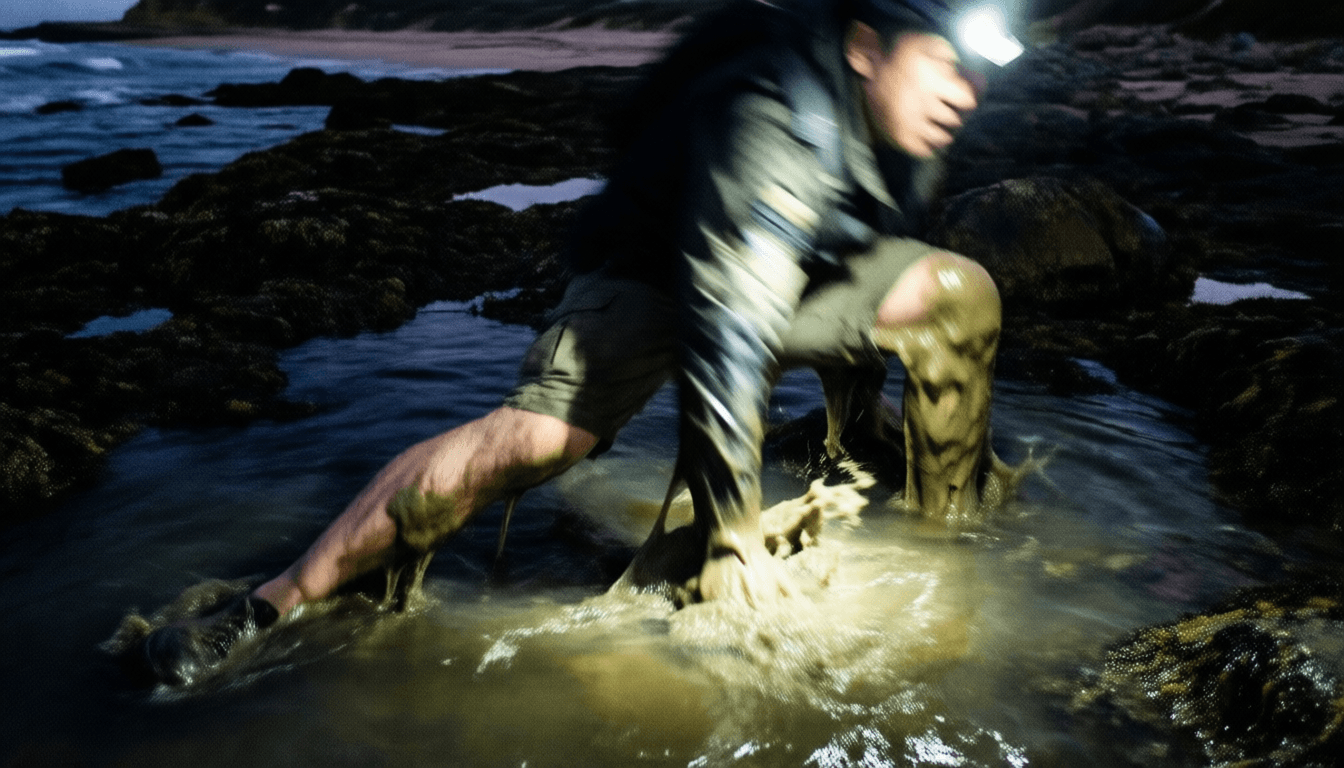
Driven by an incomprehensible instinct, I stepped ankle-deep into the tidal pool. As the words echoed in my mind, the water around my ankles began to *constrict*. Not a suction, but a rapid, inexplicable increase in density and viscosity. The previously cool water became impossibly cold, its texture shifting from liquid to a heavy, clinging semi-solid that grasped at my calves. I tried to withdraw my legs, but the pool pulled me downwards with a subtle, persistent force. The whispering chorus swelled into a cacophony of "Tamam Shud," reverberating through the congealed water and into my very bones. The violently shaking beam of my headlamp momentarily caught a faint impression within the dark, dense mass around my legs—not a reflection, but a momentary *indentation*, a tactile pressure as if a colossal, formless hand briefly squeezed.
Primal fear galvanized me. This was no auditory hallucination or mere environmental quirk. Whatever it was, its presence acted independently, manipulating fundamental physics. With a desperate, adrenaline-fueled surge of strength, I tore my legs free from the viscous, impossibly cold mass. The "water" abruptly released its grip, returning to its liquid state. Simultaneously, the ocean's roar *surged back*, deafeningly loud, a violent wave of sound that shattered the suffocating silence and the entity's hold. I stumbled, half-crawling over the slippery rocks, the ocean's sound a terrifying yet welcome assault on my ears.
I fled Somerton Park beach in a desperate haste, not looking back. The ocean's ceaseless roar was now a horrifying reminder of its recent unnatural absence. Back in the controlled environment of my lab, with still-trembling hands, I meticulously began reviewing the multi-spectral audio recordings.
The data was undeniable. The initial environmental sounds, the gradual distortion, the eerie cessation of the ocean's roar, the multi-layered chorus of "Tamam Shud," and my own fear-choked gasps—all captured with chilling, irrefutable clarity. But the most unsettling detail awaited analysis. In the final seconds of the recording, immediately after the ocean's roar violently returned, and just before my own desperate flight was fully captured, a faint, almost subliminal echo of "Tamam Shud" was detected. It was no longer an external sound. It was embedded *beneath my own ragged, hyperventilating breaths*. As if the word had somehow been internalized, etched into my very being, captured by the microphone as if it had become part of my internal soundscape.
And then, as the initial shock subsided, I realized a cold, alien object was clutched tightly in my numb, trembling right hand. It was a single, unburnt matchstick. It wasn't mine. The wood was dark and dense, slightly damp, unlike any modern match. On its side, almost imperceptibly etched into the dark grain, was a single, clear initial: 'T'. I hadn't picked it up. My hands had been busy with equipment, then with struggling to escape. It wasn't mine, and I hadn't dropped anything in the tidal pool.
The realization settled. A cold, insidious dread. The phrase "Tamam Shud" means "ended." Yet the unburnt matchstick, a sentinel from a bygone era, and the internalized echo of the words hinted at something far more sinister. The end, it seemed, was not over. It had merely *shifted*. And a piece of it, a cold, anachronistic token, was now clutched in my hand. A subtle, chilling calling card from something that refused to be concluded. The Somerton Man case wasn't just an unsolved mystery. It was an open door. And something had slipped through.

[ CLASSIFIED VERDICT ]
[ACCESS LOG - SOURCE FILE]
This story is based on the 'Somerton Man' case, an unidentified man found on Somerton Park beach in Australia in 1948. Associated with this famous unsolved mystery and the cryptic phrase 'Tamam Shud' (ended) found in his pocket, it builds upon a local legend about a specific tidal pool where the sound of the ocean ceases and whispers are heard.