An Alien Scar on Earth: The Blood-Red Mystery of Lonar Crater
In 1972, geologists examining lunar rock samples brought back by Apollo 11 and 12 were confronted with an exceedingly strange, translucent glassy mineral. Known as Maskelynite, this substance cannot be forged by normal terrestrial volcanic eruptions or tectonic collisions. It is the cosmic fingerprint of an extraterrestrial impact, created only when a shockwave exceeding 300,000 atmospheres instantly collapses the crystal lattice of plagioclase feldspar into isotropic glass before the rock even has time to melt.
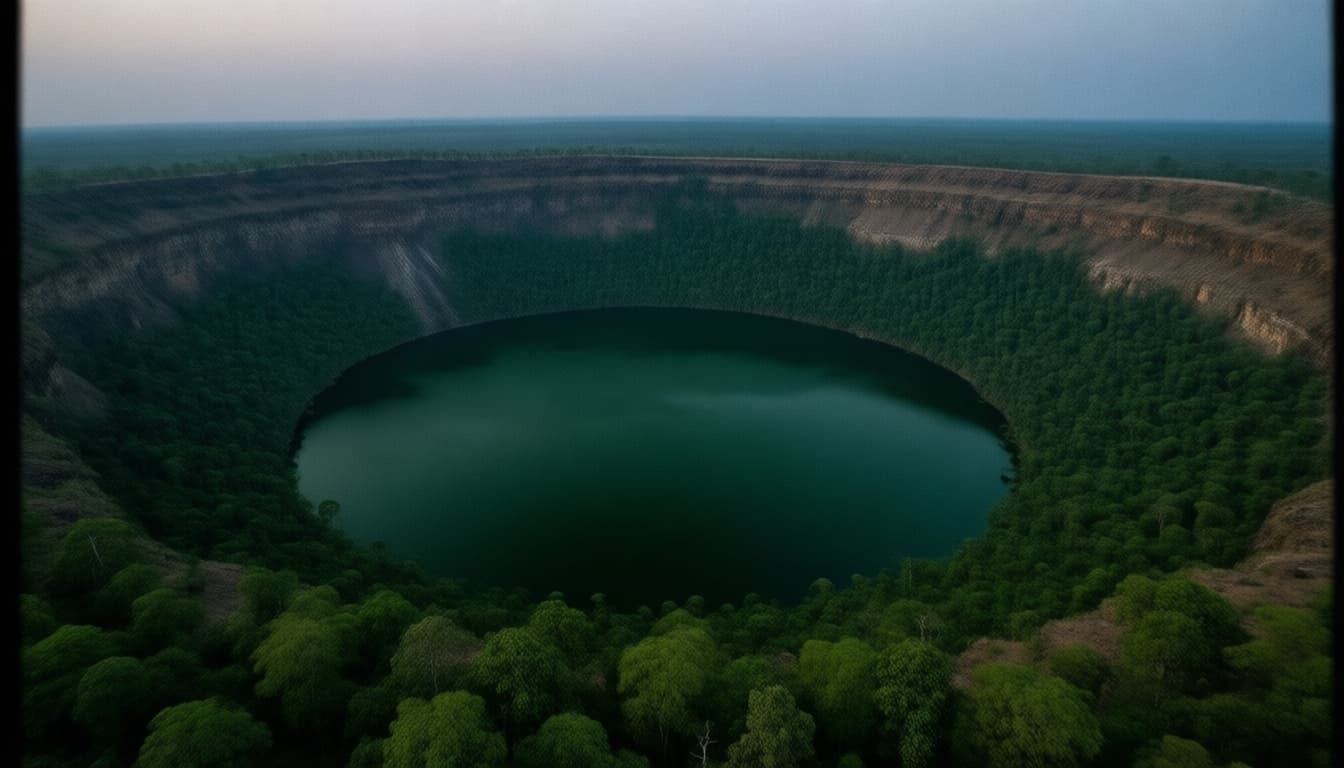
The odds of discovering this extreme mineral on Earth are almost non-existent. Yet, in the midst of the vast ancient basalt plains of the Deccan Plateau in west-central India, a geometrically near-perfect circular basin gapes open—measuring 1.8 kilometers in diameter and 150 meters deep. Located in Maharashtra, India, the Lonar Crater is the world's only hypervelocity meteorite impact crater formed on solid basalt rock.
The moment one descends the sheer cliffs from the dry, arid plateau, the very nature of the atmosphere changes drastically. Shielded from the outer plateau's heat, the crater's interior shelters a cool, humid microclimate where a dense, near-primeval teak forest blankets the basin. Approaching the water's edge, ancient Hindu temples built between the 10th and 13th centuries—constructed solely from interlocking black basalt without a drop of mortar—emerge from the foliage. Despite the region's lack of seismic activity, the temples' colossal stone pillars lean askew and sink unevenly, distorted along underground fissures left by the subterranean shockwaves.
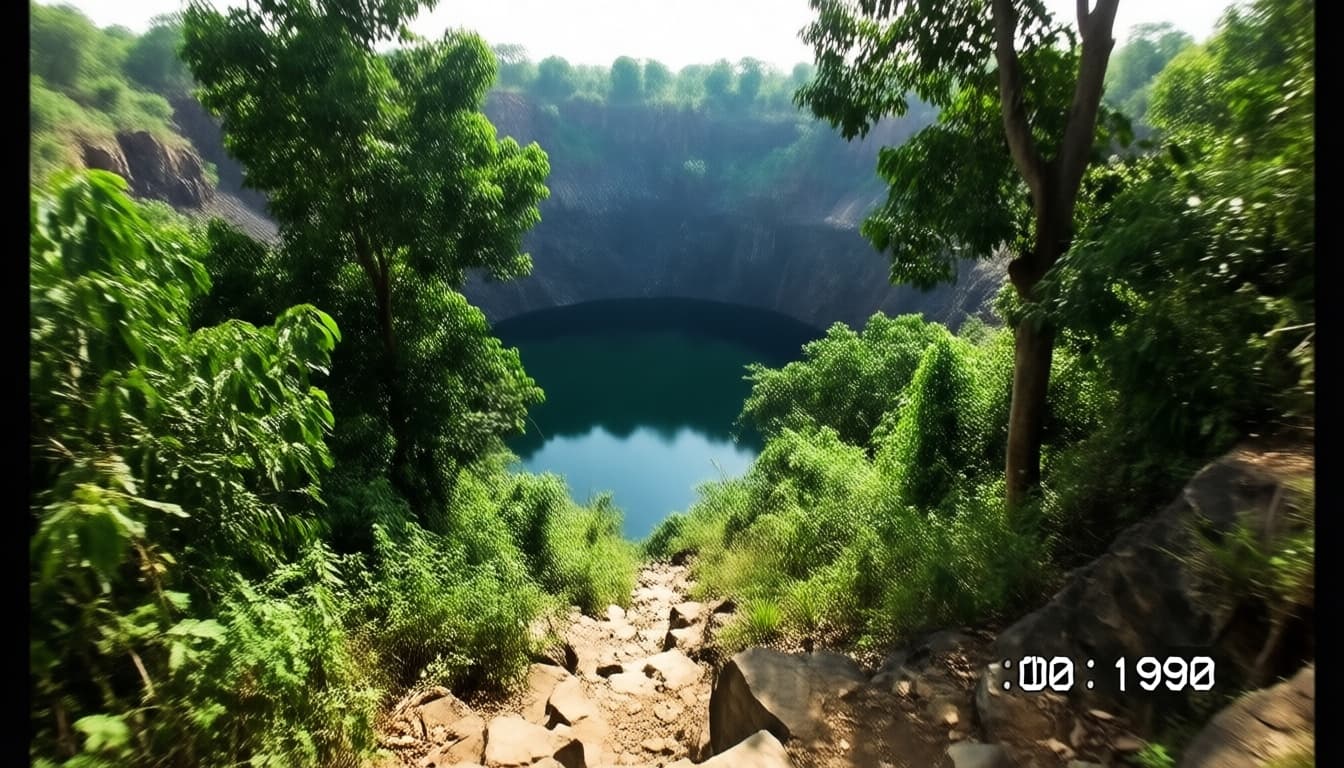
Yet the most bizarre phenomenon here lies in the behavior of the lake itself. Lonar Lake is an endorheic basin—water enters, but none leaves. Although the perennial Gomukh spring cascades cold, clear freshwater from rock fissures year-round, the moment this water enters the lake, it vanishes into a viscous, dense emerald liquid. Within just a few strides, the chemical makeup morphs into an extreme hypersaline and hyper-alkaline state, reaching a pH of 10.5.
For centuries, geologists dismissed this massive chasm as a mere volcanic caldera, given the surrounding basaltic bedrock. However, shatter cones, high-pressure silica minerals like coesite, and maskelynite discovered in the surrounding rocks proved beyond doubt that this void was born not from terrestrial eruptions, but from cataclysmic violence falling from the heavens.

Modern physics calculates that carving an impact crater of this magnitude required an extraterrestrial body roughly 60 meters wide, weighing over a million tons, striking Earth at 20 kilometers per second. It produced a 6-megaton explosion—equivalent to hundreds of Hiroshima atomic bombs. Yet despite drilling hundreds of meters underground and conducting precise gravity surveys, the core of the meteorite has never been found. The giant bolide completely vaporized upon impact. All that remains is a scar in the stone whose magnetic orientation was permanently warped by the shockwave, causing compass needles to spin aimlessly and deviate by over 15 degrees.
The mystery of time surrounding this site deepens the riddle further. Early thermoluminescence dating indicated the impact took place roughly 52,000 years ago, when early humans roamed the land with stone tools. Yet a 2010 argon-argon dating study pushed that date back to an astonishing 570,000 years ago. If so, modern archaeology cannot explain how the ancient Sanskrit oral epic Skanda Purana could vividly describe a crater formed by a thunderous, heaven-sent strike creating a deep subterranean lake.
Lonar's true wonder, however, lives beyond the impact scar—within the waters themselves. The lake is meromictic, meaning its upper freshwater layer and deep hypersaline, hyper-alkaline layer never physically mix. Deprived of oxygen and saturated with sodium carbonate, the deepest depths kill ordinary terrestrial life within minutes. Instead, the depths are ruled by haloalkaliphilic archaea and anaerobic extremophiles that exist far outside the boundaries of normal Earth life.
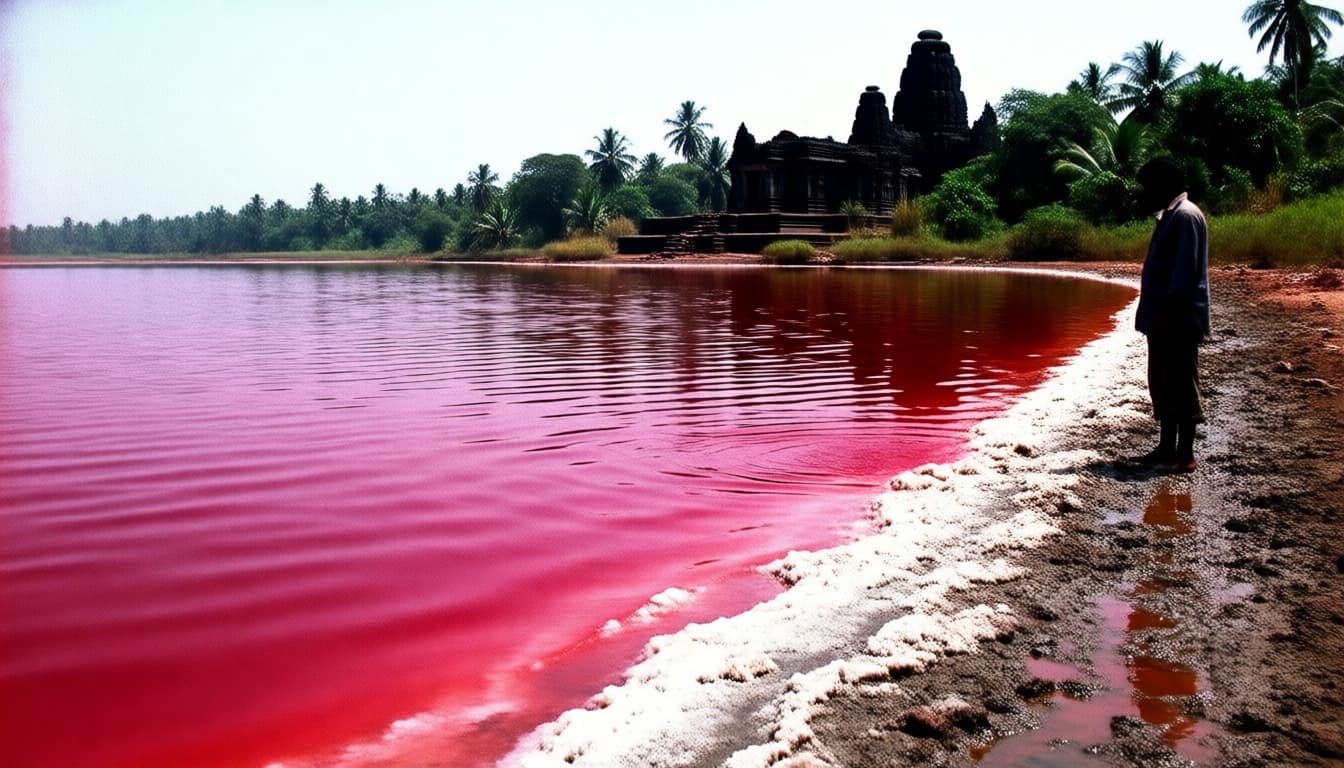
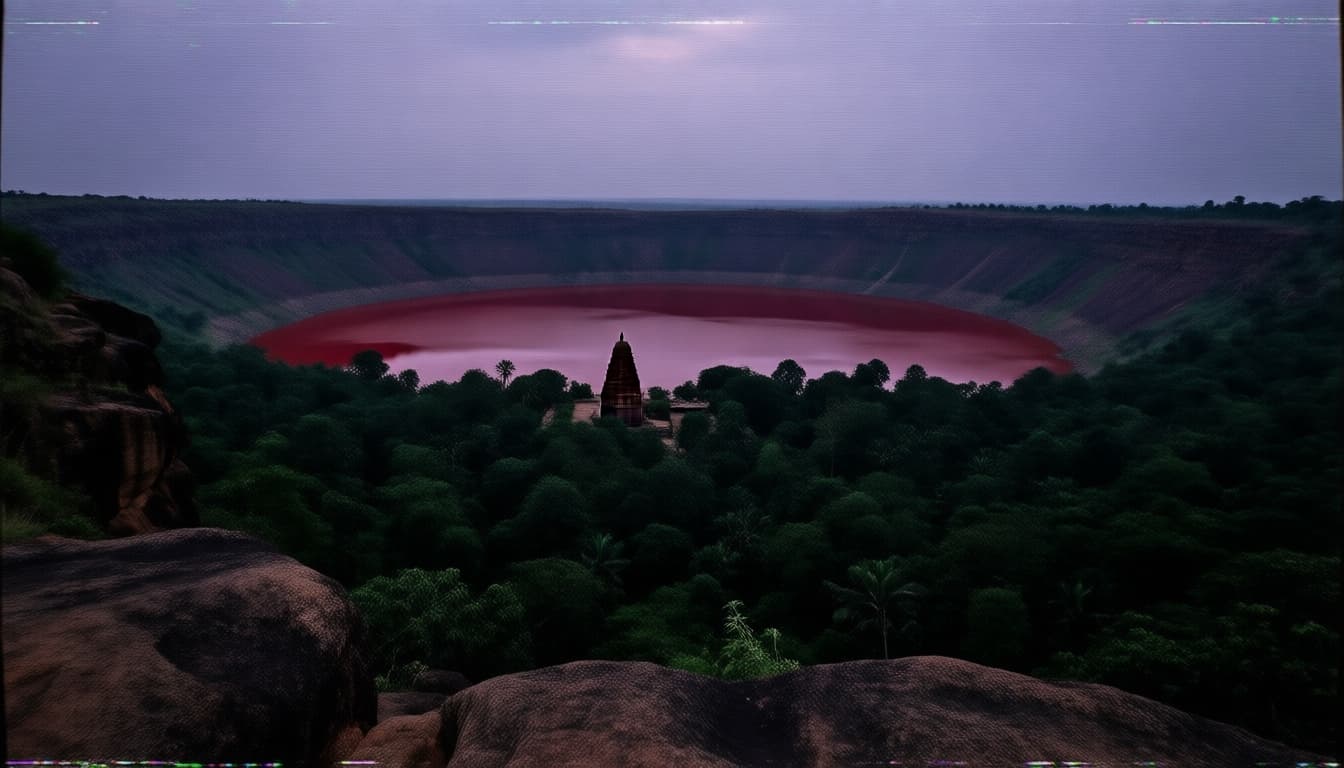
In June 2020, this closed ecosystem astonished the world. In under 48 hours, the entire 1.8-kilometer expanse of the lake transformed from deep emerald green into a shocking, vivid blood-pink. Scientists attributed the shift to a sudden bloom of haloarchaea spurred by rising salinity, yet the exact biochemical mechanism allowing such an immense body of water to turn red overnight as if it were a single living organism remains an enigma.
NASA and planetary scientists now treat Lonar Crater not merely as an earthly oddity, but as an analogue of ancient Mars. Craters like Gusev and Jezero on Mars were also formed in basaltic crust and once held mineral-rich waters. Lonar is an alien laboratory of life forged where our planet collided with cosmic violence.
Standing on the crater's rim at twilight, even the howling winds of the Deccan Plateau fail to disturb the dense water 150 meters below. A glassy wound carved by 300,000 atmospheres of raw celestial pressure, and within it, an ancient bacterial sea silently mimicking the primordial cosmos, quietly laughing at humanity's rigid boundaries of time and geology.
[ CLASSIFIED VERDICT ]
[ACCESS LOG - SOURCE FILE]
Lonar Lake in Maharashtra, India, is the world's only basaltic impact crater lake formed by a meteorite collision between 50,000 and 570,000 years ago, renowned for compass-spinning magnetic anomalies and extreme hyper-alkaline waters. Ancient Hindu epics like the Skanda Purana record descriptions matching a cosmic impact, and in June 2020, the entire lake turned blood-pink almost overnight, baffling observers worldwide.