Voynich Disease: The Whispering Abyss
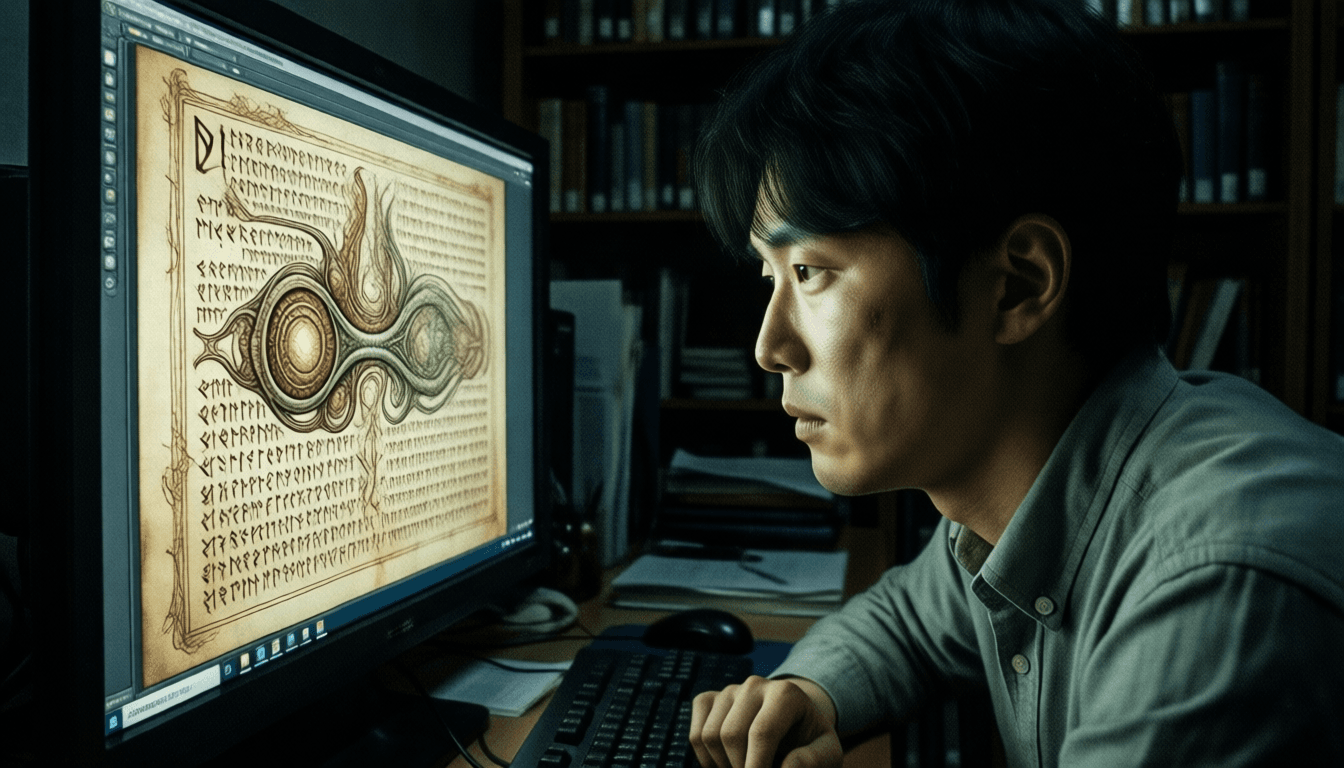
The internet, a crucible of arcane knowledge and shared anxieties, occasionally distills truths too uncomfortable to fully acknowledge. For years, hushed rumors have circulated not about the meaning of the Voynich Manuscript, but its effect. Beyond the well-documented frustrations of cryptographers and linguists, a darker pattern emerged among fringe communities dedicated to its decipherment: the "Voynich Disease." Not a medically recognized condition, but a recurring series of anecdotal testimonies. Seasoned scholars, brilliant amateurs, and obsessive enthusiasts, after prolonged immersion in high-resolution copies, or, rarely, the original itself, began exhibiting peculiar cognitive shifts. Symptoms ranged from chronic, debilitating migraines and acute aphasia, where coherent thought devolved into meaningless phonetic fragments. There were also visual distortions: persistent afterimages of the manuscript's bizarre glyphs superimposed on their vision. More disturbing, a small but consistent number of individuals simply… vanished. Abandoning their research, severing contact, their online footprints often ending abruptly after a final, rambling post hinting at an overwhelming, alien presence within the manuscript. My investigation began with a specific thread in an arcane forum, detailing the abrupt institutionalization of Dr. Alistair Finch, a renowned medieval scholar. His last academic paper, found unfinished, contained not a single coherent sentence, instead filling pages with increasingly erratic Voynich glyphs, and a single phrase written repeatedly: "Listen too deeply, and it whispers."
Access to the digital archives of the university library’s special collections was a hard-won victory after persistent bureaucratic hurdles. While the original manuscript remained under stringent security, this was an exquisitely digitized, high-resolution replica, authorized for academic study. I secured a private research chamber, sterile and temperature-controlled, designed for minimal distraction. The filtered, recirculated air held no scent, and all external sounds were dulled to a distant, muffled murmur. My workstation consisted of a high-spec monitor displaying the manuscript page-by-page in extreme detail, a pristine keyboard, and a voice recorder. My purpose was not decipherment, but to correlate the reported “disease” with physical and psychological markers in a controlled environment. I began with the botanical section, known to be Dr. Finch’s focus. For hours, in clinical silence, the bizarre, otherworldly flora unfurled across the screen. The texture of the vellum, the faded ink, the intricate, alien script—all static and digital, yet possessing an undeniable, almost biological presence. I scrutinized the complex brushstrokes, the subtle variations in ink density, searching for visual anomalies that could explain the reported effects. The room, designed for focus, became a vacuum, pulling me deeper into the manuscript's labyrinthine silence.
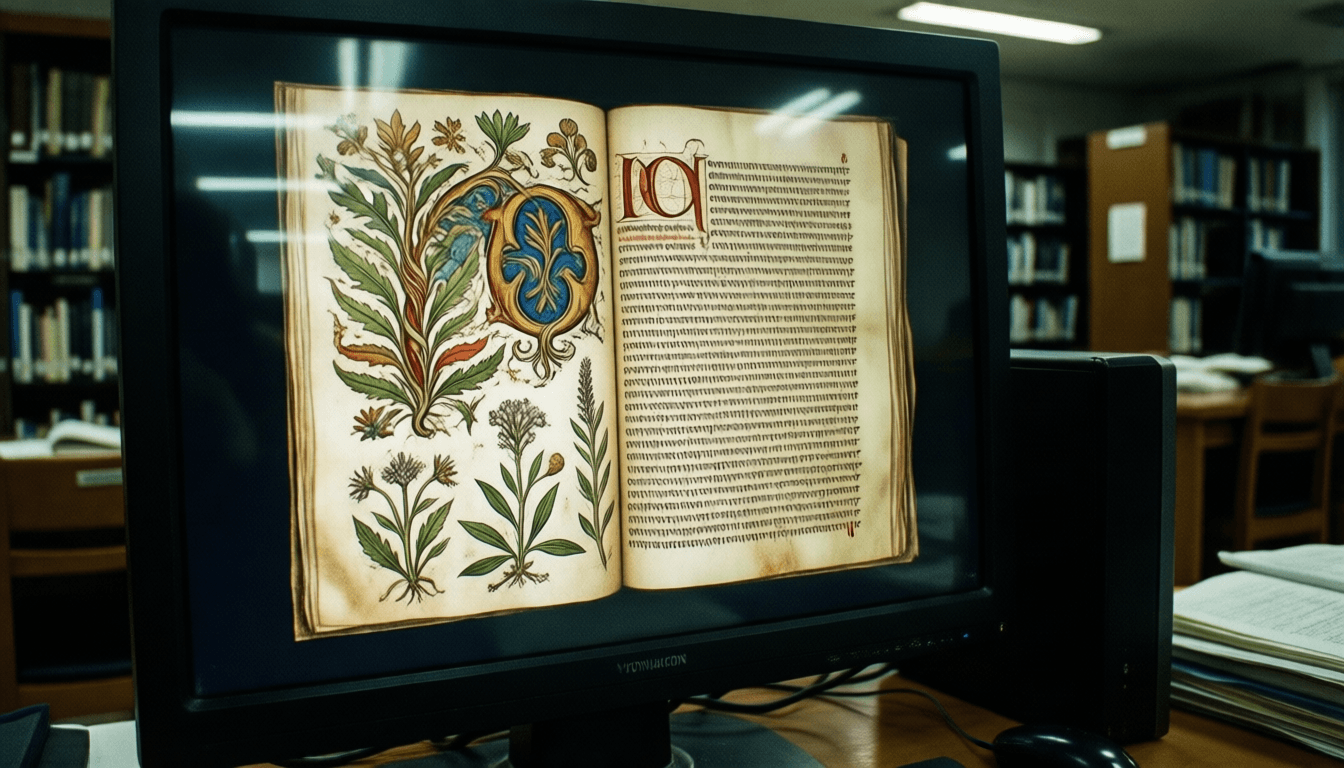
The initial hours were unremarkable, a test of endurance. Then, subtle shifts began. The constant, almost imperceptible hum of the server racks began to phase. Not a technical glitch, but a subtly shifting pitch. The air felt heavy, as if vibrating against an unknown frequency. The temperature, usually stable at 20°C, seemed to fluctuate; cold drafts brushed my skin despite the sealed room, followed by oppressive heat. I meticulously noted these anomalies, checking external meters against my own thermoreceptors, initially dismissing them as psychosomatic.
Soon, however, visual distortions began. The digital image of the manuscript, fixed on the screen, subtly seemed to “breathe.” The delicate lines of the sprawling glyphs, particularly in the margins, faintly undulated, like seaweed in an invisible current. The vellum's texture was not uniform but rippled in sections, creating an impossible sense of depth on a flat screen. I blinked, rubbed my eyes, readjusted the monitor. No change. The longer I stared, the more pronounced the effect. The eyes of the strange “Voynich women” in the botanical section, whose expressions were famously blank, seemed to briefly soften and harden, flashing with an eerie, unknowable significance. Faint, indistinct whispers began at the edges of my hearing. Too indistinct to grasp, yet undeniable, seeming to emanate not from the room, but from a concentrated point on the screen. It was not a sound, but the presence of a sound. My thoughts, normally precise and orderly, became sluggish, as if wading through molasses. A profound sense of disorientation washed over me, a deep loneliness as if utterly isolated from the outside world. It was as if only the room and the manuscript were real.
The whispers were no longer phantoms. They amplified into a cacophony of urgent, indecipherable voices, emanating directly from the screen. They burrowed inward, forming a dense, guttural cloud of impossible syllables, scratching at my eardrums, rattling the bones of my skull. The monitor's illumination, previously a calm, steady light, exploded into dazzling, pulsing flashes, synchronized with the rhythmic waves of alien speech. The glyphs on the screen no longer merely undulated. They writhed, peeling themselves from the digital matrix, coalescing into impossible, shifting patterns that clawed at the edges of my vision. The room’s air, once merely heavy, became unbearably dense, crushing my chest, making breathing a desperate, burning effort. My inner monologue, once an anchor of reality, began to fragment. Familiar words—"monitor," "research," "breathe"—shattered into dissonant sounds, replaced by the relentless, invasive patterns of the manuscript echoing in my mind.
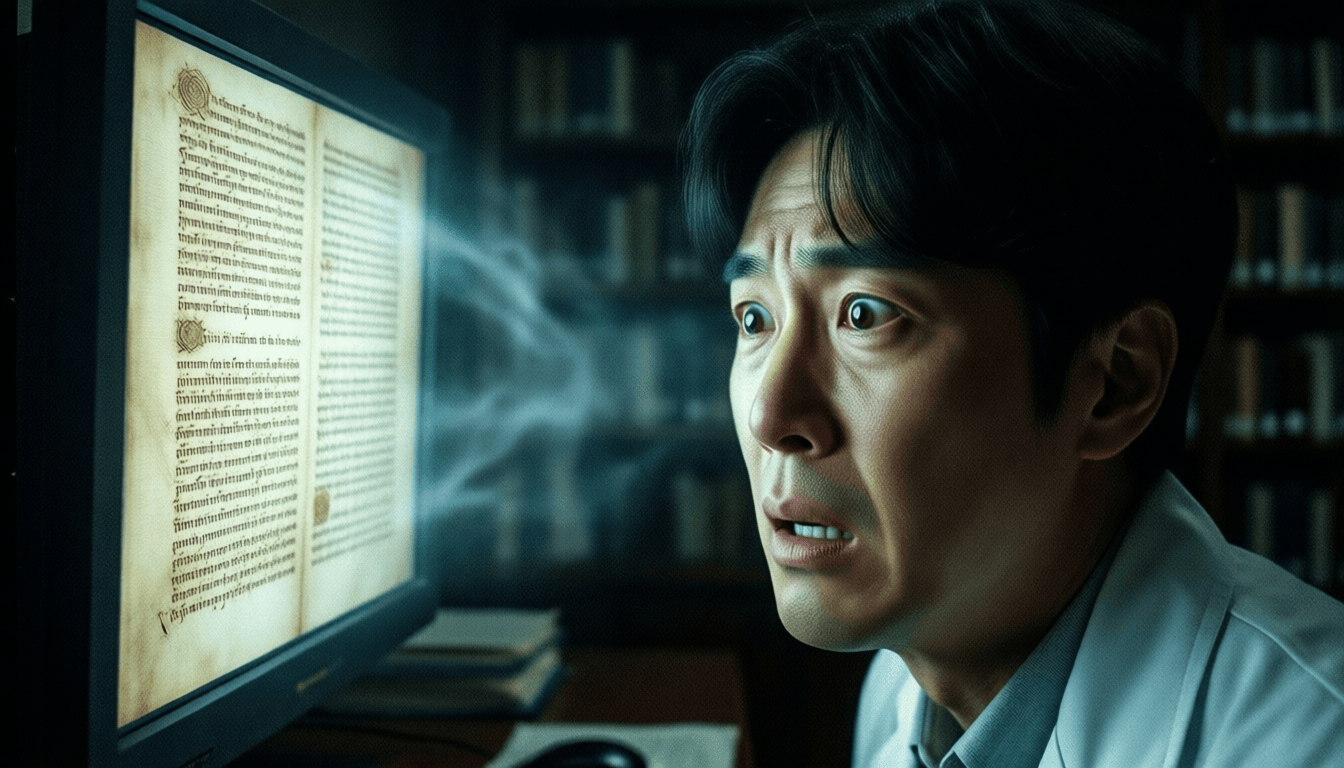
Suddenly, the screen itself rippled. Not a malfunction, but like a liquid surface under extreme pressure. From its depths, unknowable glyphs, pulsating with light, seemed to extend outwards as glittering, insubstantial tendrils of pure information. They reached into the room, soundlessly, swiftly, too fast to track, too dense to comprehend. One touched my hand, resting on the keyboard. Not a physical contact, but a searingly cold pressure, a backfire-like sensation that struck my nervous system, paralyzing me, preventing even a scream. My vision blurred, overwhelmed by the fractal geometry of impossible Voynich script, transforming into a vortex that sucked my consciousness into its unreadable core. I was trapped, impaled in my chair, my mind being disassembled under an onslaught of pure, unfiltered alien data. The threat was not to my body, but to the very fabric of my cognition. The tendrils burrowed deeper, silently dissecting my thoughts, replacing them with the raw, meaningless noise of the manuscript.
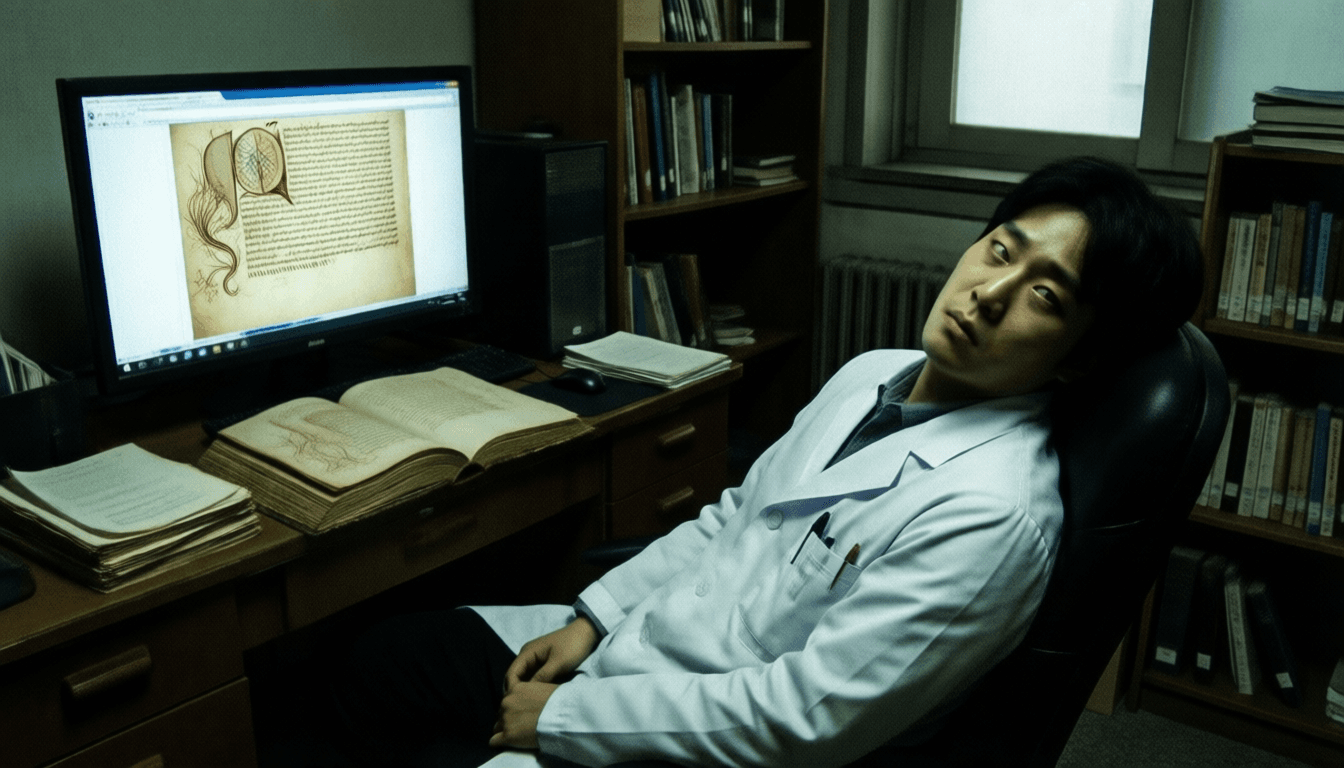
They found me hours later. Slumped in my chair, eyes wide but unfocused, staring at the perfectly still digital manuscript on the monitor. The room was normal. The server racks hummed consistently. There was no evidence of power surges or flickering lights. My body was intact, but rigid and unresponsive.

I was conscious, but my inner landscape was irrevocably altered. When spoken to, sounds were recognized, but the words themselves seemed to melt before reaching comprehension. My mind, once an orderly library of language, was now a fragmented kaleidoscope of manuscript glyphs, endlessly shifting, echoing with the faint, persistent whispers of alien syllables that only I could hear. I could no longer form coherent sentences. Attempts to write filled pages with intricate yet meaningless Voynich-like script, my hand moving with unconscious precision. The world’s logic felt distant, twisted.
Every printed word, every street sign, every digital display would momentarily shimmer, the text fleetingly transforming into the impossibly complex, utterly unreadable language of the manuscript. But the most chilling detail was at the periphery of my vision: the same faint, swirling patterns of incomprehensible glyphs, like persistent, silent snowflakes, always there, subtly superimposed over reality. It was not a disease of the eyes, but of the mind. A hole, perpetually open, to the alien core of the manuscript. I had sought to understand the disease, but instead, became its most recent, living testament.
[ CLASSIFIED VERDICT ]
[ACCESS LOG - SOURCE FILE]
The Voynich Manuscript is an ancient document that remains undeciphered, its content and origin shrouded in centuries of mystery. This story is based on an urban legend concerning "Voynich Disease," a peculiar cognitive shift experienced by scholars who delve deep into its study. Those afflicted suffer from chronic migraines, aphasia, and hallucinations, with some even vanishing without a trace during their research.