The Melon Heads of Wisner Road
Among the declassified 1979 documents from the Lake County Health Department in Ohio was a maintenance log for the drainage culverts along the abandoned northern stretch of Wisner Road in Kirtland. The log did not describe typical silt accumulation. The nine concrete culverts excavated by the road crew had not been blocked by dirt, but by the carcasses of animals whose marrow had been entirely scraped clean, braced behind meticulously stacked slabs of river shale. Wedged into the iron grates with wet clay were dozens of human deciduous teeth—every single baby tooth arranged with its root pointing outward.
For generations, the local urban legend of the 'Melon Heads'—feral children with deformed, bulbous skulls abandoned in the wilderness—had been dismissed as juvenile campfire folklore. However, cross-referencing Lake County property registries between 1968 and 1982 reveals an unsettling reality. A prime three-mile parcel of lakefront hemlock forest had been officially reclassified as an 'Active Biological Containment and Erosion Buffer Zone,' strictly barring all civilian access and development for decades.
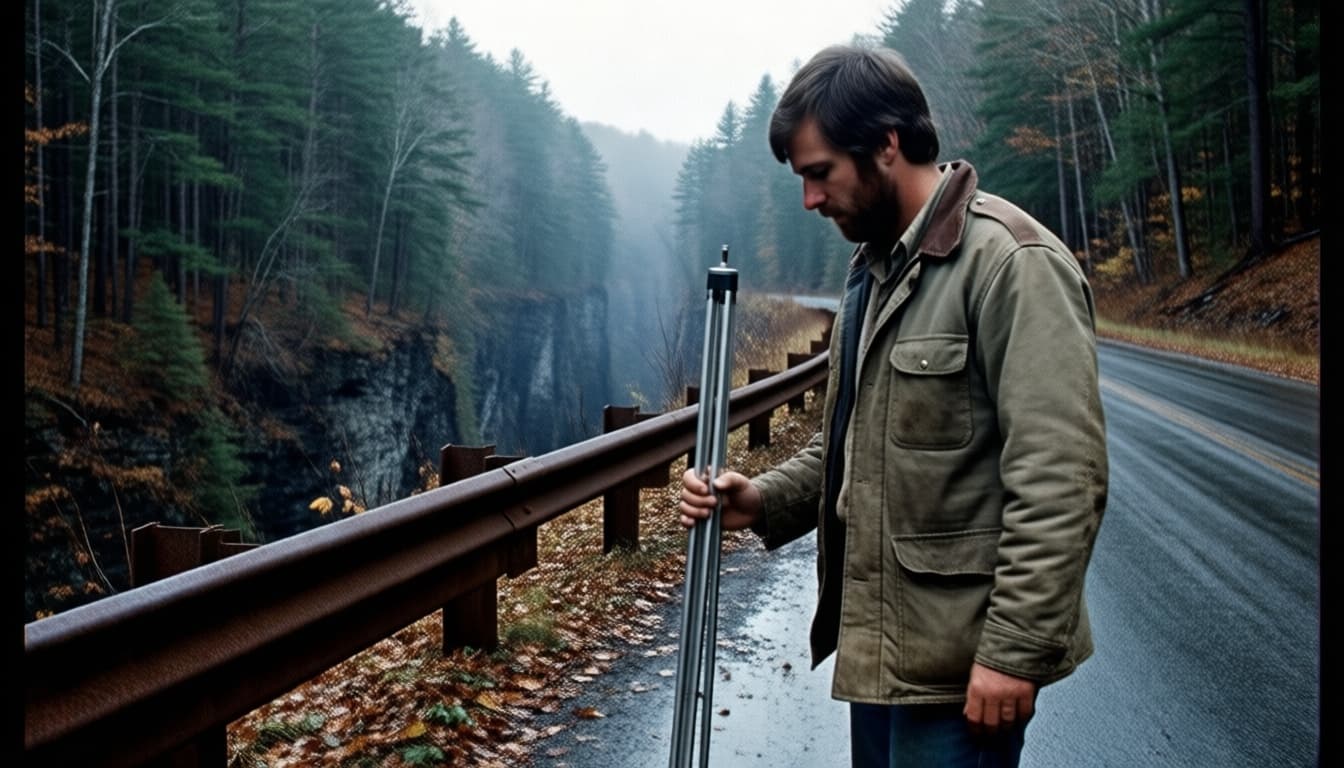
In early November, just before the season's first frost, I ventured into that forest under a hydrological contract to trace unauthorized discharge into the Chagrin River. Past a rusted guardrail stripped of its paint, Wisner Road vanished into nothingness. The sheer shale bluff plunged forty feet down into a churning grey torrent, crumbling beneath every step. Beneath the dense canopy, even at two in the afternoon, dusk seemed already to have settled. A pungent, alkaline stench of rotting shale and stagnant swamp gas rose from the sodden floor of dead hemlock needles.
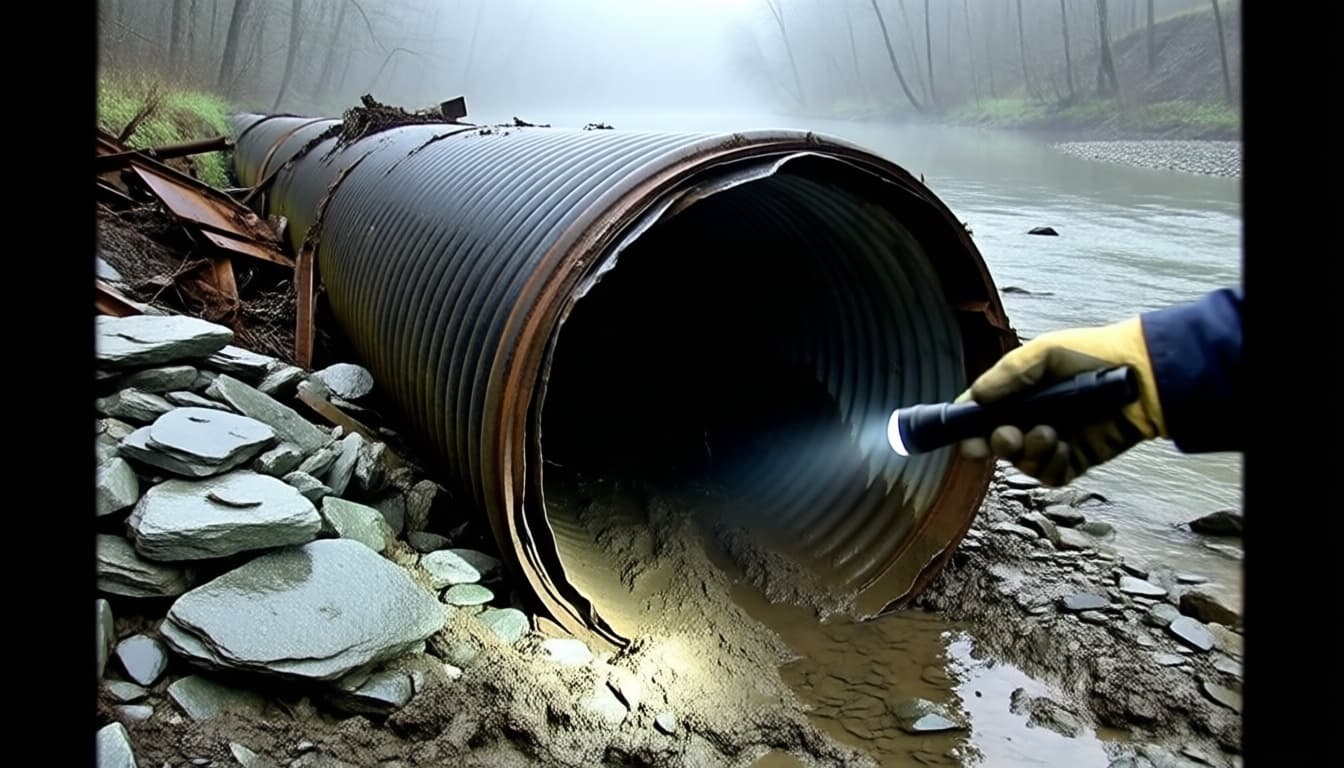
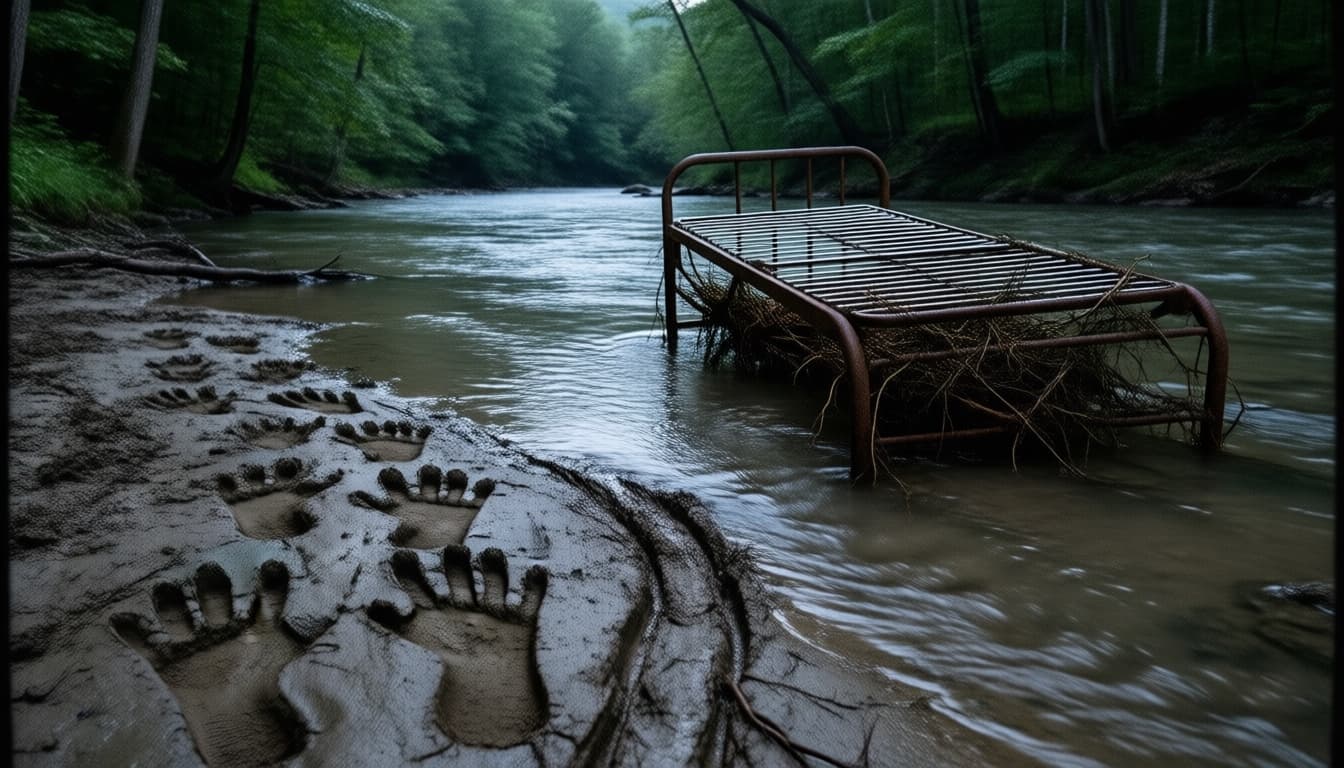
When I located an uncharted outflow conduit, the heavy corrugated steel pipe was crushed flat, as if crushed under an impossible downward mass. Brushing my fingers across the mud at the pipe's mouth, my blood ran cold. The impressions left in the silt were neither hiking boots nor animal tracks. They were abnormally broad human palm prints, accompanied by deep dragging trenches left by a heavy, low-slung weight brushing the earth.
To test the bedrock density, I struck the shale cliff face with my steel surveying rod. A crisp metallic ring echoed through the gorge, but the reverberation was wrong. The echo did not return from across the gorge; instead, three erratic taps clinked back from three separate points downstream, separated by deliberate four-second intervals. The final sound was not metal at all. It was the sharp, rhythmic clack of two river stones being struck together in the dark, like a deliberate reply.
The birds in the canopy had retreated to the highest boughs, entirely silent. Along the trunks of the red oaks and hemlocks, precisely eighty centimeters from the ground, the bark had been buffed to a smooth sheen. It was not the rubbing of deer antlers. It was the friction of greasy, repetitive contact with living flesh, leaving behind coarse bleached hairs and a rancid reek of sour milk and oxidized copper. The needle of my pocket compass swung erratically toward the riverbank, pulled by rusted iron bed frames and crushed surgical washbasins half-buried in the silt upstream.
The moment I decided to turn back, breath caught in my throat. The shale slope I had slid down fifteen minutes earlier was gone. Someone had gouged out the lower foundation, converting the path into a vertical, four-meter wall of raw mud. Before panic could fully set in, the sound of parted water rose from the upstream riffles. It was not a splash, but the steady, deliberate tread of something displacing the river's weight.
What emerged into the gloaming was no wild beast. It was the body of a full-grown adult, grotesquely warped by decades of closed-bloodline isolation. Standing barely four feet tall, its torso was corded with thick, rope-like muscle, while bowed limbs were adapted for knuckle-walking quadrupedal motion. And resting upon those shoulders was a monstrous, hydrocephalic skull, its skin stretched so sheer and translucent that thick, pulsating blue veins bulged visibly against the pressure of trapped fluid. Its milky, unfocused eyes never blinked. Its jaw hung slack, venting wet, whistling wheezes driven by severe intracranial compression.
The instant our eyes met, another silhouette dropped from a fracture in the shale cliff behind me. It did not leap through the air; it scrambled horizontally across the mud with sickening, low-centered agility. Blunt fingers, calloused to the point of lacking fingernails, seized my calf and dragged me violently toward the half-submerged culvert. Paralyzed with terror, I drove the tapered end of my steel surveying rod down with all my weight.
The steel point buried itself deep near the creature's shoulder joint. No human scream followed. Through clenched teeth came a deafening, wet hiss, and from the puncture erupted a pressurized jet of dark blood mixed with sickeningly sweet, pungent cerebrospinal fluid. As its grip loosened, I scrambled through the freezing, waist-deep current, clawing up the exposed hemlock roots of the opposite bank. As I hauled myself over the crest, pale, swollen hands broke the surface of the river below in unison, clapping stones together in a frantic, deafening rhythm that rattled the entire valley.

When I reached my truck with freezing limbs, there was nothing I could write in my official report. Mentioning feral, hydrocephalic figures in the woods would have cost me my license and earned me a psychiatric hold. I closed the file citing severe ground subsidence and an assault by aggressive trespassers. Two weeks later, the Lake County Metroparks quietly purchased ninety acres around Wisner Road without a single public hearing. Heavy equipment moved in, but they did not build trails. Instead, they poured thousands of tons of concrete aggregate, permanently entombing every ancient stone culvert exposed along the gorge.
Six months later, while cleaning my field kit, I found dried matter encrusted around the threads of my surveying rod. Placing what I thought was dried mud beneath a magnifying lens, I discovered a calcified fragment of skull bone, barely two millimeters thick, curved at an impossible angle. Embedded dead center in that bone fragment was a rusted surgical staple—the exact kind used in pediatric operating theaters during the 1950s.

[ CLASSIFIED VERDICT ]
[ACCESS LOG - SOURCE FILE]
Based on the famous Ohio urban legend of the 'Melon Heads,' rumored to haunt the dense hemlock woods and gorges around Wisner Road in Kirtland. According to folklore, hydrocephalic orphan children were subjected to cruel medical experiments by a sadistic doctor in a hidden facility, until they revolted, killed him, and retreated into the ravine drainage networks to live on as feral creatures.