The Infrasound Predator of Devil's Hollow
On November 14, 2021, bioacoustic monitoring Node 14-B, deployed by the Arkansas Game and Fish Commission in the Buffalo National River Wilderness, went abruptly dark. There was no preceding indication of mechanical failure or severe weather. The final 34-second audio burst transmitted before the cutoff captured an anomalous infrasonic pressure wave between 14 and 19 Hertz at an extraordinary sound pressure level of 118 decibels. Stranger still was the microbarometer telemetry: atmospheric pressure inside the limestone box canyon plunged by 26 millibars in just four seconds—a drop typical of the core of an EF-2 tornado. Two days later, a field technician's truck was discovered downstream. Its windshield had not been struck by any projectile; instead, it was pulverized into a precise hexagonal spiderweb fracture pattern, a phenomenon seen only during exposure to continuous resonant frequency. On the technician's recovered tablet, left beside his ruptured eardrums, was a single typed sentence: "Sound has weight."
Where the soil thinned out between the scrub pines and bare gray limestone bedrock emerged, I entered the sheer vertical gorge of Devil's Hollow, locally referred to as 'The Devil's Basin.' The karst topography of the Ozarks is not solid ground; the entire foundation beneath one's boots is a cavernous honeycomb of sinkholes, hollow voids, and underground drainages. Barely twenty paces from the ridge down to the dry wash, the air turned glacial, the mercury dropping more than eight degrees Celsius almost instantly. Condensation bloomed across the cold metallic casing of the precision acoustic recorder and thermal imaging gear slung across my back.
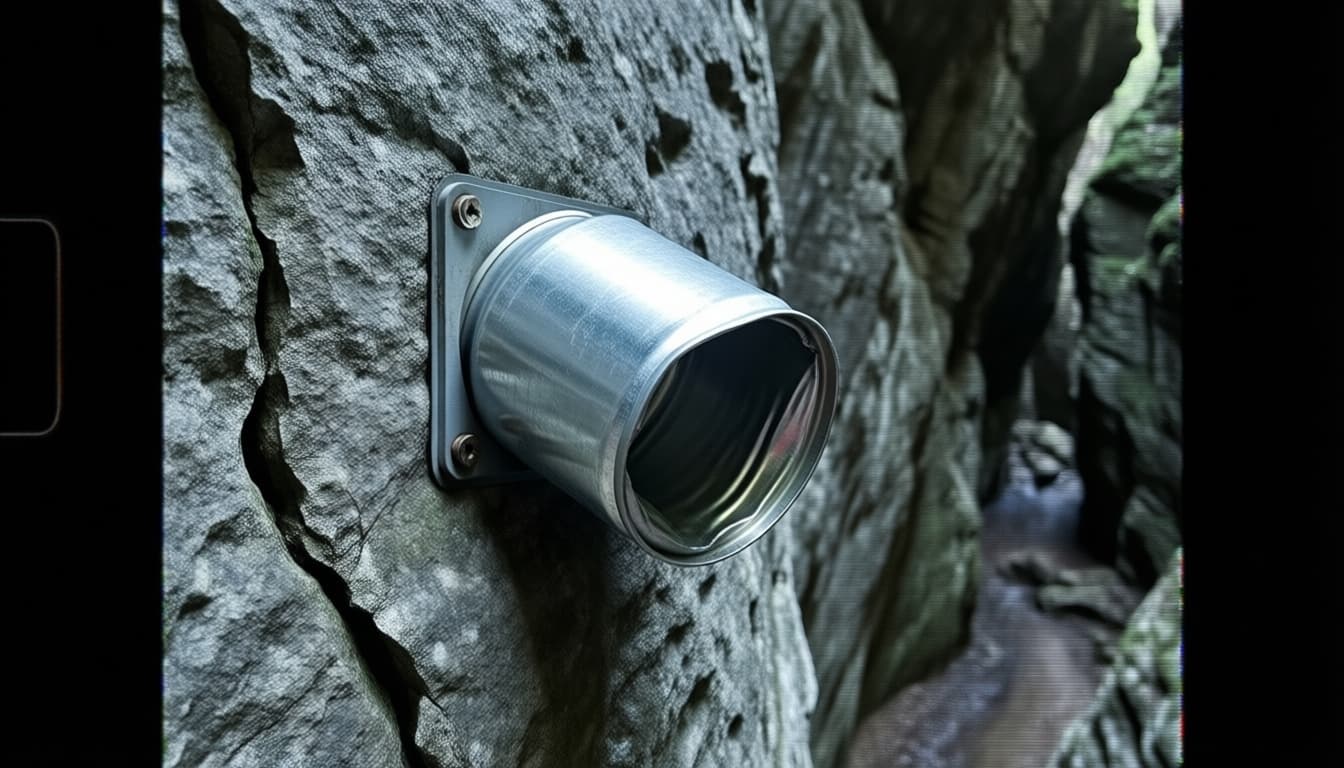
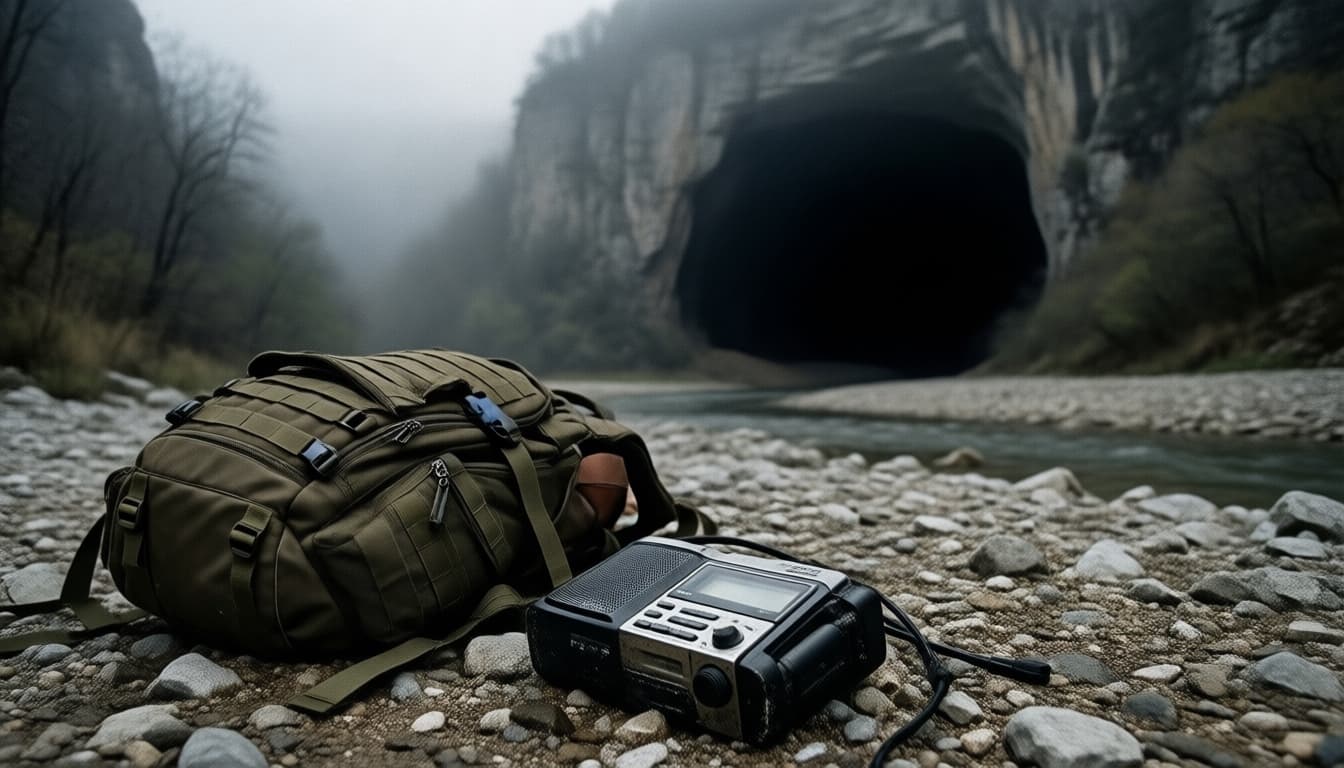
Reaching the dry creek bed, I found chunks of dolomite and limestone scattered with bizarre, unnatural fracture planes. These were not the product of natural freeze-thaw cycles; the stone had been sheared cleanly along its crystalline grain, as though subjected to sustained, high-intensity vibratory shear. My breath hitched when I located Node 14-B bolted into the canyon wall. The heavy-duty aluminum wind-screen shielding the acoustic capsule had not taken a physical strike—it was compressed inward with absolute uniformity, like an empty tin can flattened in a hydraulic press.
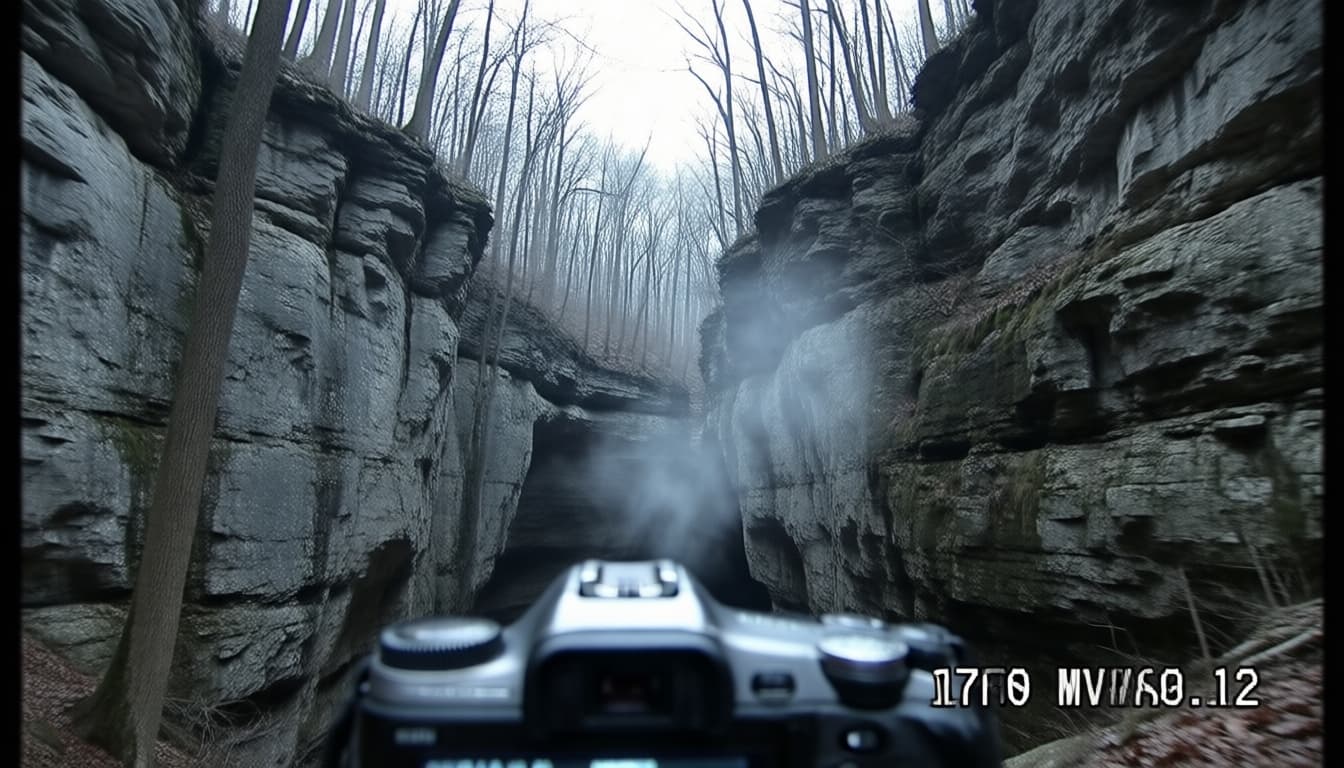
To gauge the local acoustic profile, I shouted a sharp monosyllable toward the sheer cliff thirty meters ahead. No echo bounced back from the rock face. It had not vanished, however; after a jarring three-second delay, my own voice crawled upward from the porous subterranean fissures directly beneath my feet. Sound was not dispersing into the atmosphere—it was being pulled into the earth, reverberating from deep within the rock under my boots.
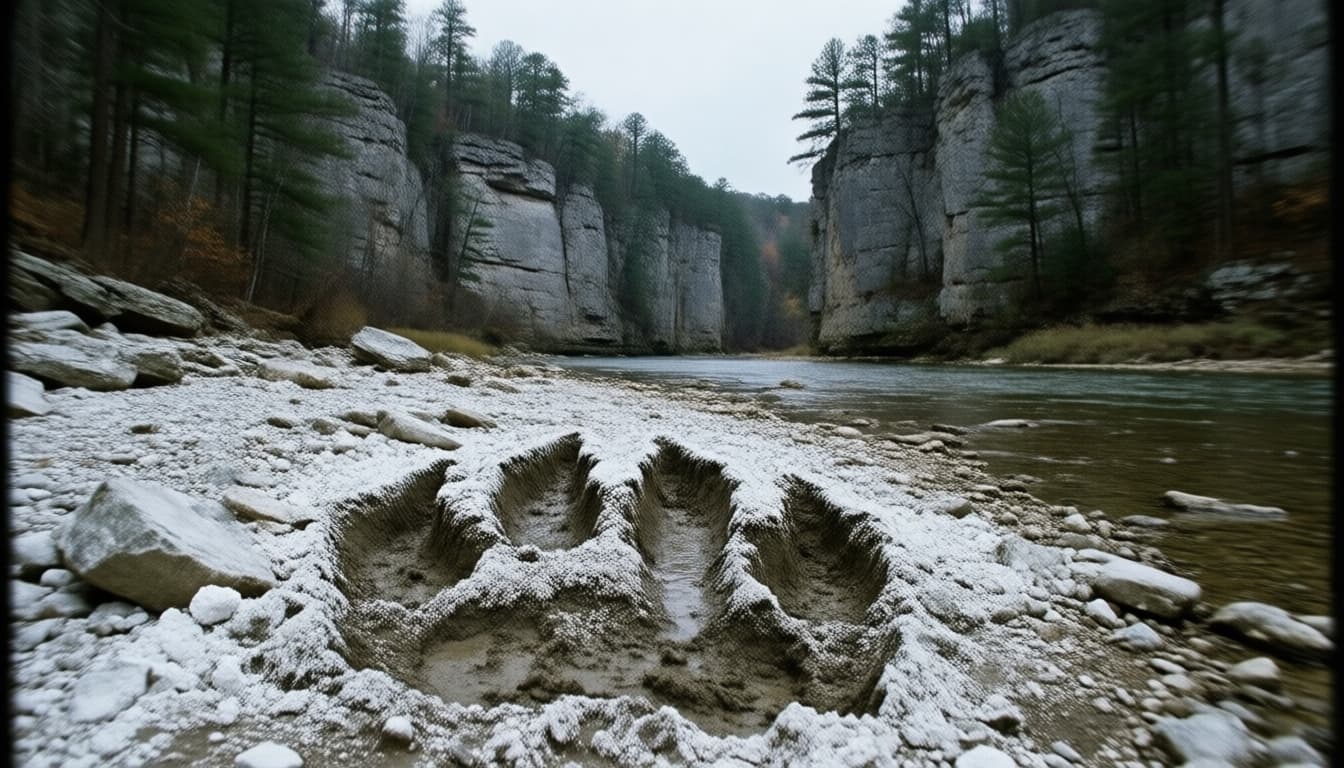
Suddenly, the edges of my peripheral vision degraded into fluttering gray afterimages—a known mechanical illusion caused when the human eyeball is forced into resonance at around 18.9 Hertz. A dense vibration hammered against my sternum, creating a sickening sensation that the entire canyon horizon was pitching downward. Cold sweat dripped past my temples. In that suffocating, insect-free vacuum, I noticed a fresh depression pressed into the damp creek sediment. It was neither bear nor mountain lion: four thick, splayed toe impressions sunk more than ten centimeters deep, surrounded by river gravel crushed into fine white powder under an estimated downward mass of over four hundred kilograms.
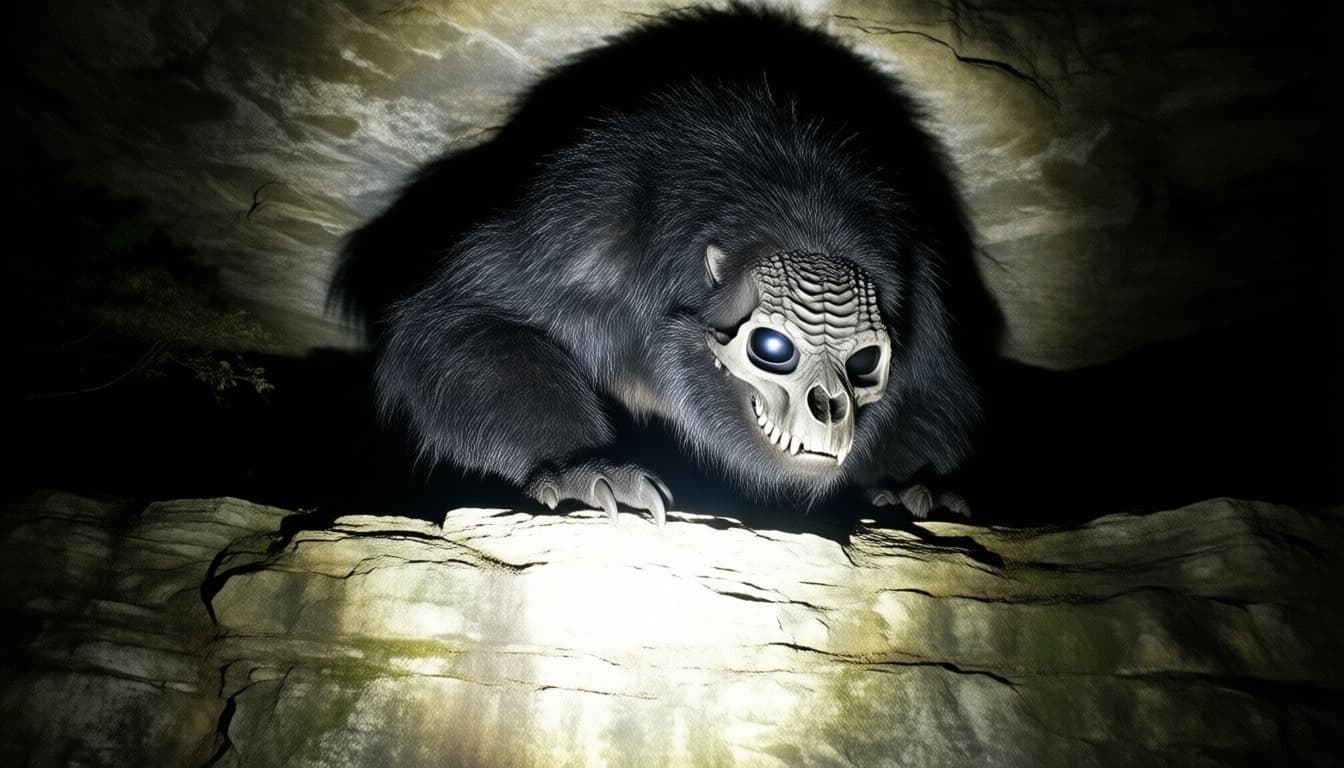
A sharp crack echoed from the rim above. Dolomite rubble rained down, sealing the sole exit from the box canyon and completely cutting off my retreat. Dense, freezing air laden with the stench of hydrogen sulfide hissed from the bedrock fissures. Lifting my gaze, I froze. Perched on a smooth, ninety-degree limestone shelf—a ledge impossible for any known quadruped to scale—something was crouched in the shadows. It did not move like a living animal creeping forward; it drifted smoothly along the rock, sliding without visible joint movement like an engineered mechanism.
I trained my high-output searchlight upward. The beam did not illuminate reflecting retinas. Where tapetum lucidum eye-shine should have flared, there were only two sunken, light-absorbing discs of dead, obsidian blackness. A massive frame draped in coarse, soot-black matted fur, abnormally hunched shoulders like those of an American bison, and an undulating bony cranial crest swept back into the gloom. The creature displayed none of the nervous caution typical of an apex predator stalking prey.
It did not roar. It discharged the entirety of its internal air pressure at once. A devastating shockwave of compressed atmosphere—a horrifying sonic rupture blending grinding iron, the rutting whistle of an elk, and the sudden release of a high-pressure pneumatic valve—struck the canyon floor. The invisible blast tore the breath straight out of my lungs. With a sickening wet pop and a surge of scalding liquid from my right ear, my body was hurled against the limestone wall. Even as my vision faded into black, I saw it: the beast plummeted from the five-meter shelf to the gravel bed, yet produced no sound on landing. No stone rolled; no physical kinetic shock was transferred into the earth despite its immense bulk.
A suffocating heat smelling of stagnant cave water, decomposing limestone, and oxidized copper washed over my face. The entity did not tear my flesh. It simply rested one heavy forelimb atop my field pack. The aluminum frame and custom acoustic telemetry hardware collapsed like cardboard under the weight. After six agonizing seconds of burning, subterranean exhalations against the back of my neck, the creature wheeled with impossible fluidity and vanished into the unmapped, yawning mouth of a fissure cave.
Crawling back to the access road at daybreak, I was recovered by a ranger patrol; the hearing loss in my right ear proved total and permanent. The AGFC regional office quickly classified the recovered data as 'equipment failure caused by sensor malfunction.' Yet an unofficial spectrogram analysis leaked from the data burst revealed a detail conspicuously omitted from the official report. During those final three seconds when the creature stood over my neck, buried beneath the deep rumble of infrasound, a faint, crystalline audio track was recorded. It was not an animal call. It was a mechanical, pitch-perfect mimicry of the exact words I had spoken into the canyon hours earlier:
"...Is anyone down there?..."
[ CLASSIFIED VERDICT ]
[ACCESS LOG - SOURCE FILE]
This story is inspired by the folklore of the 'Ozark Howler,' a legendary cryptid said to roam the deep limestone box canyons of the Arkansas Ozarks and Buffalo National River. It combines the myth with real-world acoustic anomalies of subterranean karst sinkhole systems—specifically extreme infrasonic resonance and sudden localized barometric drops that disorient the human nervous system.