Nazca Lines: Resonance of the Living Ground
For centuries, the Nazca Lines have remained a mystery. Not just their colossal scale or intricate architecture, but the very process of their creation and existence. Archaeologists speculate they are ancient astronomical calendars, ritual pathways, or territorial markers. However, local legends whisper a deeper, stranger truth. Pilots flying over the area often report unpleasant phenomena, especially at dusk or dawn: sudden, inexplicable dead air, brief but extreme disorientation, or visual distortions causing specific, lesser-known figures to appear subtly 'moving' as if rippling. More chilling are recent, albeit anecdotal, testimonies from independent drone operators. In two separate incidents, six months apart, advanced surveying drones momentarily lost telemetry over the 'Lizard' geoglyph before performing erratic, impossible maneuvers and crashing. The recovered black boxes showed no mechanical failures. Instead, they recorded high-frequency, unnatural electrostatic pulses effectively 'jamming' the guidance systems, seemingly originating directly from the 'ground itself' of the targeted figure. No rational explanation has ever been presented. These are not isolated reports; they are a persistent, underlying phenomenon in the operational records of anyone attempting to map too closely the less-explored regions of the Nazca Pampa.
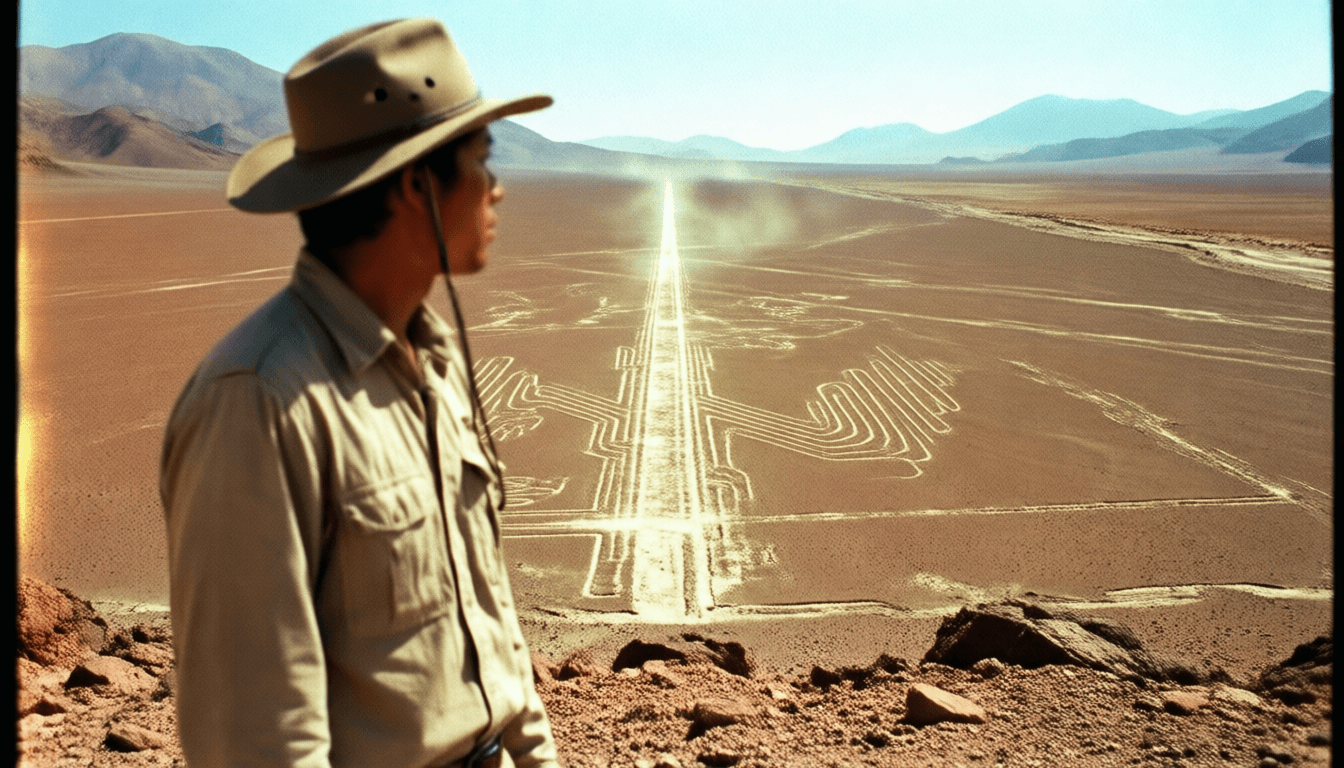
Intrigued by these repetitive and specific anomalies, I headed to the Nazca Pampa. My goal was to verify the claims regarding the 'Lizard' geoglyph (figure 118 in some classifications) and the recorded electrostatic pulses. The landscape was a cruel master. The air was bone-dry, thick with the scent of sun-baked earth. When the wind blew, fine red dust flew, stinging my eyes. From the observation tower, the famous figures stretched out impossibly clear on the ochre plain, etched with eerie precision onto the desert surface. However, the 'Lizard' was far from the tourist paths, extending for a mile in a serpentine shape across a secluded plateau.
As I approached on foot with specialized long-range acoustic sensors and a modified drone, the sheer scale of the desert began to overwhelm me. The oppressive silence was broken only by the crunching of my boots on the gravel. The heat was relentless, creating shimmering mirages on the horizon that made judging distances difficult. As I neared the reported incident spot, the air seemed to thicken, and a subtle pressure built in my ears. The drone I deployed for initial scans resisted an unseen current, its normally steady flight path faltering, and I quickly recalled it. The ground, a mix of dark stones and lighter scratched earth, felt unsettlingly stable, almost immobile.
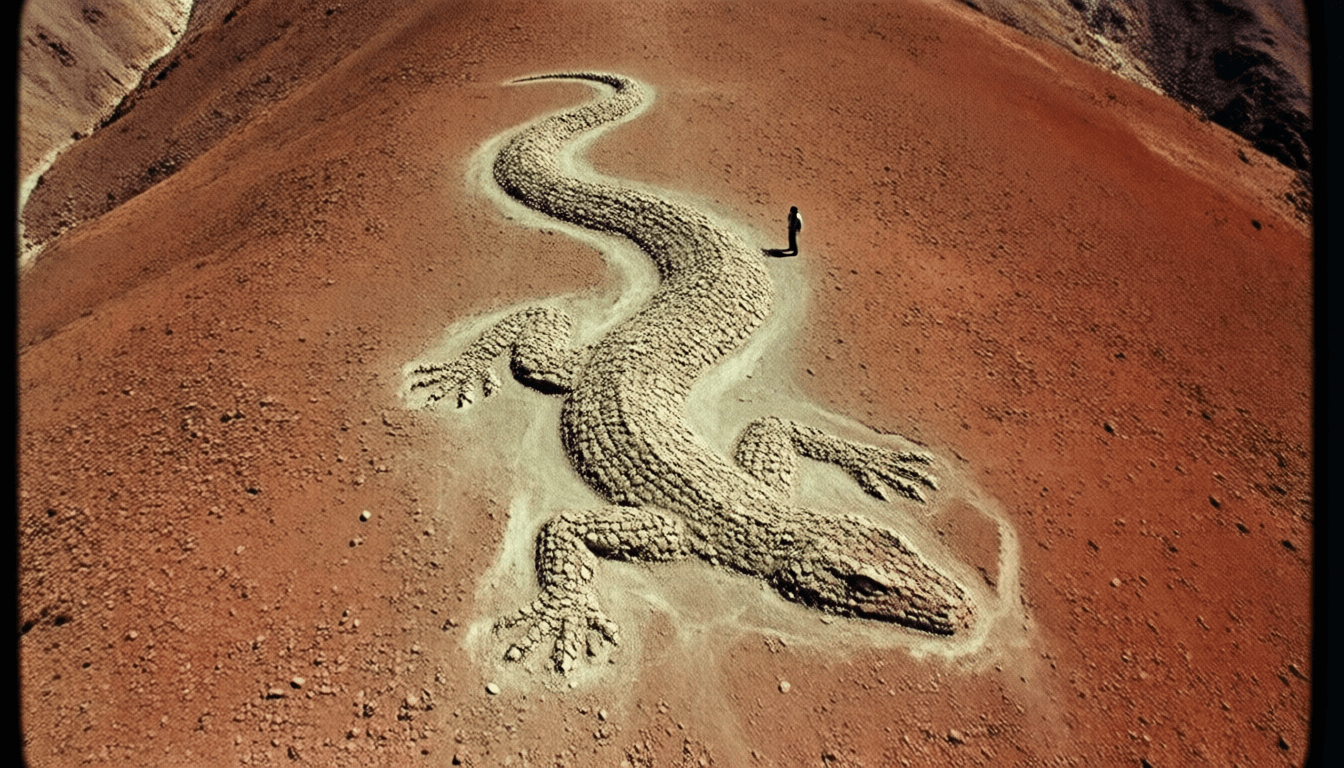
As I stepped onto the ancient boundary of the 'Lizard' geoglyph, an unsettling shift occurred. The oppressive silence deepened, becoming absolute. My footsteps, once distinct, now sounded muffled, as if the air itself absorbed the sound. My handheld acoustic sensor, calibrated for sub-audible frequencies, began detecting a faint, rhythmic hum. An almost imperceptible, deep, resonant frequency that seemed to emanate directly from the ground beneath my feet, vibrating through my boots. It wasn't the wind, nor was it a seismic tremor. It was something intrinsic to the earth 'itself'.
The light, though intense, seemed to behave strangely here. Shadows cast by the low stones appeared sharper, yet at the same time, their edges seemed to subtly waver. This defied the absolute stillness of the air. The lines of the lizard, formed by clearing dark surface stones to expose lighter earth, felt impossibly deep. They weren't merely scratches on the surface; they appeared recessed or carved into a different, darker material. Looking down the length of the figure, a slight disorientation set in, like a subtly warped vision. The distant tail of the lizard seemed to pulse, not from heat haze, but from an almost imperceptible optical effect. The hum intensified, a low thrum vibrating through my chest, making my breathing feel shallow. The small, dark pebbles forming the edges of the geoglyph, though undisturbed by wind, occasionally clicked against each other with a dry, unsettling sound.
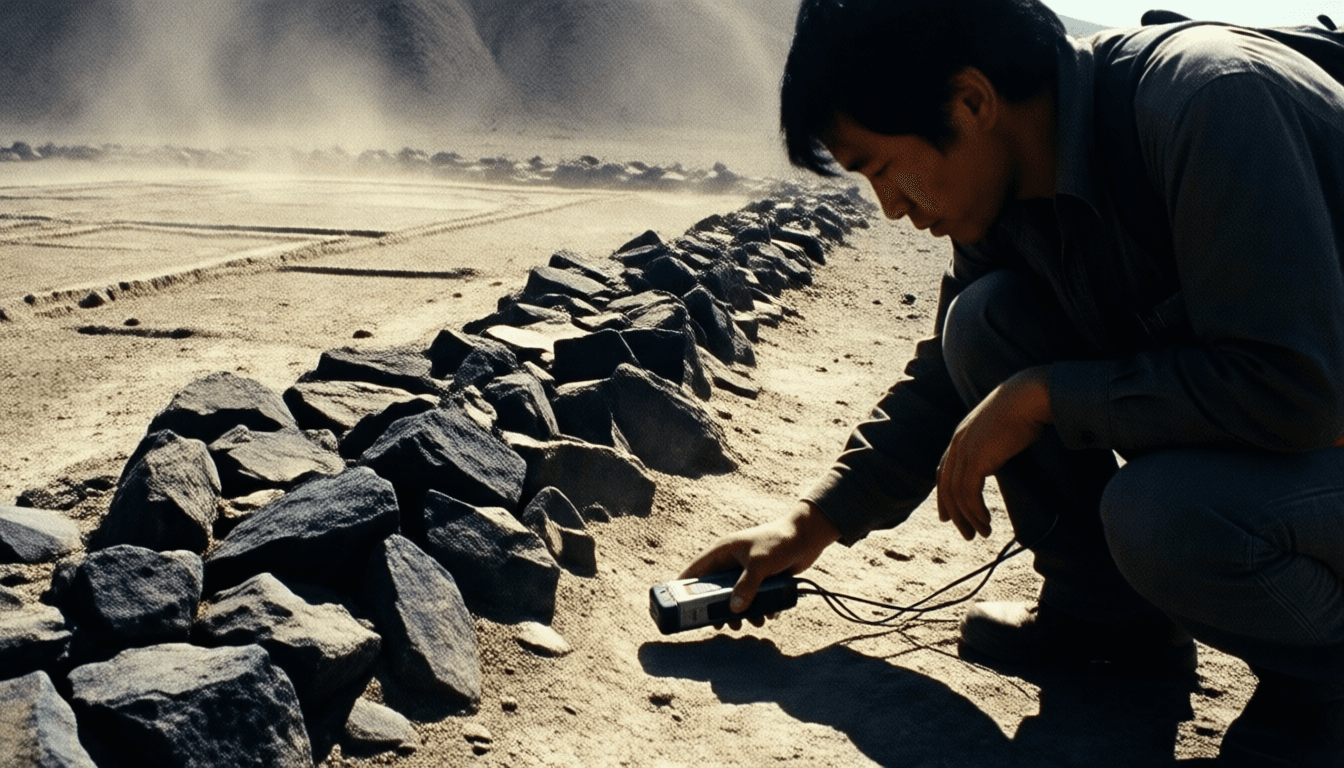
I stood near the 'head' of the lizard, and the hum was now a physical presence, vibrating through my teeth and skull. The air had become incredibly heavy, thick and resistant as if I were underwater. My acoustic sensor peaked, registering a low-frequency resonance overload. Then, without warning, the ground beneath my feet 'moved'. It wasn't a tremor, nor was the earth shaking. It was a profound, almost fluid undulation, as if the solid desert floor briefly ceased to be solid. I lost my balance, stumbled, and fell to my hands and knees.
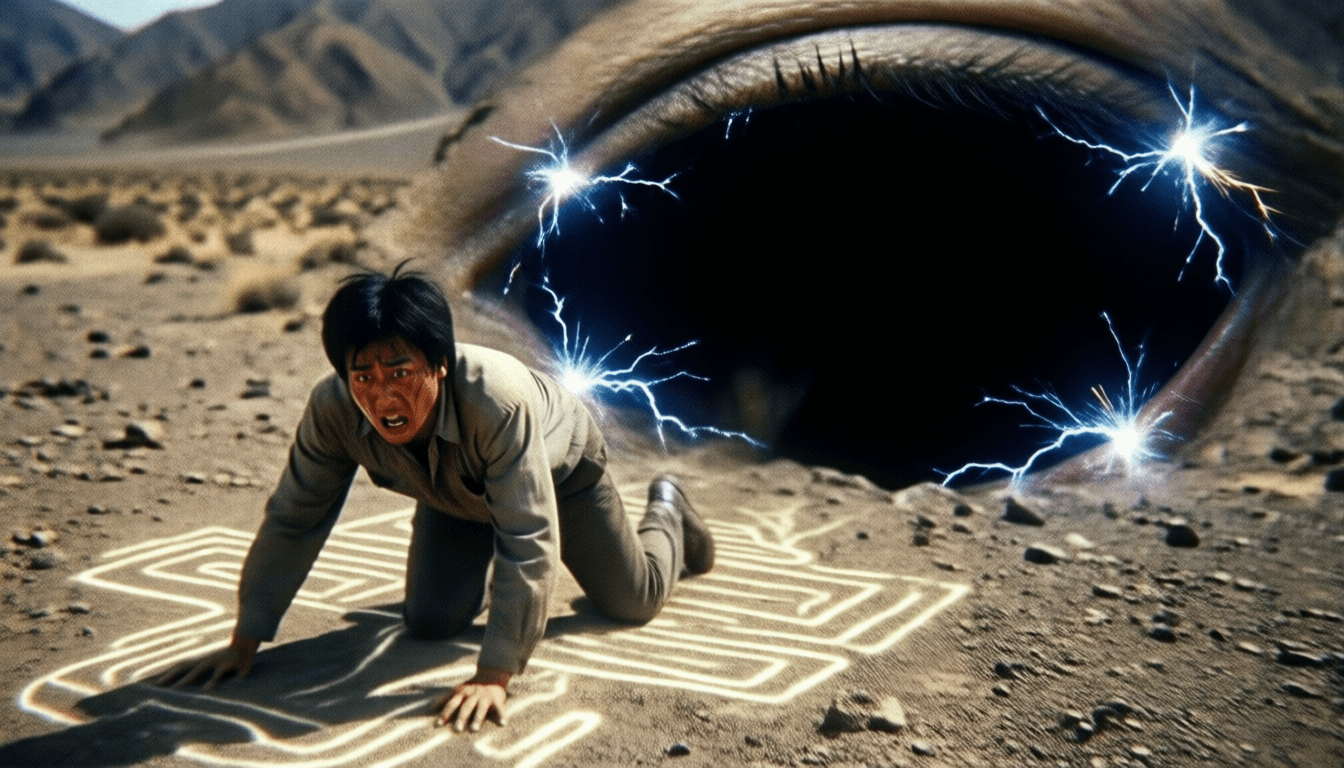
The surrounding geoglyph lines began to pulse with a faint, almost internally emanating luminescence. A pale, ethereal glow, eerily distinct in the approaching twilight, outlined their edges. The hum transformed, shifting into a sharp, high-frequency static that pierced my ears. It felt as if drills were boring into my eardrums. My vision blurred, overwhelmed by the compounded sensory assault. The distinct line of the lizard's 'eye' — a perfect circular depression in the earth — seemed to deepen, darken, and 'widen' at an impossible speed. It wasn't erosion; it was an instantaneous, geometric excavation. As the earth peeled away, it revealed not just darker soil, but a perfectly smooth, inky black void that swallowed light. I felt an irresistible, magnetic pull, not by gravity, but by some force inherent to the void itself, threatening to drag me in. I struggled to escape, but my muscles screamed, my limbs heavy as lead, refusing to move. The static shrieked, tearing through my head. The edges of the widening void began to crackle with tiny blue-white flames, like miniature lightning tracing the impossible geometry of its expansion. I clawed at the resisting earth, desperate to pull myself away from the intensifying draw. With one final, agonizing surge of adrenaline, I wrenched myself free and rolled away, just as the shriek reached a deafening crescendo, the void impossibly expanded by another meter, then seemed to solidify, still and dark once more.
Immediate escape is not recalled. When I next regained consciousness, I was far from the Nazca Pampa, half-crawling, half-stumbling across the vast plain, the high-frequency static still ringing in my skull. Blood trickled from my ears, a thin, dried line on my jawline. The acoustic sensor in my hand was dead, its internal components melted, a faint scent of ozone emanating from its casing.
A week later, I revisited the site with a local guide under the searing midday sun. The 'void' was gone. The 'Lizard' geoglyph was etched into the desert as it always was, unchanged, perfectly intact. The 'eye' was a shallow depression, as depicted in countless photographs. There were no scorch marks, no freshly dug earth, no evidence of my horrifying encounter. Yet, the high-frequency electrostatic pulse has never completely left me. It remains a persistent phantom at the periphery of my hearing, especially in open, quiet spaces. Sometimes, when I close my eyes, I see the faint, internal luminescence of the lines and the impossible deepening of the void. My hearing is permanently damaged, certain frequency ranges dulled, replaced by the ghost of that resonant hum.
There are no photographs of the event, no physical samples extracted from the impossible abyss. Only the melted sensor and the internal vibration that now defines my perception of silence. The Nazca Lines are not merely ancient symbols. They are not simply static works of art. They are a canvas for something else, a medium through which the very earth itself responds with geometric, non-Euclidean malice to intrusion. I understand now that the desert is not merely a blank canvas. It is alive, it listens. And those lines are its language.

[ CLASSIFIED VERDICT ]
[ACCESS LOG - SOURCE FILE]
The Nazca Lines are speculated to be ancient astronomical calendars or ritual pathways, but local legends whisper of a deeper, stranger truth. Pilots report dead air, disorientation, and visual distortions over specific geoglyphs, and recently, drones have crashed over the 'Lizard' geoglyph due to unexplained electrostatic pulses. This story explores the possibility that these mysterious phenomena might originate from a living, malevolent force within the geoglyphs themselves.