
Waitomo Glowworm Caves: The Living Galaxy Underground
Imagine stepping into the heart of New Zealand's North Island, into a profound silence where darkness seems to swallow every sound. And in that moment, not billions of light-years away in space, but just a few meters beneath the earth, a galaxy slowly ignites on the subterranean ceiling. This is the Waitomo Glowworm Caves, where millions of tiny bioluminescent larvae form living constellations, emitting light like a celestial river flowing silently through the deep underground caverns. It's a phenomenon that has captivated human imagination for centuries, still defying simple explanation with its immense scale and mysterious beauty.
This wondrous world was first introduced to Europeans in 1887, when Māori Chief Tane Tinorau and English surveyor Fred Mace embarked on an exploration. As they navigated the Waitomo River by raft through intricate limestone passages, they gradually extinguished their lanterns, eventually confronting a breathtaking sight. Stepping into the quiet, cool air of the cave entrance, ancient limestone formations, sculpted by water over millennia, reveal their colossal forms in the dim light. The only sound resonating in the stillness is the dripping of subterranean water.
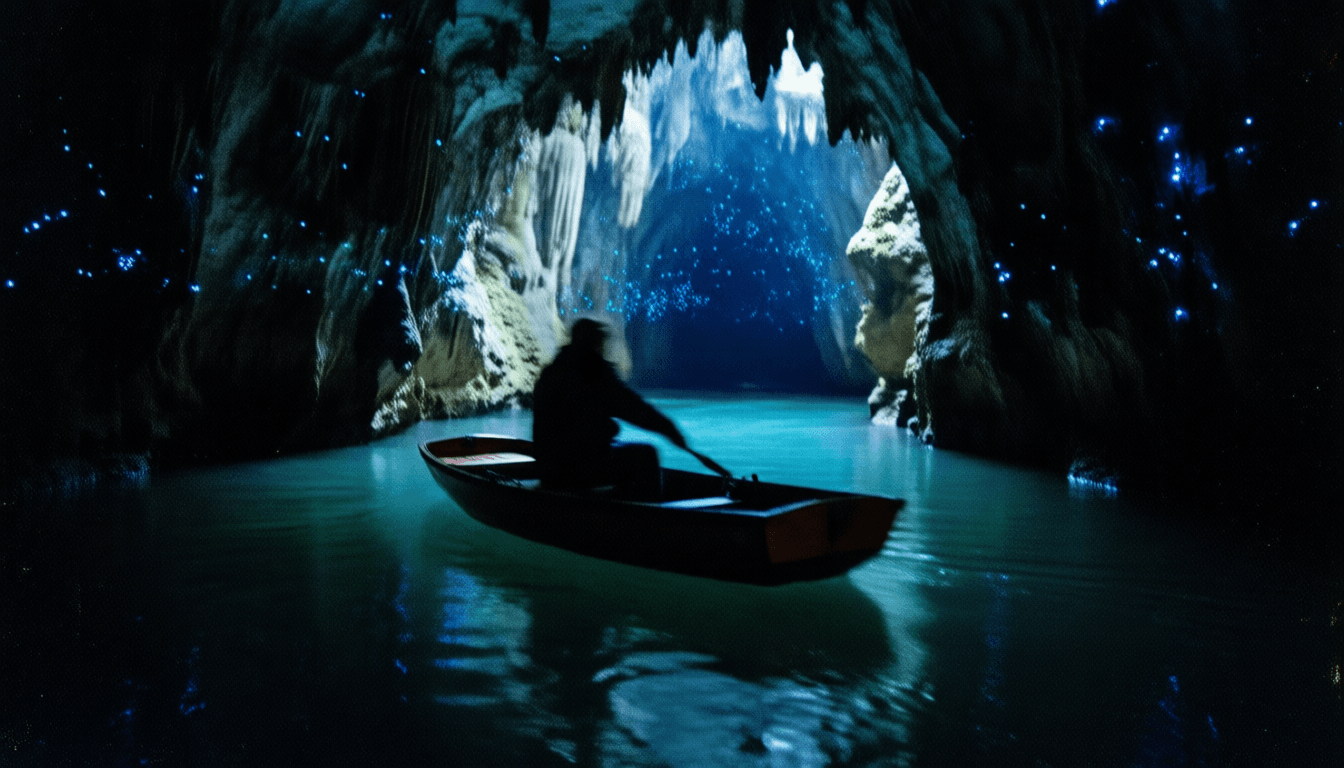
As visitors venture deeper, past towering stalactites and rising stalagmites, the outside world gradually recedes, and an intense sense of anticipation envelops them. Within this geological cathedral, sculpted by ancient rivers and tectonic uplift, faint blue points of light, like newly born stars, are scattered across the cave walls, offering clues to the astronomical marvel about to unfold.
This light is not merely a mineral formation or an optical illusion, but rather a precisely orchestrated bioluminescent phenomenon produced by the larvae of Arachnocampa luminosa, a unique species of glowworm found predominantly in New Zealand. According to scientific explanation, these larvae emit light through a chemical reaction in their tails. This cold light, generated when the luciferase enzyme reacts with luciferin, oxygen, and ATP, serves a singular predatory purpose: to lure small flying insects into a forest of sticky, silk strands, resembling spiderwebs, draped from the cave ceiling.
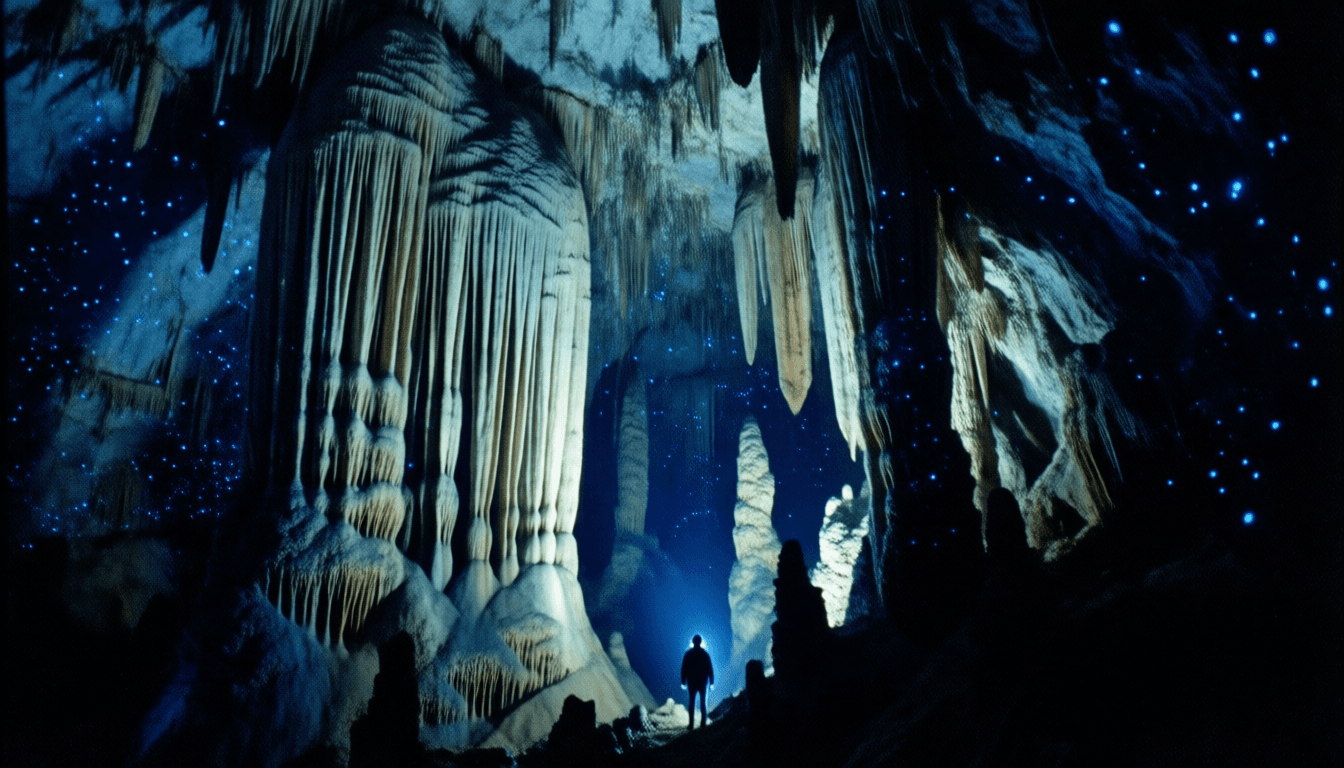
However, the more precisely science explains the 'how' – the biochemistry and hunting strategies – the deeper the mystery becomes regarding 'why here' and, furthermore, 'how on such an astounding scale' this phenomenon came to be. What combination of environmental factors – geological stability, consistent humidity, absolute darkness, and abundant food sources – allowed this particular cave system to foster a continuous bioluminescent ecosystem of unparalleled magnitude? The harmony achieved by millions of individual organisms, each emitting light independently for their own survival, transcends simple biological function, forming an unbroken celestial tapestry.
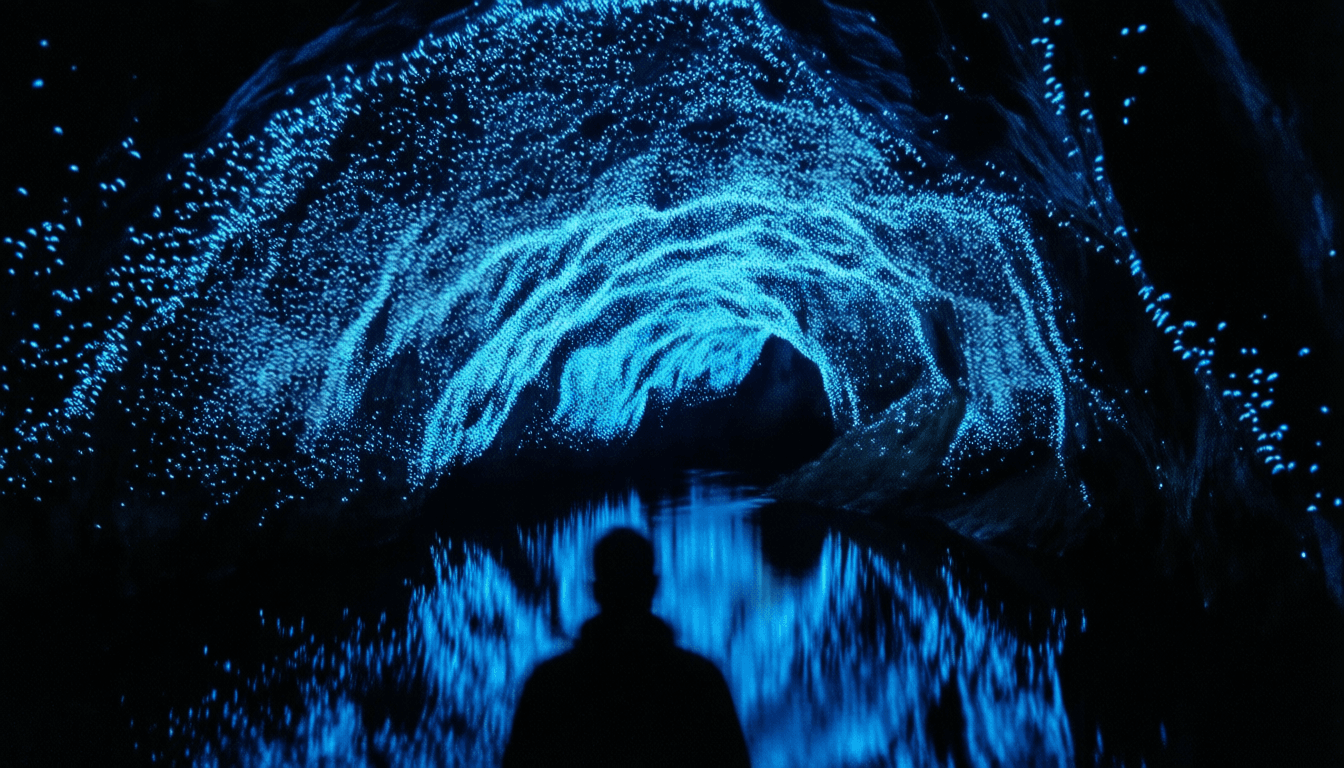
The true heart of the Waitomo phenomenon lies in the "Grotto of the Glowworm," a vast, cathedral-like space reached by silently gliding in a boat across the subterranean river. Here, all artificial lights are extinguished, and visitors are immersed in a mysterious darkness filled only with the living constellations overhead. Millions of glowworms create a densely interwoven curtain of light, akin to a quiet, star-studded sky unfurled above your head.
This is not merely an aggregation of lights, but a cohesive, pulsating entity. The blue light reflects on the still, black river below, creating a perfect mirror image, presenting a doubled galaxy within the abyss. Observers report perceiving almost intelligent characteristics, as if the light itself breathes. This bioluminescent display, shining with such immense density and uniform intensity, raises fundamental questions. How can individual, non-sentient larvae, each acting independently for their own survival, create such a perfectly balanced, continuously glowing, and breathtakingly beautiful panorama? It is a spectacle that transcends the sum of its parts, a symphony of nature played without a conductor, sustained for millennia by a complex balance of life and environment with a profound artistry found nowhere else.
Upon returning to the surface, leaving behind the quiet, glowing labyrinth of Waitomo's depths, a profound impression of having witnessed a living universe beneath the earth is imprinted. The transition back to the sounds and lights of the surface feels disorienting, as if returning from a place where time and familiar physics had subtly paused. The Waitomo Glowworm Caves offer more than mere scientific curiosity; they present an enduring testament to nature's boundless ingenuity. While we understand the mechanisms of bioluminescence, the astonishing scale, elegant cohesion, and sustained perfection displayed by this subterranean starfield across countless generations evoke deeper, philosophical questions. How many profound wonders does our Earth still hold, quietly unfolding cycles of life and light without human observation or complete understanding? Waitomo's light remains not just a memory, but a quietly twinkling question mark, reminding us that the most profound mysteries are often found not in grand declarations, but in the delicate, autonomous brilliance of the natural world.
[ CLASSIFIED VERDICT ]
[ACCESS LOG - SOURCE FILE]
The Waitomo Glowworm Caves, located in New Zealand's North Island, are an underground world illuminated by the mysterious bioluminescence of millions of Arachnocampa luminosa larvae. This wondrous natural phenomenon, beyond mere scientific explanation, constantly captivates human imagination, reminiscent of a living universe teeming with stars. Discovered in 1887 by a Maori chief and a British surveyor, these caves continue to enchant many with their overwhelming scale and profound mystery.