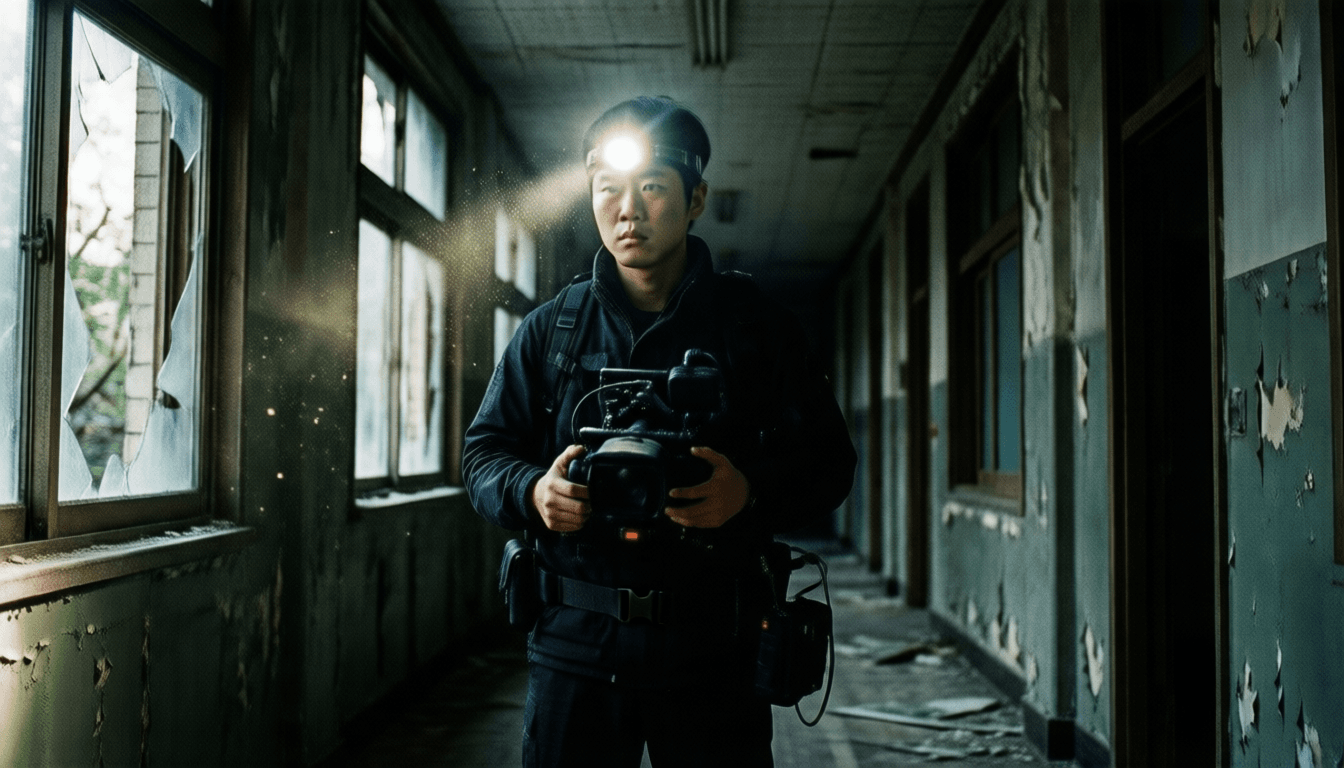
Unceasing Footsteps: The Curse of Seonghwa School
My archival work always begins in the dark shadows of digital spaces. It's the pursuit of whispers often lumped together as urban legends. In this case, it was the 'Seonghwa School Footsteps' phenomenon that appeared on anonymous Korean forums and TikTok from 2021 to early 2023. These weren't sophisticated paranormal investigations. They were shaky, crude cell phone videos shot by thrill-seeking teenagers or urban explorers. Among them, the most unsettling series was uploaded by an anonymous user named 'NIGHTOWL_KR'. His videos consistently depicted the desolate, dilapidated corridors of the abandoned Seonghwa Girls' High School, located in Gyeonggi-do. In each video, from various perspectives, a rhythmic 'thump-thump-thump' sound could be heard from down the corridor. It grew louder as if approaching with heavy, dull steps, then suddenly stopped. The characteristic of this sound was eerily consistent, regardless of users or dates. It was too loud for a simple echo, too dull for natural building creaks. Many descriptions stated it sounded like 'wooden clogs on concrete, but heavier, more resolute.' Crucially, no source of the sound was ever captured on screen.
My interest shifted from a mere anomaly to a potential phenomenon when a local historical society briefly proposed a theory linking these sounds to a specific tragic event: the disappearance and subsequent death of student Kim Ji-yeon in 1987. Her body was found at the base of Seonghwa High School's central staircase, but her distinctive red enamel shoes were never recovered. The school, already scheduled for demolition, was closed shortly after the incident. Among former students, rumors circulated that Ji-yeon had been running, chased by someone, before her fatal fall. The 'footsteps' were said to be her endlessly, angrily searching for what she had lost or had been taken from her. While the initial videos were merely unsettling, with the added historical context, they gained a chilling, concrete weight, becoming more than just internet hoaxes.
Accessing the long-abandoned Seonghwa Girls' High School was not easy. I gained entry through an acquaintance who possessed an old master key, under the guise of an architectural preservationist. My objective was clear: to capture and characterize the 'footsteps' under controlled conditions, beyond the limitations of unreliable cell phone recordings.
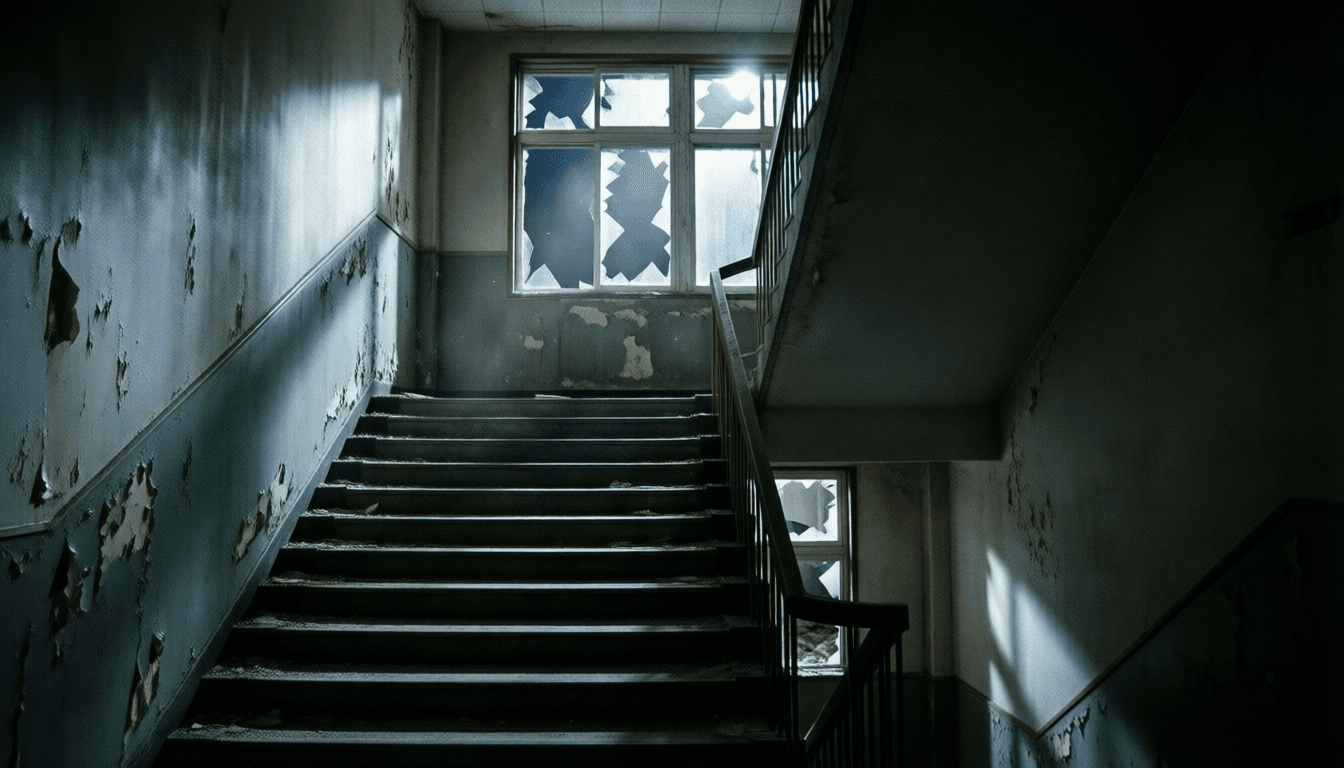
The school was like a slowly decaying monument. The athletic field was overgrown with tangled weeds, and broken windows gaped like empty eyes. Inside, peeling paint curled off the walls like dried skin. The grand concrete central staircase dominated the main corridor, the very focal point where Ji-yeon's incident occurred and the 'footsteps' were reported. The internal air was heavy and stagnant with the pungent smell of mold and forgotten things. Dust motes danced in the faint shafts of moonlight filtering through the broken windows.
I meticulously set up my equipment: professional audio recorders with directional microphones aimed at various points in the main corridor and staircase, sound level meters, and high-resolution cameras with night vision, all powered by external batteries. I positioned myself near the center of the corridor, minimizing my own movements and interference. The silence that followed the setup was absolute. It was an overwhelming void, devoid even of distant city noise. Even my breathing, the slightest shift in weight, seemed amplified, almost sacrilegious. Near the base of the staircase, there was a noticeable drop in ambient temperature in the air – a persistent, unnatural chill.
My initial recordings captured only the ambient noise of my equipment and the occasional faint creaks of the building itself. However, after about 20 minutes, a subtle anomaly was detected. A faint, singular 'thump' was picked up by the directional microphone aimed down the corridor. It was too soft to be clearly discernible by ear. A perplexing detail was the echo pattern; it seemed to be recorded by the secondary microphone before the primary one, as if the reverberation preceded the sound itself, or came from the opposite direction of the apparent source. A faint, low-frequency tremor, too subtle to be actual footsteps, began to vibrate faintly beneath my feet. It was a deep resonance, as if the building itself was under pressure.
This subtle activity soon ceased, replaced by an even deeper, almost artificial silence. It wasn't merely the absence of sound; it was an active sound nullification, a pressure pressing down on my eardrums. In that vacuum, my own breathing sounded deafening. And then, from the second-floor railing of the central staircase, a single, sharp, distinct 'thump' rang out. It violently tore through the silence. This time, there was no echo. My camera, set to monitor the staircase, captured a subtle, almost imperceptible movement of a shadow at the top of the stairs. Too fast for a person, too firm for a distortion of light. Rewatching the footage yielded nothing conclusive – just a flash, a teasing trace.
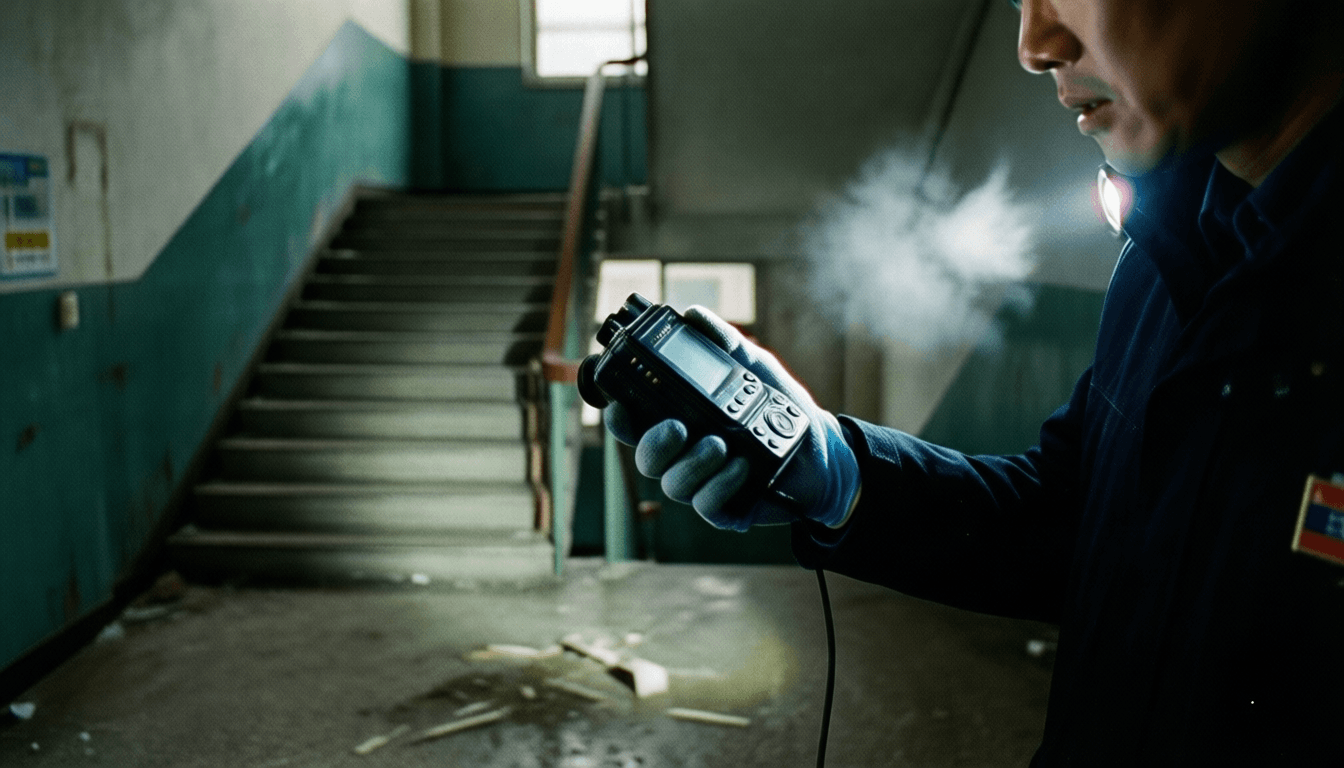
The distinct 'thump-thump-thump' began again. This time, it was undeniably louder, resonating from the second-floor railing and descending the central staircase. It was rhythmic, heavy, and approached with a spine-chilling, deliberate certainty. The sound didn't reverberate naturally; it sounded almost dry, as if the acoustic properties of the concrete itself had changed. The floor beneath my feet vibrated in sync with the sounds. A deep, unsettling resonance grated against my teeth. This was a sound that defied the physics of physical space, yet it was undeniably, physically there. I activated the recorder in my hand, pointing it towards the invisible descent.
The footsteps descended the stairs. Each 'thump' rattled the massive concrete structure, growing deafeningly loud, hitting my chest with physical force. It was too fast, too heavy for any human to make. I instinctively shone my powerful headlamp up the stairs, but saw nothing but rough, featureless concrete. Yet the sound intensified further, blurring my vision. The air grew colder, and my breath plumed thick and white in the headlamp's beam. Rationally, I knew it was impossible, but physically, the sound felt like hammer blows.
The footsteps reached the bottom of the stairs. I instinctively recoiled, retreating towards my perceived escape route: the long main corridor. But the footsteps did not follow a linear path. Instead, with sudden, impossible immediacy, the heavy 'thump-thump-thump' now resonated from behind me, at the far end of the corridor I had just entered, cutting off my only escape. There was no moving sound or transition between the two points; merely an instantaneous repositioning of the sound source. I was trapped in a human funnel formed by the old architecture: between the presence by the stairs and the presence that had abruptly materialized behind me.
The footsteps from both ends of the corridor converged. The rhythmic 'thump-thump-thump' now enveloped me from all directions without a visible source. The vibrations became violent, now actually knocking me off balance, impacting my chest like physical blows. My carefully placed equipment tumbled to the floor. I stumbled, hitting my head on the cold concrete. As my vision blurred, I felt a cold, firm pressure around my ankle, as if an invisible something was grasping and trying to pull me. A low, raspy growl, almost a whisper, yet impossibly loud, resonated directly in my ear. And then a final, violent 'thump' vibrated through the entire building, rattling the remaining panes of glass. My head rang, and blood trickled from a shallow cut above my eyebrow. The pressure on my ankle intensified. It was a distinct, firm grip, pulling downwards. I thrashed wildly, but found nothing to grab onto, only a heavy, resisting force, like struggling against heavy water.

I wrenched myself free with pure, panicked adrenaline, blindly scrambling through a side classroom towards an unexamined, abandoned emergency exit. I tripped multiple times over debris. The moment I cleared the school's boundaries, the oppressive sounds and vibrations ceased. Instead, the distant hum of the city night replaced them with irritating but normal noises. I have no memory of the journey back to my apartment.
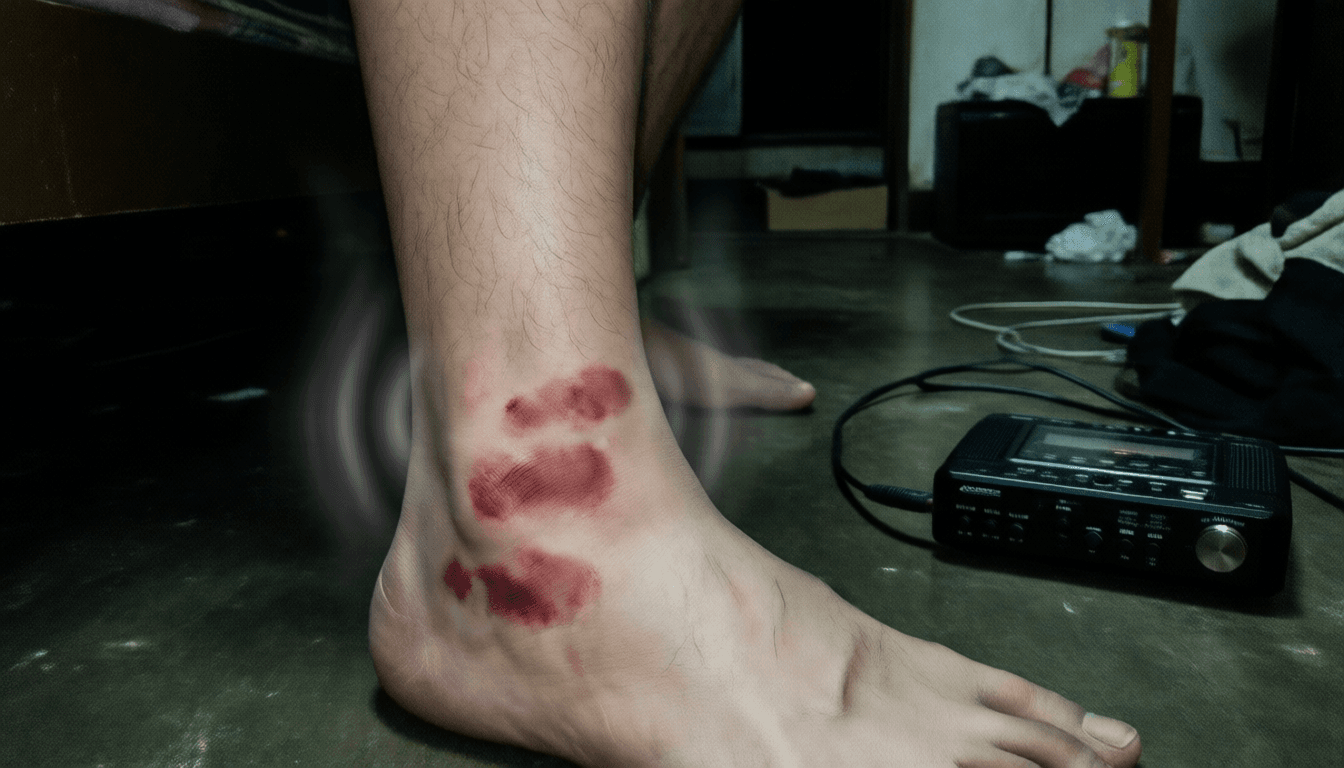
Hours later, I woke up slumped on my living room floor. My recording equipment was scattered and damaged; the recorder I had held was lying beside me. Its microphone grille was dented inwards, as if gripped by an immense, concentrated force. On my left ankle, five distinct, symmetrical, narrow, deep red finger marks were bruised, still radiating a persistent, cold ache.
With trembling hands, I retrieved the recorder. Miraculously, the last few minutes of audio were intact. Playing it back, it began with the escalating footsteps, my frantic breathing, the sounds of my fall, the indistinct growl, and the final violent 'thump.' But beneath the chaotic audio, almost imperceptibly faint, the rhythmic 'thump-thump-thump' continued. It wasn't a sound from the recording environment; it was subtly embedded within the recording itself, in the silences between my ragged breaths. When I held the recorder close, I realized the sound wasn't coming from the speaker. It was emanating from my left ankle. The same rhythmic vibration I had felt on the school floor, faintly, like a low-frequency echo, a persistent phantom pulse, had now followed me home. Quiet, almost imperceptible, but always there. An endless, internal echo. Those shoes are still searching.
[ CLASSIFIED VERDICT ]
[ACCESS LOG - SOURCE FILE]
This story is based on an urban legend about the 'Seonghwa School Footsteps' phenomenon, which appeared on anonymous Korean online forums and TikTok from 2021 to early 2023. This phenomenon is linked to Kim Ji-yeon, a student who disappeared and died at Seonghwa High School in 1987, and the footsteps are rumored to be her endlessly searching for her distinctive red enamel shoes that were never found.