The Crushed Staircase of Raynham Hall: The Lost Plate 692
On September 19, 1936, at Raynham Hall, a stately home in Norfolk, England, a photograph was taken of the entity known as the 'Brown Lady', remaining the most famous spirit photograph in history. While photographer Hubert Provand’s Glass Plate No. 691 was released to the public and sparked decades of authenticity debates, exceedingly few are aware of the existence of 'Plate No. 692,' deliberately expunged from the confidential files of the Society for Psychical Research (SPR) in London.
In 2021, during the cataloging of a private estate, an entry from Provand’s original studio ledger was uncovered, documenting the bizarre events of that fateful day. When the magnesium flash powder detonated, the pungent sulfurous smoke did not disperse outward into the hall. Instead, the smoke condensed violently toward the center of the staircase as if sucked into a massive atmospheric vacuum. Plate No. 692, exposed four seconds later in the pitch darkness, captured no light whatsoever; the chemical emulsion had been gouged into two deep vertical furrows before the silver salts could even settle.
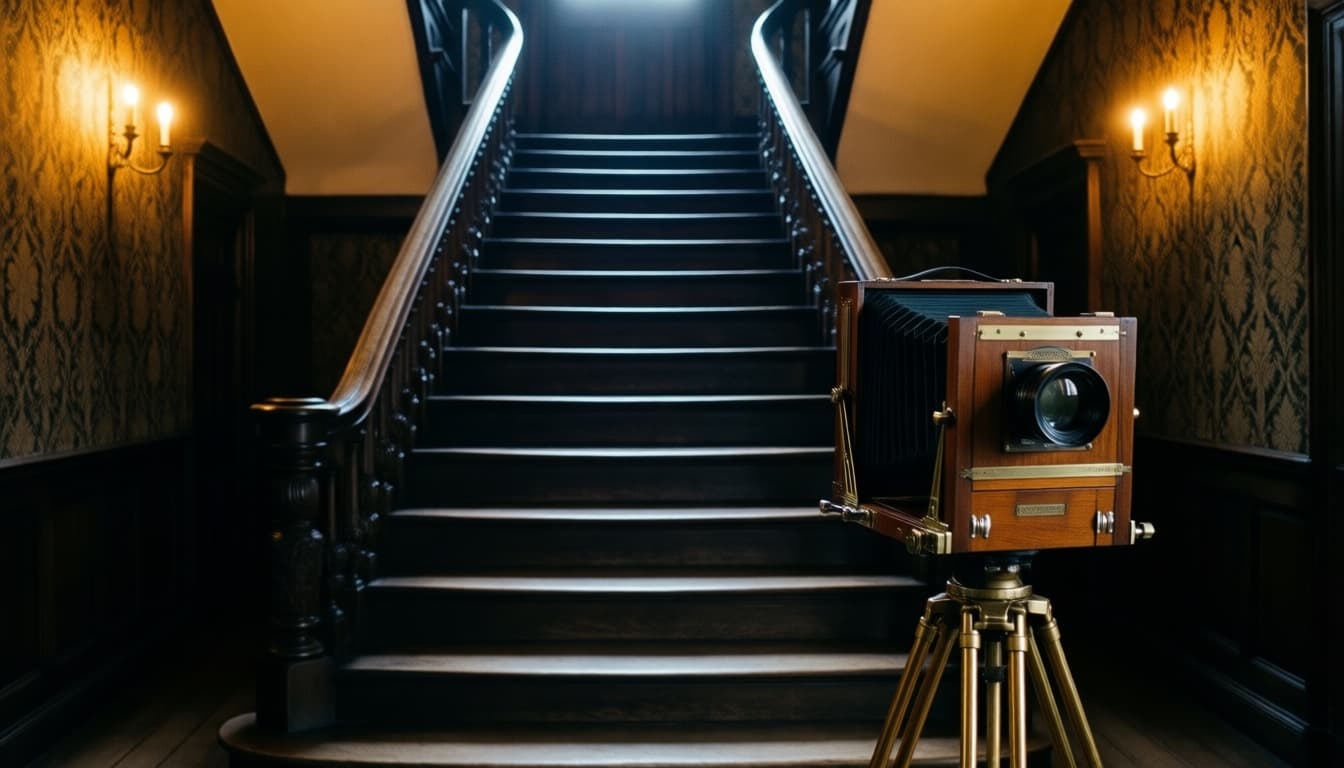
To investigate this suppressed record, a solitary survey was conducted during the manor's late-autumn winter closure under the official pretext of measuring timber shrinkage rates for architectural preservation. Inside the stairwell crafted from Baltic oak, the damp odor of lime mortar and hardened floor wax lingered heavily in the cold air. Modern directional barometers, thermal imaging sensors, and an identical 1930s Thornton-Pickard wooden field camera were mounted precisely over Provand’s old tripod indentations still marked on the floorboards.
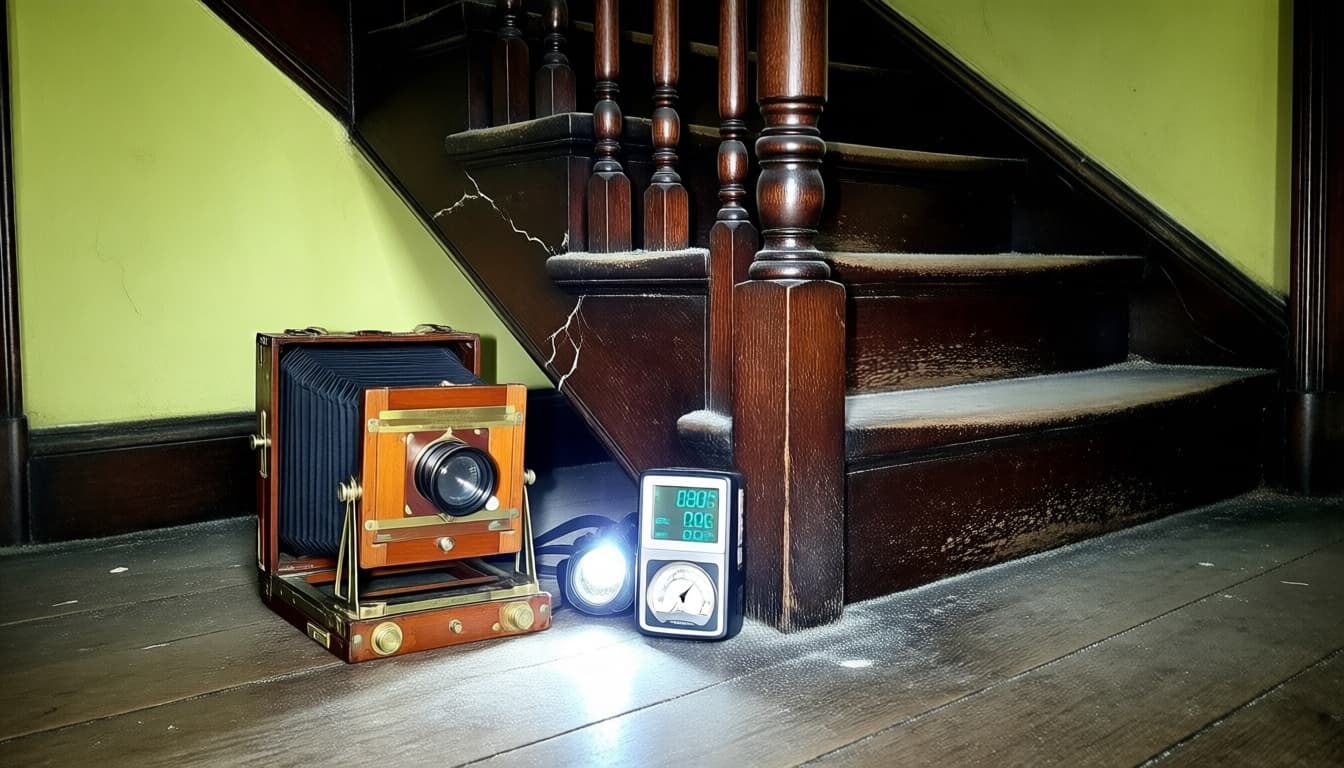
The moment my foot pressed onto the first tread to affix reference markers, an eerie chill crawled down my spine. The oak did not creak upon contact. Only two seconds after lifting my foot entirely did a dull, rupturing groan echo out, resembling wood belatedly expanding in the crushing depths of the deep sea. The thermometer mounted on tread number five plummeted from the ambient room temperature of 9°C to exactly -3°C. It was a razor-sharp boundary where warm and cold air simply refused to mix.
The sound of the late-autumn wind rattling against the windowpanes abruptly died away, as if smothered beneath a slab of lead. An aluminum lens cap accidentally dropped to the floor produced only a single, muffled thud; it yielded no rebound resonance, its sound entirely swallowed upward into the empty air above. Through the camera’s ground glass viewfinder, the balusters appeared perfectly straight, yet to the naked eye, the air around the handrail was refracting like a heat shimmer, visibly warping the geometry of the timber.
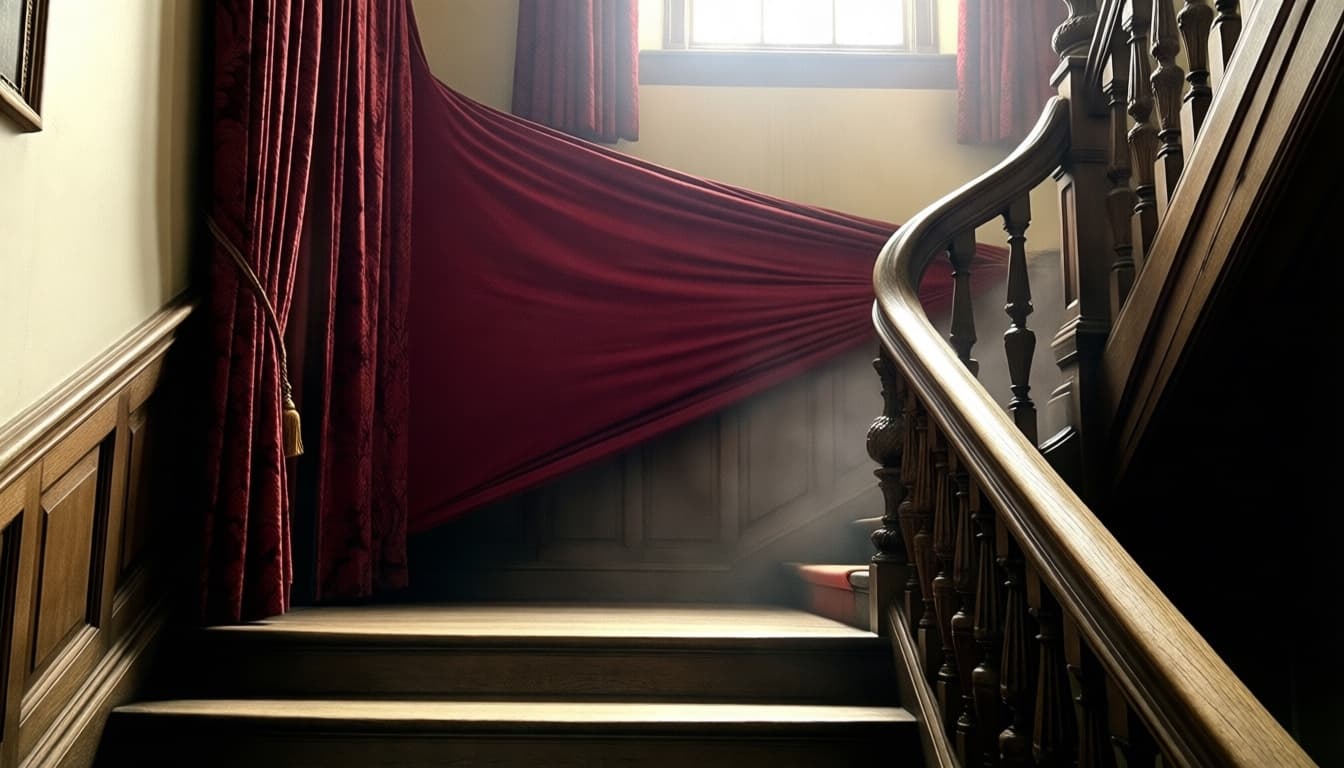
At 2:22 AM, a piercing tinnitus erupted in my ears. The atmospheric pressure readouts dropped by 40 millibars in five seconds flat. My breath caught in my throat as oxygen was violently siphoned from the room. The heavy brocade drapery hanging from the upper landing did not merely sway; it was pulled taut horizontally toward the dead center of the staircase, stretched as though drawn into an invisible, bottomless sinkhole.
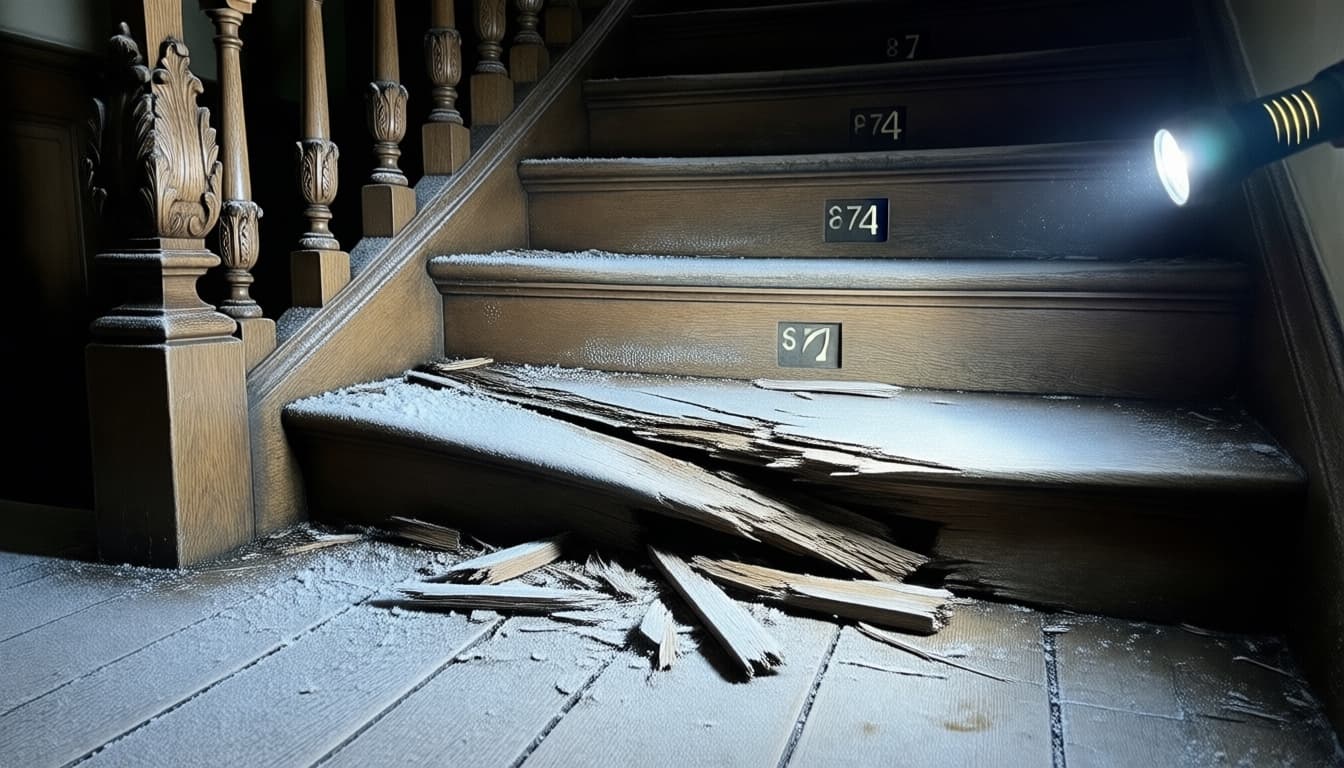
One after another, the thick Baltic oak treads—which had withstood centuries of human foot traffic—began to groan and buckle downward. A 1,000-lumen searchlight was aimed at the steps, yet the beam did not reflect or scatter against the air. The light halted abruptly at the landing, vanishing completely into nothingness without striking a surface. It was not a visible specter. The instant I realized a human-shaped void of absolute blackness was carving through the air by absorbing the light itself, an overwhelming, crushing mass descended down the stairs and crashed over me.
White frost instantly crystallized over the camera’s metal tripod legs. I attempted to stumble backward, but the collapsing barometric pressure created an inward draft that dragged my body toward the steps. Reaching out with my left arm to brace against the handrail, my sleeve brushed through that distorted threshold. The wool jacket sleeve shattered like frozen glass, and my flesh instantly went numb, freezing bone-white upon meeting the sub-zero anomaly. Under the immense twisting force, the balustrade fractured with a violent snap and hurled timber fragments across the floor.
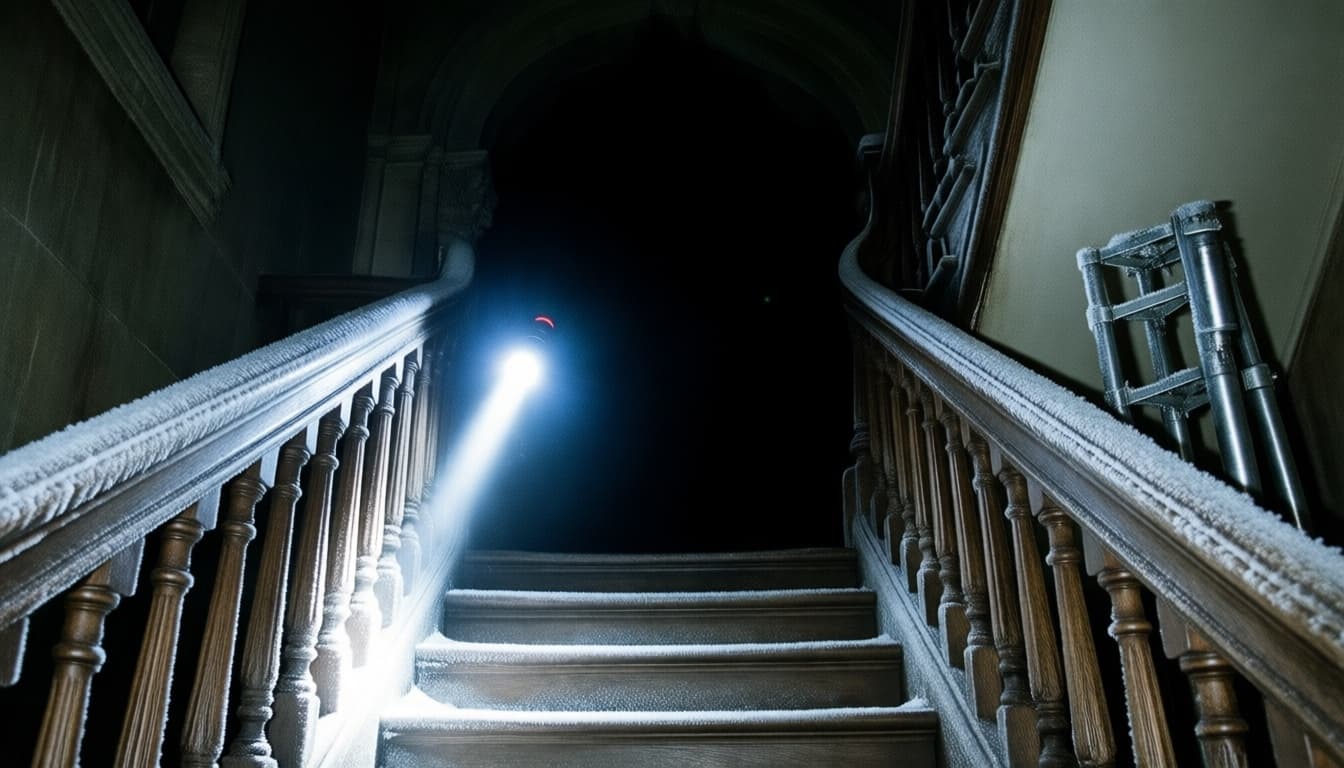
By the time I crawled out through the emergency fire exit at dawn, I was left with severe hypothermia, a ruptured eardrum, and third-degree frostbite necrosis across my left arm. Yet the data logged by the digital sensors could not be contested: the barometric pressure inside the staircase enclosure had plummeted to levels unsustainable for human life for precisely four minutes. The glass plate retrieved from the abandoned wooden camera showed no phantom figure. Instead, the thick photographic glass had physically warped outward, bowed under catastrophic atmospheric pressure.
Following the incident, the grand staircase of Raynham Hall was permanently barricaded. Treads four and nine, engineered to sustain three tons of structural load, have never regained their level alignment. Even now, the wood remains depressed half an inch into the frame, silently supporting the crushing weight of something that has still not finished descending.
[ CLASSIFIED VERDICT ]
[ACCESS LOG - SOURCE FILE]
Based on the legendary 1936 'Brown Lady' spirit photograph taken by photographer Hubert Provand at Raynham Hall in Norfolk, England, widely regarded as the most famous ghost picture in history. While the photograph spurred decades of authenticity debates, this story reimagines the incident with a fictional suppressed second plate and catastrophic physical anomalies, depicting the ghostly descent as an overwhelming gravitational and atmospheric distortion that crushed the ancient oak staircase.