Claws in the Sand
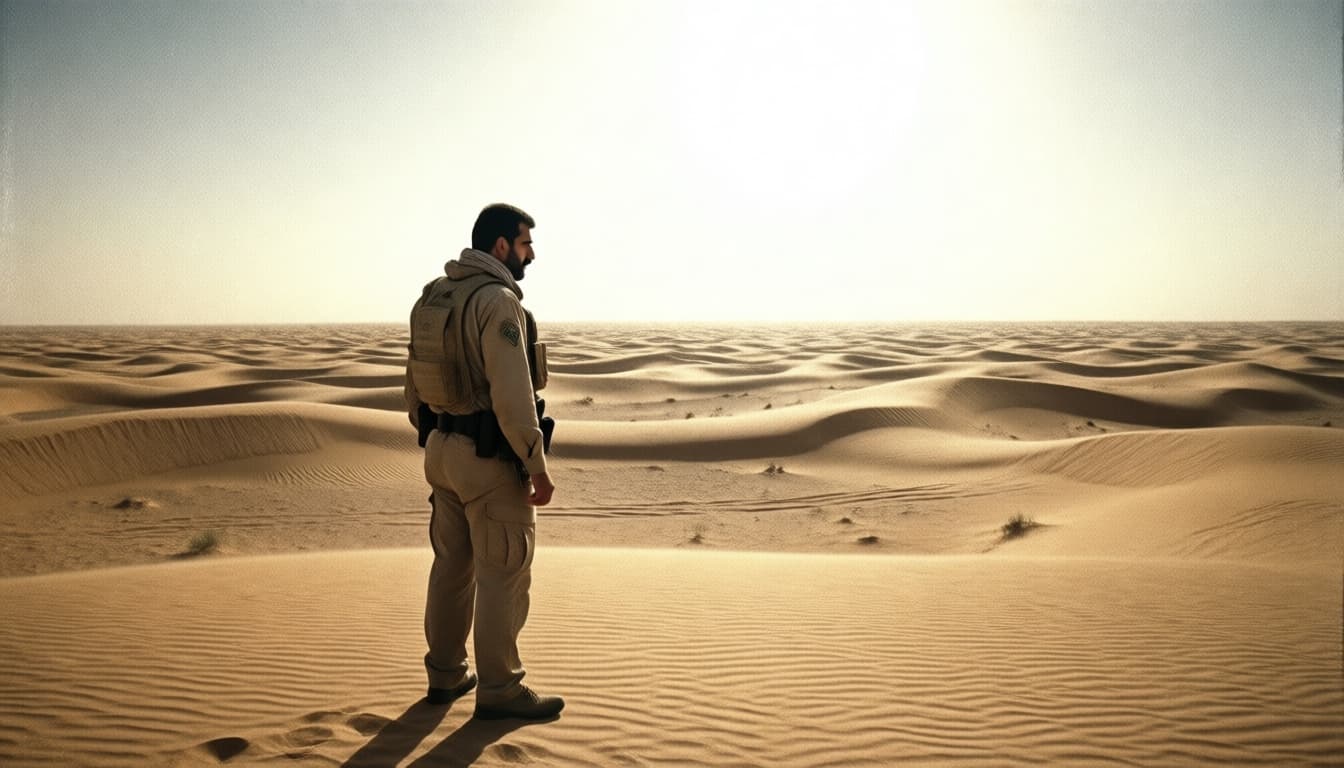
Over the past decade, a series of bizarre disappearances have occurred in the arid desert region known as Wadi al-Jinn. Official reports are eerily consistent: "Abandoned vehicle, no trace of occupant." SUVs left stranded in the vast expanse of the desert. Satellite imagery, thermal drones, ground search teams—nothing proved useful. Other than footprints around the vehicles, there was no trace, no shred of clothing, no distress signal. Only absence.
Authorities mentioned disorientation, sudden floods, and even the possibility of foul play, but upon close investigation, these explanations lost their credibility. The desert was flat and open, and the last footprints of the disappeared often led away from the safety of the vehicle, sometimes towards steep sand dunes or a featureless horizon. This was a logically impossible trajectory.
In 2018, an elderly Bedouin man, interviewed after the disappearance of a young European hiker, finally spoke of local legends. "She follows the cries in the wind. And her legs... you won't see them. Only the sand knows where she walks." He spoke of Umm al-Duwais (meaning 'Mother of Small Legs'), a being that lures travelers with deceptive sounds and drags them into the sand. Most dismissed it as superstition. However, the police forensics report for the 2018 case contained one strange detail: "Faint, unidentifiable scratch marks were found in the sand near the abandoned vehicle, but did not match human or known animal gait patterns and were attributed to wind." Scratch marks. The Bedouin's warning. Unexplained disappearances. This was not a mere desert mystery. It was a clear pattern.
My investigation began at the last known coordinates of Dr. Aris Al-Hamad, a geologist who disappeared two months prior. His old 4x4, left as the rescue team had found it, lay baking under the sun. The tires were slightly deflated, and the engine hood was still warm from the sun, but otherwise, it was untouched. No forced entry, no signs of a struggle. Just... empty.

I followed Dr. Al-Hamad's last GPS waypoint, a deep, basin-shaped depression called the "Whispering Hollow" due to its peculiar wind patterns. The desert stretched vast and indifferent. The air shimmered with heat, distorting the horizon like a rippling mirage. The sound of my boots on the gravelly sand echoed unnaturally loudly in the profound silence. I reassured myself that this was just a routine investigation, collecting data. The only footprints were my own and occasionally the delicate tracks of desert rodents. But a strange unease weighed on my chest. The sun was fierce, yet the shadows around the sparse rock formations seemed unusually sharper, somehow too distinct. The heat felt like more than physical warmth, like a pressure, a subtle weight.
As I descended into the Whispering Hollow, the environment itself seemed to change. The wind, which had blown like a constant hot breath, ceased. An unnatural stillness enveloped the basin. My footsteps didn't echo immediately; instead, they reverberated with a subtle, eerie delay, as if they had to push through a medium denser than air. The sound physics in this particular basin seemed… wrong.
And then I found them. Near a cluster of wind-carved rocks, faint, delicate marks on the sand. Not footprints. Rather, parallel lines of small, shallow scratches, as if something with multiple needle-thin limbs had crawled across the surface. Too regular to be wind-blown debris, too intentional-looking to be random. They led deep into the basin, seemed to vanish, then reappeared, sometimes heading in utterly illogical directions, like straight up short, steep sand dunes.
An almost imperceptible, faint sound began to penetrate the overwhelming silence. It sounded like a child in distress. Carried on a non-existent wind. I checked my compass; the sound seemed to emanate from a specific point deep in the basin, but as I adjusted my position, it subtly shifted, now from behind me, then to my left. It played with my perception, a cruel auditory mirage.
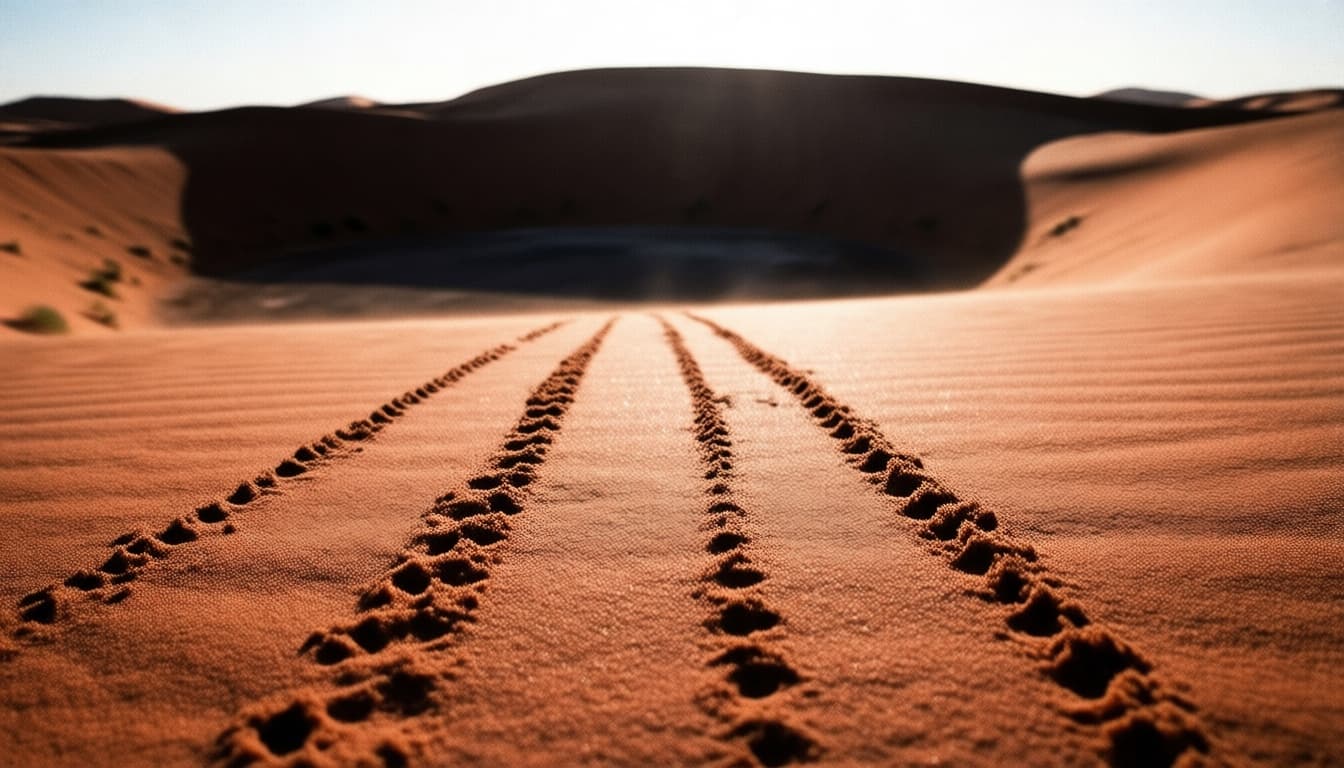
My communication device sputtered with static. The GPS signal flickered. Batteries, fully charged that morning, were draining at an alarming rate. The unpleasant premonition solidified into a cold certainty. I was not alone. The desert was not empty. And those "scratch marks" were leading me deeper into something I couldn't comprehend.
The whimpering grew louder and more insistent, drawing me towards a small, innocuous-looking dune of fine red sand at the deepest point of the Whispering Hollow. It was no longer a child's cry. It had transformed into a desperate, almost guttural plea. As I drew closer to the dune, the sand around it seemed to subtly vibrate. A barely perceptible tremor traveled through my boots to my feet.
Suddenly, the feel of the sand beneath my feet changed. It was no longer firm, but seemed to flow
around my ankles. Not quicksand, but more like an intentional, intelligent current. My left boot sank deeper than expected, then my right. I tried to pull free, but the sand solidified just enough to impede movement, then softened again, pulling me down. The temperature plummeted. Despite the fierce sun above, a localized arctic chill enveloped me. My breath plumed.
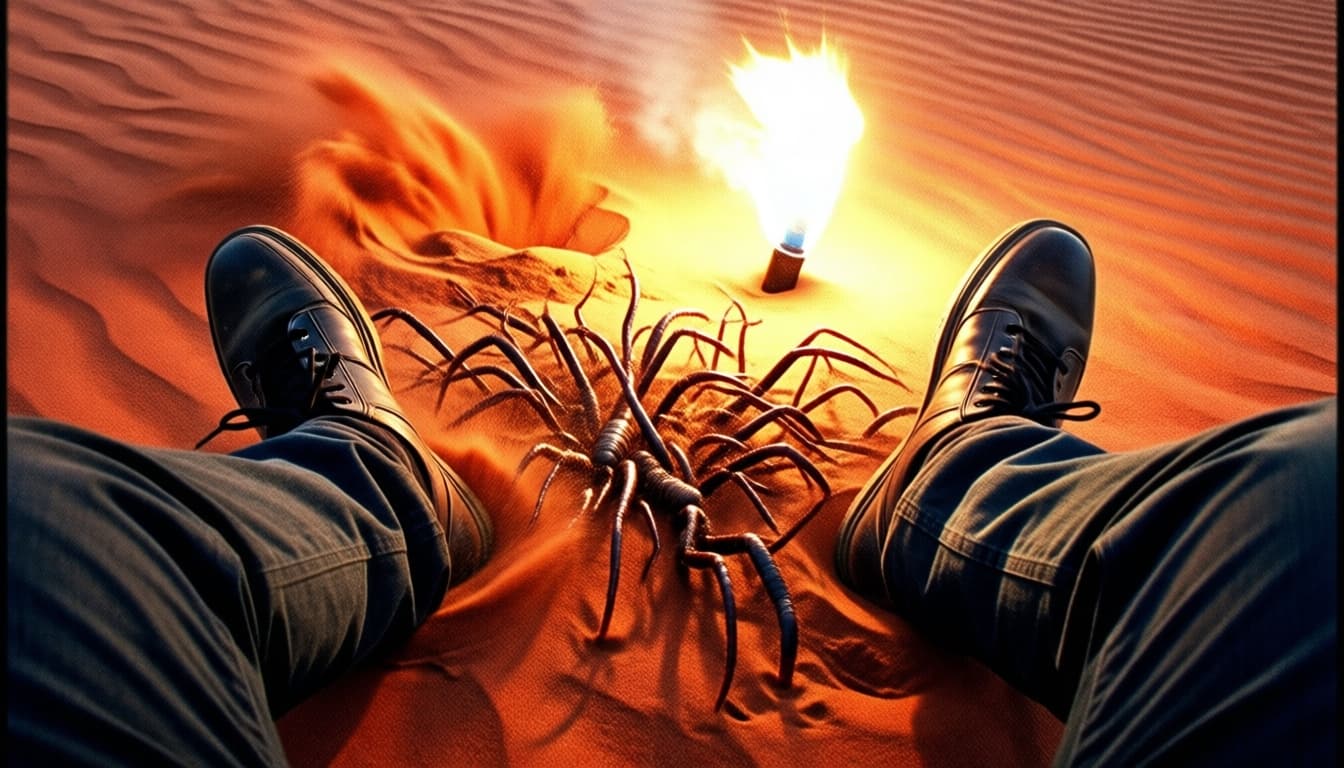
And then the physical contact began. A sudden, sharp tug at my ankle. Not just suction, but a grip. Multiple needle-sharp ends pierced through my hiking sock and trousers, pricking and scratching my skin. It felt incredibly thin, yet pulled with immense strength, tearing at me. I stumbled, reaching for the shifting sand with my hands, but found no purchase. That's when I saw a horrifying, fleeting glimpse. Just beneath the surface of the sand, I realized, countless thin, dark, almost insect-like legs were moving with chilling speed, extending from beneath the dune and converging on me. They weren't just pulling; they were probing, digging into, finding purchase on my clothing and the skin beneath.
The whimpering had now transformed into a distorted, echoing shriek that vibrated through my teeth, assaulting my mind. The sand around me erupted in small, localized whirlpools, resisting my thrashing limbs, pulling me deeper, more violently. I felt a searing pain as something thin and impossibly strong seemed to tear at my calf. Terror surged. I screamed and thrashed, barely managing to reach for the emergency flare in my backpack. With a desperate effort, I lit the flare and plunged the burning stick into the writhing sand around my legs. The heat and sudden light caused an immediate, instinctive reaction. The gripping pressure released, and the legs beneath the sand retreated with astonishing speed, disappearing back into the earth. Wounded and bleeding, but alive, I scrambled away from the seething dune as fast as my injured legs could carry me, the echoes of the shriek slowly fading behind me.
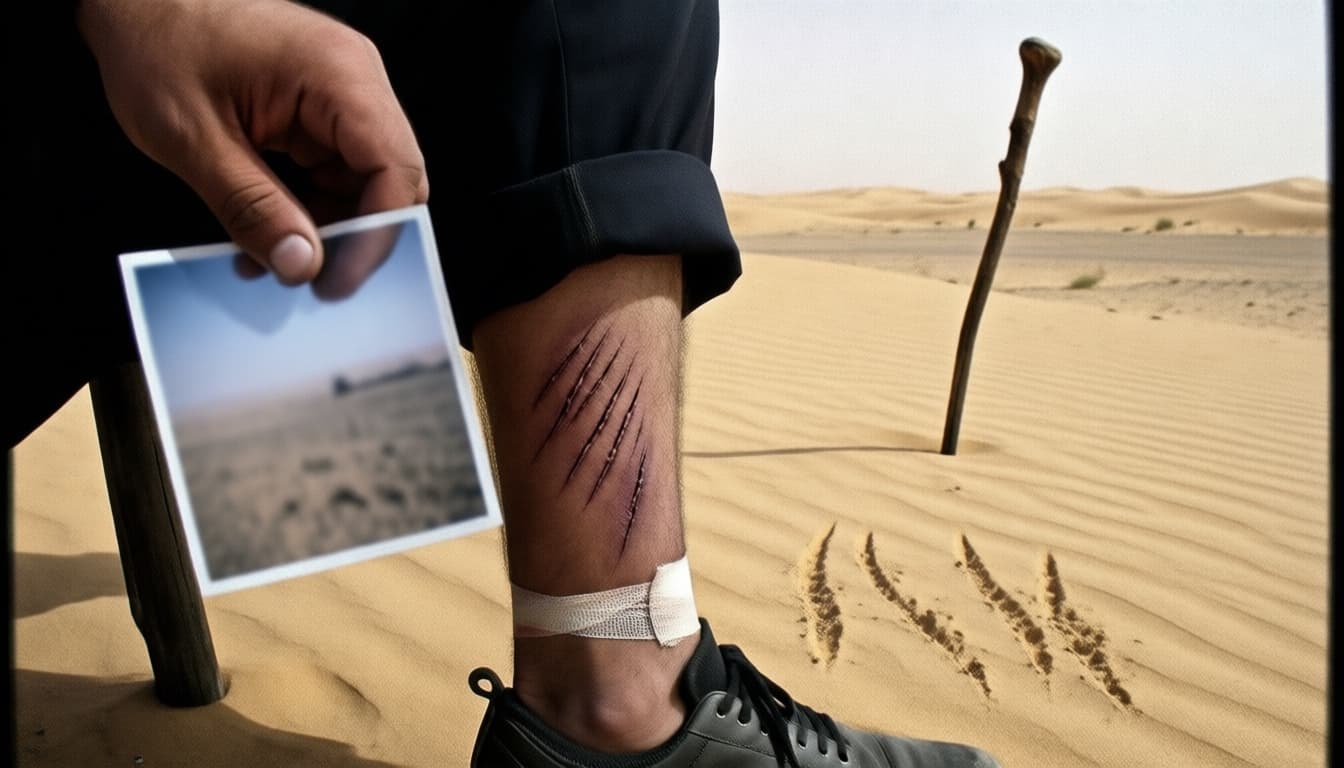
I was found nearly nine hours later, several kilometers from my vehicle. Disoriented, suffering from heatstroke, and with a peculiar form of deep lacerations on my ankle and calf. Despite their seasoned experience, the desert medics were perplexed by the wounds, describing them as "numerous linear perforations, like multiple small claws, inconsistent with any known desert animal." My fragmented story of the attack was dismissed as delirium from heatstroke and trauma. I did not argue.
Back in my archives, reviewing the photos I had managed to capture before my GPS failed, I saw only the vast, empty desert. However, one specific image, taken just before fully descending into the Whispering Hollow, captured a faint, almost imperceptible blurry distortion at the edge of the frame. An anomaly my camera lens couldn't have created. Even more chilling, when digitally enhanced, the faint scratch marks on the sand were clearer than I had seen them in person, leading directly towards the central dune.
I never returned to Wadi al-Jinn. But now, the silence feels different. Sometimes, deep in the night, when the city is quiet, I hear it. A faint, distant whisper, sometimes like the wind sweeping over sand, and sometimes, perhaps, the plaintive cry of a child, barely audible.
Last week, an unofficial internet forum dedicated to mysterious disappearances posted about a new incident. A young Bedouin shepherd, along with his flock, had vanished near Wadi al-Jinn. A blurry photo, reportedly found on the shepherd's abandoned phone, showed only the vast desert landscape. However, in the foreground of the picture, faint, delicate lines marred the sand's surface. A pattern of small, countless scratch marks. They led away from where the shepherd's staff had been abandoned. The Mother of Small Legs is not a legend. She is still there. And I carry her indelible mark.
[ CLASSIFIED VERDICT ]
[ACCESS LOG - SOURCE FILE]
This story is based on the Bedouin legend of 'Umm al-Duwais' (Mother of Small Legs) from the Middle Eastern desert regions. Umm al-Duwais is said to lure travelers with the cries of a child or whistling sounds in the desert, then drag them into the sand with her countless small, unseen legs. The narrative explores the terror behind inexplicable scratch marks and sounds discovered in desert disappearance cases.