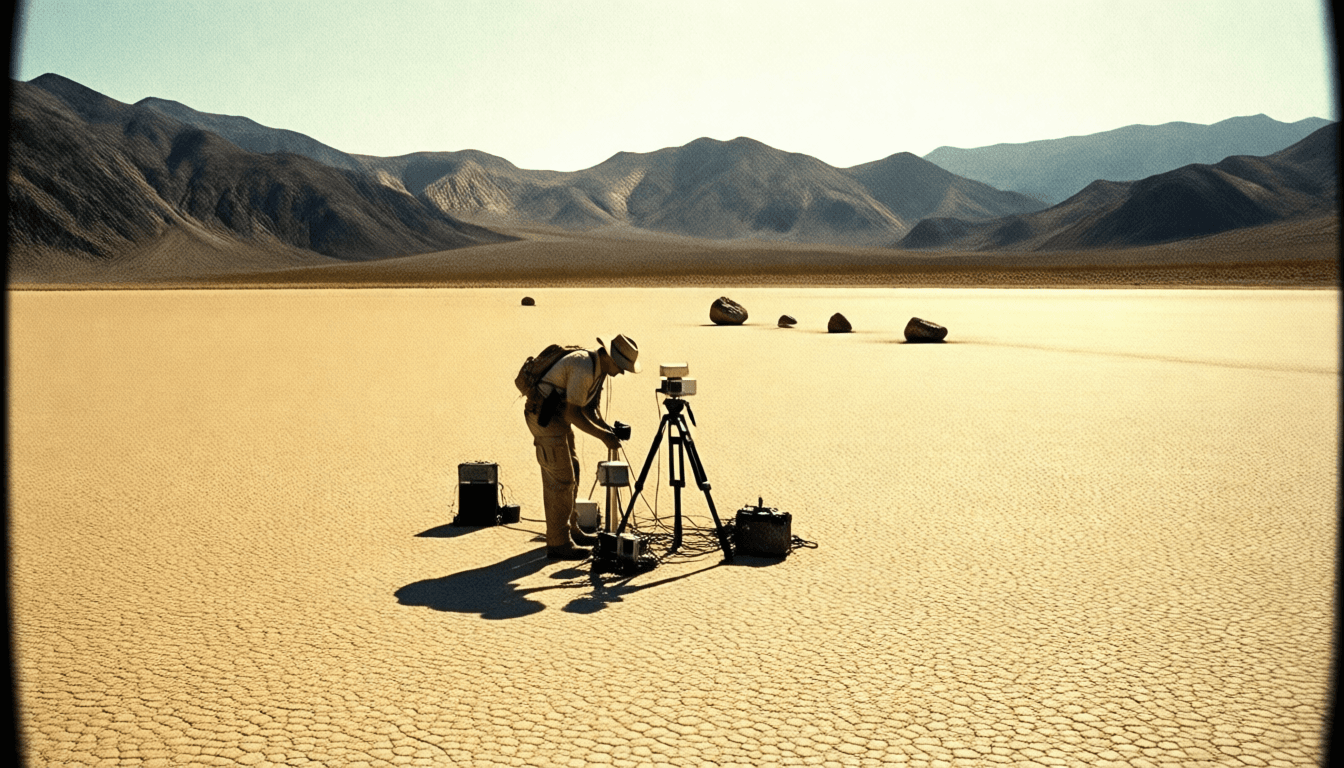
Death Valley: The Footsteps of Stones
The phenomenon of 'moving rocks' scattered across Death Valley's Racetrack Playa is often hailed as a triumph of modern science. For decades, massive boulders, some weighing hundreds of kilograms, traversed the desolate plain, leaving enigmatic trails with no visible motive force. In the early 21st century, time-lapse photography and GPS tracking finally offered a scientific explanation: thin layers of ice forming during rare winter conditions, propelled by strong winds. Thus, the mystery seemed resolved.
However, an odd record persists in my archives. An appendix, written in faded handwriting, attached to a 1973 Geological Survey report of Death Valley National Park. It was by Thomas Eldridge, a reclusive prospector who had explored these ranges for decades. 'They speak of ice and wind. Too simple. I've seen them walk in summer. Under the scorching August sun, when the air shimmers like a mirage and the ground cracks like bone. Not sliding, but taking steps. And the sound... the ground groans when it moves its children.' Eldridge's account was dismissed as delirium brought on by dehydration. Yet, he referred to specific stones as 'sentinels' and left a crude map marking patterns of movement inexplicable by wind or ice. Where science, content with its answer, ceased questioning, my investigation began.
I arrived at Racetrack Playa in late July, deliberately at the peak of summer. The landscape here was an assembly of sharp geometry. Miles of perfectly flat, desiccated lakebed, ringed by barren mountains. The ground was a mosaic of sun-baked mud polygons, brittle and unforgiving. The heat was immediate and stifling; the air completely still. The silence was profound, an oppressive weight, like a vacuum pressing down on me.
My objective was clear: to document any movement in the distinct absence of ice and significant wind. I established an elaborate observation network: time-lapse cameras, ultra-sensitive ground vibration sensors arrayed around Eldridge's 'sentinel' stones, and directional microphones calibrated to detect even the most subtle shifts. My camp was minimal: a sturdy tent and an all-terrain vehicle. The first few days passed in a haze of fierce heat and constant data logging. The sensors merely registered distant bird wingbeats or the microscopic expansion and contraction of the earth under the sun. Nothing moved.
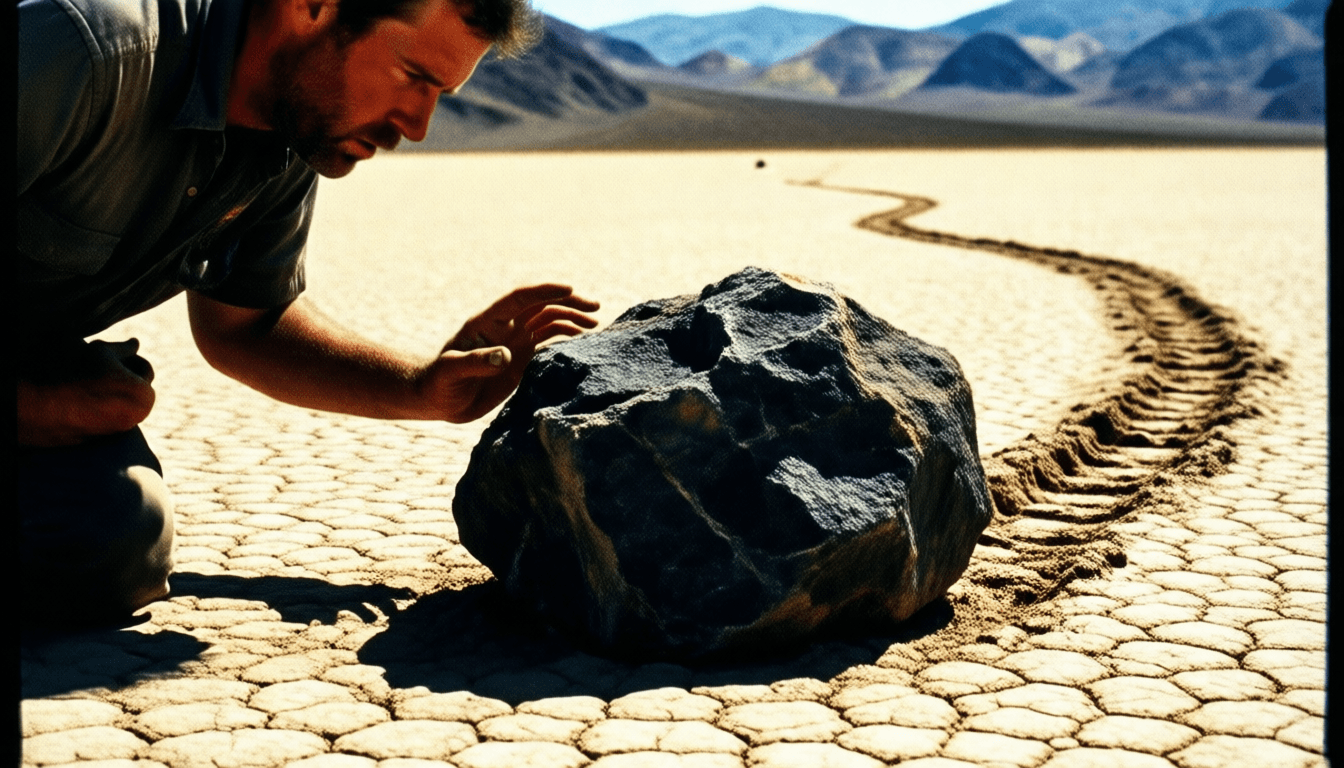
The psychological strain began subtly. The silence, initially just an absence of sound, gradually transformed into an oppressive weight. Even my own breathing seemed unnaturally loud. Sounds seemed to be absorbed. Footsteps landed dully, and the whirring of camera lenses did not carry, seeming to dissipate instantly.
On the morning of the fourth day, one of Eldridge's 'sentinels,' a massive stone designated M-17, appeared to have shifted approximately 60 centimeters from its previous position. The trail it left in the mud was not uniform, but partially deeper. The ground sensors around it had registered nothing overnight. When I reviewed the time-lapse footage, it showed only a single anomalous frame transition: the stone 'there' in one frame, then 'here' in the next, with no captured movement in between. Equipment malfunction?
That afternoon, placing my hand on M-17, I felt a distinct, localized chill emanating from the stone itself. Not merely cool, but a deep, permeating cold, unpleasantly contrasted with the murderous heat. Within minutes, the chill dissipated.

That night, a faint, rhythmic 'hum' began to register on the ground sensors. Not wind, not seismic activity, but a deep, irregular thrum, as if something immense was slowly, intermittently moving far beneath the surface. The frequency was too low to hear, but the data was undeniable. The stones remained fixed, yet the playa itself felt subtly alive. The vast emptiness no longer felt like freedom but exposure. A strange prickle ran down my spine: I felt observed, not by any creature, but by the land itself.
It was the ninth night. A moonless sky, absolute darkness save for the impossible pinpricks of stars. The air was dead still. As I reviewed sensor data inside my tent, the hum on the main monitor exploded into violent, irregular waveforms. Simultaneously, the low-frequency audio recorder picked up sound: a resonant, guttural groan, as if rising from the deepest parts of the earth, accompanied by a high-pitched, almost metallic scraping sound.
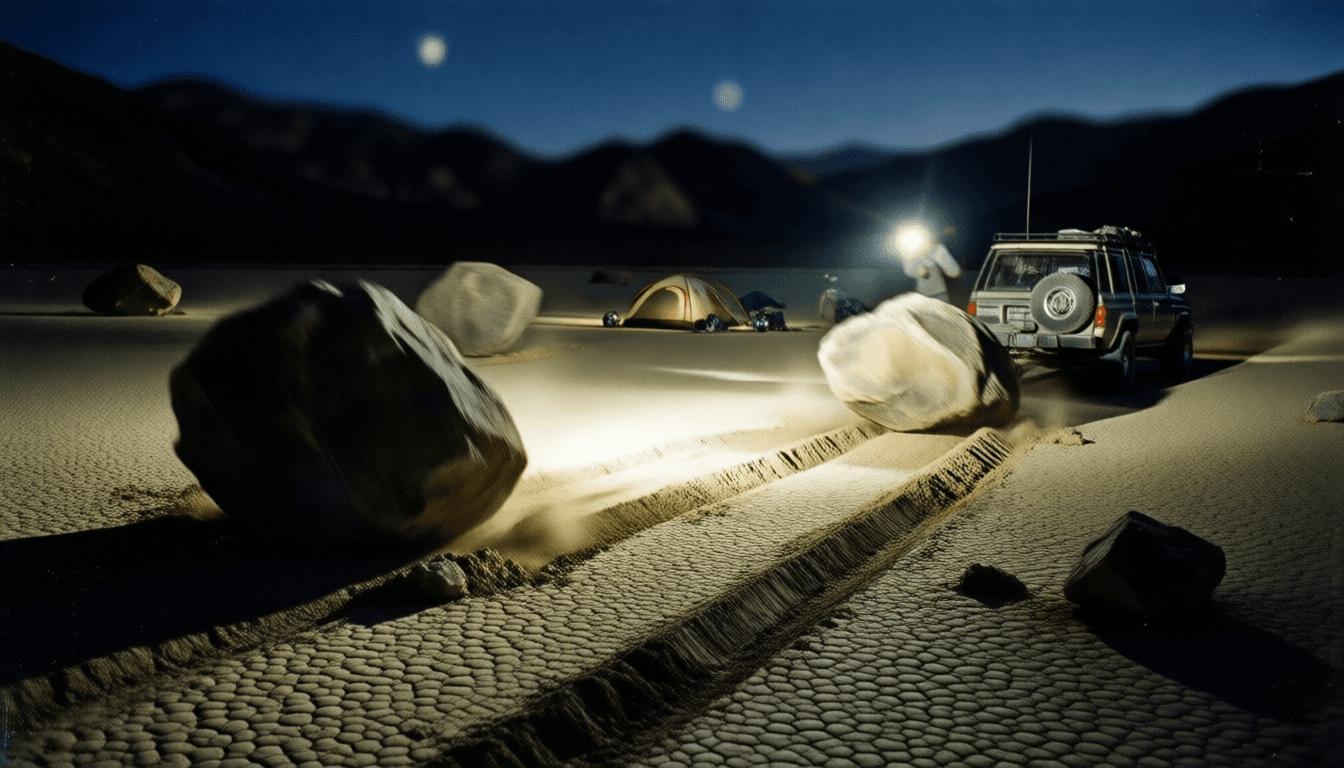
I stepped out of the tent. My headlamp beam cut through the inky blackness. Several of Eldridge's 'sentinels,' scattered across the playa, were moving. They were not sliding smoothly. Sometimes they would lurch forward, defying gravity with an impossible shudder as they briefly lifted slightly, then settled back down, sliding several feet. The trails were sharp and deep, scarring the ancient mud. They were moving with terrifying purpose, towards my camp.
A massive stone, G-5, weighing hundreds of kilograms, suddenly surged forward, blocking my path to the vehicle. It wasn't sliding. It accelerated with impossible momentum. I tried to skirt around it, but another, smaller but equally swift, stone rotated to cut off my retreat. I was being herded, encircled, by an unseen, deliberate force, not the wind.
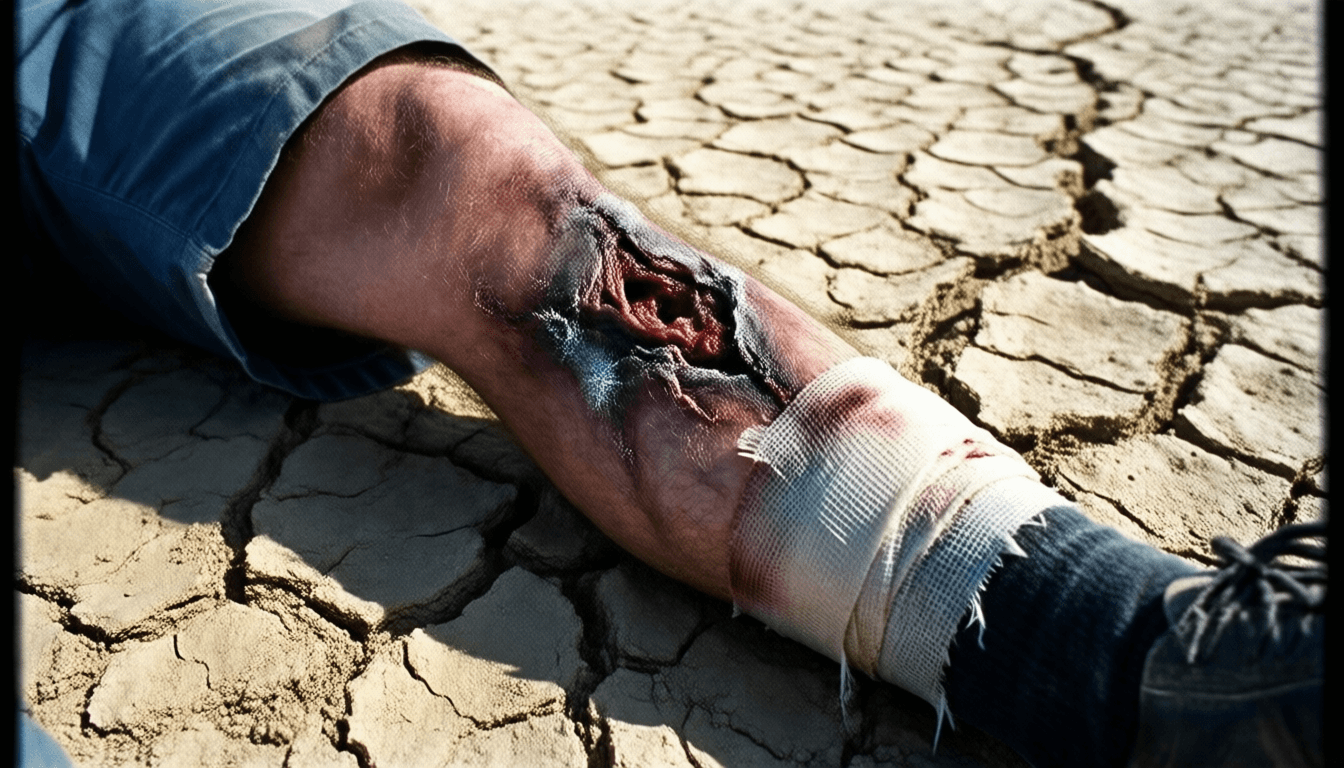
The groaning grew more intense, now accompanied by an eerie sucking sound, as if the very air was being drawn into the earth. G-5 lurched once more, crashing towards me. It slammed my right leg against the sharp edge of another stone. I heard the sickening crack of bone. But what truly paralyzed me was the cold. Despite the scorching desert heat, an impossible, permeating chill radiated from G-5, freezing my leg, seeming to bore into my very marrow. The ground around me vibrated violently, exerting a suction that seemed to pull me down. The metallic scratching came from within the crushing rock, like old gears meshing as the earth digested something. I was trapped, crushed, and the vast, empty playa no longer felt like a landscape, but a colossal maw slowly closing.
I don't remember how I escaped. The official report, filed weeks later, cited 'unexpected rockfall' and 'unstable ground conditions.' My leg, shattered and severely damaged, required extensive surgery. Yet, the doctors noted unusual tissue damage and nerve degeneration, unlike typical crush injuries. They dismissed my testimony of impossible cold and internal vibrations as shock-induced delirium.
My archived records tell a different story. The recovered camera footage was mostly noise, but one millisecond-long fragmented clip caught the G-5 stone momentarily suspended an inch above the playa surface, silhouetted against the stars, before settling back down. The carefully preserved ground sensor data revealed patterns of highly localized force, not seismic, but an unpleasantly rhythmic buildup and release of pressure. The audio recorder captured the low, growling groans and metallic scratching, sounds that defied any conventional explanation.
My leg still aches, a deep, persistent pain, accompanied by a phantom chill that never truly leaves. Sometimes, in the dead of night, even on solid concrete, I feel faint, rhythmic vibrations beneath my feet. I understand now why Eldridge wrote of the earth's hunger and the stones that take steps. The playa is not empty, nor is its mystery fully solved by ice sheets and wind. The scientific explanation is merely a ripple on the surface. Beneath it, something vast, cold, and endlessly patient continues to writhe. It moves at its own pace, imperceptible to human eyes, but its intentions are clear. This land has architects, and they are never still.
[ CLASSIFIED VERDICT ]
[ACCESS LOG - SOURCE FILE]
The 'moving rocks' phenomenon on Death Valley's Racetrack Playa was a mystery for decades, but science recently attributed their movement to thin ice sheets and strong winds. However, this story delves into a darker truth behind the scientific explanation, beginning with an old explorer's records claiming the stones actually take steps and move on their own. The protagonist journeys to the Playa in mid-summer to prove this assertion, encountering a mysterious force.