Tik-Tik: The Whispers of Death Heard Up Close
For the past five months, a remote barangay in Antique province has been plagued by livestock predation incidents, manifesting in ways that defy conventional explanation. Official reports have largely attributed these events, in their dry, dismissive tone, to wild dogs, civets, or occasionally "unknown perpetrators." However, a deeper dive into local community forums, regional news archives, and whispered testimonies paints a far more sinister picture.
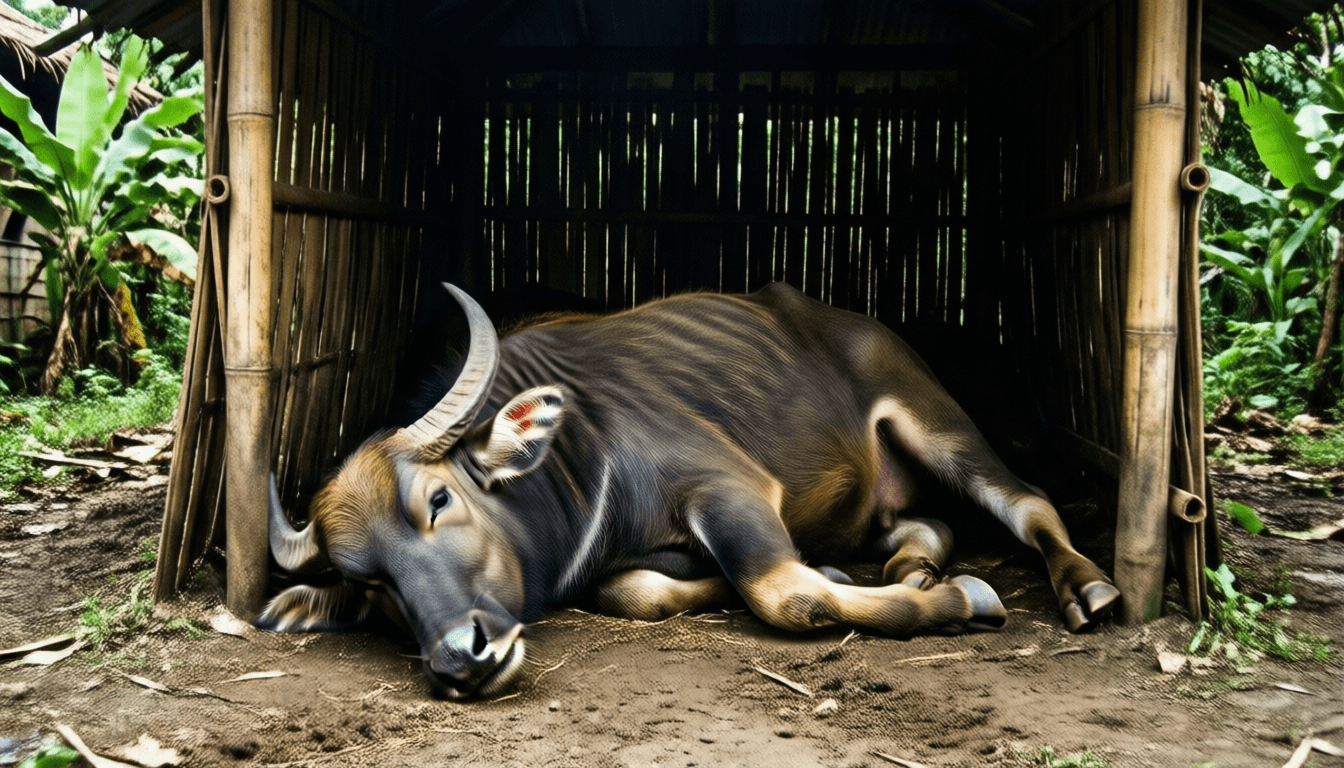
Since late May, more than a dozen young carabao calves, piglets, and an unusually high number of poultry have been found dead across four isolated hamlets. The key anomaly, consistently reported by farmers but absent from official police records, is the nature of the kills. Animals are found externally mostly intact, with no signs of struggle within their enclosures. Yet, their internal organs—specifically the heart, liver, and sometimes portions of the small intestine—are missing. There are no large lacerations or bite marks indicative of common predators. Instead, some detailed testimonies describe "pin-sized" holes sometimes found near the chest or flank. Blood loss is invariably severe, completely draining the animals of their vitality.
Older residents, particularly the elders of Masaplod, speak of "dili-ingon-nato" (things not like us), invoking ancient tales of the Manananggal, a winged entity known to detach its upper torso from its lower half at night to feast on internal organs. This ancient folklore, once relegated to mere ghost stories for children, has undergone an unsettling resurgence in local discourse following the disappearance of an infant from a nipa hut in Masaplod last month, leaving behind only a small, unidentifiable stain on the bamboo floor. The official verdict was 'kidnapped by unknown persons,' but whispers of the *tik-tik* grew louder, further fueled by a distinct, almost sickeningly sweet metallic odor reported near some kill sites, which livestock owners could not explain. This repetitive, inexplicable methodology and consistent cultural correlation demanded immediate on-site investigation.
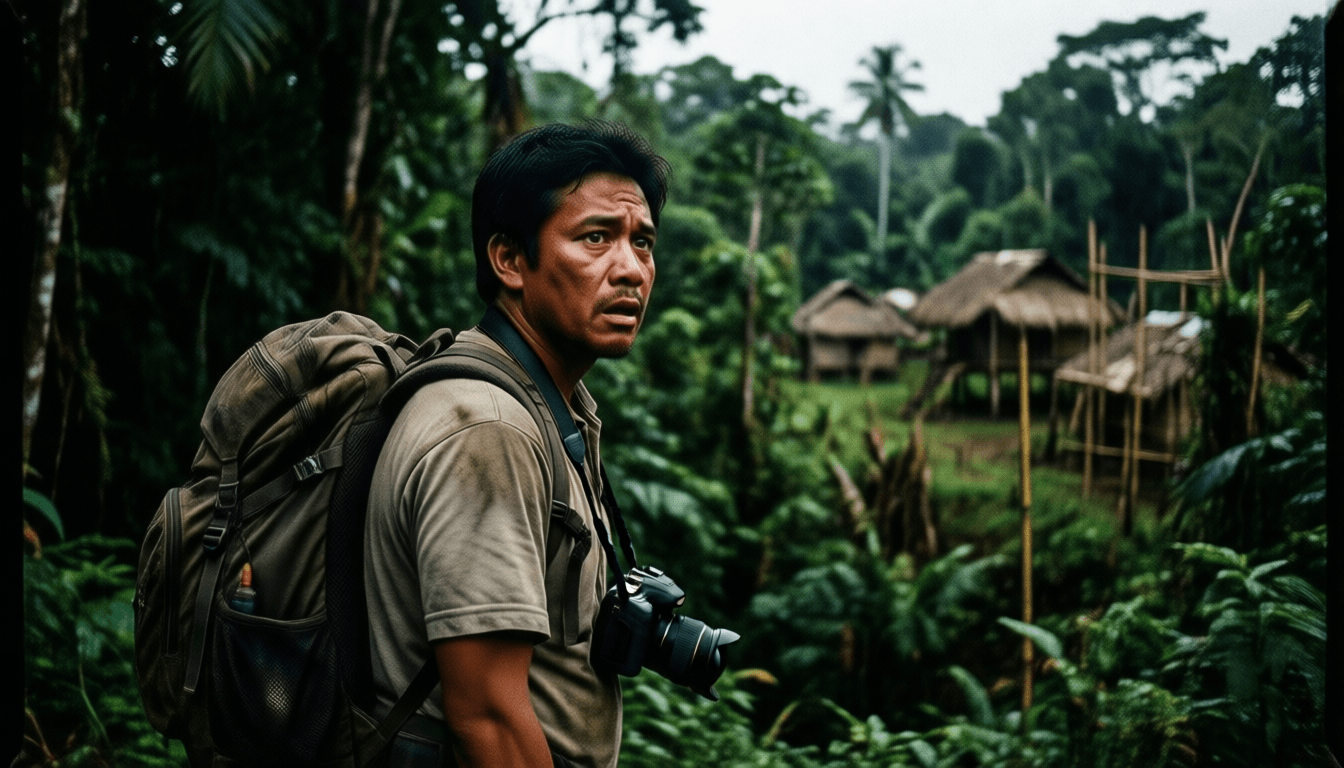
Upon arrival in Barangay Masaplod, I was met with an pervasive, visceral unease, layered with seasoned skepticism. The younger generation offered polite but hollow dismissal, while the elders merely shook their heads with a weariness beyond their years, pointing only towards the emerald curtain of dense jungle that pressed upon the village's edge.
My first reconnaissance led me to an abandoned pigsty, where Grandma Maria's prized sow, the most recent victim, had been found two days prior. The enclosure itself, a sturdy bamboo structure, showed no signs of forced entry. The ground within was disturbed only by the desperate flailing of the dying animal. The sow lay on its side, unnaturally pristine for a carcass, with that characteristic small puncture mark just behind its foreleg. There was no gruesome blood, no scattered entrails, just an empty cavity beneath the skin. In the air, thick with the damp smell of earth and decaying vegetation, there was a faint, almost imperceptible metallic sweetness, sickening and unsettling. It was exactly as described in the online reports. It wasn't the stench of decay, but something else, something 'cleaner' yet more profound.
I rented a small hut at the village's periphery, setting up my field equipment. It overlooked a narrow tributary that fed into the larger Masaplod River. The humid air hung heavy, promising rain. I reviewed the characteristics of the *tik-tik* myth: aversion to salt, garlic, running water; a disorienting call; the nocturnal hunt for entrails. I tried to rationalize the evidence: a specialized predator, an elaborate theft. But the missing organs, the absence of struggle, the peculiar smell—it all felt too precise.
As night fell, an unsettling, profound silence descended, replacing the jungle's usual din. Crickets, cicadas, the distant bark of dogs—all the usual nocturnal symphony seemed to have either muted themselves or simply vanished from my immediate vicinity. It was an unnatural quiet, as if sound itself was absorbed by the surrounding dense foliage. I attempted to drop a pebble into the slow-moving tributary beside my hut. Instead of a crisp splash, there was a dull, delayed 'plop,' like dropping a stone into thick mud.
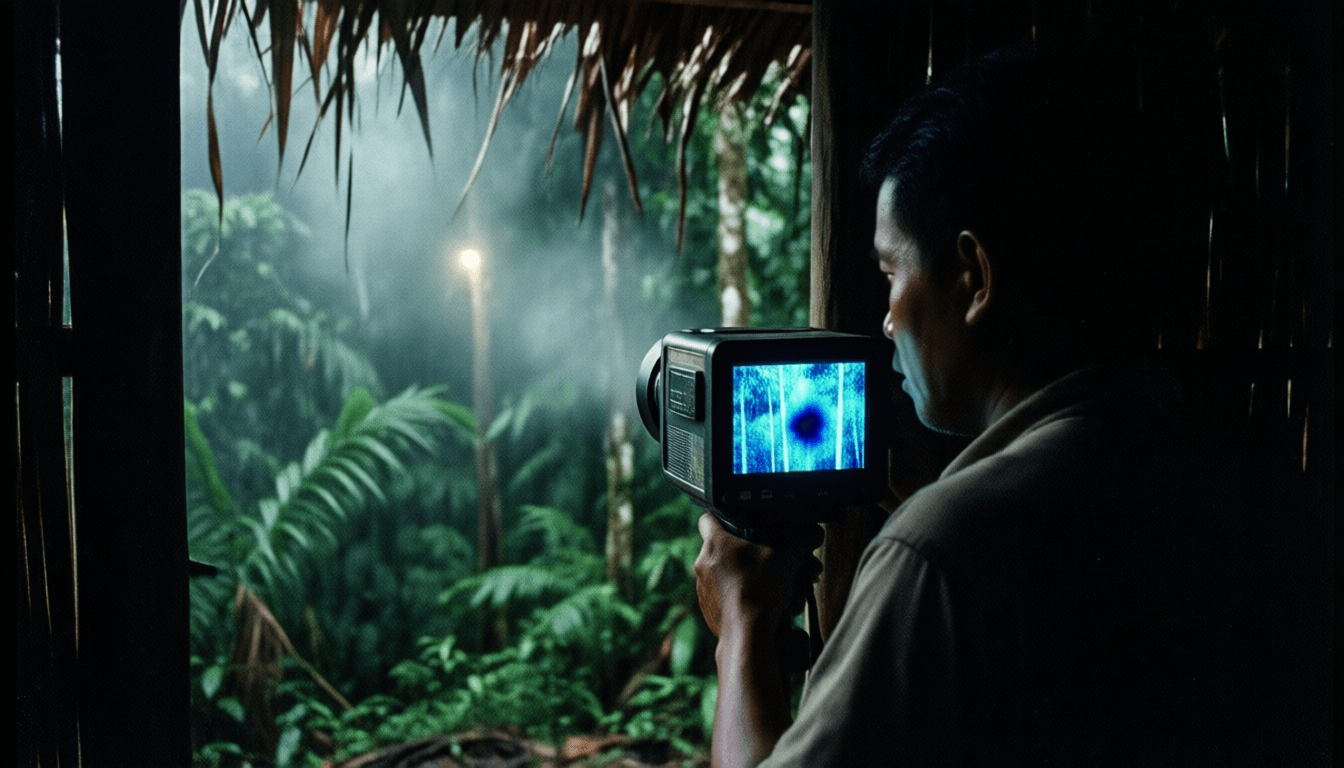
Then, the smell returned. Now, it was more intense. That sickeningly sweet metallic aroma, like old blood mixed with jasmine, seeped through the bamboo wall crevices, making the air heavy and cloying. I switched on my thermal camera. The trees were hazy outlines of cool blue and green, but a specific patch about fifty meters into the forest edge showed a sudden, localized drop in temperature by several degrees—a strange, deep indigo—before rapidly returning to normal.
And then, the sound. A faint, rhythmic *tik-tik*. It wasn't loud, but it cut through the unnatural stillness with chilling clarity. It sounded like a bird, deep in the jungle, far away. Yet, as I strained my ears, trying to triangulate its source, the sound seemed to move. When I focused on where I thought it originated, it seemed to recede, fading. But when I shifted my attention, letting my guard down, it suddenly felt *closer*, faintly vibrating in the humid air just outside my hut. The disorienting effect described in the folklore was horrifyingly real, playing with auditory perception, warping spatial awareness. My heart began to pound. This wasn't merely an acoustic illusion of echoes. This was active manipulation of sound, a predator's sensory camouflage.
Driven by a desperate need to confirm or deny the impossible, I gripped my flashlight and camera and cautiously stepped towards the jungle's edge, following that elusive *tik-tik*. The air grew colder, and the metallic sweetness was overwhelming. Pushing through fern thickets and thorny vines, I came upon a small clearing, almost perfectly circular.
And it was there.
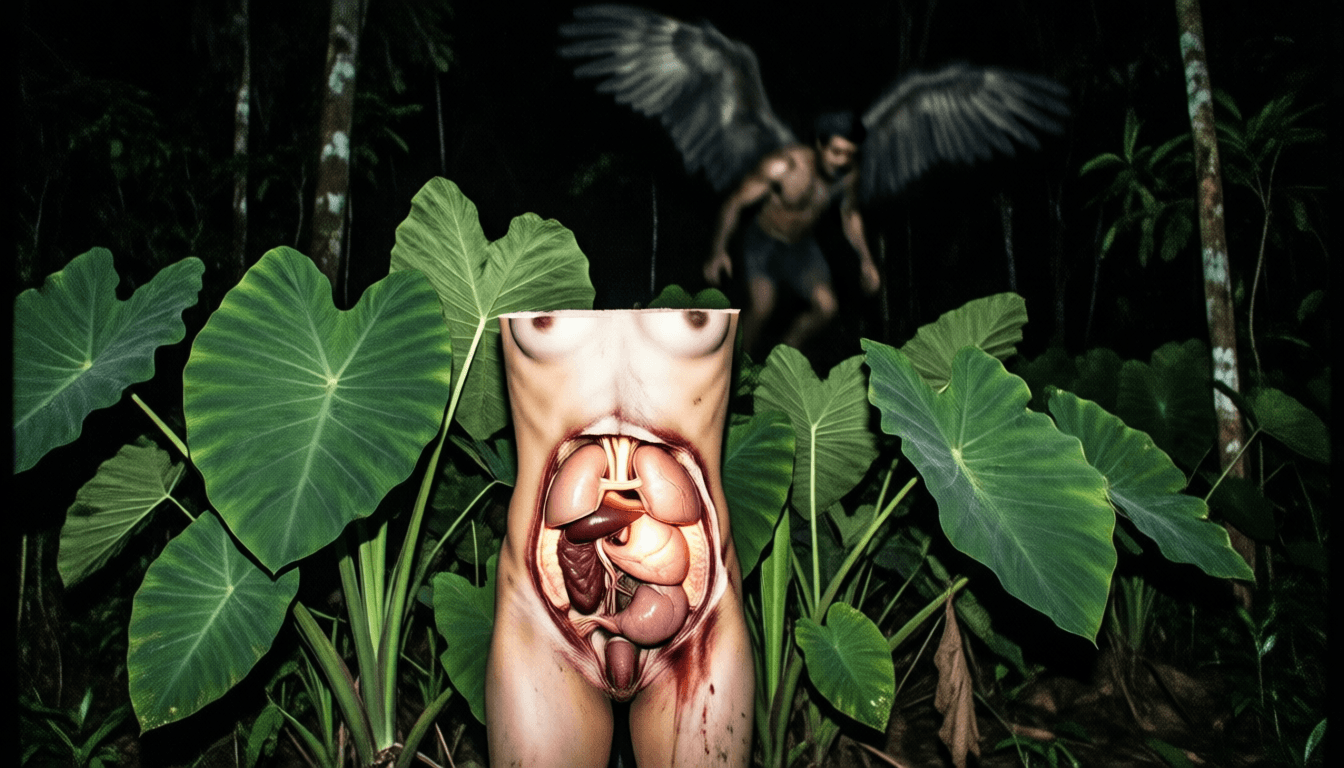
Not a whole creature, but a grotesquely pulsating human lower torso. It stood upright amidst a cluster of taro leaves, cleanly severed at the waist. It was sickeningly corporeal, its exposed entrails at the severed edge emitting a faint, repulsive internal glow. The metallic sweetness emanated directly from it, an overwhelming presence. My breath hitched. This was no animal carcass, no mere folklore. This was a physical presence.
As my mind struggled to process the impossible sight, a cold, unnatural gust of wind suddenly swept through the clearing, even though the surrounding foliage was perfectly still. Above me, a soundless shadow detached itself from between the branches. It was the creature's upper torso. Undeniably human-like in proportion, yet monstrously distorted. Skin was stretched taut over sharp angles, its eyes gleamed with malevolent intelligence, and vast, leathery wings flapped with silent ferocity. Its head extended forward, a long, needle-thin proboscis quivering and reaching from its mouth. It descended with a speed that defied the physics of air resistance; less a flight, and more a deliberate fall.
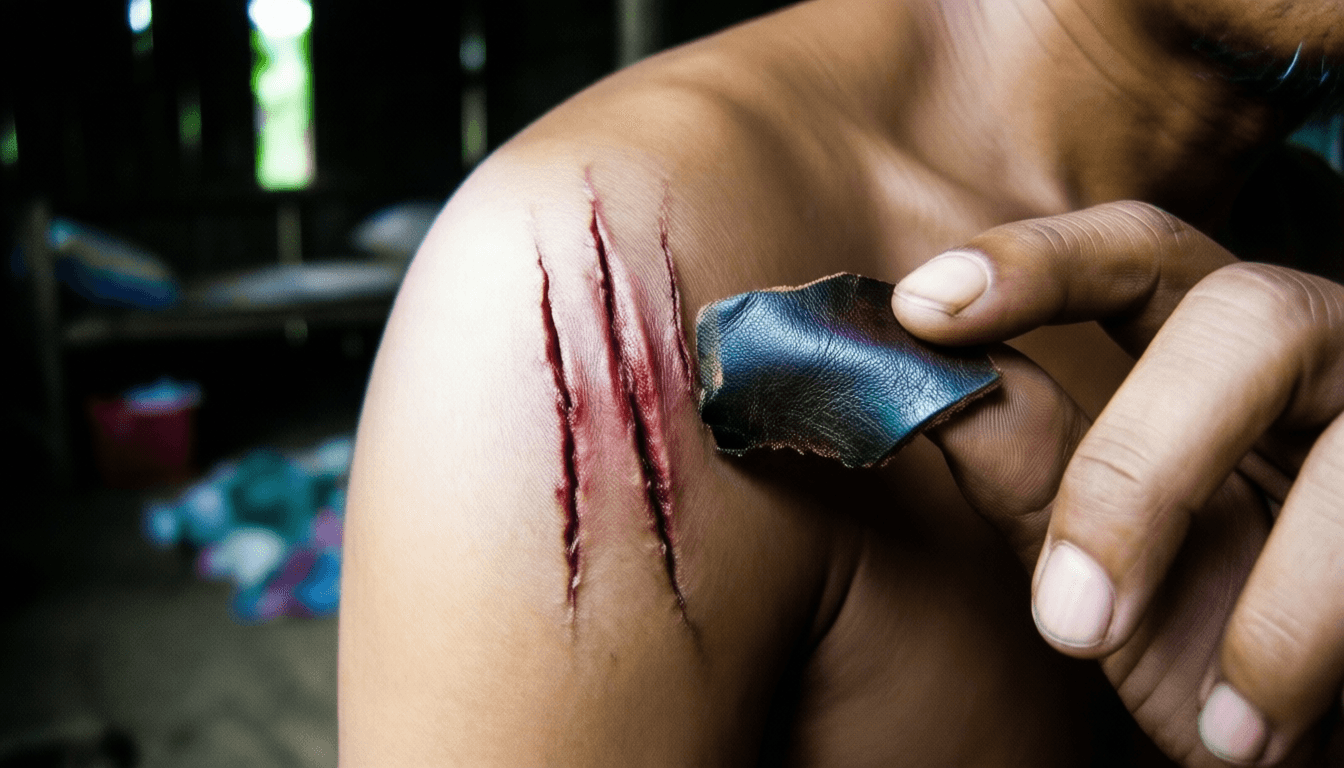
Before I could scream, the creature was upon me. Sharp, incredibly strong talons raked across my shoulder, tearing through my shirt and skin. I stumbled back, dropping my flashlight but desperately clinging to my camera. The scent of fresh blood—my blood—mingled with that unbearable sweetness. It lunged again, proboscis extended. Pure instinct, a desperate memory of the old women's tales, drove my hand to fumble for the small pouch of rock salt I carried. I threw it blindly, a handful of salt scattering towards the pulsating lower torso.
The reaction was instantaneous and violent. A sharp, utterly inhuman shriek tore through the stillness, shaking even the surrounding leaves. It was a sound of pure agony and rage. The upper torso recoiled as if struck by an invisible force, its wings flapping madly and erratically. Then, with one final, thick scream that seemed to distort the air itself, it shot upwards, vanishing into the darkness, leaving only the now distant *tik-tik* sound. The lower torso, where the salt had landed, withered and rapidly collapsed into a heap of dry flesh and dust.
Clutching my burning shoulder, the sickeningly sweet smell clinging to my clothes and hair, I scrambled out of the clearing. My camera had been dropped, but I had miraculously captured a few seconds just before the final lunge—a raw, shaky image of *something* pulsating among the plants. Too indistinct for forensic proof, yet for me, undeniably there.
The next morning, that specific clearing where I had faced the impossible was eerily pristine. No pile of dust, no dry flesh, not even disturbed earth where the lower torso had been. It was as if the ground itself had swallowed the evidence whole. Yet, on my shoulder were three deep, parallel lacerations unlike any animal scratch I had ever seen. The wounds bled continuously for three days, refusing to clot properly, and even under the tropical sun, that area emitted a persistent, deep cold.
Tucked into the torn fabric of my shirt, I found a small, dark fragment. It was leathery, strangely warm to the touch, and shimmered faintly with iridescence. Too small to identify, yet undeniably organic, and unlike anything found in the local fauna.
I left Masaplod that day, giving a vague explanation of a wild animal attack to the local authorities. They merely nodded with their accustomed indifference. But that metallic sweetness never fully left me. Now, it resurfaces in the most mundane moments. A ghostly presence in the sterilized air of my apartment, in the smell of rain on concrete, in the quiet hum of my laptop.
The *tik-tik*, once a warning, is now a chilling echo in my mind. I understand its trickery. Far when near, near when far. It means that during those first nights, unknowingly, those separated body parts could have been everywhere around me, moving independently, obscuring their presence with the very sound they manipulated. It was never truly far. It was always, horrifyingly, close. And now, I understand why the elders remain silent. They know they are not fighting a legend. They have merely learned to live with the knowledge that some things can split themselves in two, leaving one part vulnerable while the other hunts unseen, waiting for the precise moment of impossible reattachment. And the true horror is the chilling realization that somewhere, out there, that lower torso is still waiting.
[ CLASSIFIED VERDICT ]
[ACCESS LOG - SOURCE FILE]
This story is based on an ancient Filipino folktale, specifically the legend of the Manananggal. The Manananggal is a vampiric creature known to separate its upper torso from its lower body at night, flying to hunt for internal organs, particularly the hearts and livers of pregnant women and children. Its characteristic 'tik-tik' sound is deceptively heard as distant when it is near, and vice-versa, to disorient its victims.