The Solar Phantoms of Lucerne Dry Lake
In the archives of Caltrans District 8 and the California Highway Patrol, odd incident reports have accumulated for decades around an abandoned stretch of State Route 247 near Lucerne Dry Lake. They describe human-shaped outlines standing perfectly still amidst the sweltering noon heat shimmers across the salt flats—entities local truckers dubbed 'The Solar Phantoms'. Unlike normal inferior mirages that break apart or drift away as an observer approaches, these silhouettes remained razor-sharp, locked to precise geographic coordinates. In August 2023, a telecommunications surveyor tracking an unauthorized microwave signal disappeared in the basin, only to be found two days later. Despite wearing a thermal hazard suit, he suffered second-degree flash burns across his body, and both retinas were permanently scarred with microscopic grid patterns. His handheld spectrometer had melted internally while attempting to measure petawatt-scale laser oscillations that vastly exceeded its sensory threshold.
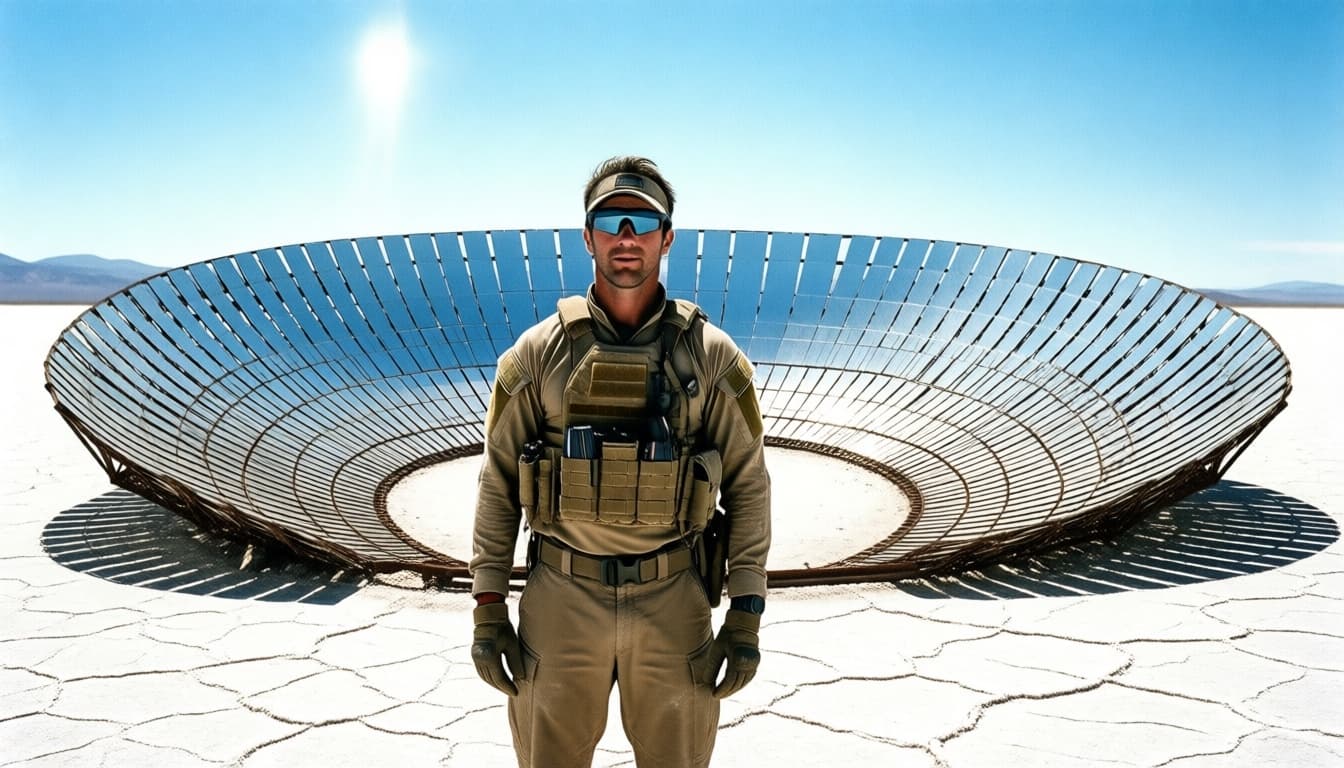
Hired by an asset liquidation firm before the land was transferred to a federal conservation trust, my assignment was to verify whether an abandoned subterranean relay array was still active. The mid-July desert sun was punishing. Ambient ground-level temperature hovered at 48 degrees Celsius, while the white crust of the salt pan beneath my boots exceeded 61 degrees. Beyond the blinding glare piercing through my polarized sunglasses stood a decommissioned optical tracking test site secretly constructed in 1999 by DARPA and a Caltech spin-off. Seventy-two massive heliostat mirrors were arranged in a wide, concentric circle.
What struck me immediately was their angle. Instead of aiming upward toward a central thermal collector tower, the mirrors were tilted nearly flat, skimming parallel to the earth. They were aimed precisely eight centimeters above the cracked alkali ground, directly into the superheated air boundary layer warped by extreme surface heat. As I set my portable LiDAR and infrared spectrometer down to check for residual power, a bizarre mechanical hum traveled up through my boots from the hardened clay basin. It was a faint, bone-conduction resonance transmitted entirely through solid earth rather than the air.
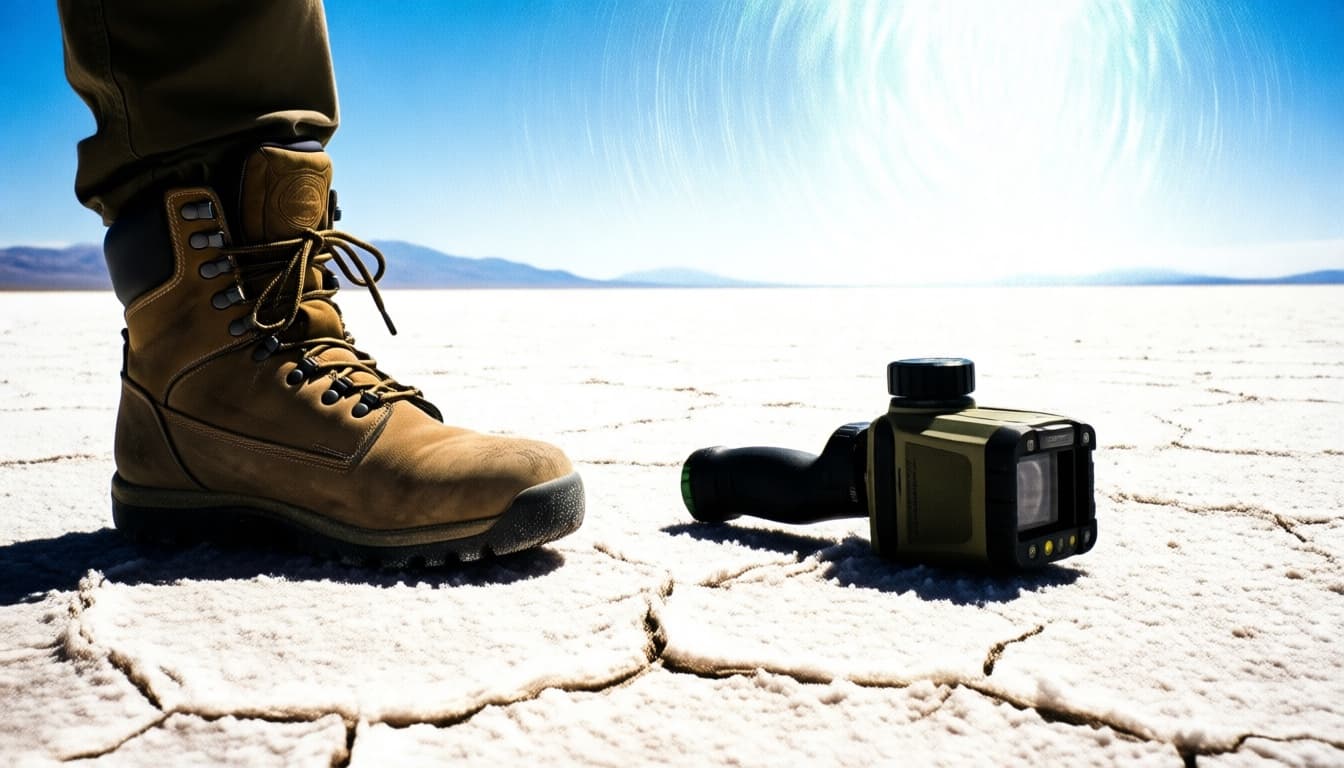
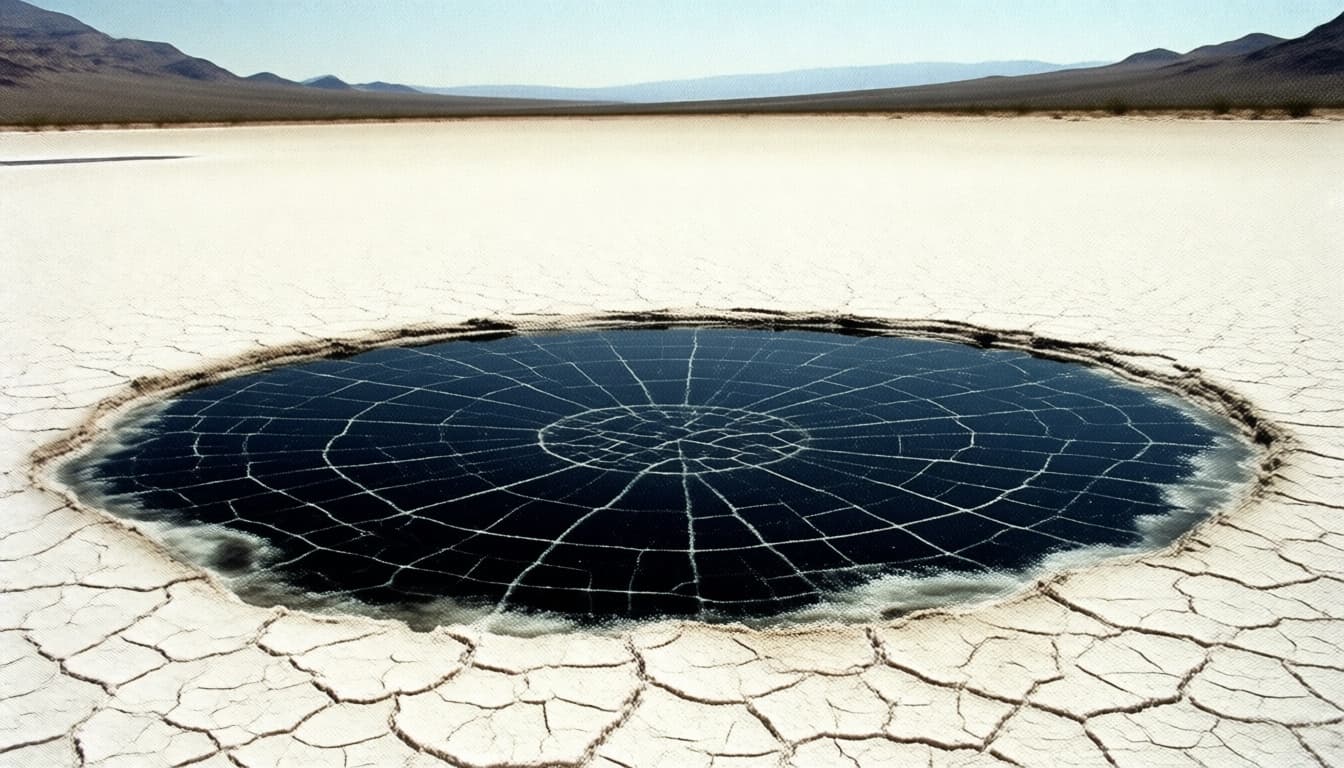
The moment I took a step, sensory reality began to fracture. The crunch of my boots crushing the salt crust only reached my ears three full seconds after my foot hit the ground. Sound was lagging behind within the distorted thermal pocket. Panicking, I tried to back away, but the silvery-blue ring of mirage water enclosing my vision refused to recede. Whether I stepped forward or retreated, the reflective band stayed exactly twelve paces ahead, encircling me in an unbroken boundary. Physical space had looped, locking me at its dead center.
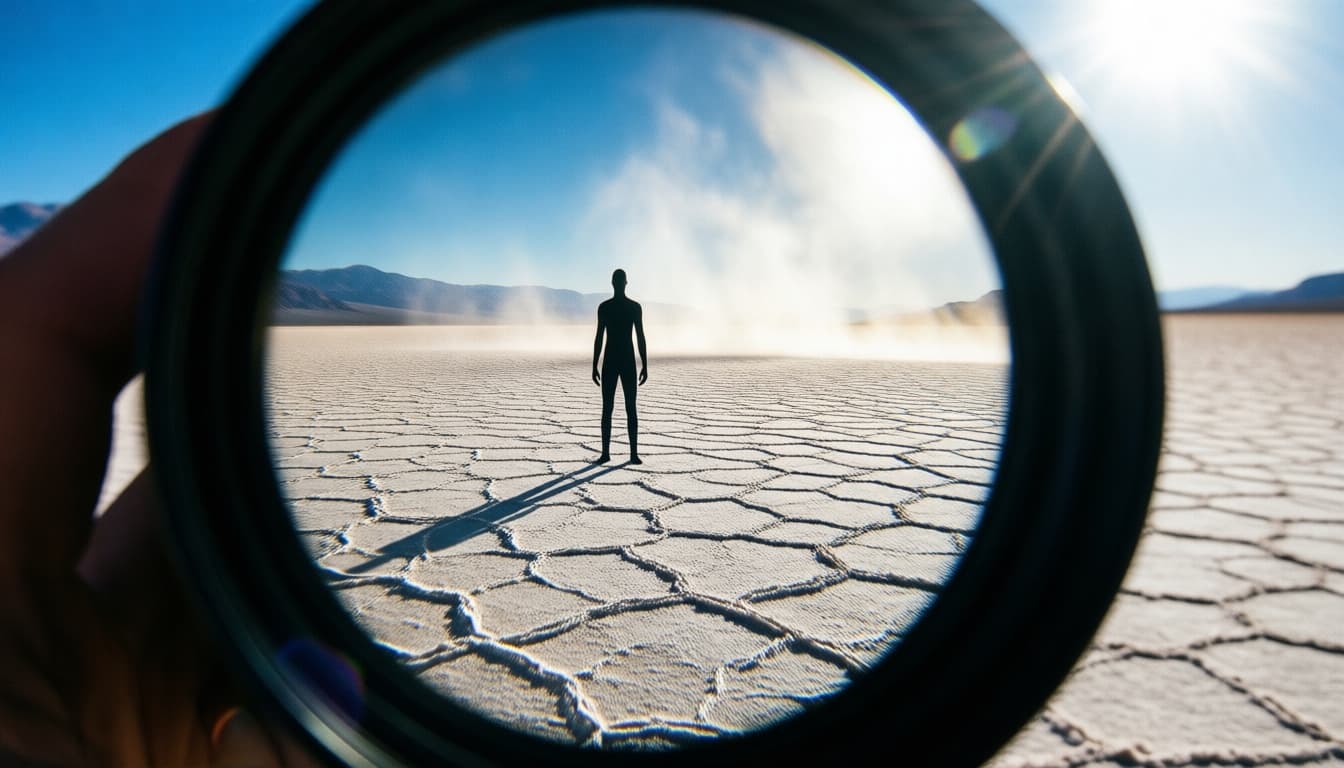
Snapping a linear polarizing filter over my inspection camera lens, the air shimmer abruptly froze. The trembling heat haze solidified into an impossibly sharp, glass-like geometric plane. Within the refractive boundary, dark silhouettes flickered into view. They weren't ghosts. They were uncompressed volumetric holograms projected directly onto the atmospheric thermal inversion layer, utilizing the superheated air itself as a dynamic optical medium. The entire installation was an open-air optical drive, using the desert's extreme temperature gradient as a physical storage disk. With the midday sun reaching its apex and the ground attaining the precise index of refraction, the buried machinery had automatically triggered its Read-Cycle.
With a deafening hydraulic screech, all seventy-two heliostats pivoted upward by fractions of a millimeter. Deep underground, a radioisotope thermoelectric generator had shifted from passive scanning to a parity-check cycle—a full data integrity verification. Invisible near-infrared laser beams discharged from the mirror faces, raking across the ground boundary layer. Wherever the beams collided with the compressed thermal inversion, sharp cracking detonations echoed, sparking plasma discharges that fouled the air with the sharp, burning stench of ozone and vaporized silica.
A wave of terror seized me. Standing inside the array, I was not recognized as an observer. To the system, my body was a foreign particulate—physical noise obstructing the data track. Severe thermal lensing triggered total internal reflection, bending the surrounding horizon inward toward the circular array. There was no horizon left to run toward. Whichever way I turned, I saw only reflections of my own coordinates staring back.
The air approached auto-ignition temperatures, shriveling the synthetic fabric of my cooling vest. The dozen dark figures trapped in the optical horizon multiplied rapidly as the laser grid narrowed, closing ranks toward me. The phenomenon broke every rule of optics. While I stood paralyzed in place, my own shadow on the bleached salt floor stepped forward independently, taking three deliberate strides toward the focal point of the nearest mirror with outstretched arms.
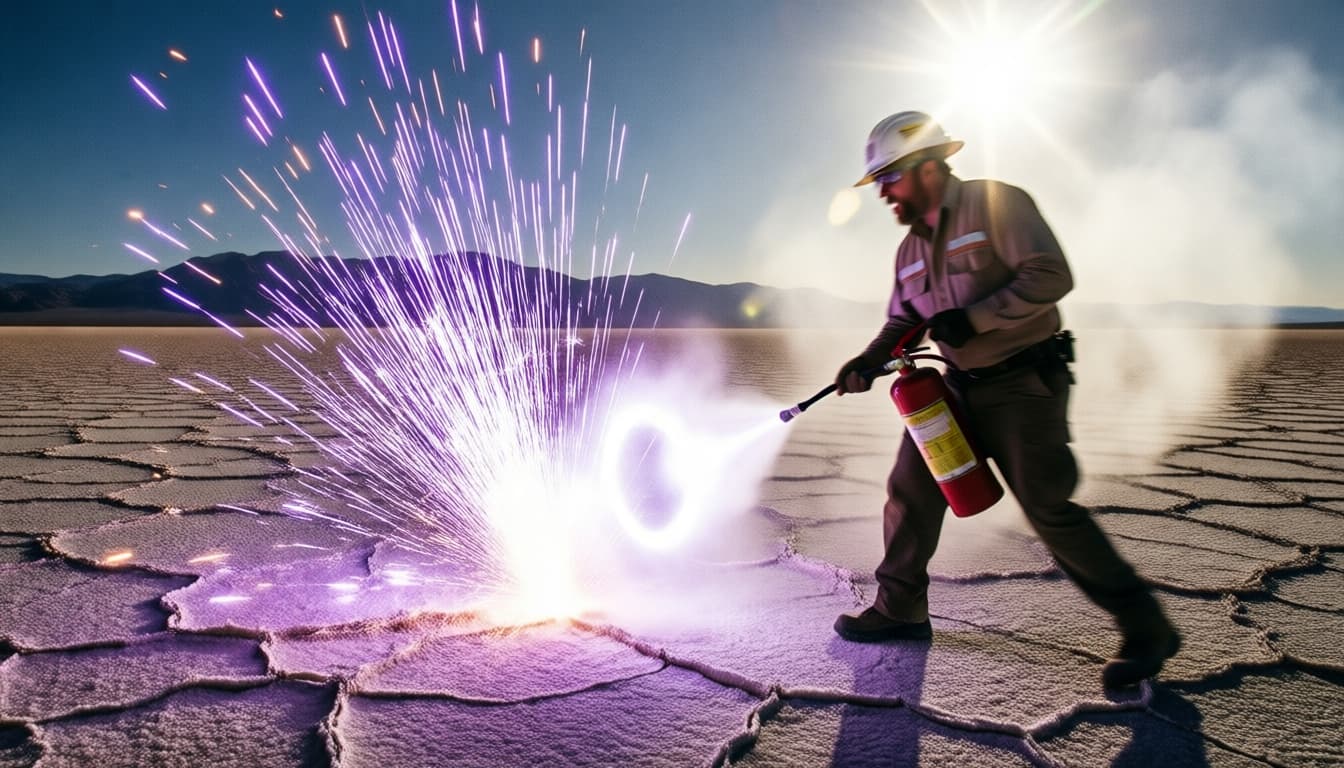
The edge of a sweeping alignment laser grazed my hip belt. The hard plastic casing of my field radio vanished in a flash of instantaneous sublimation without even producing smoke. A sickening, chemical burn tore through the flesh of my right pelvis. Even as my vision tunneled from agony, an epiphany struck: the mirrors relied entirely on the air's extreme density differential to maintain focus. Reaching for my utility harness, I unclipped a Halon fire extinguisher and emptied the entire cylinder directly into the shimmering salt crust.
Sub-zero chemical gas blasted across the alkali floor, shattering the thermal inversion layer in an explosive atmospheric collapse. The beam convergence broke instantly. A palm-sized fissure split open in the circular refractive wall trapping me. I lunged headfirst through the gap in the light. Behind me, dozens of petawatt laser pulses converged into a single focal point with an ear-splitting crackle, boiling the salt basin into a bubbling pit of black vitrified glass as I tumbled over the perimeter barbwire into the gravel wash.
As the late afternoon sun drifted westward, the critical refractive index collapsed, and the heliostats tilted back to their dormant positions with mechanical finality. I survived, but the damage was permanent. The second-degree burn across my hip never healed normally. The scarred melanin cells regenerated into a permanent, pitch-black matrix pattern resembling a microscopic high-density data barcode. The contractor classified the coordinates as an unexploded ordnance hazard, fencing off the basin forever.
Yet every year at noon on the summer solstice, National Weather Service thermal satellite imagery detects an impossible anomaly over Lucerne Dry Lake. The exact moment the desert ambient temperature hits 48 degrees Celsius, a pristine, razor-edged rectangular sector spanning 2.4 kilometers drops abruptly to near-freezing temperatures on infrared scans—as if a colossal, invisible archive is opening its pages to the sun, silently waiting for the next errant particle to wander across its track.
[ CLASSIFIED VERDICT ]
[ACCESS LOG - SOURCE FILE]
Based on Mojave Desert urban legends surrounding Lucerne Dry Lake, California, where travelers report seeing razor-sharp, motionless human silhouettes standing inside severe midday mirages. It draws upon rumors of Cold War-era DARPA optical laser installations, reimagining the desert's extreme atmospheric heat inversion as an open-air optical storage disk that treats human trespassers as corrupt data.