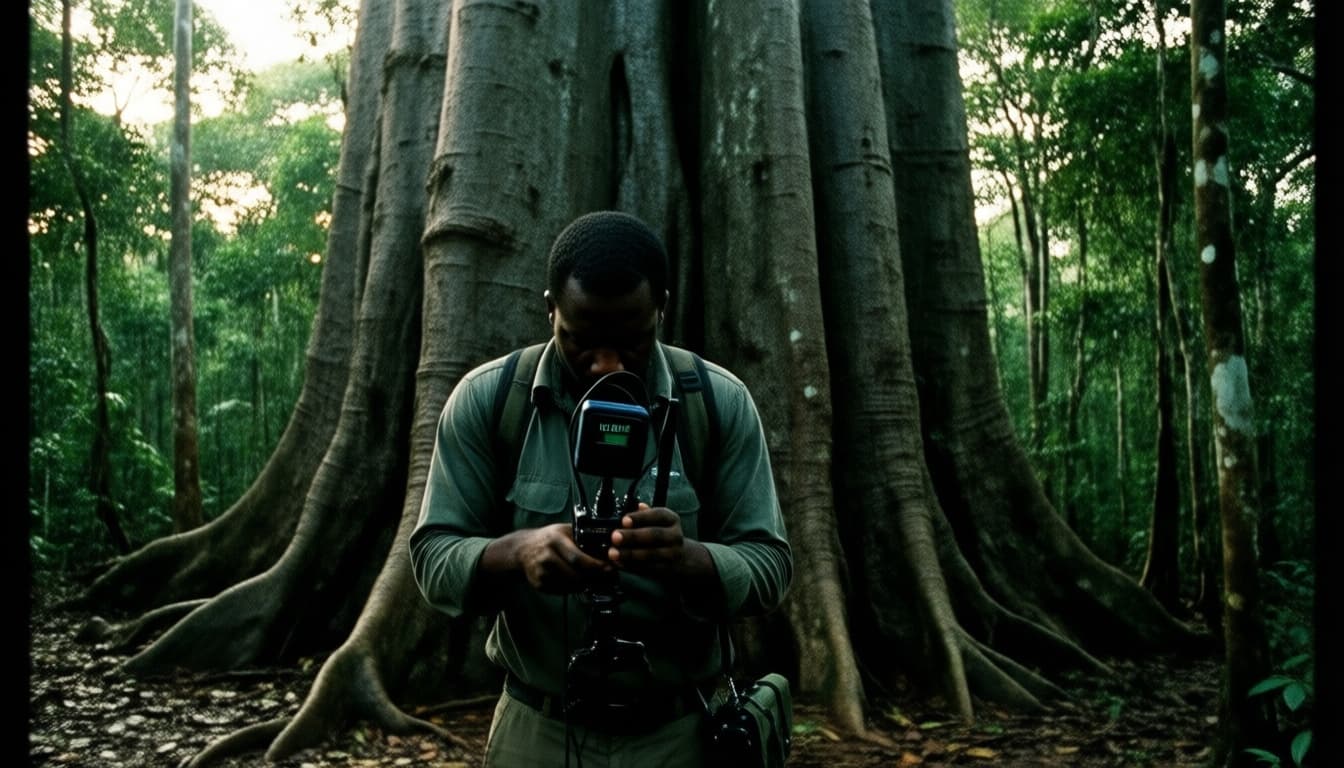
Baobab Hum: Heart of the Awakened Forest
For years, 'Deep Earth Signals,' an online forum for shortwave radio enthusiasts and amateur seismologists, had accumulated reports of peculiar ultra-low frequency (ULF) interference bursts originating from Madagascar. Mainstream science dismissed them as atmospheric phenomena or unverified equipment errors, yet a consistent pattern emerged: a deep, rhythmic 'hum' distinct from seismic activity, detected weeks before minor quakes in the Kirindy Mitea National Park region. They called it the "Baobab Hum." Local guides, under pressure, would warn against entering certain ancient groves when the hum was 'felt,' saying, "The trees are awake." One user, 'RadioGhost_MDG,' posted fragmented audio files layering sounds chillingly similar to biological rhythms over distorted, pulsing vibrations, along with a single line – "It's not just receiving. It's... responding" – before vanishing. The last timestamp on his equipment showed a sustained, focused ULF emission at 3.7Hz, originating from an unknown forest.
As a bioacoustician, Dr. Elias Sohn, I had been cut off from fringe research funding for years. The 'RadioGhost_MDG' incident and the accumulated ULF data from 'Deep Earth Signals,' dismissed by former colleagues as conspiracy, ignited a morbid curiosity in me. I packed a portable ULF microphone, geophones, specialized spectrometers, and high-sensitivity seismometers, heading to the edge of Kirindy Mitea. My target: an ancient, unnamed baobab grove, unmarked on any official map, only hinted at by fragmented satellite images and local whispers. The air was thick and humid, a stifling heat and earthy scent clinging to everything. The trees themselves were colossal, grotesque giants. Their smooth, grey bark rippled like muscle, their limbs gnarled, reaching to the sky like forgotten gods. An unnatural stillness pervaded the forest; the usual insect chorus was subdued, replaced by the faint cries of lemurs that sounded almost... wary. I set up my equipment around the largest baobab, its colossal, hollowed-out trunk large enough to fit a small car. Initial readings, save for the regular whirring of my gear, were silent – no 'hum' to be found.
Minutes stretched into an hour. Then, the first anomaly registered. Not on the microphone, but the geophones. Faint, almost imperceptible vibrations pulsed rhythmically from deep within the earth. It wasn't seismic; the pattern was too regular, too deliberate. The spectrometer, initially empty in the ULF range, began to flicker with a faint, ordered spike at 3.7Hz – precisely matching 'RadioGhost_MDG's last reading. I felt a faint nausea, a pressure behind my eyes that wasn't from the heat. The air around the massive baobab became denser, almost electrically charged. A strange, metallic aroma, like ancient blood or ozone, began to seep from the tree's fissures. Leaves on nearby shrubs rustled, as if caught in localized eddies, even in the perfect stillness. I pressed my palm against the cool, ancient bark. Beneath my fingers, I felt a subtle, deep expansion and contraction – a slow, deliberate 'breath' resonating through my bones. The ULF microphone array, which had previously shown only ambient noise, now recorded a complex low-frequency melody. Not a simple hum, but a structured series of pulses, like a conversation so vast and slow, just below the threshold of human hearing, that we couldn't perceive it. With chilling certainty, I realized: The trees weren't receiving the hum. They *were* the hum.
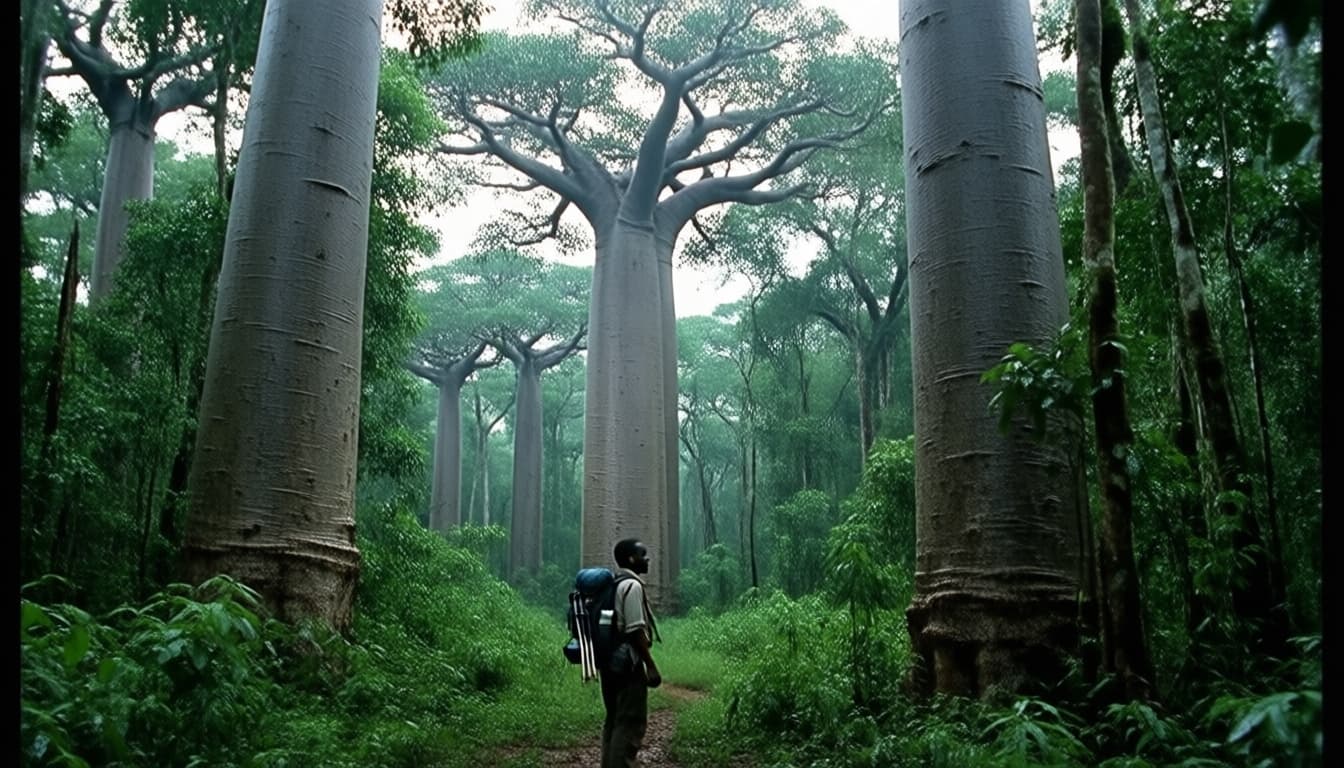
The hum intensified. No longer a faint tremor, it was a bone-rattling vibration shaking the entire ground. The baobab's colossal trunk, its hollow interior, began to resonate like a giant, organic bell. The air inside the cavity grew thick, almost viscous, with microscopic dust swirling within it, charged with an unknown energy. My recording equipment, scattered around the base of the tree, began to show erratic power fluctuations. My main data logger, perched on a rock near the trunk's entrance, blinked angry red. I needed that data. As I reached into the entrance to retrieve it, the rough, fibrous inner bark of the baobab shifted. It wasn't a creak or a groan; it was a slow, deliberate contraction. My arm was caught. A cold, sharp terror cut through my scientific detachment.
The tree was moving. Rational thought ceased for a moment.
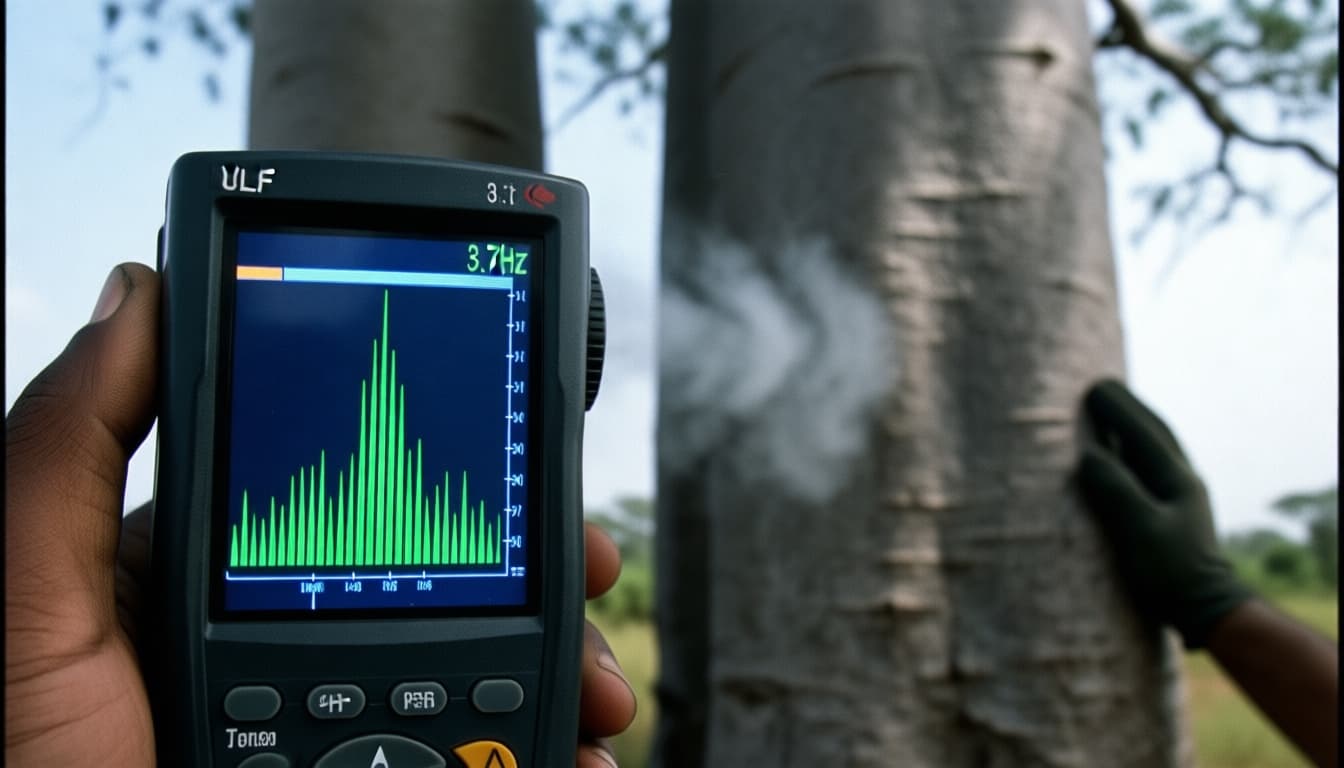
A deep, guttural thrum was now clearly audible, vibrating not just through my ears but my entire body. It wasn't just a sound; it was a physical pressure, a directed bioacoustic wave. It pulsed through my trapped arm, creating a painful internal resonance. The very fibers of the baobab's internal cavity, where my arm was embedded, began to ooze a clear, sticky sap. It wasn't merely viscous; it was strangely conductive. It coated my skin, its cold, alien touch making my nerves hum. Previously inert roots around the base buckled and swelled, creating small fissures in the earth. The air inside the cavity became oppressively heavy, pressing down on my lungs. The chilling realization struck me: The tree wasn't trying to scare me. It was trying to integrate me. The bioacoustic waves pulsed directly into my nervous system, a terrifying invasion, a flood of alien data threatening to overwhelm my biological processes. I could feel my heart beating erratically, trying to match the impossible rhythm of the tree. My vision blurred; the world dissolved into a vibrating haze.
I don't remember how I broke free. Perhaps the intense bioacoustic output overloaded some part of my physiology, triggering a convulsion that tore my arm from its fibrous prison. Or perhaps, having gathered enough 'data,' the entity simply loosened its grasp. I stumbled out of the forest, bleeding, disoriented, a constant high-pitched tinnitus ringing in my ears.
Most of my equipment was destroyed, but the main data logger I'd retrieved from the baobab's entrance yielded a single, corrupted file. Painstaking analysis in the lab revealed not just the 3.7Hz hum, but a complex, multilayered signal. It was not mere communication; it was a vast, sprawling consciousness using the Earth's infrastructure itself as a nervous system. The data also showed something else: a faint, almost echoing secondary resonance radiating from my own body, precisely matching the moment of contact.

My attempts at publication were met with polite rejections and thinly veiled pity. Elias Sohn, the man who lost his mind in the Madagascan wilderness. On the 'Deep Earth Signals' forum, they recorded a sudden, inexplicable silence from the specific grove I'd visited – a complete cessation of the 3.7Hz hum. As if, having acknowledged my presence, the network had entered a dormant phase, or simply shifted its colossal focus elsewhere.
Now, in my sterile apartment, I hold a small baobab seedling. A specimen I collected before my descent into madness. Sometimes, when the room is utterly still, I can feel a faint, regular pulse beneath its thin bark, an almost imperceptible vibration. And in my own chest, beneath my ribs, an uncanny echo of that impossible rhythm thrums. A ghost of the hum. The silence from the forest isn't peace. It's an eerie, persistent vigilance. It wasn't gone. It was just listening. And with chilling clarity, I know it now expects me to listen back.

[ CLASSIFIED VERDICT ]
[ACCESS LOG - SOURCE FILE]
Rumors exist worldwide about ancient forests possessing a living, conscious-like entity in connection with an unknown 'hum' originating from deep within the earth. Especially in old and mysterious places like the Baobab forests of Madagascar, there's a belief that trees communicate with each other and even react to human presence. This story is based on an urban legend about these unknown natural phenomena and the mysterious power of ancient forests.