
The Land That Swallows Sound: The Silence of Great Serpent Mound
The Great Serpent Mound in Ohio has captivated archaeologists and explorers for millennia. This colossal serpent-shaped effigy mound, stretching over 400 meters, aligns precisely with celestial phenomena, standing as a remarkable legacy of a forgotten civilization. Yet, beneath its astronomical marvel and academic theories, an ancient unease lingers over the region.
Our archives hold numerous testimonies regarding peculiar sensory phenomena occurring around the mound, often dismissed as folklore or misconception. Early surveyors in the late 19th century reported abnormal compass behavior or, more chillingly, zones of "impossible silence" where all natural sounds abruptly ceased. From the 1960s to the present, park rangers have also intermittently mentioned "auditory hallucinations" or "unexplained pressure changes" in unofficial logs, particularly near the serpent's head. However, the most persistent whispers, quietly shared among long-serving staff, describe sounds not reflecting, but being absorbed into the ground, sometimes returning as a voice not their own, from non-existent places. This report details an investigation into these persistent anomalies concerning the mound's own acoustic properties.
My initial objective was clear: to quantitatively document the rumored acoustic anomalies. Equipped with a high-performance parabolic microphone, seismograph, and atmospheric pressure sensors, I entered the protected area under the pre-dawn darkness to minimize environmental interference.

From ground level, the serpent-shaped mound was even more imposing in scale, subtly rising above the plateau. The air was still, thick with the scent of damp earth and old leaves. I began ascending near the tail, following the gentle curves of the effigy towards its iconic head. My first observation was immediate and unexpected: a peculiar death of ambient sound. The usual vibrant chirping of crickets was strangely muted. The rustle of my equipment seemed unusually loud, yet at the same time, oddly contained. It felt as if sound waves were being drawn inward, unable to disperse naturally into the surrounding forest. Initial seismograph readings, taken to establish a baseline for surface vibrations, recorded faint, pulsating low-frequency tremors, with no discernible geological or mechanical origin.
Deeper within the first major coil of the serpent's body, the anomalies intensified. I attempted controlled acoustic tests: a sharp clap, a shouted word. Any echoes were either heavily distorted and unintelligible, or returned from impossible directions. Not from across the mound, but as if emanating from beneath my feet.
Within certain depressions, the temperature abruptly dropped several degrees, and distinct localized eddies of air swirled around my clothing, independent of any ambient breeze, even in the stillness. My parabolic microphone, aimed at distant owl calls, captured only static before picking up a faint, periodic humming, resonating with an indistinct rumble from the ground itself.

A sudden, absolute silence enveloped me. The rustle of leaves that had just been there completely ceased. The air grew heavy, pressing on my eardrums. My equipment began to malfunction. The digital compass spun wildly before locking onto a point directly beneath the mound. My recorder, manually paused, flickered momentarily, its recording levels spiking for an unknown duration before returning to absolute silence. The uneasy feeling of being watched was no longer a psychological impression, but a chilling certainty, as if the very ground beneath my feet had awakened.
I reached the head of the mound, the most geometrically complex and archaeologically significant point. Here, the low pulsations detected by the seismograph intensified, reverberating through my boots and up my body. Localized downdrafts became a strong headwind, pushing me towards a central altar stone.
I struggled to maintain my footing, but the earth beneath me felt strangely pliant. It was as if solid clay had suddenly liquefied. Pressure sensors spiked, recording hundreds of pounds per square inch of external pressure localized around my chest and legs. This was not wind; it was an unmistakable physical compression.
A cacophony of whispers erupted, not from the air, but resonating within my mind. Distorted, hoarse, inhuman, yet terrifyingly clear. They weren't words; they were a discordant symphony of countless ethereal noises, forced into my consciousness. The ground around me began to ripple subtly, producing small, rapid vibrations. The pressure intensified, forcing me to my knees. The serpent's coils seemed to tighten, the very earth striving to absorb me into its ancient, silent abyss like a living trap. I struggled against the crushing force, the whispers becoming a deafening roar within my head. In that moment, I realized the earth beneath me truly sought to drag me down.

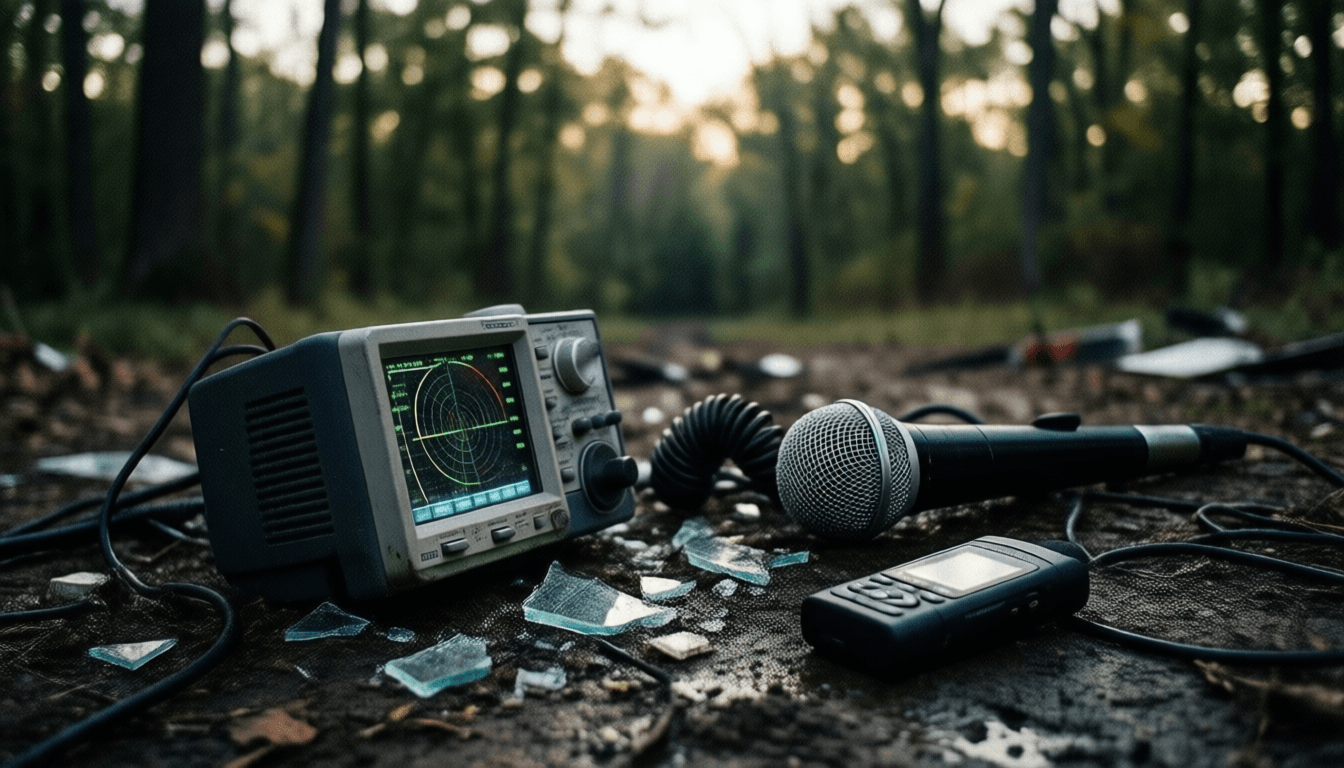
I escaped the mound's coils, though my memory of how is fragmented. My field report documents extreme disorientation and a blank in time. My body bore severe bruising and fractured ribs, consistent with immense compressive force. The seismograph was shattered, its internal components melted into an incomprehensible metallic slag. The parabolic microphone was twisted, its dish caved inward as if by extreme external pressure. Crucially, my primary recorder, though externally intact, contained no valid data from the time of the incident.
However, a secondary, small digital voice recorder, tucked deep in my backpack, miraculously survived. Its final recording contained only static, followed by the same faint, periodic humming I had detected near the mound's tail, which abruptly cut off. Then, a single, drawn-out, all-too-human whisper emerged. The voice was impossibly deep, not English, but carried an unmistakable nuance of proprietorship. The word, phonetically transcribed in my recovered notes, was untranslatable, yet its intonation implied possession.
My official report attributed the incident to 'catastrophic equipment failure exacerbated by environmental factors.' But the persistent humming on the recovered audio, the inexplicable injuries, and that chilling final whisper defy easy explanation. The Great Serpent Mound stands, as it always has, a silent sentinel in the Ohio landscape, yet its earth now feels profoundly heavier, its ancient coils concealing not just history, but a persistent, conscious weight that draws breath from the world around it. My compass now consistently spins in the vicinity of any significant mound.
[ CLASSIFIED VERDICT ]
[ACCESS LOG - SOURCE FILE]
The Great Serpent Mound in Ohio is a colossal serpent-shaped effigy mound created by ancient peoples thousands of years ago. For a long time, strange phenomena such as compass malfunctions, unexplained silences, and auditory hallucinations have been reported in this area. In particular, rumors persist that sounds are absorbed into the ground or return from unknown places.