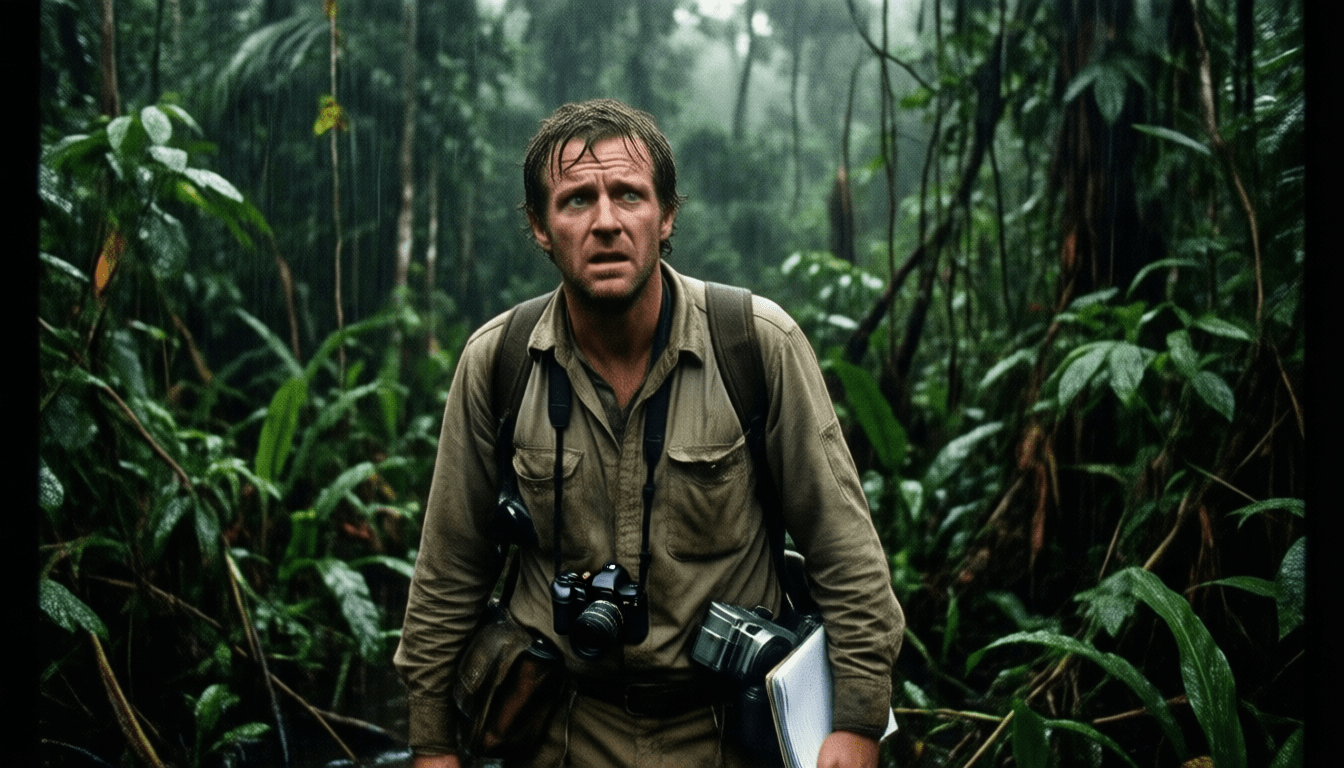
The Kasai Rex: Echoes in the Jungle's Silence
In 1932, Swedish hunter John Johnson published his shocking experience in the Belgian Congo. While tracking a herd of buffalo, his porters suddenly screamed "Dinosaur!" and fled in panic. Johnson described a "grayish-red" creature that emerged from the tall grass, resembling a Tyrannosaurus Rex but smaller in size. His account was later corroborated by other whispers from the colonial era and continuous reports from indigenous communities around the Likouala Swamps. They speak not of a dinosaur, but of a being called "Ngoy" or "River Devil." It is a predator of immense size and abnormal stealth, said to make livestock and even people disappear, leaving footprints unlike any known creature. These were not isolated incidents. Satellite images occasionally captured unexplained disturbances in remote swamp areas, large expanses of flattened vegetation with no clear cause. These repetitive and disparate testimonies, spanning nearly a century, form the compelling and unsettling basis of the Kasai Rex myth.
Dr. Elias Thorn, a meticulous cryptozoologist and archivist, had spent months compiling these testimonies. Drawn to the convergence of old colonial records and recent fragmented digital whispers, he commissioned a small, local expedition into the Likouala Swamp basin. The expedition itself was an ordeal. Suffocating heat, stifling humidity, the ceaseless hum of insect swarms, and the suffocating density of the jungle pressed down on him. Dr. Thorn noted the immediate physical details: the air was thick with the smell of decay and damp earth, and the ground beneath the forest canopy was a treacherous mosaic of mud and tangled roots. The local guides, initially calm, grew progressively more agitated the deeper they ventured, whispering low warnings about "where silence devours you." Dr. Thorn focused on areas identified through integrated data points: interconnected, almost impassable waterways and choked clearings that consistently appeared in the "Ngoy" narratives.
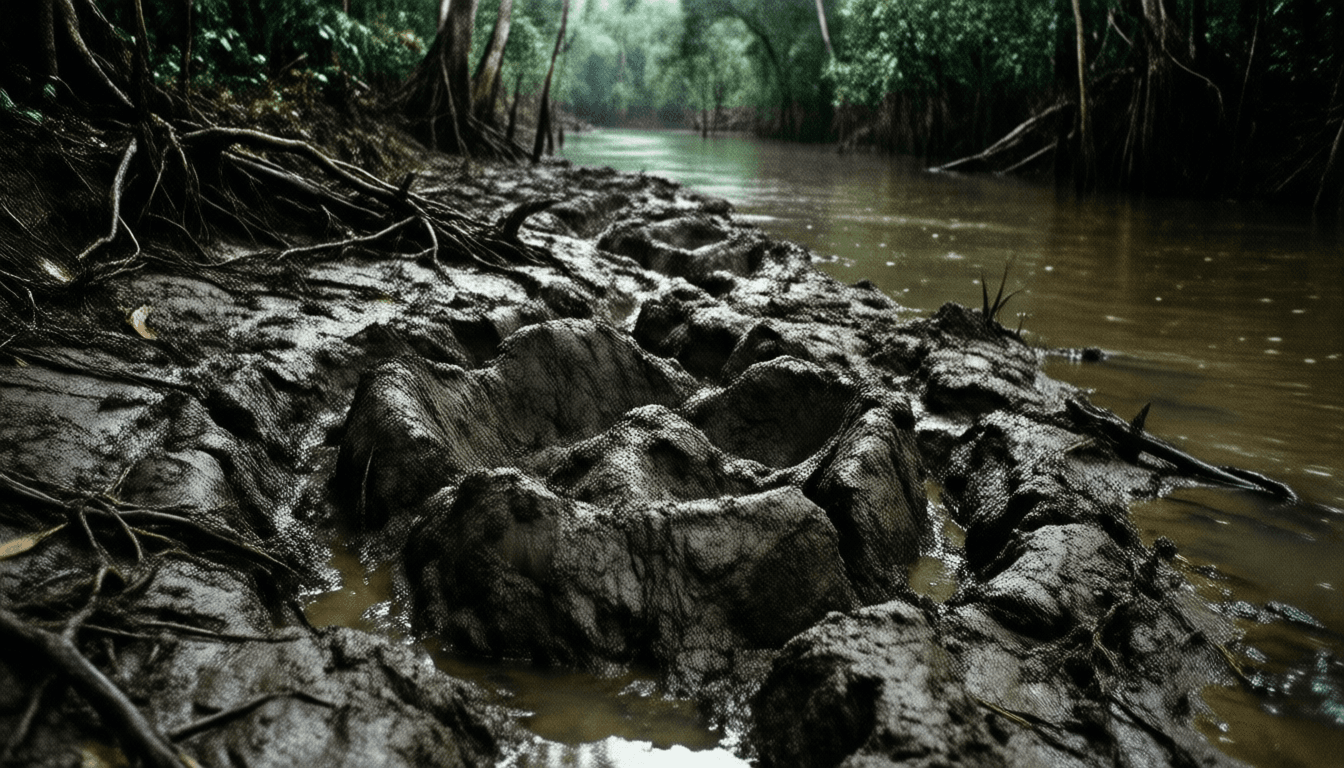
As the expedition neared the suspected region, the atmosphere shifted. The jungle's incessant symphony began to unravel. First, the usual chatter of monkeys and birds diminished, then ceased altogether, replaced by an unnatural, heavy silence. Dr. Thorn noted that their own voices seemed unnervingly small, absorbed by the dense foliage, their echoes vanishing instantly without the usual reverberation. The water in the narrow channels, typically teeming with life, became eerily still and dark. He found colossal, irregular indentations in the muddy riverbanks – too large for hippos, too distinct for elephants, sometimes leading directly to places where no logical current could have carved such a path. One evening, a massive tree hundreds of meters away, seemingly healthy, groaned and cracked with agonizing slowness before toppling. There was no wind, no storm. The guides grew nervous, one abandoning his gear in the night, muttering, "The ground shakes where it shouldn't." Dr. Thorn felt increasingly isolated, the sensation of being watched becoming a physical pressure in the stifling air. He began to hear a deep, regular thud, thud, thud – not a heartbeat, but heavy, sluggish footsteps that seemed to circle the camp from impossible distances.
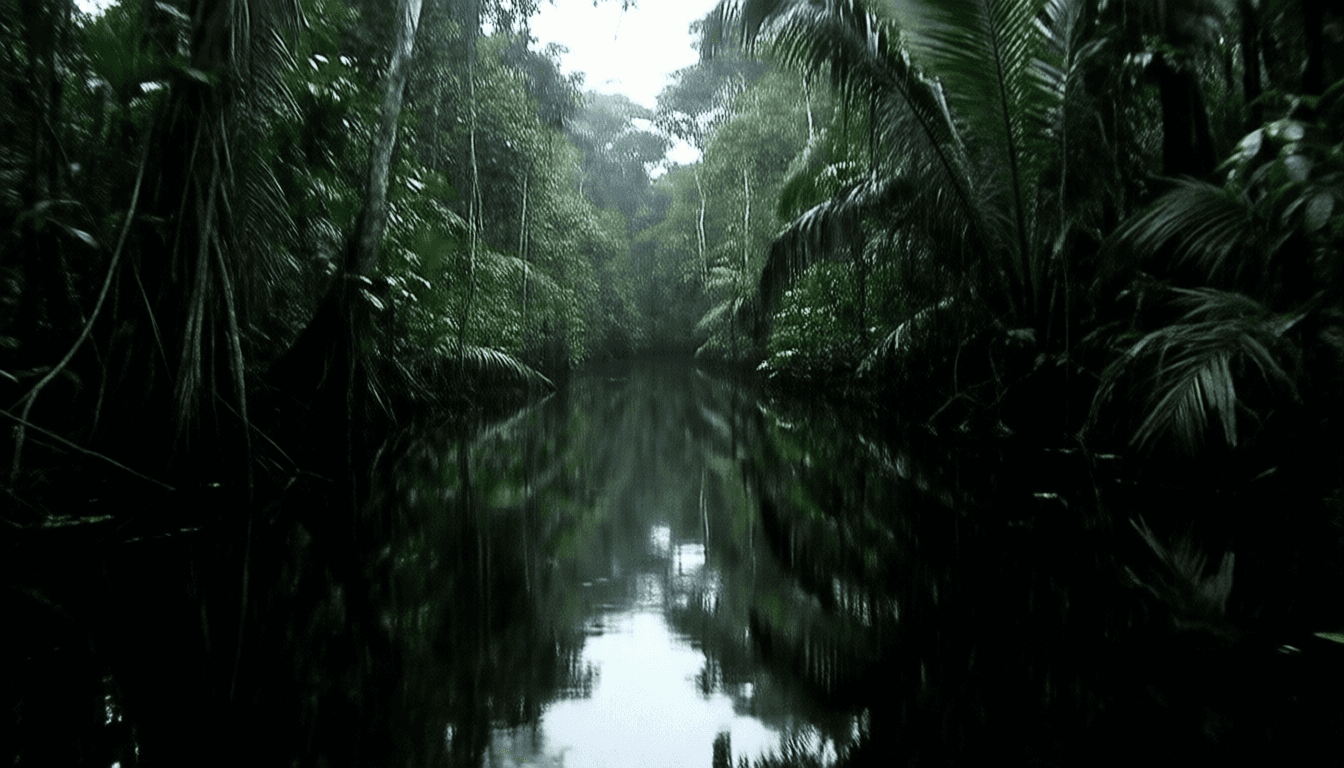
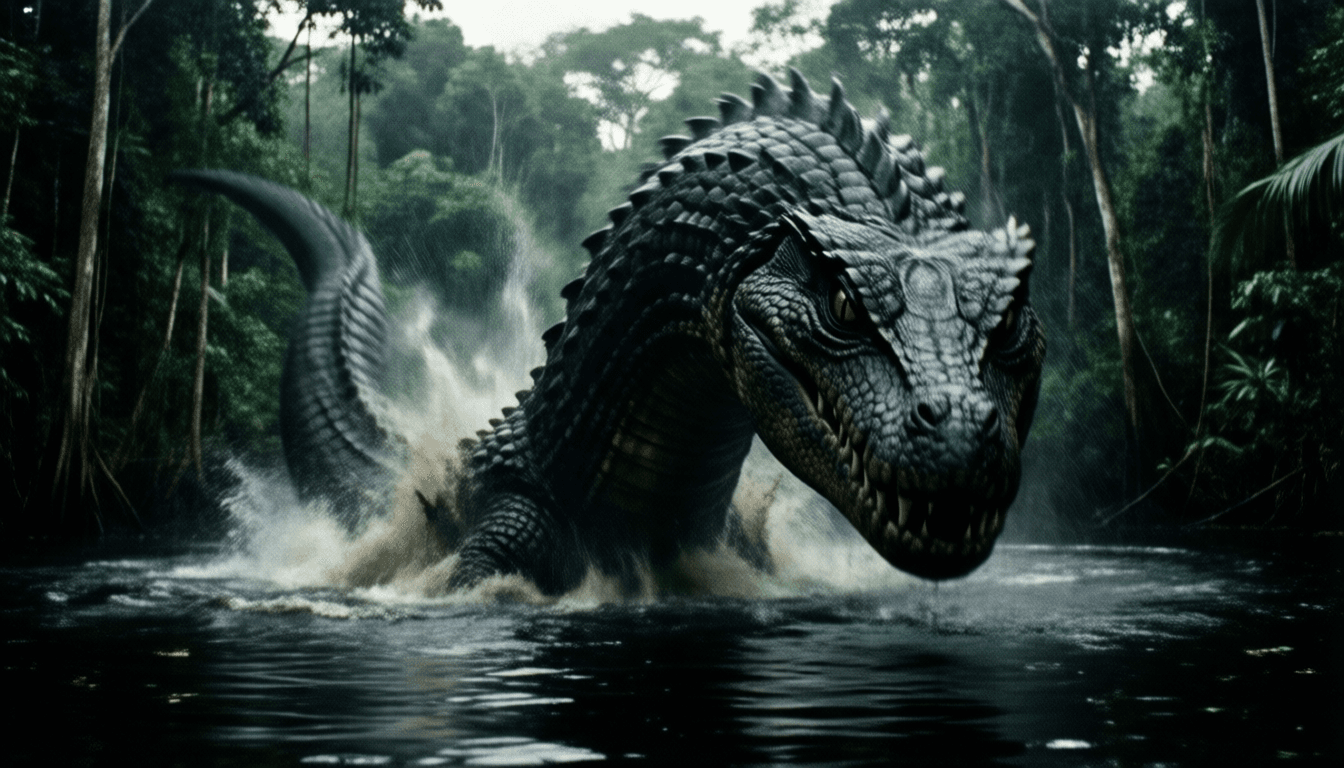
Dr. Thorn pressed deeper with his last remaining terrified guide, following the strange tracks to a particularly choked, primordial lake. The water here was black, reflecting the dense canopy like an obsidian mirror. The air was heavy, almost vibrating with an unsettling silence. Suddenly, the water in the center of the lake began to churn – not from current, but from a deliberate, powerful movement beneath the surface. A colossal form erupted from the water. Not a dinosaur in the traditional sense, but an unimaginably large, black mass of a creature. It was leathery and scaled, with a powerful, serpentine neck and head, and thick, stubby forelegs tipped with heavy claws. It was too massive for its environment, its movements in the water too swift for its bulk.
The creature turned its head towards Dr. Thorn. Ancient, predatory eyes locked onto him. The physical laws of the environment seemed to bend.
A resonant roar, as if the very jungle itself screamed, erupted. It wasn't just from the creature's throat; it vibrated through Dr. Thorn's bones, disorienting his sense of balance, and the air around him warped with its immense force. The sound was too loud, too deep, and it lingered far too long in an environment designed to absorb sound.
With a blurred movement of impossible speed for its size, the creature lunged from the water, crossing an unbelievable distance across the muddy bank towards Dr. Thorn in an instant. Its massive bulk moved in silence, a charge that should have been accompanied by the slap of mud and the snap of branches. It seemed to flow through the dense undergrowth, a living anachronism itself.
Dr. Thorn stumbled in the mud, trying to flee. The creature loomed, its colossal shadow engulfing him. He felt the impact of weight on his leg. Powerful claws scraped and tore, pinning him briefly against a tree root. A foul, musky breath washed over him, and he saw the glint of impossible teeth. He kicked and writhed. His leg twisted, screaming in protest, but then came free. The creature's immense momentum carried it slightly past him, granting him a precious few seconds. He half-crawled, half-dragged himself away. Behind him, the rhythmic thud-thud-thud of the creature's impossibly quiet pursuit, and the jungle was no longer silent, but filled with the sounds of the hunt. He plunged into a particularly deep, narrow river channel, escaping. The cold water offered temporary concealment, and the predator thrashed violently on the bank above, unable to follow into the dense reeds.
Dr. Thorn eventually made it back to a distant outpost. He was wildly bleeding, his leg deeply lacerated and infected. He had no clear photographs, no perfect specimen. All he possessed was a single, dark, blurry, almost abstract image on his damaged camera's memory card – a dark, indistinct mass against black water, but too large, too *wrong* to be anything known. More chilling was what was recorded on his audio device: not the roar, which he still struggled to process, but the unnerving, deep silence *before* the attack, and the impossible, rhythmic thuds that had preceded the distorted jungle scream at the end.
His injuries were severe, but the true wound was psychological. He described the creature with a detached, clinical horror, its movements a "violation of scale," its silence a "physical pressure." He knew what he had seen was not only biological but physically defied the order of nature. He constantly looked over his shoulder, feeling the vibrations of passing vehicles as the heavy footfalls of an approaching predator. He stared at the grainy image on his screen, then at his scarred leg – long, deep gouges that doctors couldn't precisely match to any known animal attack. The world now felt thinner, the veil of certainty irrevocably torn. The Kasai Rex was not just a cryptid; it was a living paradox, and somewhere in the quiet, suffocating heart of the Congo, it remembered him, a small, fragile anomaly in its impossible world. He had left the jungle, but the jungle, and its silent, impossible guardian, never left him.

[ CLASSIFIED VERDICT ]
[ACCESS LOG - SOURCE FILE]
The Kasai Rex is a cryptid rumored to inhabit the Likouala Swamps of the Belgian Congo, with sightings describing it as resembling a Tyrannosaurus. Local indigenous communities refer to it as 'Ngoy' or 'River Devil,' depicting it as a predator that causes livestock and people to disappear, leaving enormous footprints. This legend has been consistently reported since a Swedish hunter's account in 1932.