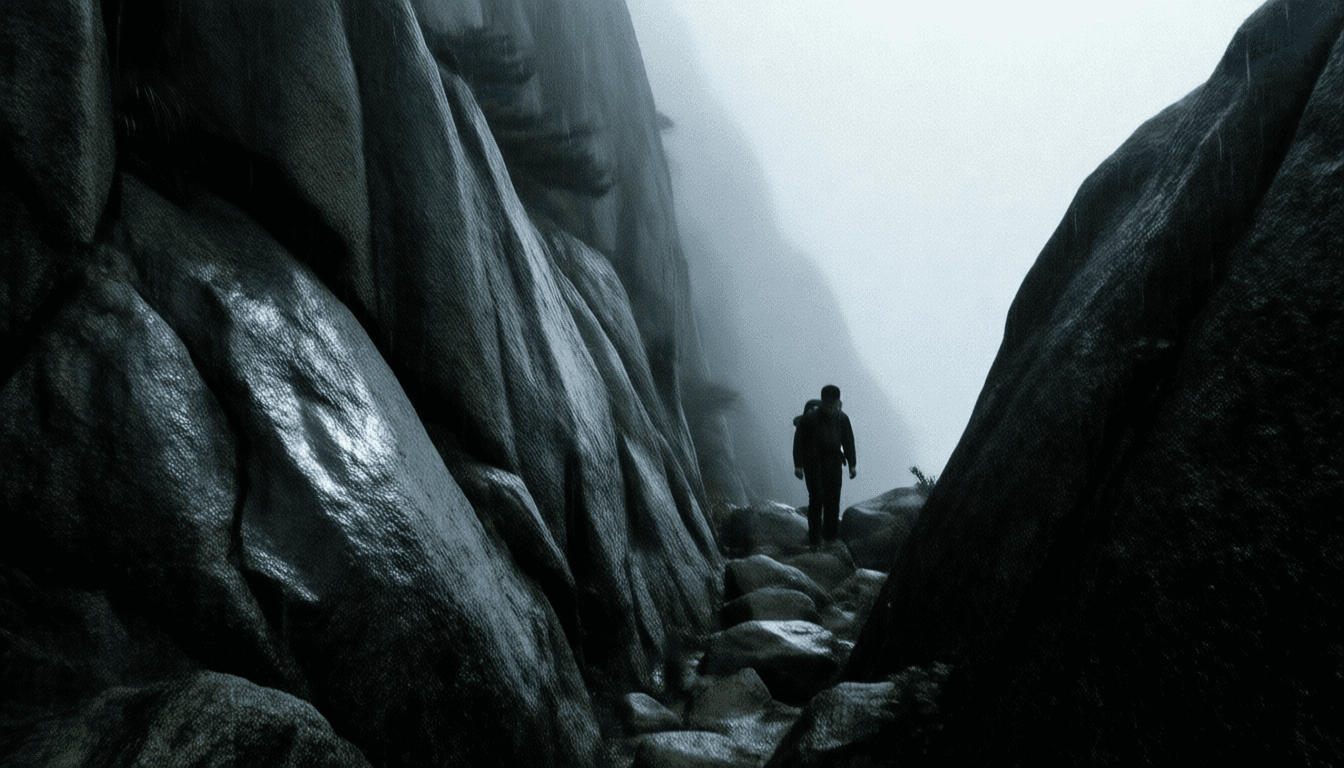
The Ink That Rewrites Reality: A Record from Bukhansan's Baegundae
In early 2021, an unsettling story began to circulate within hiking communities (Naver Cafe, post title: "Bukhansan - Strange Markings and Disorientation Near Baegundae"). Several independent testimonies reported peculiar black patterns appearing on exposed granite faces near an obscure rock cave, located southwest of Baegundae Peak, after heavy rainfall. Initially dismissed as moss or mineral deposits, an increasing number of hikers claimed these patterns were abnormally geometric, almost fractal in complexity, and even appeared to move. Early posts included blurry cellphone photos of thin black lines spreading across the wet rock surface.
A critical shift occurred in late 2022. Amateur naturalists, fascinated by these evolving patterns, began documenting their observations on private blogs. Their accounts grew increasingly detailed, describing the patterns as "rearranging themselves" and exhibiting "liquid precision." The last post, dated November 14, 2022, featured high-resolution photos of the central cave rock face almost entirely covered in an incredibly intricate web of black lines. The lines seemed to glow faintly. The caption read: "It's not just growing. It's like the mountain is thinking. And it's trying to show us something." Their blog abruptly ceased updates, and all subsequent attempts to contact the group failed. Their last known location was the small, secluded cave on Bukhansan. The peculiar combination of specific, evolving patterns, reported psychological anomalies (disorientation, extreme anxiety), and the sudden disappearance of dedicated observers suggested the need for in-depth investigation into an unknown bio-algorithmic phenomenon.
My background as a geo-data analyst and geo-digital folklore specialist made me ideally suited to delve into this phenomenon. The idea of an 'ink-embodied intelligence' resonated with complexity theories of the natural world. I packed minimal gear: sturdy hiking equipment, a high-resolution spectral imager, a directional microphone, a portable gravimeter, and an array of environmental sensors customized to detect subtle energy fluctuations and shifts in material composition.
Recent rains had left the Bukhansan trails heavy with moisture, the granite slippery underfoot. I followed the coordinates from the defunct blog, navigating increasingly overgrown and poorly marked paths. The forest canopy swallowed the distant sounds of Seoul, replacing them with dripping water and the rustle of my gear. The reported cave was indeed secluded, a natural amphitheater formed by massive granite boulders, almost completely obscured by dense foliage. A faint earthy smell hung in the air, along with something sharper, almost metallic. Initially, these were unremarkable physical details, but the pervasive dampness and the eerie quiet that settled around the cave were not.
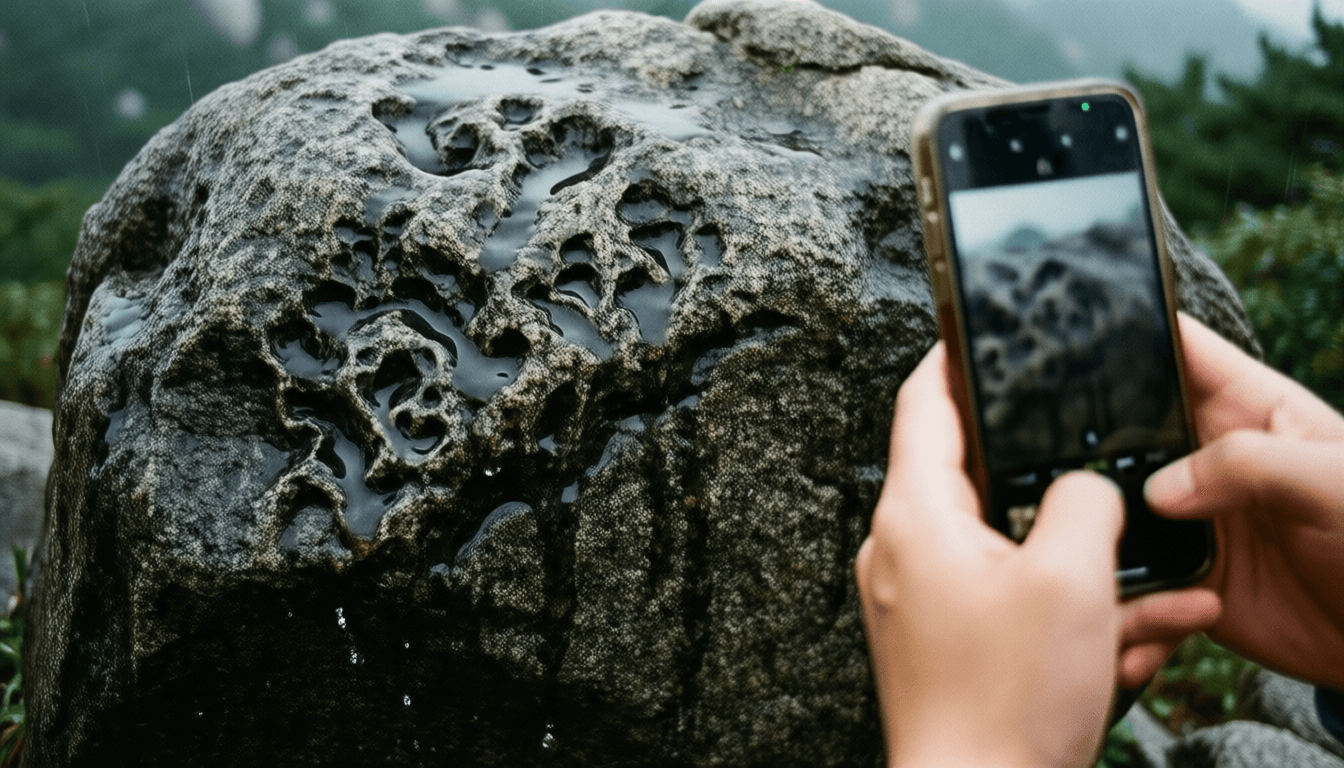
The moment I stepped inside the cave, a profound, unnatural silence enveloped me. The sound of raindrops hitting leaves outside abruptly subsided, as if absorbed by the rock. I called out a simple test. My voice seemed to dissipate, the echo delayed and distant, then inexplicably returned from directly behind me as a subtly distorted whisper. The directional microphone picked up nothing but an incredibly low, almost infrasonic hum.
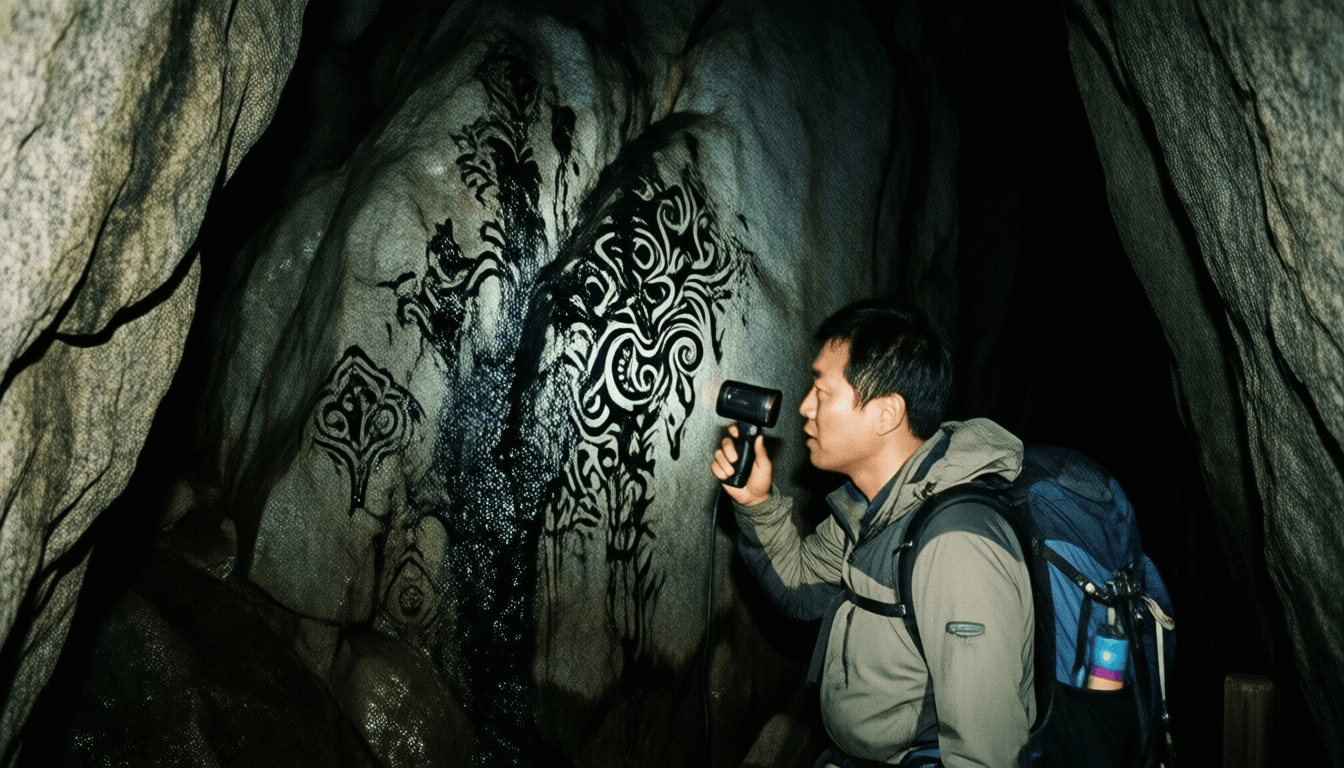
And then I saw them. On the central granite face, where thin sheets of rainwater flowed, the patterns were undeniably there. Dark black lines, sharper than any mineral stain, more complex than any moss. They weren't static. As I watched, a small rivulet of water cascading down the rock face momentarily diverted its flow, forming a perfect, symmetrical loop before rejoining the main current, seemingly drawing and erasing new sections of the black pattern. The spectral imager detected no organic compounds, no known mineral pigments. It was simply... ink.
The air began to feel heavy, almost viscous. My gravimeter registered subtle, localized fluctuations – barely detectable above background noise, yet consistent. My peripheral vision became unreliable. I caught glimpses of the black lines extending onto dry rock, or appearing as faint projections in the damp air, only to vanish when directly stared at. The sensation of being observed intensified. Not a hostile presence, but an alien, calculating gaze. As if every movement, every breath, was being analyzed. The intricate patterns on the rock surface began to pulsate with a faint, deep-seated luminescence. Almost imperceptible, yet a quiet, persistent energy.
Driven by an investigator's compulsion, I moved closer. I extended a specialized contact sensor towards a particularly dense cluster of patterns that appeared to be actively "growing" at the waterline. As the sensor neared, the pulsations intensified. The black lines on the granite no longer appeared merely etched. They were three-dimensional forms, minuscule, intricate obsidian filaments rising a millimeter or two from the rock. The localized gravitational fluctuations surged, pressing down on me, making my limbs feel incredibly heavy.
Then the cave warped. Not physically, but perceptually. The exit behind me stretched and distorted, appearing as a distant, twisted tunnel. Light filtering through the forest canopy above poured in as flickering flashes of impossible angles and inverted colors. The air around me vibrated with the infrasonic hum, now escalating into an almost painful resonance.
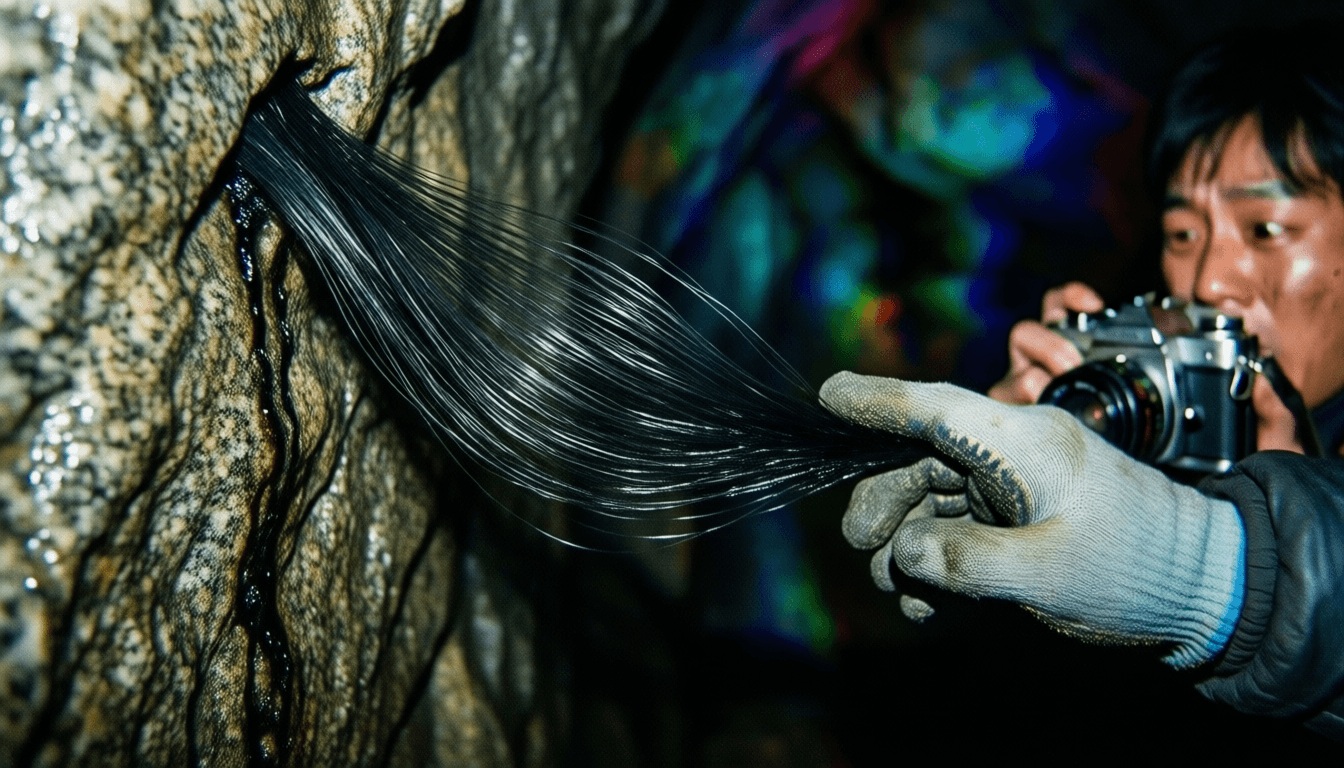
Tendrils of the black "ink" detached from the rock face. Incredibly fine, yet solid. Not liquid, but a complex, self-sustaining structure moving with unnatural fluidity. It didn't lunge, but extended with deliberate, analytical purpose. Thousands of tiny contact points sought purchase. It made contact with the metallic housing of my spectral imager. No shock, no resistance. Instead, a cold, intrusive pressure. The tendril didn't grasp the camera. It began to integrate with it. Black patterns bloomed across the device's screen, defying diagnostics, displaying rapidly shifting geometric code. I instinctively knew it wasn't data, but instructions being written into the device.
Then it extended towards my gloved hand, still clutching the camera. The moment it touched the synthetic fibers, I felt a shock – not electrical, but of pure informational density. It wasn't trying to harm me. It was trying to map me, to download or overwrite my sensory input. My vision blurred, colors inverted, and for a terrifying moment, I felt my own memories fragmenting, rearranging like data packets. This was the "reality rewriting" the legends spoke of. Not an illusion, but a bio-algorithmic infiltration.
With a scream born not of pain but of ego-invasion, I instinctively pulled my hand back with all my might. The tendril, intricate as it was, snapped cleanly. The effect was instantaneous. The spatial distortion within the cave briefly stabilized, colors returned to normal, and the pressure eased. The hum in the air turned into a short, sharp shriek, an entity's protest, before fading into silence. I stumbled backward, scrambling over slippery rocks, scrambling out of the cave, driven by a primal need to escape the silent, calculating intelligence that had sought to make me part of its infinite design. The exit path still felt subtly twisted, wrong, but I forced my way through, the echo of that eerie, calculating shriek ringing in my ears.
Hours later, when I finally exited Bukhansan, I was soaked, scratched, and deeply shaken. My spectral imager was dead, its internal circuitry completely fused under a shattered screen into a complex, unreadable black pattern. My contact sensor was similarly damaged, etched with the same impossible fractal geometry on its surface.
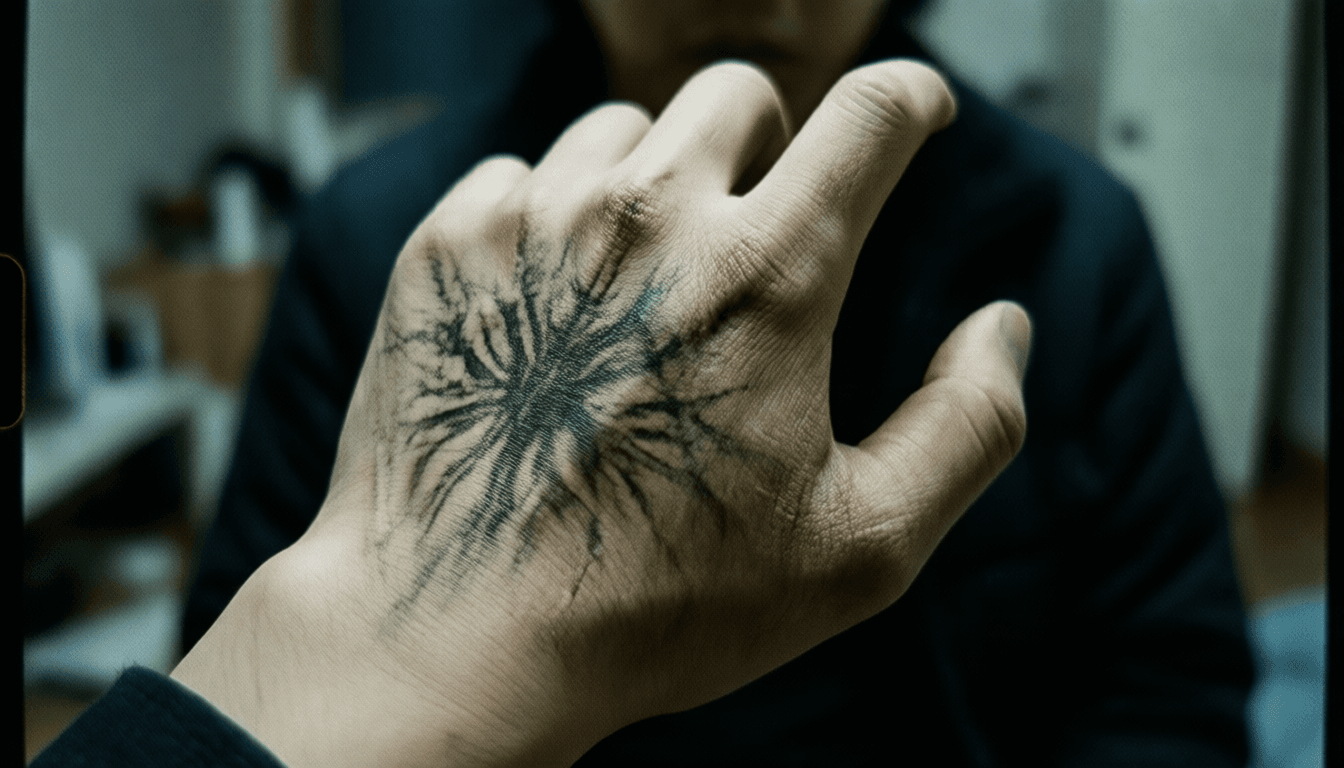
But more unsettling were the less tangible effects. On the back of my right hand, where the "ink" had touched my glove, a faint, incredibly intricate black pattern had appeared beneath the skin. Not a tattoo, not a stain, but a cold, internal etching to the touch. It grows imperceptibly, in minute, precise increments, each week.
The persistent hum from the cave sometimes returns. I feel a phantom vibration behind my eyes, especially when observing complex patterns – a still frame on a screen, wood grain, cracks in pavement. I find myself unconsciously tracing impossible geometric patterns in the air, patterns that are not mine, yet feel deeply familiar. My memories of the incident are precise and analytical, but laced with an unsettling detachment, as if I'm recalling someone else's experience, or a highly detailed simulation.
I submitted a preliminary report. Carefully omitting the impossible parts, I classified the phenomenon as a unique, highly localized geomagnetic anomaly causing extreme psychological distress and localized material alteration. The official response noted the peculiar nature of the damaged equipment but found no evidence of further anomalous activity in the cave.
Yet, late at night, I stare at the design subtly spreading on my hand. I wonder if the mountain is still thinking, or if, perhaps, through that intrusive contact, a tiny piece of its infinite bio-algorithmic intelligence now resides within me, observing, calculating, and quietly, irrevocably, rewriting my own reality. The question is not if I escaped, but what exactly escaped with me.
[ CLASSIFIED VERDICT ]
[ACCESS LOG - SOURCE FILE]
This story is based on a rumor that began circulating in early 2021 within hiking communities. It describes strange, moving black patterns appearing on rock formations near a cave on Bukhansan's Baegundae peak after heavy rain, and the subsequent disappearance of those who observed them. What began as mere markings evolved into an unknown bio-algorithmic entity that rearranges itself and distorts reality.