The Hum of Züün Gobi
Over the past six months, three bizarre incidents have been reported in Mongolia's Züün Gobi region. Geographically adjacent, these events defied any conventional explanation, rekindling whispers among local elders and some government agencies about the legendary 'Olgoi-Khorkhoi,' or the 'Mongolian Death Worm.'
The first incident occurred last January. A high-altitude drone, deployed by the Ulaanbaatar Institute of Geophysics for soil analysis, abruptly lost communication. The recovered drone's main circuit board was 'vaporized,' and the metal casing showed rapid, localized oxidation traces, unlike impact, fire, or typical electrical failure.
The second was in February, two weeks later. Two camel herders reported their camels suddenly collapsing in the same area. The camel carcasses showed no external trauma but were unusually desiccated. The herders themselves experienced temporary paralysis and severe localized skin irritation, later diagnosed as a rare form of acid burn. They spoke of a 'deep hum' and an unseen force.
Most recently, in March, a Mongolian army reconnaissance vehicle passing through the anomalous zone suffered a catastrophic failure of all systems – engine, communications, and lights. Their report detailed an 'intense, resonant vibration' felt beneath the vehicle, followed by a powerful electrical discharge that rendered two crew members unconscious. The tires were melted into the sand, and the rubber was partially dissolved and burnt, yet no external fire marks were found. My data, documenting these unprecedented patterns, argued for a deeper investigation. A traditional cryptid was suddenly taking on a terrifying modern context.

I joined a small, independent geological survey team heading to Züün Gobi under the guise of mineral exploration. Our true objective was to discreetly investigate the anomalous zone. We were equipped with advanced gear: specialized Ground-Penetrating Radar (GPR), high-frequency acoustic sensors, shielded EMF detectors, and environmental sampling kits.
Days of travel were a monotonous stretch of sun-baked dunes. The suffocating silence, the shimmering heat haze, the vast, empty expanse of the Gobi. Even the air felt thick and heavy, charged with an unexpected tension. As we reached the periphery of the reported anomalous zone, our GPR began detecting subtly shifting subterranean tunnels, unlike any known geological patterns. The EMF meter occasionally twitched erratically, recording unexplained spikes.
We located the site of the third incident: the abandoned military vehicle. It was a severely warped hulk of twisted metal. The tires were indeed melted into the sand, like solidified black tar. The undercarriage was heavily scorched and buckled. More eerily, there were 'no' direct heat sources or impact marks. It appeared as if the metal had degraded and melted in situ. A faint, acrid smell, like burnt electronics and ozone, still lingered in the air.
As we pushed deeper into the zone, the atmosphere grew strangely heavy, almost metallic. The environment itself began to behave subtly out of expectation. The vast desert silence became unnaturally intense. Even our own voices seemed to be absorbed, muffled, as if the very air density had changed. Then, a low, sustained 'humming' began. Barely audible at first, it was felt more strongly as a vibration through the soles of our boots. It came from 'underground,' a deep, resonant sound that vibrated in our bones, subtly increasing in intensity.
The EMF meter was no longer just twitching. It spiked violently and continuously, especially around faint ripple patterns in the sand. Satellite communication radios filled with static, then cut out entirely. GPS units intermittently failed, displaying erratic coordinates. Small, insulated wires left on the sand momentarily sparked, melted slightly, and gave off a faint ozone smell.

The surface sand subtly shifted, forming patterns that could not be created by wind. Fine dust particles shimmered, clinging to surfaces due to inexplicable static electricity. In some hollows, the sand felt unnaturally warm, unlike sun exposure. Our two initially calm local guides grew visibly uneasy, exchanging worried glances and muttering about 'desert spirits.' The extreme isolation, combined with escalating technological failures and the pervasive subterranean hum, created an undeniable feeling of being stalked by something unseen moving beneath our feet. We could feel its presence. Something vast and persistent.
We set up a temporary observation post at the exact point where the military vehicle had failed, hoping to get more definitive data. As dusk fell, the subterranean hum intensified, becoming a felt vibration. The GPR screen flickered, showing a massive, rapidly moving anomaly several meters beneath us. Suddenly, the ground directly beneath our main sensor array 'heaved.' Not an earthquake, but a focused, cohesive uplift. A section of the sand 'liquefied,' beginning to glow faintly. A sickening bluish-green luminescence surged from deep within. A sweet, ozone-like smell thickly filled the air. The sand around us grew rapidly hot, our equipment thermometers soaring to unbelievable levels.
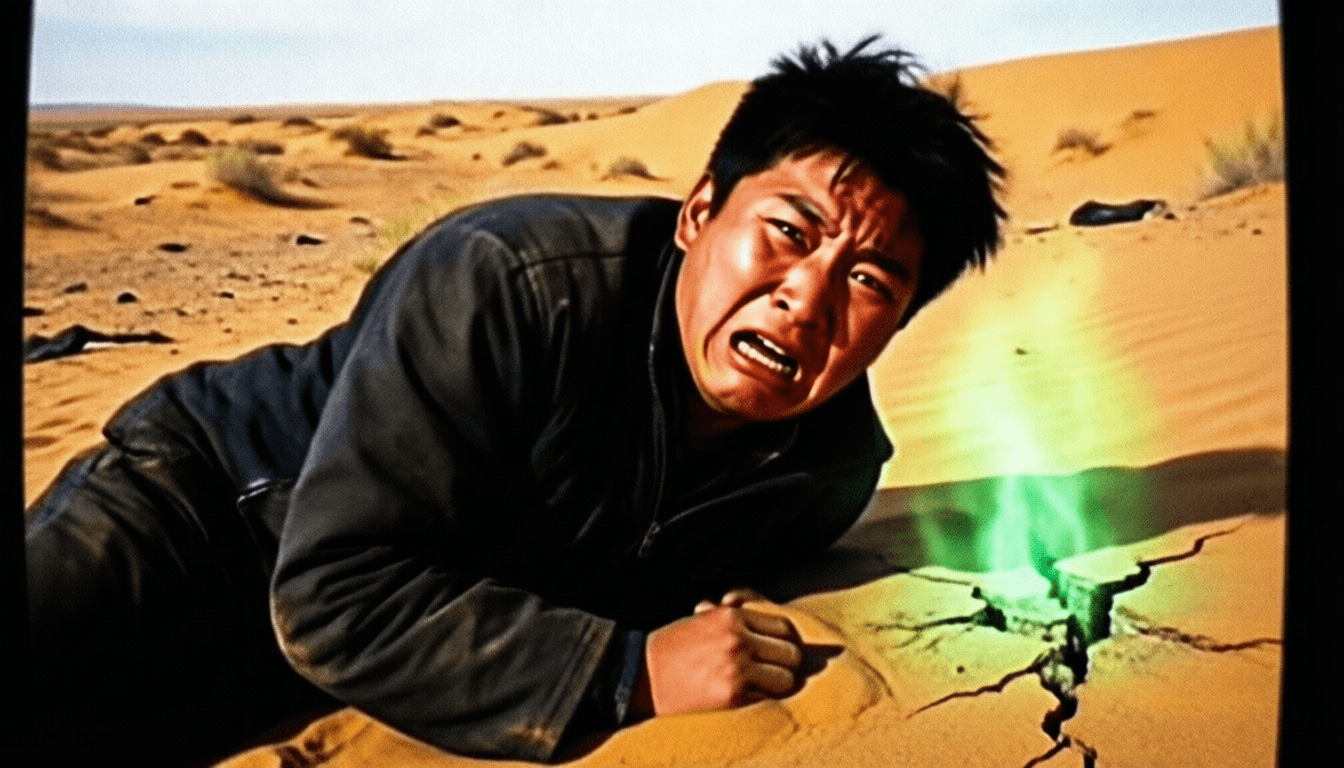
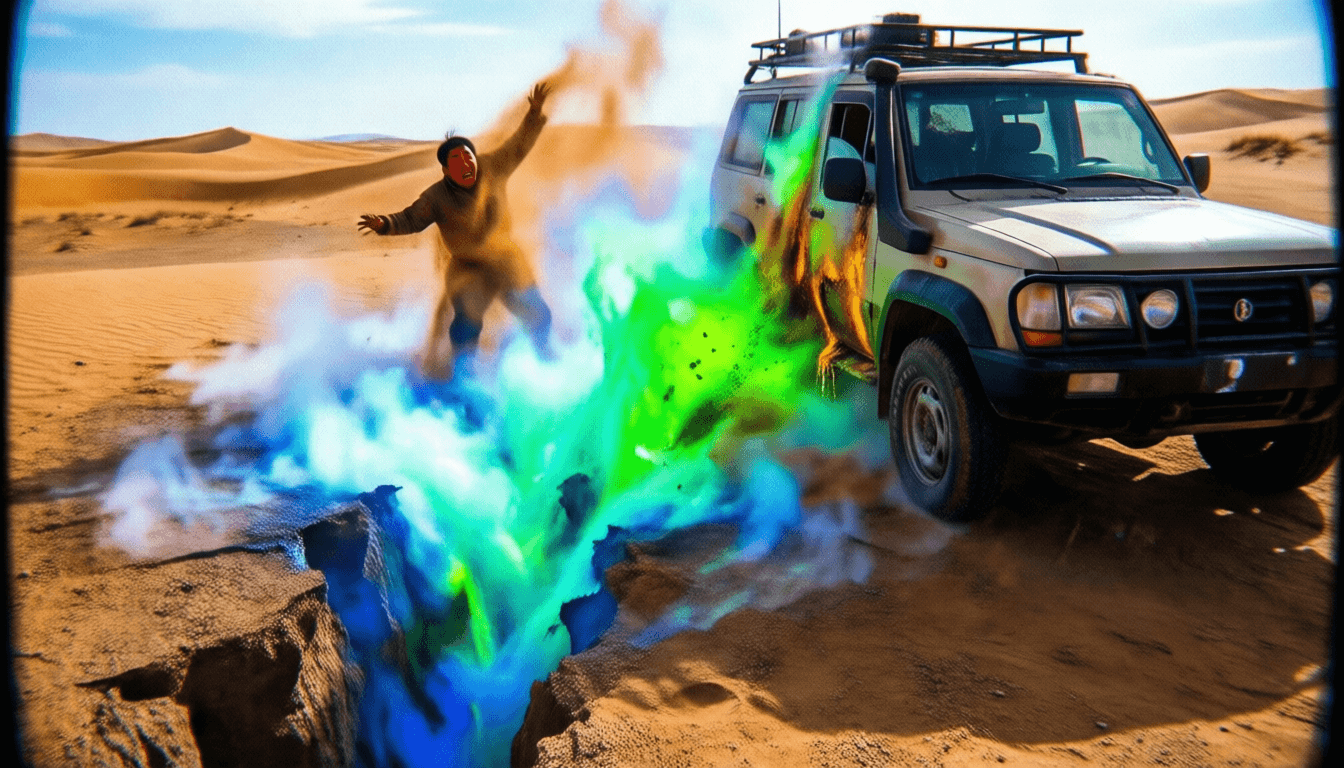
In that instant, a corrosive, glowing green liquid erupted from the epicenter. It struck our armored survey vehicle first. The reinforced metal sizzled and melted with an awful shriek, creating grotesque, smoking holes in seconds. Solid tires exploded not from pressure, but immediate chemical disintegration, turning into molten slag. Before we could react, an invisible wave of powerful electrical energy pulsed from the ground. It wasn't lightning. All electronic equipment — comms, flashlights, even our 'EMP-proof' watches — sizzled, smoked, and died. My body locked up. Muscles spasmed violently. A sharp, unbearable pain shot through my limbs, and I collapsed, feeling the sand beneath me vibrating intensely, as if trying to shake me apart.
Through blurred vision, paralyzed on the ground, I saw it. A vast, indistinct reddish-brown mass writhing incredibly fast just beneath the surface, creating waves of churning sand. For a terrifying fraction of a second, a huge, tubular, vaguely segmented form momentarily broke the surface. Its 'head' – if such a thing existed – was an amorphous, pulsating mass, radiating intense heat and a faint, flickering light, before plunging back into the earth. Left in its wake was a smoking, vitrified crater of sand. The air crackled with residual energy. The hum was now a beastial roar, then slowly, eerily, it began to recede back into the earth.
As the paralysis began to recede, I crawled with horrific effort from the melting vehicle. My team members were in disarray, some burned, one guide convulsing with a dark, spreading scar where the electrical discharge had struck hardest. The creature did not pursue directly, but its passage had rendered the terrain impassable, our transport destroyed, and us exposed. We fled on foot, in chaos and trauma. The memory of the vast, unseen mass burned itself into our minds, the metallic smell of ozone and burning rubber clinging to our clothes, refusing to leave.
We stumbled out of the anomalous zone hours later, injured and deeply traumatized, but alive. Search parties found us. Officially, our injuries were attributed to a severe sandstorm, equipment malfunction, and dehydration. No one would believe the truth.
My limbs still twitch sometimes, phantom echoes of the paralyzing current. Faint, unhealing burns remain on my skin where the electrical discharge was strongest. My hearing is now hyper-sensitive to low-frequency vibrations, picking up a constant, irritating hum that others don't perceive. I constantly smell the metallic tang of ozone on my clothes, a smell that now triggers primal fear. The only 'proof' I possess is a small, completely unique chunk of vitrified sand, cooled from the eruption point, strangely conductive, like metal. And the memory. The memory of technology's complete and instantaneous destruction, impossible heat, silent electricity, and the sheer physical power of something that shouldn't exist.
I understand the whispers now. The 'Olgoi-Khorkhoi' doesn't merely exist. It operates on a scale and with abilities beyond our current scientific understanding. It is not merely a worm, but a living electromagnetic and chemical anomaly, the hidden apex predator of the Gobi Desert. It doesn't 'break' physics; it 'rewrites' our current understanding of biology and energy.
Official reports will continue to cite equipment malfunctions, extreme weather, and localized geological phenomena. But I know. Even in this city, the sand beneath my feet still hums. A phantom vibration, a memory of ozone. They say the desert whispers. Sometimes, it screams, but only those who get close enough hear it. And fewer still live to tell the tale. The anomaly of Züün Gobi remains, a wound on the map, occasionally consuming another drone, another herd, another unsuspecting traveler. And somewhere beneath the shifting sand, it waits. A silent, vibrating engine of destruction, a truth too profound and terrible for the world to acknowledge.

[ CLASSIFIED VERDICT ]
[ACCESS LOG - SOURCE FILE]
This story is based on the legendary cryptid known as the 'Olgoi-Khorkhoi', or 'Mongolian Death Worm', rumored to inhabit the Gobi Desert. Local legends describe it as a large, red, worm-like creature capable of killing prey from a distance with either acid or electric shock. This terrifying tale has been passed down through generations of Mongolians for centuries.