The Heartbeat of Roopkund
It wasn't an official record, but a document leaked from the deeper recesses of a defunct meteorology forum that sparked it all. In late 2023, a climate expedition studying high-altitude weather patterns around Roopkund Lake reported anomalous phenomena that defied any conventional explanation. Their advanced atmospheric sensors recorded localized, profound atmospheric stillness directly emanating from the lake basin, coupled with a consistent temperature drop of several degrees Kelvin. This phenomenon persisted for days, unaffected by broader weather fronts, and was accompanied by an infrasonic resonance identical to what had previously been detected in micro-samples of ancient bone tissue recovered from the lakebed. Heavily redacted official reports dismissed it as “instrumentation error” and “atmospheric lensing.” But for those who knew where to look, the raw data told a different story. An implication that ‘Skeleton Lake’ was not merely a passive tomb, but that something was active. It wasn't a storm, nor an avalanche. It was an environmental echo, a re-enactment, or perhaps, the lingering residue of a catastrophe itself. So I went there.
Deep within a forgotten public directory on a university server lay an online post, speaking of “The Heartbeat of Roopkund.” It cited telemetry data from recent, highly specialized climate studies. Not the usual academic jargon about ancient migrations or geological shifts, but precise, chilling figures: localized atmospheric pressure inversions, micro-climates of absolute stillness, and an almost 7°C drop in ambient temperature radiating from the deepest point of the lake, irrespective of surrounding weather. The truly unsettling detail was the infrasound. A deep, almost subconscious hum consistently detected in the anomalous zone. This specific frequency, the post claimed, perfectly matched vibrational patterns previously discovered via spectroscopic analysis in well-preserved bone marrow from some of Roopkund's 9th-century remains. The implication was clear. The environment wasn't just cold. It was resonating with something ancient, the signature of the dead amplified into a tangible form. As a phenomenon documenter, the idea that a geographical location could remember a catastrophe with measurable physical singularities demanded immediate on-site investigation.
The journey to Roopkund was an arduous climb, a path familiar to those seeking Himalayan solitude, or like me, uncomfortable truths. Tenzin, a taciturn Sherpa whose face was a map of years, led the way, his silence as eloquent as the mountains themselves. Above 4,000 meters, the air thinned to an extreme, each breath a conscious effort. The landscape was bleak and desolate, a monochrome world of rock, ice, and sparse, hardy vegetation. Already, a profound, almost absolute silence prevailed, save for the crunch of gravel underfoot and the occasional whisper of wind.
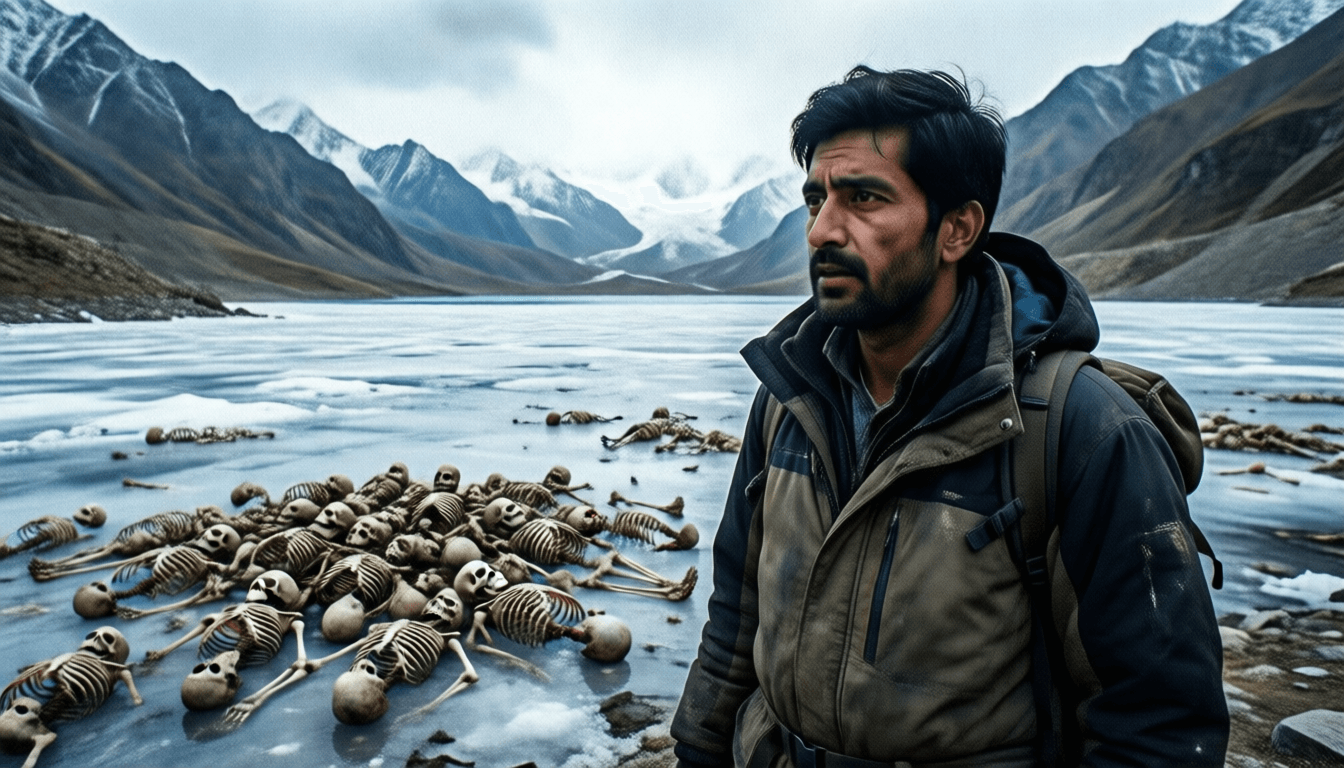
When the basin of Roopkund finally revealed itself, it was exactly as in photographs: a dark, cold eye set in snow and ice. But no photograph could convey the feeling. The incessant wind, a constant companion, abruptly ceased. The air felt heavy, viscous. The partially frozen lake shimmered in an ominous stillness, dark. And I saw them. Hundreds of human skeletons, some submerged beneath the glassy surface, others exposed along the retreating ice line. Ancient flesh, hair, and fragments of clothing clung to bones, preserved by the bitter cold, making a centuries-old death eerily, vividly real. I set up my portable sensors: high-sensitivity audio recorders, thermal cameras, atmospheric pressure gauges. My objective was precise: to pinpoint the source of the reported stillness and resonance and correlate it with the remains.
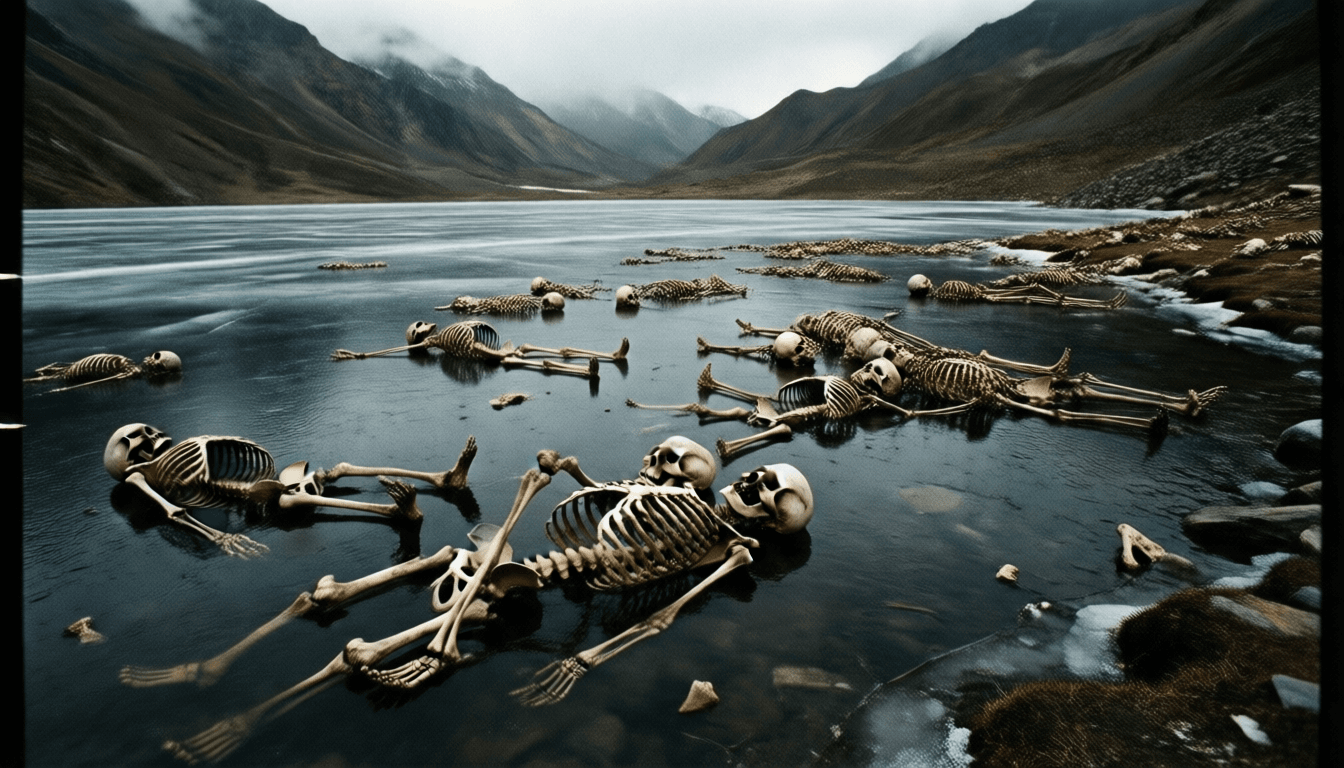
Within hours, subtle anomalies began. My audio recorders, calibrated for deep silence, started picking up a low, almost subconscious hum. It wasn't wind, nor geological sound. It was a pure, resonant tone, just above the human auditory threshold, yet distinctly present when wearing noise-canceling headphones. It seemed to emanate directly from the dark heart of the lake.
Next came the temperature. My thermal camera, sweeping over a particularly well-preserved cluster of skeletons at the lake's edge, registered an isolated cold spot. Not a general drop, but a single point consistently 5 degrees colder than its surroundings, even in the midday sun. This cold spot seemed to move, almost imperceptibly, along the edge of the ice, as if searching for something.
The lake water itself exhibited strange physical properties. As I attempted to collect a sterile sample near a small melt stream, I felt genuine unease as I watched a small, dark eddy form, moving against the natural downstream current. It pulled my collection spoon downwards with an impossible, almost magnetic force. I had to wrench the spoon free, the water feeling unnaturally viscous, clinging to the metal.
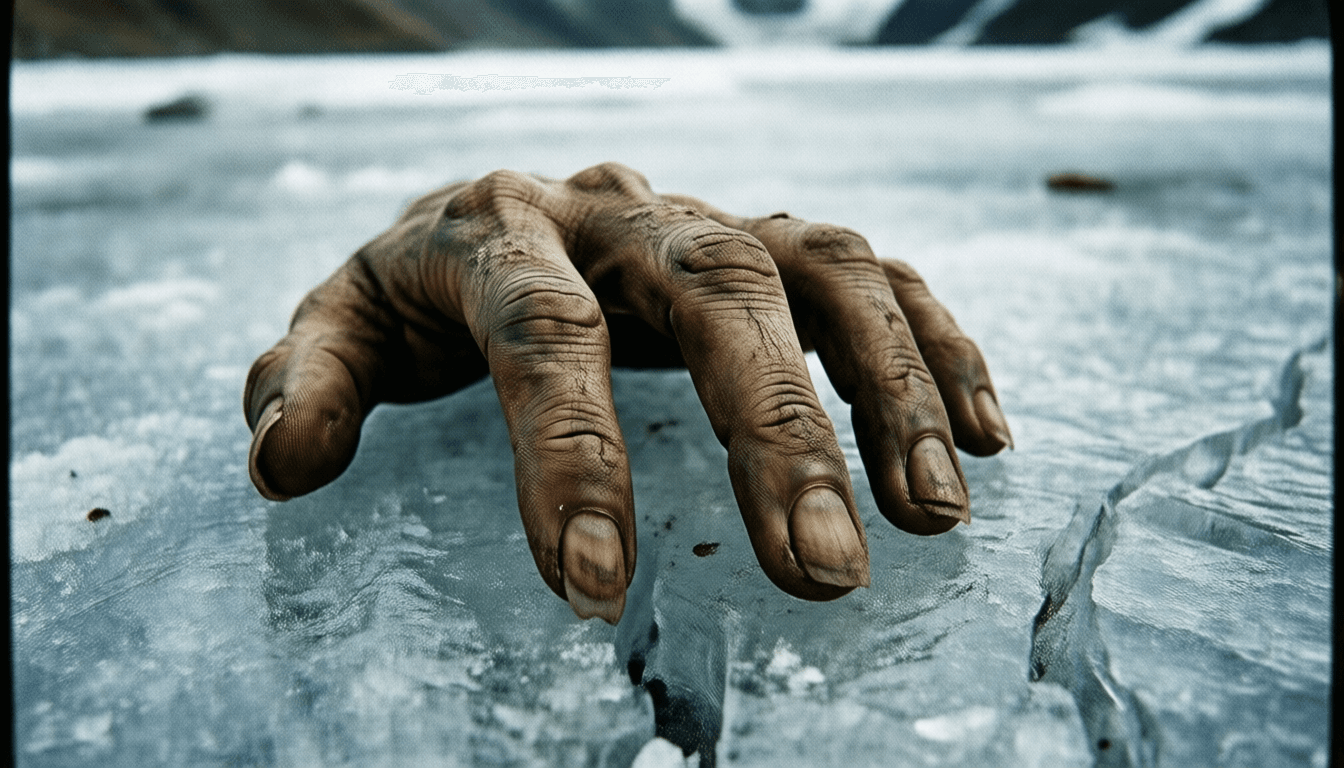
But the most unsettling detail involved the skeletons themselves. I had meticulously photographed and documented a particular cluster, especially a remarkably preserved hand, flattened onto an ice sheet, still retaining desiccated skin and fingernails. Returning after a short break, the angle of the hand had shifted. Subtly, perhaps a centimeter, but undeniably. The fingers, previously splayed flat, were now curved ever so slightly inwards, as if beginning to clench. There had been no thaw, no wind strong enough to move it. The ice was solid. It was an impossible movement. The expression of a nearby skull, jaw permanently agape, seemed to deepen, its eye sockets falling into profounder shadow, as if reacting to an invisible internal pressure.
The localized cold spot intensified, tightening its frigid circle around me. The ambient temperature, merely biting before, now felt as if the air itself was siphoning warmth directly from my bones. The subconscious hum captured by my recorders was no longer subconscious. It morphed into a resonating, invasive vibration, not just in my ears, but deep within my skull, aching through my teeth with a dizzying pressure.
And then the laws of physics shattered. A sudden, localized gust of wind erupted, not from the surrounding mountains, but from the very center of the lake. It wasn't blowing outwards. It was a massive, unseen weight pressing downwards, pinning me to the ice-covered ground. The force was immense, stealing my breath, making my muscles tremble. Simultaneously, the previously placid dark surface of the lake began to churn violently. Not waves from wind, but an internal upheaval, as if something colossal and unseen thrashed beneath the surface.
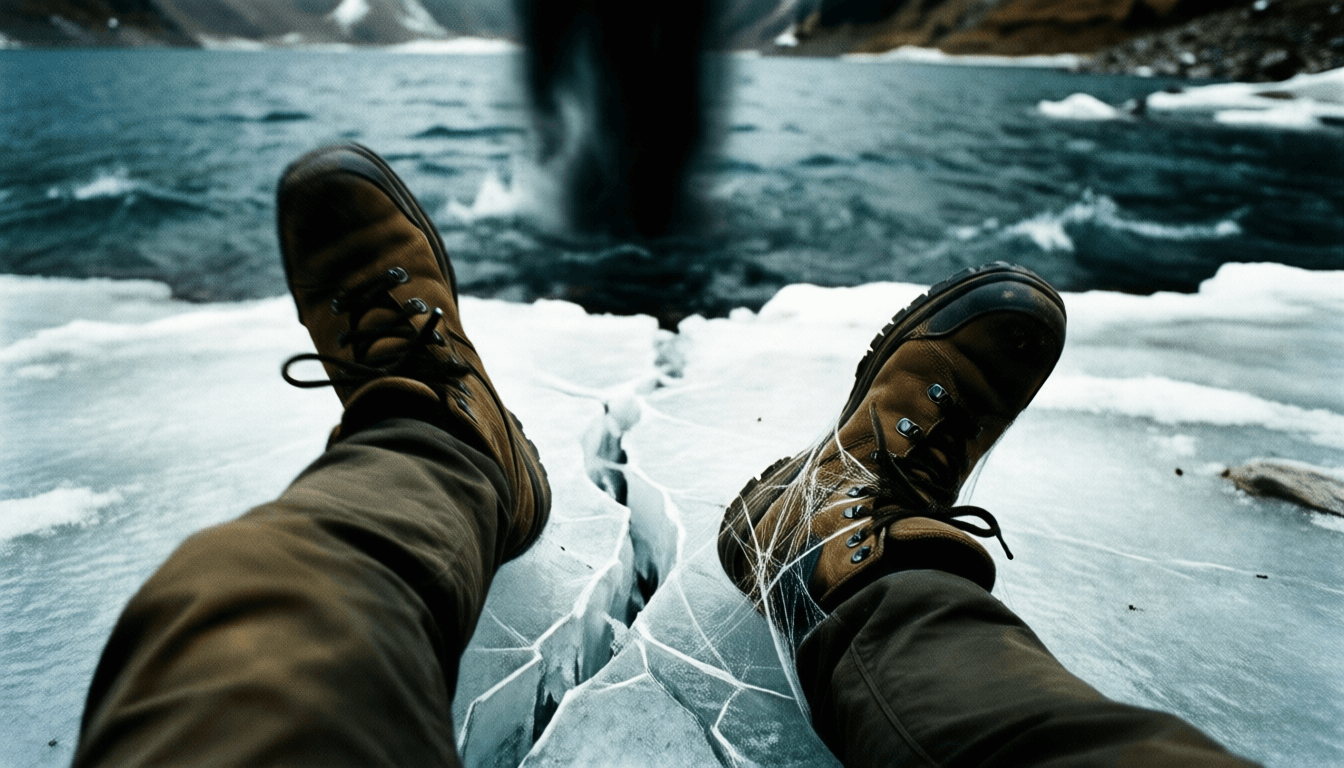
The ice beneath my feet cracked with a sharp RIIIP. Not natural thaw cracks. They spread like a spiderweb with impossible speed, as if something beneath was actively tearing it apart. The ice beneath my legs rapidly expanded, freezing inwards, gripping my boots, then my ankles, in a searing, burning cold. I was being cemented in place. The temperature around me plummeted further, an incandescent cold that felt like it was burning my exposed skin.
From the churning center of the lake, a dark, columnar mass seemed to rise. Not a distinct creature, but a condensed form of shadow, water, and perhaps, extreme cold. It was indistinct yet utterly present. It exerted a palpable, unseen gravitational pull, dragging loose objects on the shore towards the expanding cracks. Small stones skittered across the ice. My backpack, a few feet away, began to ominously slide towards the edge. And then, with a sickening lurch, I saw one of the remarkably intact skeletons, previously lying prone, begin to slide across the ice towards the dark, widening abyss, drawn by the same invisible force.
The ice tightened its grip on my legs, a bone-crushing vise. The profound, downward pressure intensified, making movement agony. I felt the resonating hum vibrate through the very framework of my bones, a disorienting, sickening sensation. With chilling certainty, I understood: this was how they died. Trapped, crushed, dragged into the depths of the lake. With a desperate, primal surge of adrenaline, I wrenched one leg free with a painful tearing sound, a sickeningly loud rip above the hum. The other leg remained stubbornly trapped in the ice. With a final desperate struggle, I heard a sharp, sickening CRACK in my ankle, but managed to pull myself free just as the crack widened further and the dark column from the lake lunged forward. I scrambled on hands and knees to escape the expanding cold and the terrifying, unrelenting pull. My mind screamed one truth: the lake wasn't merely a tomb; it was an active, hungry memory.
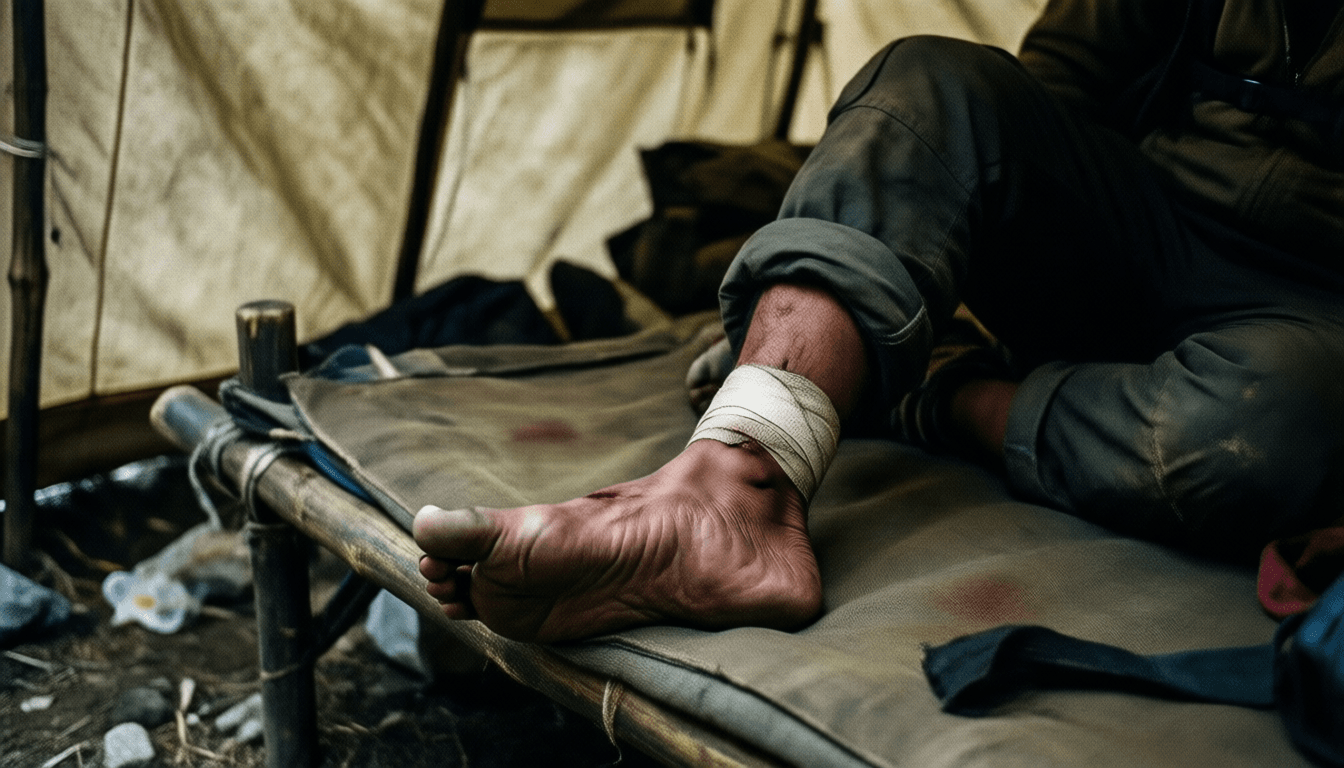
I returned to camp, bloodied and hypothermic, my ankle visibly deformed. Tenzin found me huddled in a fetal position, shivering uncontrollably, gasping for breath. He calmly and expertly tended to my wounds, speaking of mountain spirits and the dangers of venturing too close to sacred ground. I didn't correct him. He saw a man who had faced the mountain's wrath; I knew I had faced something far more ancient and precise.
Weeks later, the physical wounds began to mend. My ankle, despite being expertly set, retained a deep, unnatural coldness in certain atmospheric conditions. It was a sensation wholly unlike typical phantom limb pain during recovery. It felt like the cold came from within the bone itself.
The recovered equipment, though damaged, yielded chilling fragments of data. Audio recorded at the climax played back the horrifying, bone-vibrating hum, clear and undeniable. Thermal images showed impossible localized temperature plunges, the precise epicenter of a freezing death. But the most unsettling discovery came from my camera. Just before power failure, a blurry photograph had been captured. Not of a monster, but of the expanding cracks, and in the foreground, impossibly, one of the ancient, desiccated hands previously flattened on the ice was now slightly raised, fingers curled. As if in a spectral gesture, or a final desperate plea, frozen mid-movement. The photo was blurry enough to be open to doubt, but it was there.
I published no official reports or scientific papers on “Roopkund’s Active Resonance.” Conventional theories—sudden hailstorms, misguided rituals—remain the popular explanations for Skeleton Lake. But I know. I felt it, heard it, saw it. The lake is not merely a geological curiosity or a passive resting place. It is an ever-present, malevolent witness, a frozen memory that resents intrusion. It is not an echo, but an active, devouring force, capable of re-enacting the very catastrophe it holds. And sometimes, when the wind blows just right, or that peculiar chill settles deep within the bone of my healed ankle, I still feel the hum. Resonating within me, a subtle, chilling invitation. And the image of that hand, reaching. Waiting.
[ CLASSIFIED VERDICT ]
[ACCESS LOG - SOURCE FILE]
Roopkund Lake, nestled in the Indian Himalayas at an altitude of nearly 5,000 meters, became known as 'Skeleton Lake' after hundreds of human skeletons were discovered there in the early 20th century. Various theories exist regarding the origin of these remains, including mass death due to a massive hailstorm, an epidemic, or ritualistic killings, but the exact cause remains an unsolved mystery. This story is inspired by the mystery surrounding Roopkund Lake, adding the imagination that the lake is not merely a tomb but actively holds and reacts to the memory of an ancient catastrophe.