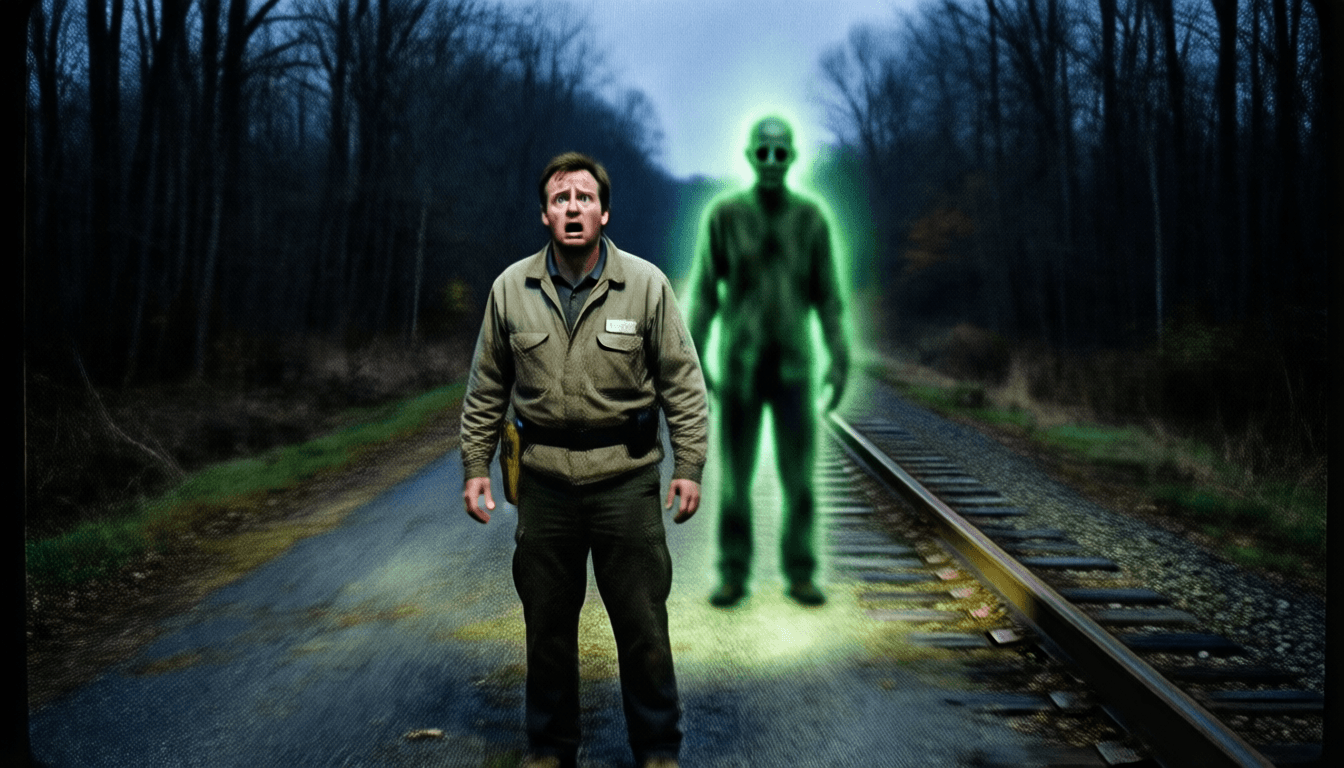
The Cold Green Mark of Route 351
Cross-referencing scattered posts on a Pennsylvania local history forum dating back to 2008 with scanned pages from a mid-1990s regional folklore magazine, there existed records of repeated, almost identical encounters along a secluded stretch of old Route 351, specifically near a defunct railway spur known as ‘Koppel’s Cut.’ The narrative was consistent: tales of a figure known vaguely as ‘The Green Man’ or ‘Charlie No-Face.’ Raymond Robinson, the real individual who lost his face to an electrical accident, had died in 1985, yet these records described sightings decades after his death. The chillingly consistent details included a shadowy, solitary form, the absence of discernible facial features, and a faint, sickly green luminescence observed in near-total darkness. Most recently, a post from three months prior detailed a brief, terrifying encounter by a former rail enthusiast whose camera battery inexplicably drained, leaving a faint green discoloration on its lens filter. As a chronicler of urban folklore, the persistence of a legend with such specific, recurrent physical characteristics post-mortem was an anomaly demanding scrutiny. This was not a mere afterimage; this was an ongoing phenomenon.
Late autumn twilight rapidly bled into absolute darkness, and I arrived at the designated coordinates: a rusted sign proclaiming ‘Old Route 351.’ The asphalt was broken, overgrown with weeds and brambles. The air was still, thick with the scent of earth and decaying leaves. I parked my nondescript sedan a quarter-mile away, out of sight, and gathered my gear. It was minimal: a high-resolution full-spectrum camera, a directional microphone, a thermal imager, and a powerful LED headlamp. The objective was documentation, not confrontation.
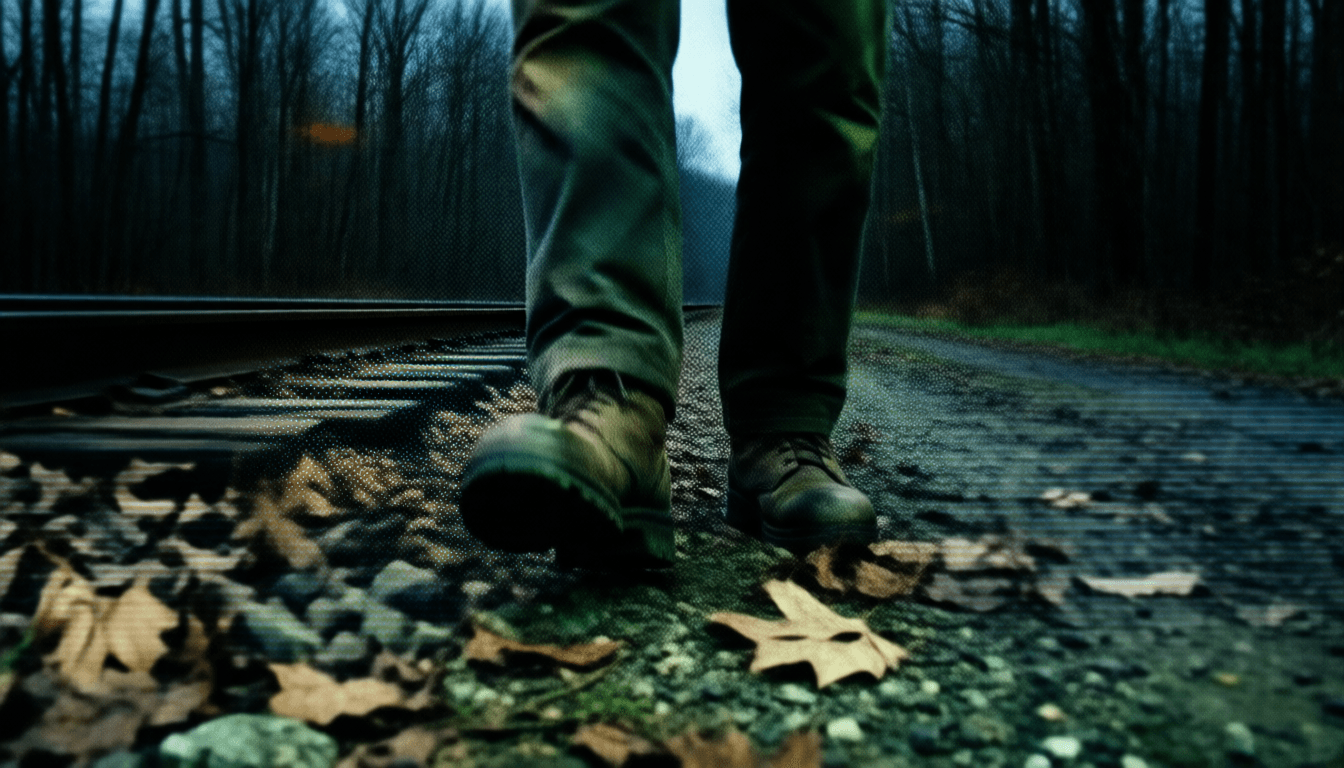
The surroundings were unnaturally silent. No distant highway hum, not even the chirping of crickets. The only sound was the crunch of my boots on gravel, which seemed amplified at first, then absorbed by the dense woods lining the path. The defunct railway spur, with its broken ties and rusted rails, was nearly indistinguishable, buried under lush undergrowth. Despite a relatively mild evening, the air grew noticeably colder the deeper I ventured. My thermal imager scanned the periphery, but picked up nothing beyond the cooling ground and faint animal tracks.
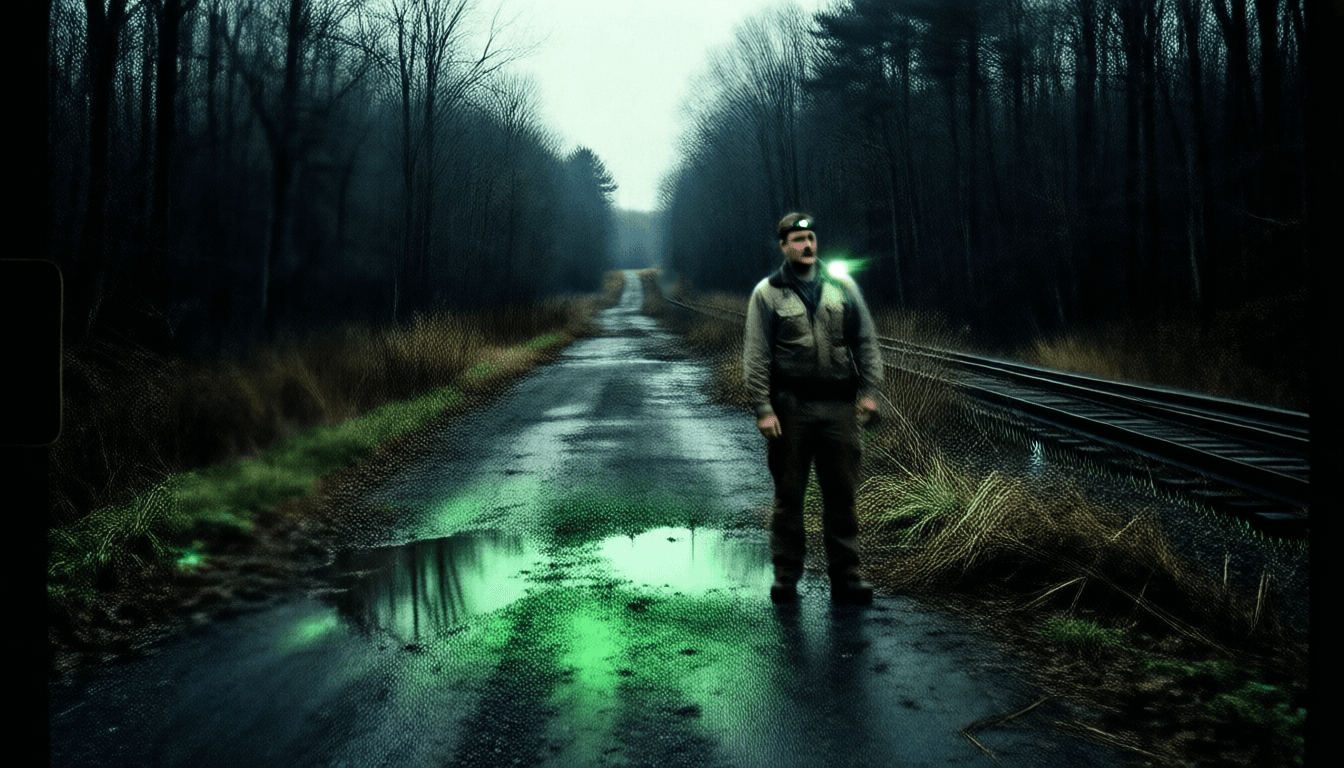
Deep within the woods, to my right, a faint, rhythmic series of footsteps began to echo. Like heavy boots crunching on dry leaves, yet the surrounding branches were undisturbed. When I stopped, the sound ceased. When I moved, it subtly kept pace, always just infinitesimally out of sync with my own steps. My powerful headlamp seemed inadequate here; its light felt absorbed, unable to penetrate the overwhelming darkness. I caught faint, almost subconscious flashes in the puddles of rainwater on the old asphalt, tinged green without any discernible source.
As I neared the deepest part of ‘Koppel’s Cut,’ a narrow, overgrown trench where the railway once passed, the air became charged with a palpable static electricity. The hairs on my arms stood on end. My camera’s battery indicator flickered, then stabilized, but the thermal imager showed erratic, unstable readings, like rapidly appearing and disappearing cold spots in the humid air. At the edges of my vision, I began to catch fleeting, amorphous shapes deep within the tree line. Always shadows, deeper blacks within the darkness, seeming to move with a fluid, unnatural grace. My rational mind tried to attribute it to pareidolia, but the frequency increased, becoming too insistent to ignore.
The footsteps were behind me, impossibly close. I spun around, my headlamp cutting through the gloom. There, at the entrance to the overgrown cut, stood the figure. It was unmistakably human in form: tall, gaunt, clad in old, heavy garments. But there was no face. Where features should have been, there was only a smooth, featureless void, like a stretched canvas. And from within this void, and from its exposed hands, a faint, sickly green light radiated, self-illuminating, independent of my headlamp.
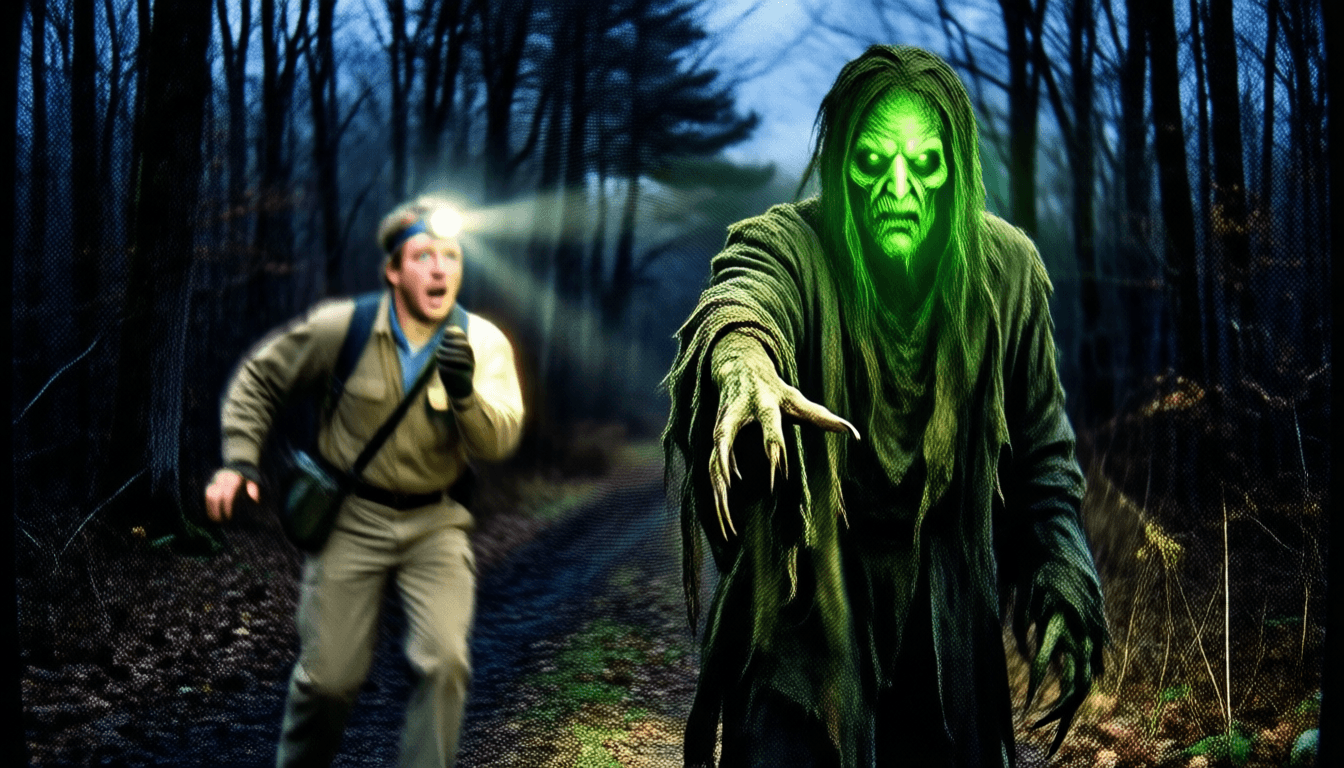
I instinctively stumbled back, my heart hammering. The figure took a slow, deliberate step forward. No sound accompanied its movement. I turned to run towards my car. The path, clear enough moments ago, now felt choked with unseen roots and sharp brambles. Desperately, I looked back. The figure was closer. Not running, but just ‘being’ closer with an impossible, blurred velocity each time I frantically averted my gaze. I veered off the path, plunging into the thick, thorny woods, thinking I could outmaneuver it. But as I fought through the dense undergrowth, the figure was there, directly in front of me, its glowing, faceless head tilted slightly. It had appeared on my new course without traversing the dense thicket.
My breath caught. I was utterly isolated. It raised a hand. Long, slender, emitting that unearthly green glow. It reached for my face. I instinctively raised my camera as a shield. Its gaunt fingers touched the camera lens. An immediate, searing coldness shot through the camera body, through my hand, up my arm. My muscles seized. A high-pitched, almost ultrasonic shriek erupted from the camera, followed by a sickening ‘thump.’ The green light intensified violently for a fraction of a second, blinding me. Then came absolute darkness. The internal light of the figure vanished. My headlamp died. I was momentarily paralyzed, overwhelmed by the cold and a profound sense of electrostatic discharge. The camera clattered to the ground from my nerveless fingers with a soft thud. When my vision cleared, the figure was gone. The darkness was absolute.
I stumbled backwards, then ran blindly through the woods, crashing into branches, tripping, propelled by pure, primal terror until I collapsed next to my car. My hands were torn, my clothes ragged, but I was out.
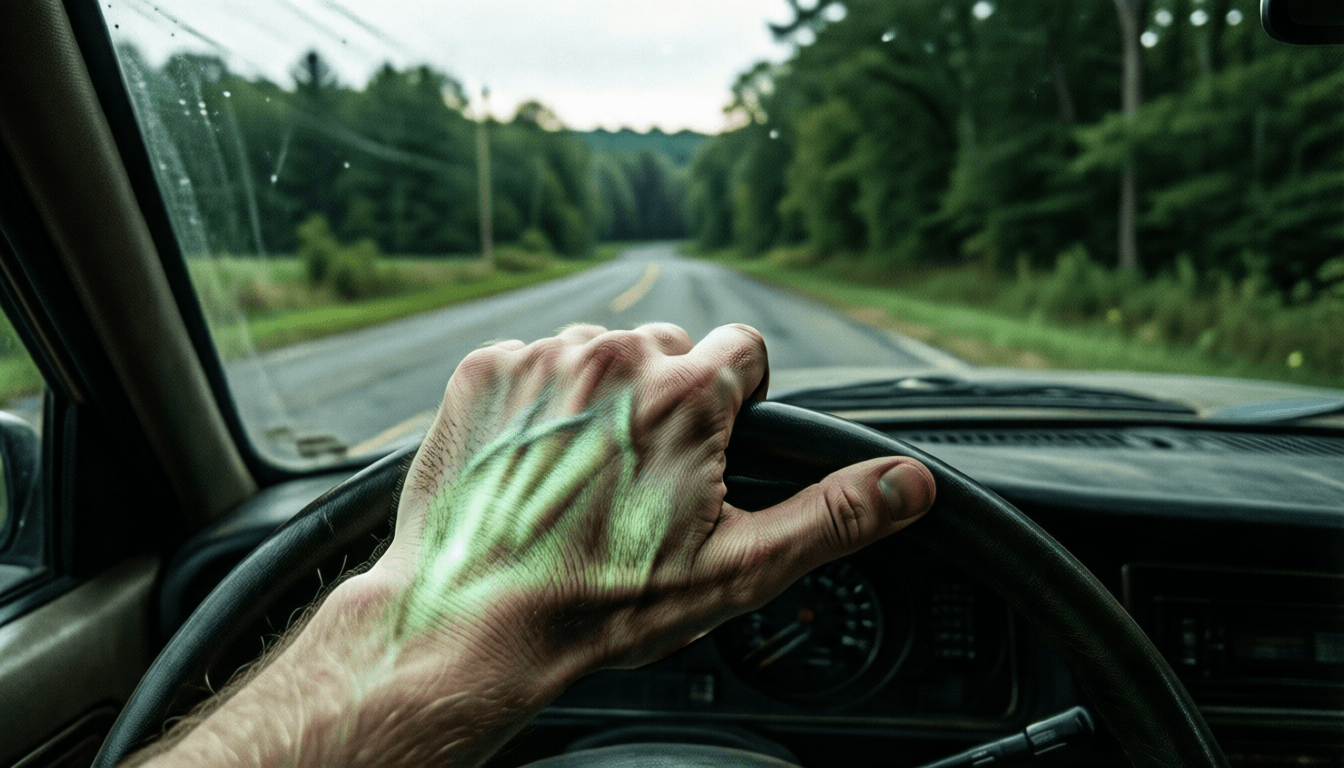
In the morning light, I retrieved the camera from the passenger seat. It was dead. The lens wasn’t merely broken; it was scorched from within. A faint, ineradicable green residue coated the shards of glass. The entire internal circuit board was ruined, with clear burn marks not attributable to a simple battery drain. My right hand, where I’d held the camera, remained unnaturally cold. A faint, almost imperceptible green discoloration had appeared on the back of my hand, a mark that no amount of scrubbing could remove. It wasn’t a bruise. It felt like a deep, cold tattoo. Occasionally, a phantom current would course through it, causing my fingers to twitch involuntarily.
I published no reports, submitted no academic papers. The rational framework I had built my life upon had fractured, a deep chasm opened within it. The phenomenon at Koppel’s Cut was not an evolved product of a real person’s folklore. It was something else entirely. Something extant, persistent, and adaptive. Raymond Robinson was merely the first documented witness, the first legend it appropriated. ‘The Green Man’ wasn’t a ghost. It was, perhaps, an extraterrestrial, a fundamental physical anomaly residing in a specific locale, feeding on darkness and perception, manifesting through an inexplicable environmental physics, leaving an indelible, chilling trace. The legend persisted not because people remembered Raymond Robinson. It persisted because it was still there, waiting for the next curious soul to step into its unnatural quiet. The true truth wasn’t that Raymond Robinson ‘became’ the Green Man. It was that the Green Man was ‘always there,’ and Raymond Robinson merely gave it a name. And now, I carry a piece of that truth, quite literally, etched onto my skin as a cold, green reminder.
[ CLASSIFIED VERDICT ]
[ACCESS LOG - SOURCE FILE]
The urban legend of 'The Green Man' or 'Charlie No-Face' in Pennsylvania stems from a real person named Raymond Robinson. Disfigured by a horrific electrical accident in childhood, he would only venture out at night. This story draws upon the persistent rumors of his sightings, even decades after his passing.