Polybius: The Truth of the Forgotten Arcade Game
The legend of Polybius isn't a tale spun in the dark; it leaves persistent digital traces. Its origins are fragmented, found in early 2000s forums and archived gaming sites, describing an arcade machine that briefly appeared in Portland, Oregon, around 1981. Operators reportedly collected data instead of coins, and players complained of severe psychological side effects: amnesia, night terrors, suicidal impulses, and even hallucinations that persisted long after leaving the arcade.
Some claimed government symbols or subliminal messages flashed within the game's abstract graphics. What elevates Polybius beyond a mere creepypasta is the multitude of anecdotal evidence that, though unverified, endures. I've collected distinct testimonies from dozens across the globe, describing similar symptoms and visual "glitches." Stories of a game they vaguely remember playing in childhood, but a game that shouldn't exist. No known ROM files, no clear photographs, yet the whispers continue, like a shared, phantom memory.
My current investigation began with an anonymous tip received through encrypted channels. It pointed to an abandoned arcade warehouse on the outskirts of Eastern Portland, leaving a single sentence: "That machine is still humming."
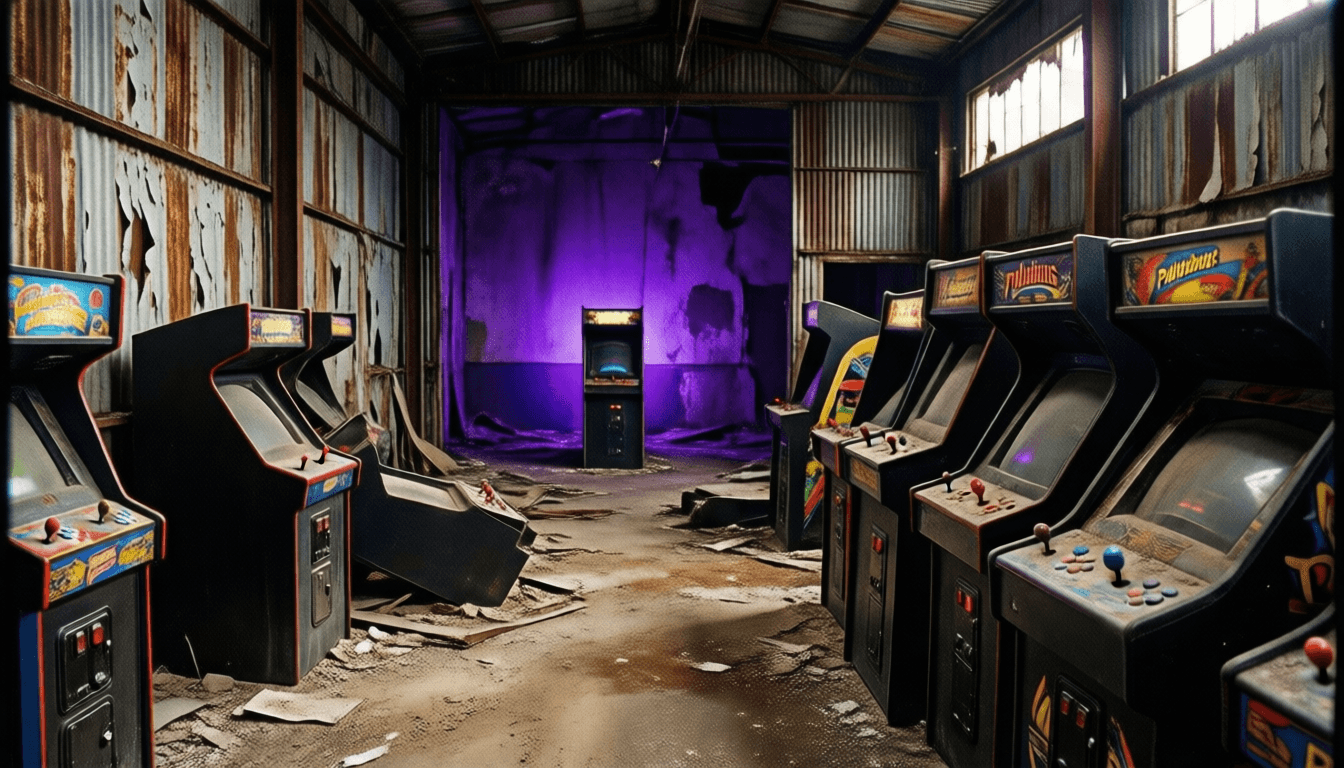
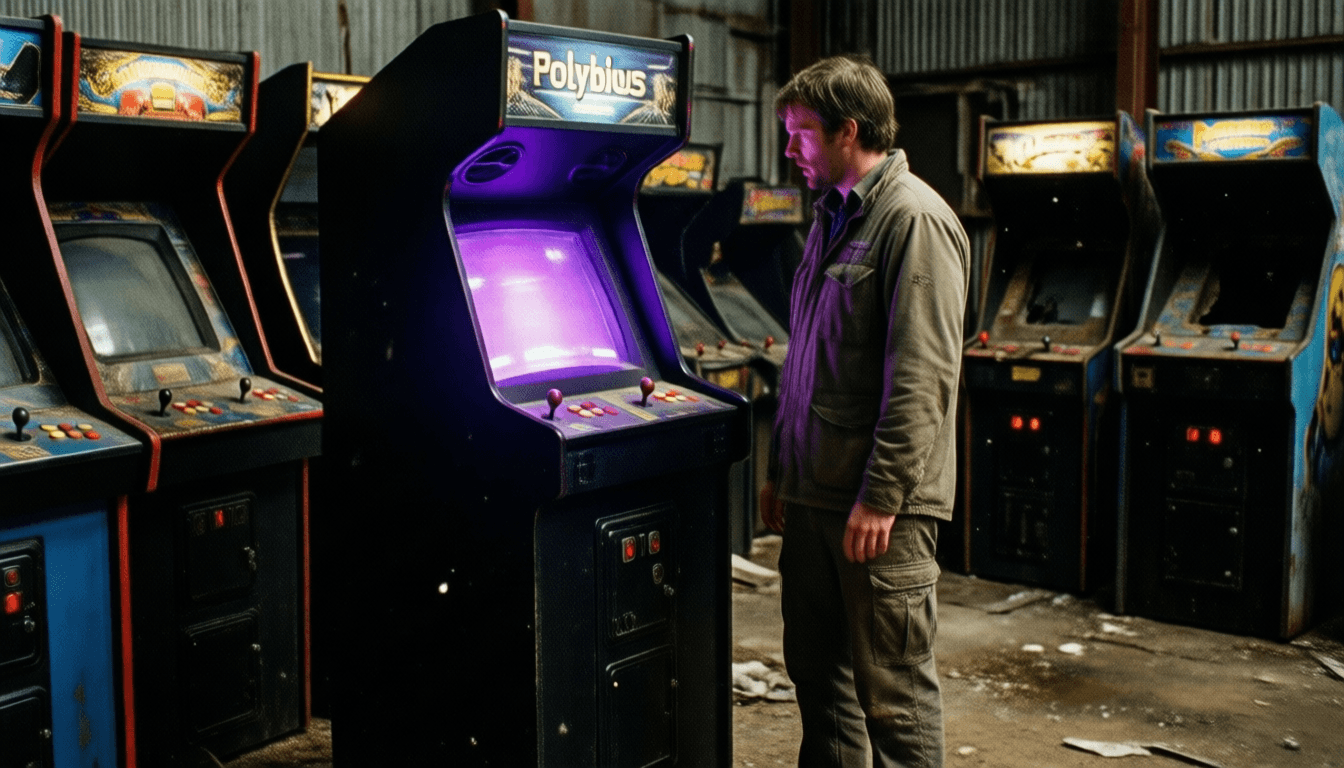
The warehouse bore the indifference of decades. Corrugated steel was rusted, and the faded paint of the "Arcade Galaxy" sign peeled away. Stepping inside, the air, thick with decades of dust, carried a faint metallic and ozone scent. Long-dead fluorescent tubes hung like skeletal fingers. Amidst a graveyard of forgotten machines – Pac-Man cabinets with shattered screens, silent pinball tables – stood a lone, incongruous console. Darker and sleeker than the others, its almost brutalist design felt more advanced. Its thick, cold joystick seemed to absorb the ambient light.
The marquee above the screen was dim, but the glyph-like title 'POLYBIUS' was clear, its angular letters seemingly vibrating with latent energy. A faint, low-frequency hum emanated from the machine, more a vibration felt through the soles of my feet than a sound heard by my ears. There was no coin slot; a small, smooth panel was inset, implying an entirely different mode of operation. Yet the screen wasn't dark. It pulsed with a faint, deep purple glow, an unspoken invitation. I pressed the singular 'START' button.
The screen exploded into a vortex of geometric shapes and flashing colors. The game's sound was discordant, sharp percussive notes layered over an ominously repetitive melody. It wasn't just the game. The low hum from the machine intensified, subtly vibrating up my legs through the soles of my boots. The dusty stillness of the warehouse, beyond the immediate vicinity of the machine, began to feel unnatural. My own breathing seemed amplified and distorted.
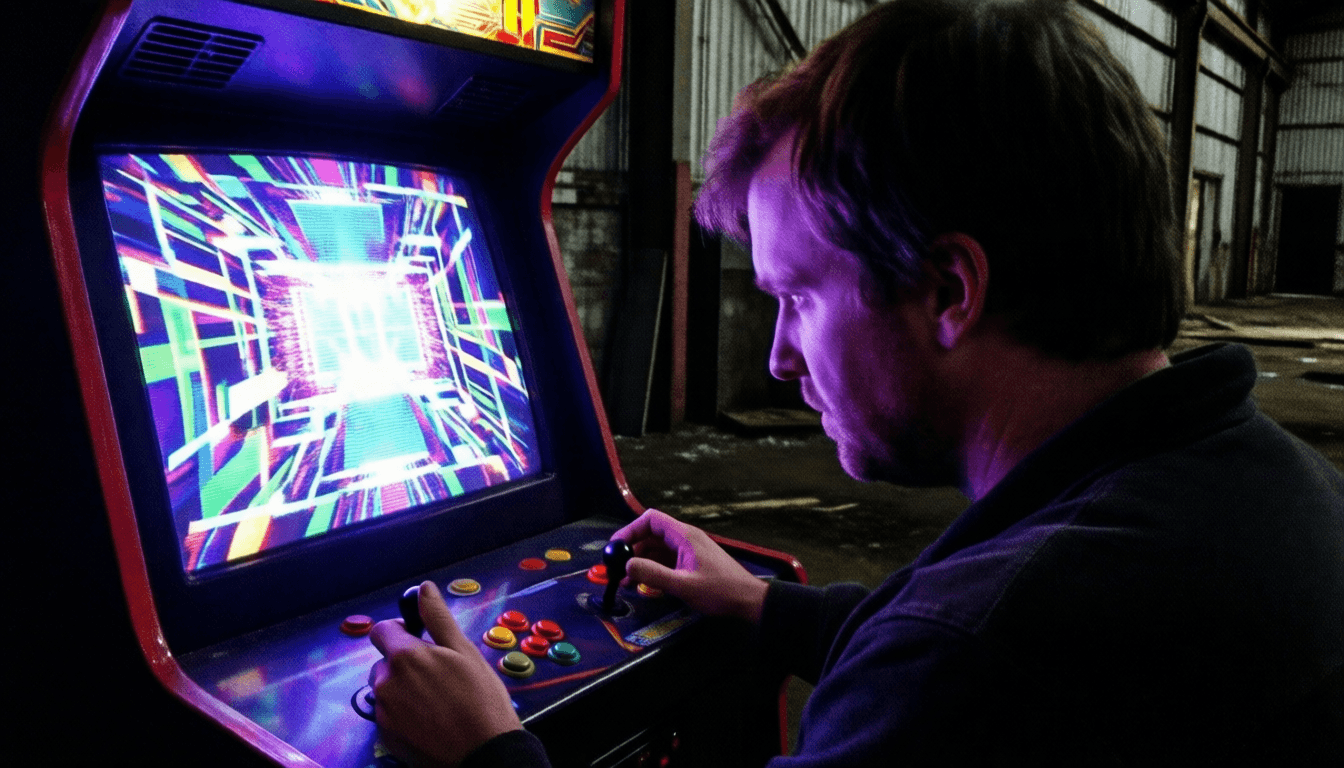
The overhead fluorescent lights, still dead, subtly reflected the bleeding colors from the Polybius screen, creating phantom patterns at the edge of my vision. The abstract forms within the game grew increasingly complex, almost alien in their structure. Text flashed by too quickly to read, leaving afterimages of exotic scripts on my retina. A pressure began to build behind my eyes, a dull ache spreading to my temples.
The game wasn't merely reacting to my input; it seemed to be observing and judging it. Abstract enemies tracked me with an intelligence beyond simple AI. Nausea swelled, and the world beyond the arcade cabinet seemed to warp and stretch at the edges of my perception. Each sound from the game seemed to echo not just off the warehouse walls, but within my skull, lingering long after its source faded.
The game seemed to be in its final phase. The colors on the screen intensified to a blinding degree, the patterns almost fractal, a kaleidoscope of impossible geometry. The discordant soundtrack escalated, no longer merely sound but a physical force, vibrating my eardrums and rattling my teeth. I tried to pull my hands from the joystick, but my fingers, clamped to the cold plastic, felt frozen. The deep purple light from the screen no longer merely illuminated its surroundings; it infused the air, bathing the entire warehouse in an unnatural, sickening hue.
Then, the impossible happened. One of the geometric 'enemies' on the screen, a rotating stellar octahedron, seemed to break free from the plane, and I realized it was faintly, translucently materializing in the empty space before my eyes. Its sharp edges glinted in the purple light. It didn't physically touch me, but the felt proximity was overwhelming. The machine's hum escalated into an ear-splitting, localized shriek, and a sudden, agonizing pressure crushed my skull. I screamed, hunching over, hands clamped over my ears, but the sound seemed to originate within me.
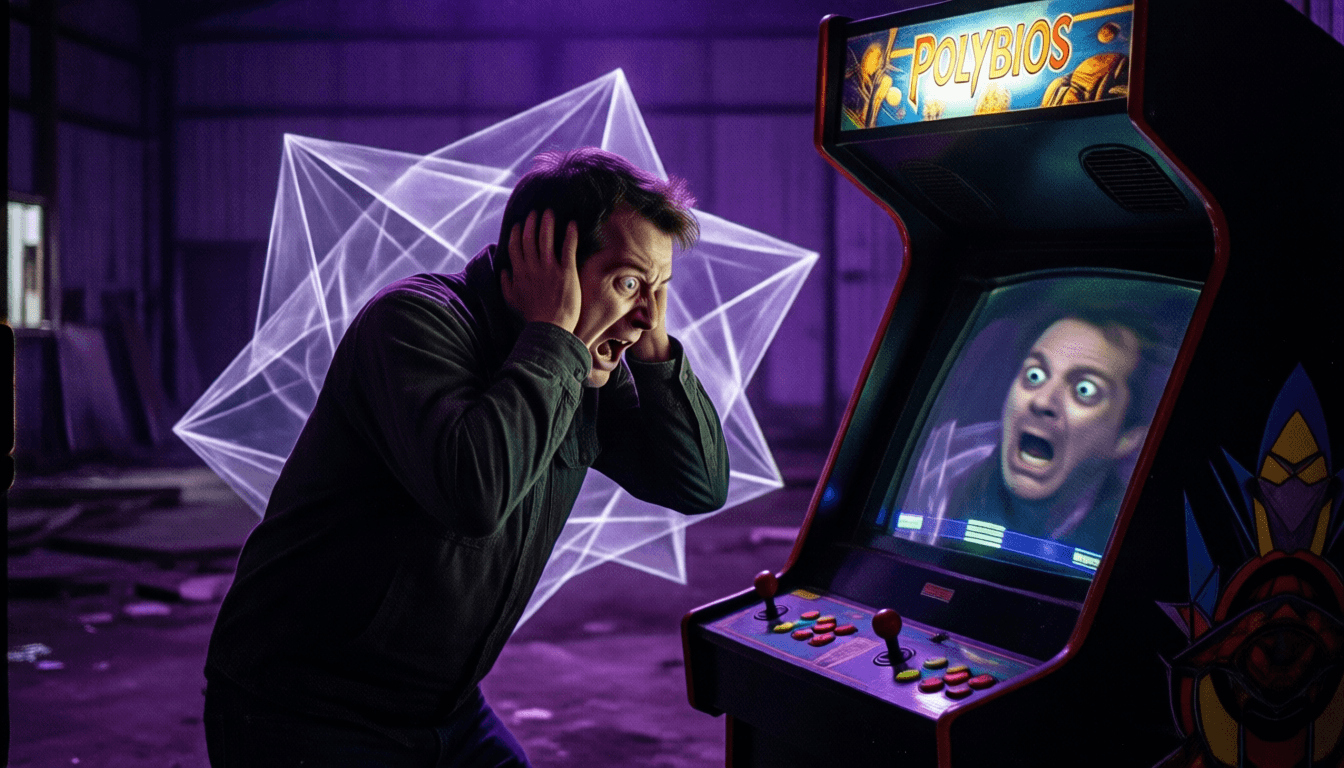
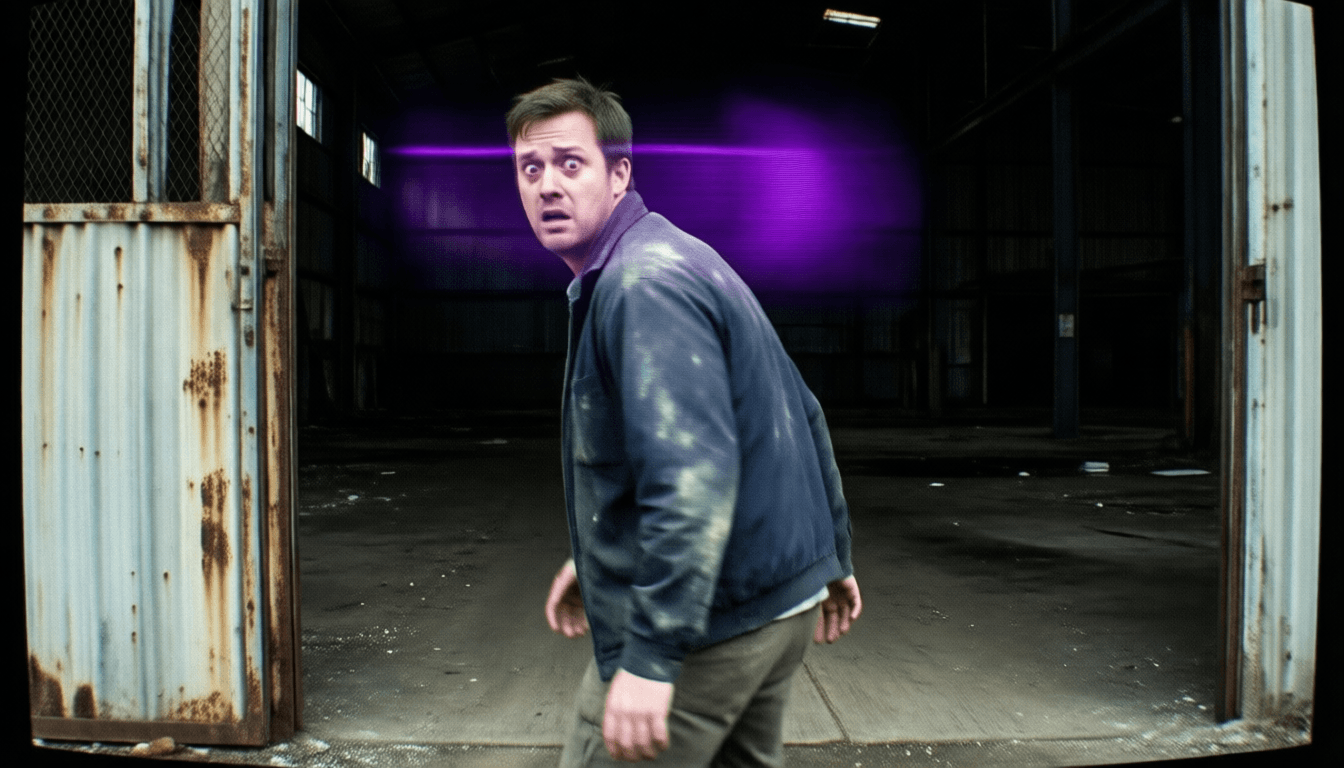
The game screen went completely black. Then, eerily, it reflected my image, but it was not normal. My eyes were too wide, my face contorted in a silent scream, and my pupils were replaced by tiny, rapidly shifting geometric patterns, identical to those on the Polybius screen. And with a palpable, crackling static burst in the air, the machine itself lurched forward, tilting precariously. I stumbled backward, scrambling away. My head still buzzed, and ghostly geometric forms swam in my vision, pressing down on my mind. I staggered towards the warehouse door, clawing through dust and debris. The machine's hum faded slowly behind me, but the purple afterimage of my distorted reflection was deeply etched into my vision.
I didn't go back. I presume the warehouse still stands, exactly as I left it. The physical wounds – scrapes on my arms from falling, the constant tinnitus that makes the world feel permanently muted and slightly off-key – these are minor injuries. What remains is less tangible. The pressure behind my eyes hasn't entirely receded. Sometimes, in the patterns of ordinary things – a brick wall, a tiled floor – I catch glimpses of the machine's geometric code, shifting and twisting at the edge of my perception. The memory of my reflection, pupils replaced by alien patterns, is still disturbingly vivid.
I experience brief, acute episodes of disorientation: familiar spaces feel utterly alien, moments where time seems to skip or repeat. I've deleted my notes, erased the encrypted tip. My archive on Polybius now sits empty on my server, a void where extensive research should be. Yet, the hum… sometimes I still feel it. That vibration, resonating from deep underground, from beneath the floorboards, or perhaps from the very marrow of my bones. Some legends aren't just stories. They are infections, and I now carry a part of it within me. Silently, with a growing dread, waiting for the next frequency.
[ CLASSIFIED VERDICT ]
[ACCESS LOG - SOURCE FILE]
Polybius is an urban legend about a mysterious arcade game said to have briefly appeared in Portland, Oregon, in the early 1980s. Players reportedly suffered severe psychological side effects including amnesia, night terrors, and hallucinations. Rumored to collect data instead of coins, it was believed to be part of a government experiment, with numerous unverified accounts supporting the legend.