The Gaze Within the Mural: The Watchers of Gangseo Daemyo
As rumors often do, this one began on the fringes of academia. A 2018 paper in the Journal of East Asian Art History (Vol. 47, No. 3), while discussing pigment degradation, casually mentioned that certain murals within the Gangseo Daemyo tomb, particularly the Four Deities (Blue Dragon, White Tiger, Vermilion Bird, Black Tortoise) in the Sasin-do, exhibited a remarkably pronounced “following gaze” effect. This phenomenon was typically attributed to clever perspective or convex surfaces in paintings.
However, in an online community focused on unusual phenomena in Korean archaeology, this observation evolved beyond a simple optical illusion. Anonymous users claiming to be former tour guides or administrative staff began sharing increasingly chilling anecdotes. Reports of tourists feeling not just watched, but “judged” by the mural’s presence, unsettling instances where the pupils appeared brighter or darker in photographs despite consistent lighting, and most strikingly, the testimony of a night guard: during a power outage, he observed a faint but rhythmic “pulsation of light” from the Blue Dragon’s eyes, a gaze he described as not passive, but “intentional.” It was these consistent subjective testimonies, dismissed by official channels as superstition or pareidolia, yet found commonly across different, geographically disparate accounts, that drew me in. Their consistency was too compelling.
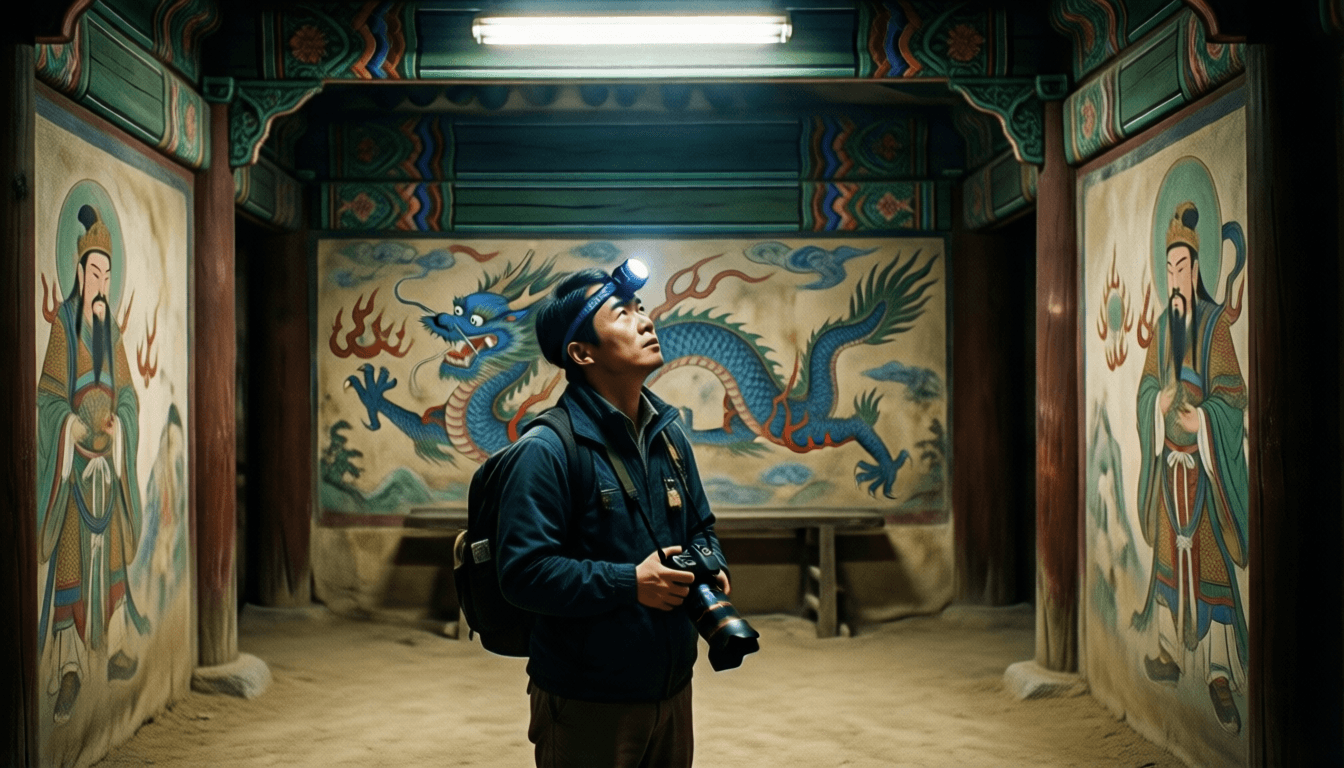
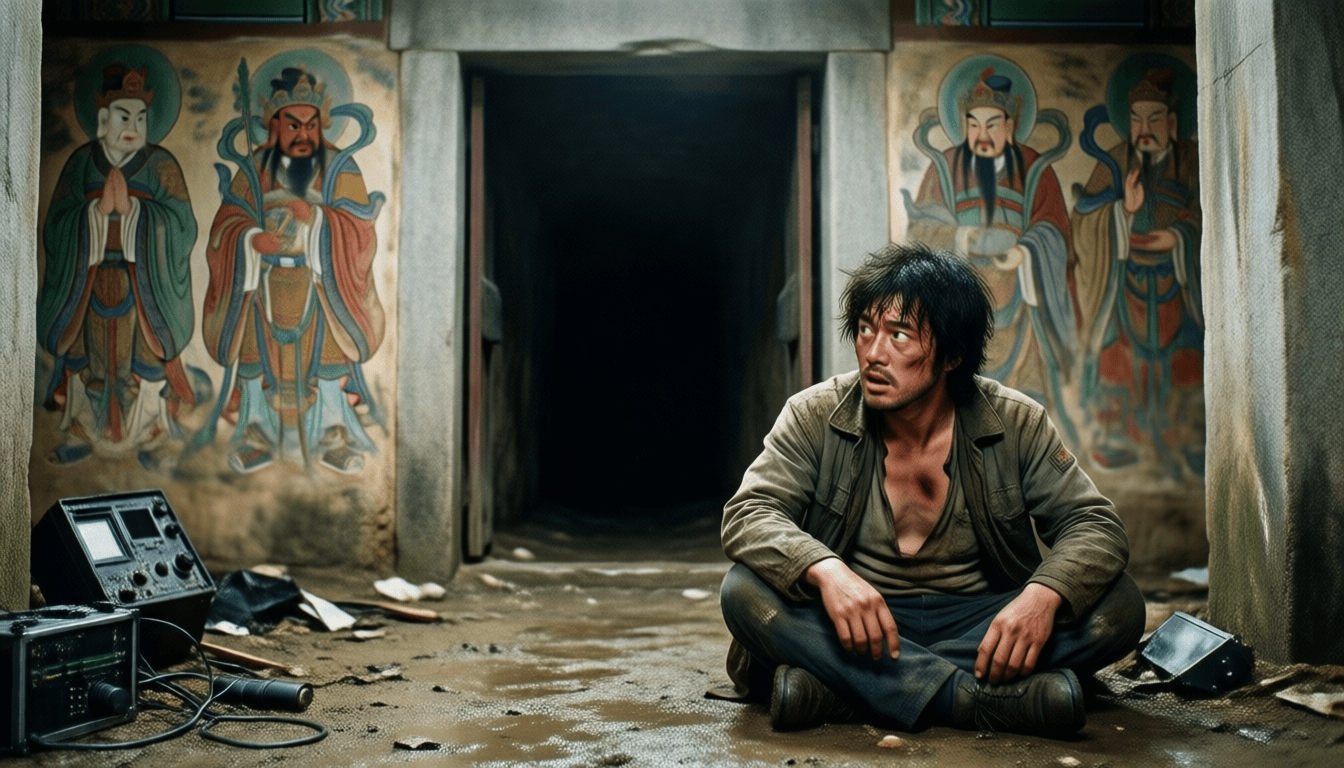
Gaining access to Gangseo Daemyo required navigating complex administrative procedures, under the guise of researching the stability of ancient pigments. The tomb itself was an excavated subterranean space beneath a low tumulus, accessible via a concrete-reinforced passage. Despite modern ventilation, the air was heavy and cold, tasting of damp earth and an undefinable ancientness. My equipment was minimal: a high-resolution camera with various filters, a thermal imaging device, a directional microphone, and a precision laser distance measurer. The central chamber was larger than expected, its walls adorned with the famed Sasin-do murals. Though faded by time, their forms remained imposing. The Blue Dragon dominated the eastern wall, its jade scales diminished, but its almond-shaped, disturbingly keen eyes stared directly into the center of the room.
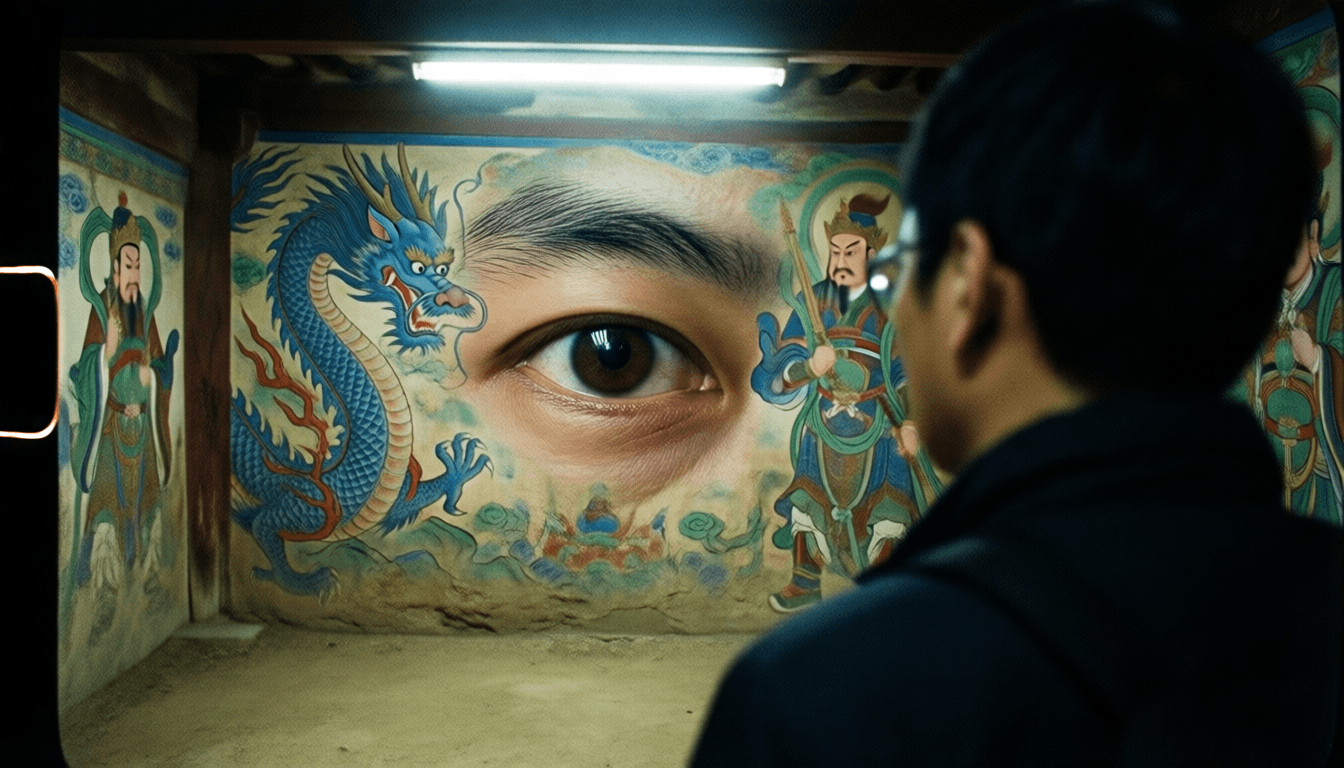
I began my standard survey, systematically photographing each mural and logging environmental data. The acoustics of the tomb were peculiar; sounds seemed to dissipate rather than echo, absorbed by the ancient stone and plaster. Even my footsteps sounded strangely muffled. It was a space of profound, almost suffocating silence.
After several hours, my initial objectivity began to waver. My normally steadfast laser distance measurer registered minute, erratic fluctuations when pointed near the murals, especially around the eyes of the Blue Dragon and White Tiger. It implied either the surface itself wasn't entirely still, or the light beam was subtly distorted. The thermal imager, designed to detect subtle temperature shifts, reported localized cold spots around the murals' eyes, varying independently of the overall tomb temperature, as if impossible pockets of cold lingered. And there was the light. My headlamp, a reliable industrial model, flickered with increasing frequency. Not shutting off entirely, but dimming for brief moments, as if battling an unseen resistance. I tried to dismiss it as a battery issue, but a fresh set yielded the same results.
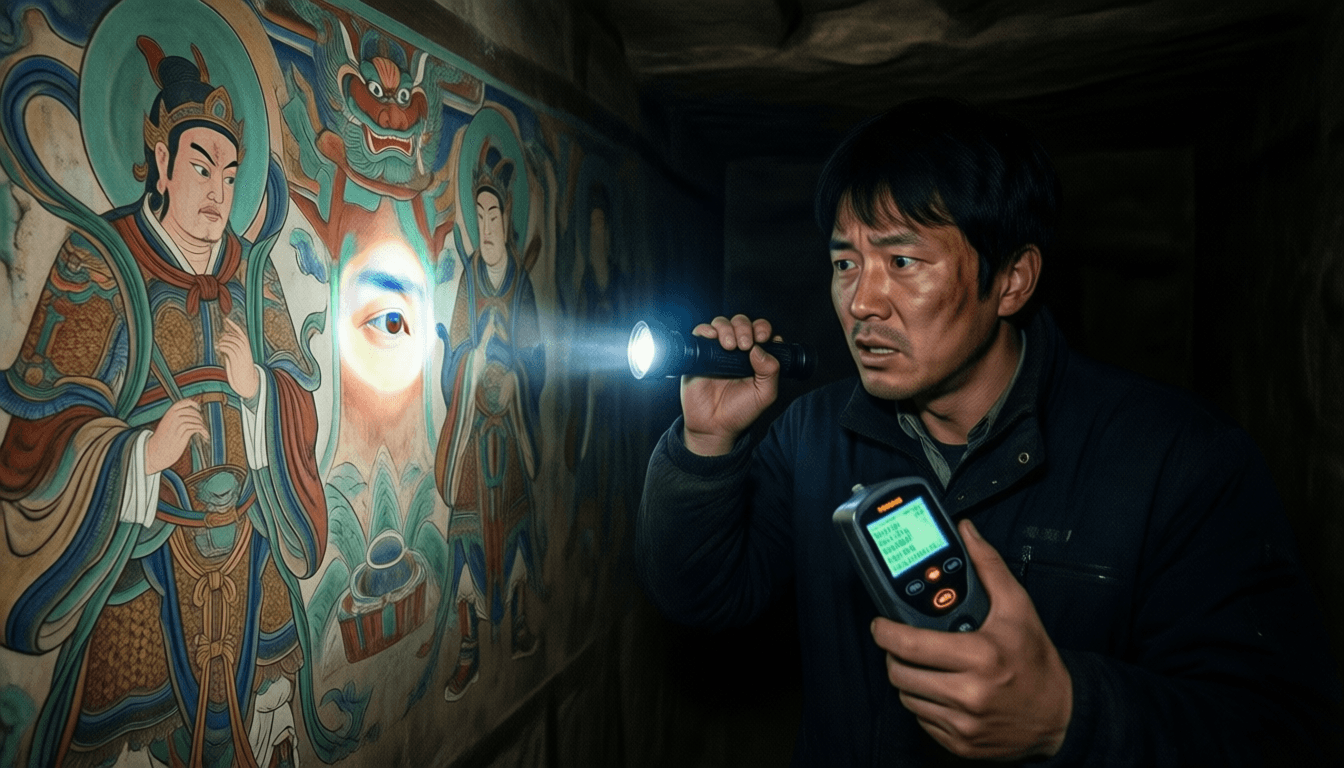
With each dimming of the light, the eyes within the murals seemed to deepen. The painted pupils absorbed the momentary absence of light with an almost perceptible intensity. I spun my head, convinced I had seen the Blue Dragon's posture shift in my peripheral vision, a subtle hunching movement, but when directly observed, the painting was still. The tomb's deep silence became not an absence of sound, but rather an active presence, pressing down on me, making the rush of blood in my ears disproportionately loud. The feeling of being watched was no longer a subjective impression; it was a physical weight, centered on the back of my neck, growing heavier with each passing minute.
As I photographed the White Tiger, the very air seemed to congeal. The low hum of the constant ventilation system abruptly ceased, plunging the tomb into absolute, suffocating silence. My headlamp gave one final, desperate flicker and then died completely. Absolute darkness. In that heart-stopping moment, the only light was now the faint, supernatural glow emanating distinctly from the pupils of the Blue Dragon on the eastern wall. It wasn't phosphorescence; it was light emitted from within, expanding and contracting with a slow, deliberate rhythm, appearing almost alive.
The laser distance measurer, still in my hand, registered sudden, impossible negative values. Something had entered and exited its measurement range. A low, resonant rumble, not of structural instability but from something far deeper, vibrated through the stone floor, aching in my teeth. I stumbled, fumbling for my spare light, and that's when a cold, immense pressure materialized directly on my chest, pinning me against the rough stone wall. It was not a hand, nor any identifiable object, but a concentrated, invisible force, squeezing the air from my lungs. My struggling vision blurred in the dimness, and in the faint, unearthly light, I saw them. The painted figures in the murals were moving.
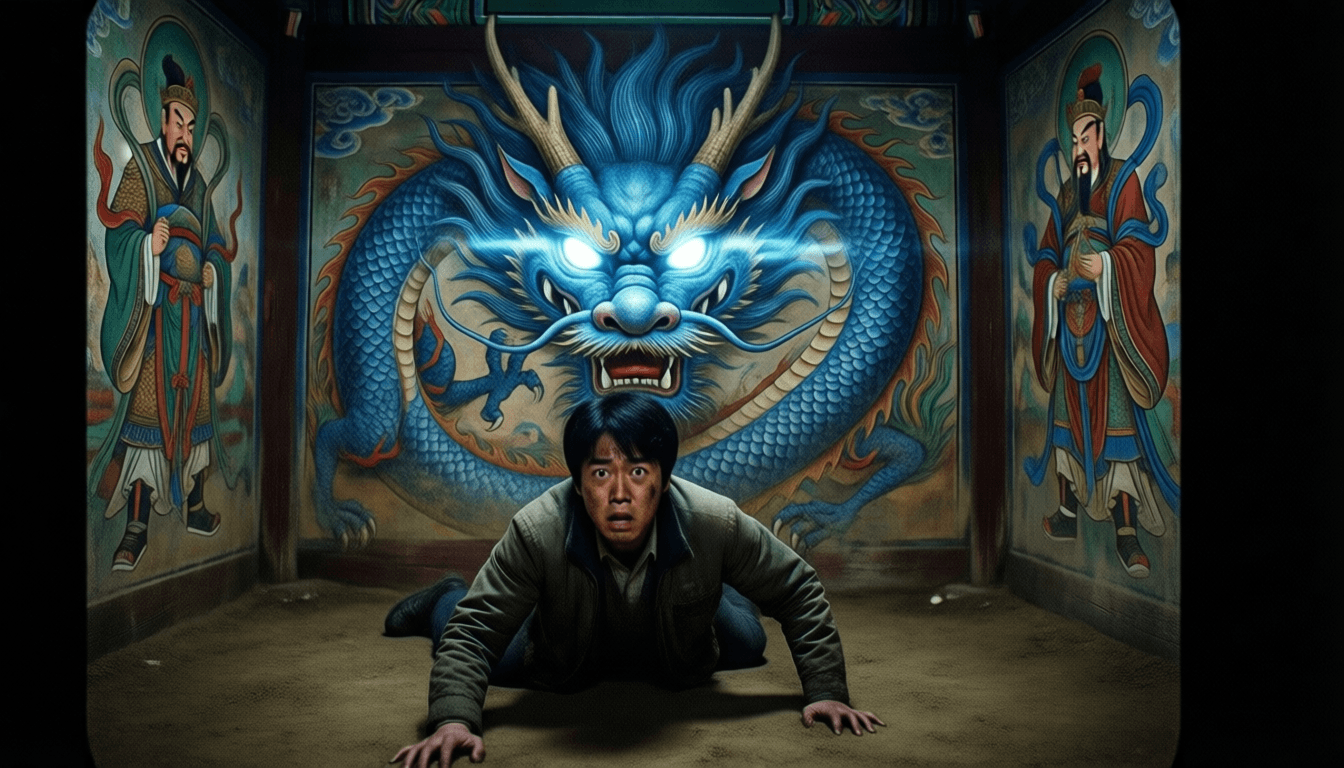
The Blue Dragon's head was tilted, its glowing eyes now undeniably fixed on me, its painted mouth seeming to open in a silent snarl. The White Tiger on the opposite wall was crouched, its painted claws subtly elongating. The impossible cold intensified, my lungs burned. The pressure on my chest became unbearable, my ribs screamed. I felt myself being dragged, slowly, inexorably, across the floor towards the Blue Dragon's pulsating gaze, without direct contact, by an invisible field of force. My fingers scrabbled for purchase on the slick stone but found none. Air seared my throat, and my vision darkened at the edges. Suddenly, a deafening clang echoed across the chamber. Not from the walls, but the concrete door leading to the passage slammed shut, trapping me. In the final fraction of a second before darkness consumed me, the last thing I saw was the Blue Dragon's glowing pupils, now impossibly vast, reflecting my own fear-contorted face.
I awoke sprawled on the damp ground outside the tomb. There was a throbbing pain in my chest, and a peculiar metallic taste in my mouth. The passage door was slightly ajar, as if forced open from within, faint concrete dust clinging to its edges. My equipment was scattered. My camera case was cracked and useless, the thermal imager shattered. But one item remained intact: my voice recorder. It contained fragmented recordings, mostly my heavy breathing and the initial hum of the ventilation system. But in the final few seconds before the recording cut out, there was a distinct sound: a deep, bestial exhale, impossibly close, followed by a faint, clicking sound of stone grating.
I pored over my notes afterward, re-examining the photos I’d taken before the incident. While nothing overtly supernatural was visible, recurring anomalies plagued my observations: faint, almost imperceptible discolorations in the deepest parts of the painted eyes in the murals, a subtle darkening that, when digitally isolated, resembled permanently dilated pupils. The official report attributed the incident to structural instability from a minor seismic event. My physical injuries – severe bruising across my sternum and superficial lacerations on my forearms – were dismissed as falling debris. Yet, the unblinking, icy gaze still lingers. Especially when I'm alone in the dark. I can no longer meet the eyes of painted portraits, and often, in quiet moments, I feel a prickling cold behind my eyelids, as if something from that tomb had taken root, observing the world from within me. The academic journal I initially referenced published a follow-up article this year, noting an inexplicable “darkening” of the pigments in the Gangseo Daemyo murals’ eyes, a fading that experts say cannot be entirely explained by environmental factors. They call it “unprecedented.” I know better. It’s not fading. They were just watching.
[ CLASSIFIED VERDICT ]
[ACCESS LOG - SOURCE FILE]
The optical illusion of the 'following eyes' in the Sasin-do murals of Gangseo Daemyo is a known painting technique. However, this story is based on an urban legend where this simple illusion transforms into a chilling entity, where ancient mural beings 'monitor and judge' visitors as if truly alive. Especially at night, rumors spread that light pulsates from the eyes and the murals even move, provoking people's fear.