The Cursed Hanok of Woljeong-ri: The Unmarried Spirit's Lament
Over the past two years, three development companies have successively abandoned projects to construct luxury villas on a 5-acre plot located on the outskirts of Woljeong-ri village, Gyeonggi Province. The official reasons cited were 'unpredictable geological instability' and 'logistical complexities.' However, an archived thread from an online forum dating back to 2021 presents a far more consistent and sinister picture.
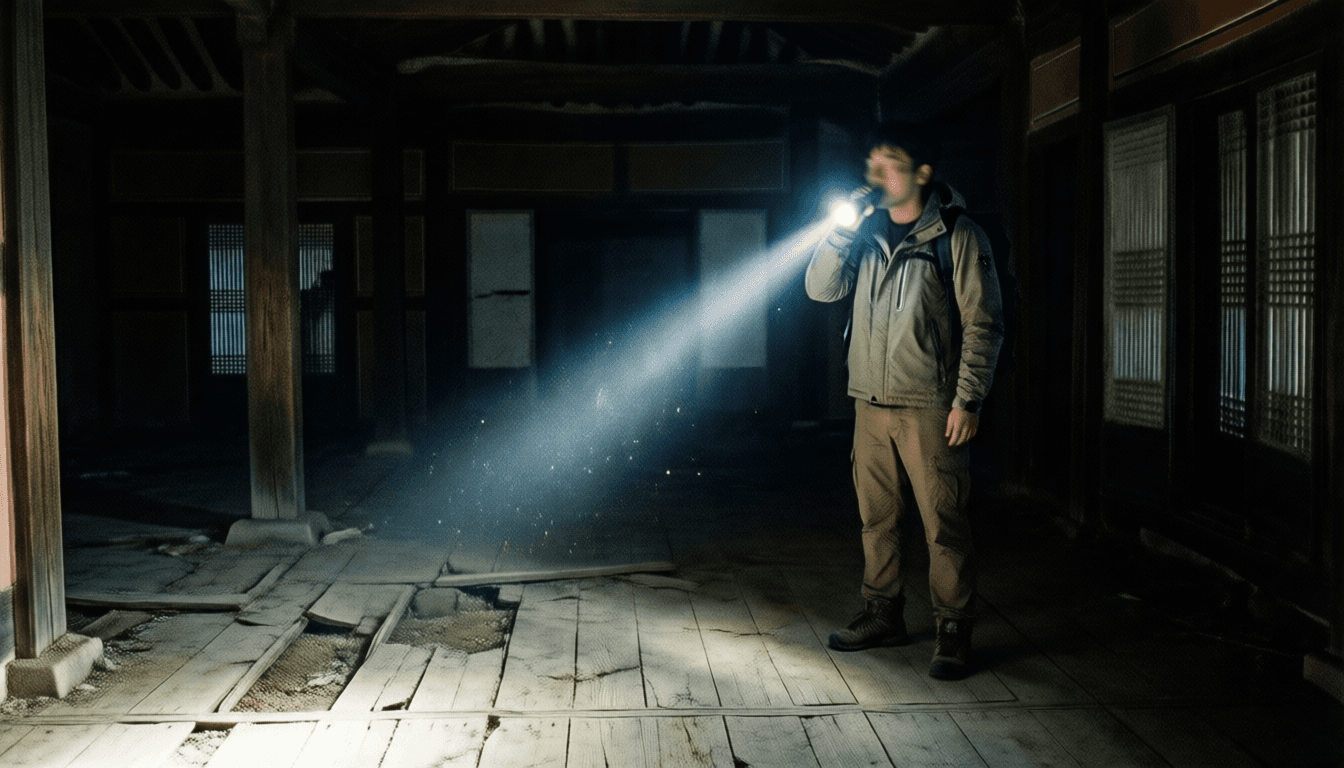
Anonymous posts, uploaded by former construction workers and site managers, enumerated a series of inexplicable occurrences: equipment malfunctions solely in the oldest section of the site, particularly near an abandoned Hanok; tools disappearing and reappearing in impossible locations; pervasive localized cold spots; and multiple reports of unidentified sobbing. One particularly chilling post detailed a frantic call from a night guard just before his disappearance. He mentioned a 'white-clad woman without a shadow' in the Hanok's courtyard, illuminated by his flashlight. His vehicle was found abandoned with the keys still in the ignition, but the guard was never found. Subsequent police investigations revealed no signs of foul play. The thread concluded with a local shaman's declaration that the land was 'unmarriageable', and any attempt to disturb it would cause Han (恨) to manifest as irreversible misfortune. The precise dates, consistent descriptions, and clear financial losses incurred by reputable development groups piqued my curiosity.
My first reconnaissance of the Woljeong-ri site immediately revealed its state of neglect. The perimeter fence, hastily erected by the last developer, was half-collapsed. Beyond it, the dirt path, once rutted by heavy machinery, was now slowly being reclaimed by weeds. As I approached the Hanok, the air grew noticeably colder. Standing incongruously in the middle of the surrounding fields, the Hanok's tiled roof had sagged, and its wooden framework was old and gray.
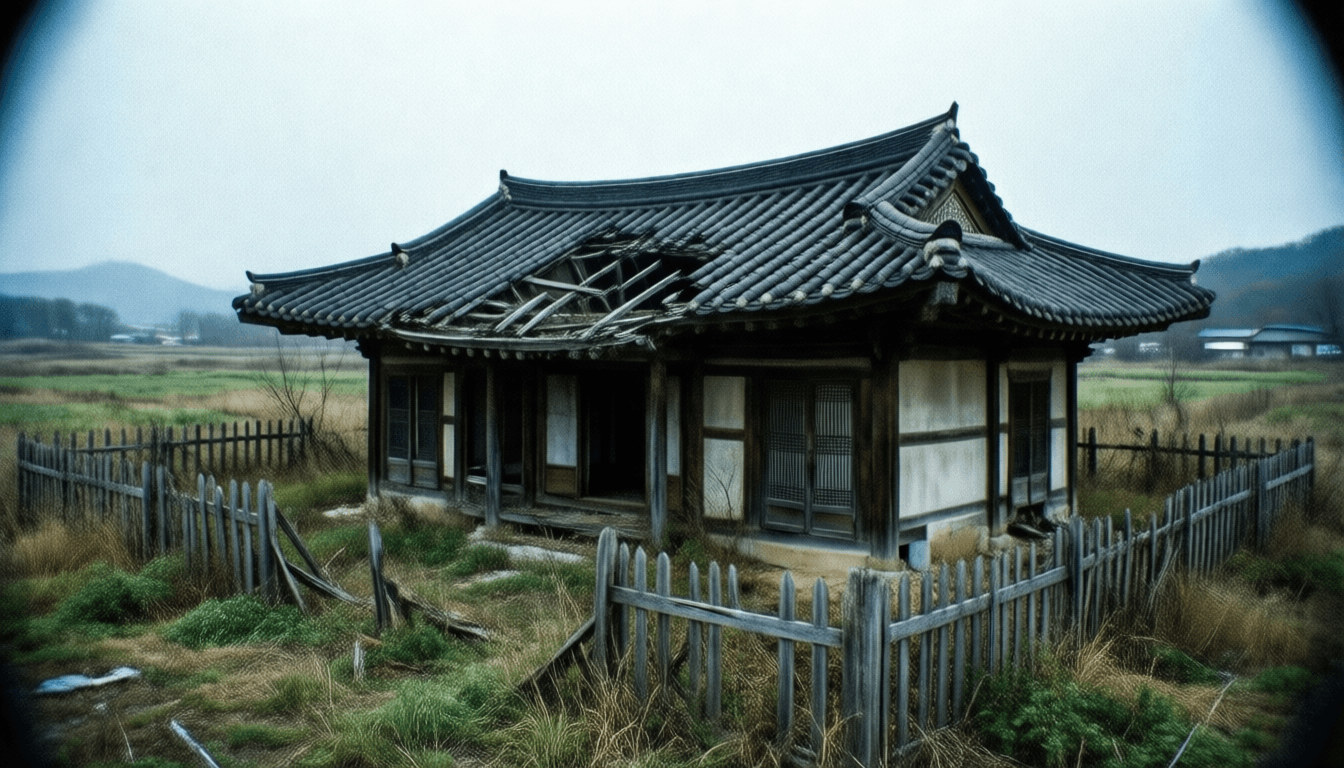
The Hanok itself stood on a gentle hill, overlooking the entire plot. The main gate (Sosaldaemun) was gone, leaving a gaping hole leading to an empty courtyard. The courtyard was overgrown with tangled grass and thorns. An unnaturally absolute silence hung in the air. The usual sounds of cicadas, even distant car noise, were inexplicably muffled, as if the air itself absorbed sound. My footsteps on the gravel felt unpleasantly loud, echoing within the silent walls. I checked my portable thermometer: 12°C in the courtyard, a comfortable 20°C outside the fence. Such localized temperature drops defied logical explanation. The heavy wooden doors of the main hall (Daecheongmaru) were slightly ajar, revealing a profound darkness that shadows alone couldn't explain.
Stepping onto the Daecheongmaru, the temperature plummeted further. It was a cold that felt less like air and more like a physical pressure. Dust motes, caught in the slivers of light filtering through cracks, danced erratically, defying any discernible airflow. A small ceramic bowl sat on the dusty wooden floor, likely left by workers. As I watched, a single droplet of water fell from empty air and landed in the bowl. Then another. And another. The ripples from each droplet deviated from normal concentric patterns, stretching elongatedly towards the bowl's edge before contracting again. The faint sound of the droplets was unnaturally amplified, echoing through the empty rooms.
I entered one of the inner rooms. The old paper door creaked as I pushed it open. The air here was completely still, yet a thin wisp of dust, settled on a wooden beam, slowly descended, only to then float upwards as if caught by an invisible updraft, before settling back down. My portable recorder, left on the Daecheongmaru, was picking up a faint, almost inaudible 'shhhk' sound, like fabric dragging across wood. This, despite being alone in the house. An intense, focused gaze pressed down on me. The chill running down my spine wasn't mere paranoia; it felt as if I was trapped in someone's stare.

The suffocating cold intensified. It was a frigidness that seemed to clench my lungs. I tried to leave the inner room to retrieve my recorder, but the paper door, which had opened easily moments ago, wouldn't budge. It felt as if a massive, invisible weight pressed against it. From the courtyard, I heard a damp, 'thud.' This was followed by several hurried sounds, as if something was being dragged across the gravel. My heart hammered violently against my ribs.
Suddenly, not from my weight, but from violent, abrupt movement, the wooden floor beneath my feet groaned. A section near the back wall shattered and collapsed inwards, revealing a dark, shallow crawl space. A strong, cold draft, faintly smelling of old earth and metal, billowed from the hole. I staggered backward, nearly losing my balance. Through the gaping hole, a pale, slender object, resembling a small, ancient finger bone, rolled out onto the dusty floor.
The Daecheongmaru doors, which had been ajar moments before, slammed shut with an ear-splitting bang. The entire silent house vibrated. I was trapped. The muffled 'shhhk' sound now came from much closer, from another inner room across the corridor. The air in my room was so dense with cold that my breath plumed visibly white. The light from the sole window seemed to dim, as if something vast and opaque had blocked it.
At that moment, true terror began. Heavy, distinct footsteps started to echo across the Daecheongmaru. Each step shook the house's very structure, heading towards my door. This wasn't spectral; it was a physical force. My paper door, still closed and unmoving, began to bulge inwards. The thin paper slowly tore, revealing glimpses of a deep, unspeakable darkness pressing from the other side. A deep, guttural moan, a sound mixed with unbearable sorrow and seething rage, resonated through the wood, vibrating through my bones. The floor beneath me gave a final, desperate groan and collapsed further, sending me tumbling into the dark crawl space below. I landed hard, my leg twisting, knocking the wind out of my lungs. Above, the moaning continued, now joined by the furious sound of what was tearing apart the very door I had tried to open. Its physical form remained unseen, but its destructive presence was overwhelming. I had to move, or be crushed.
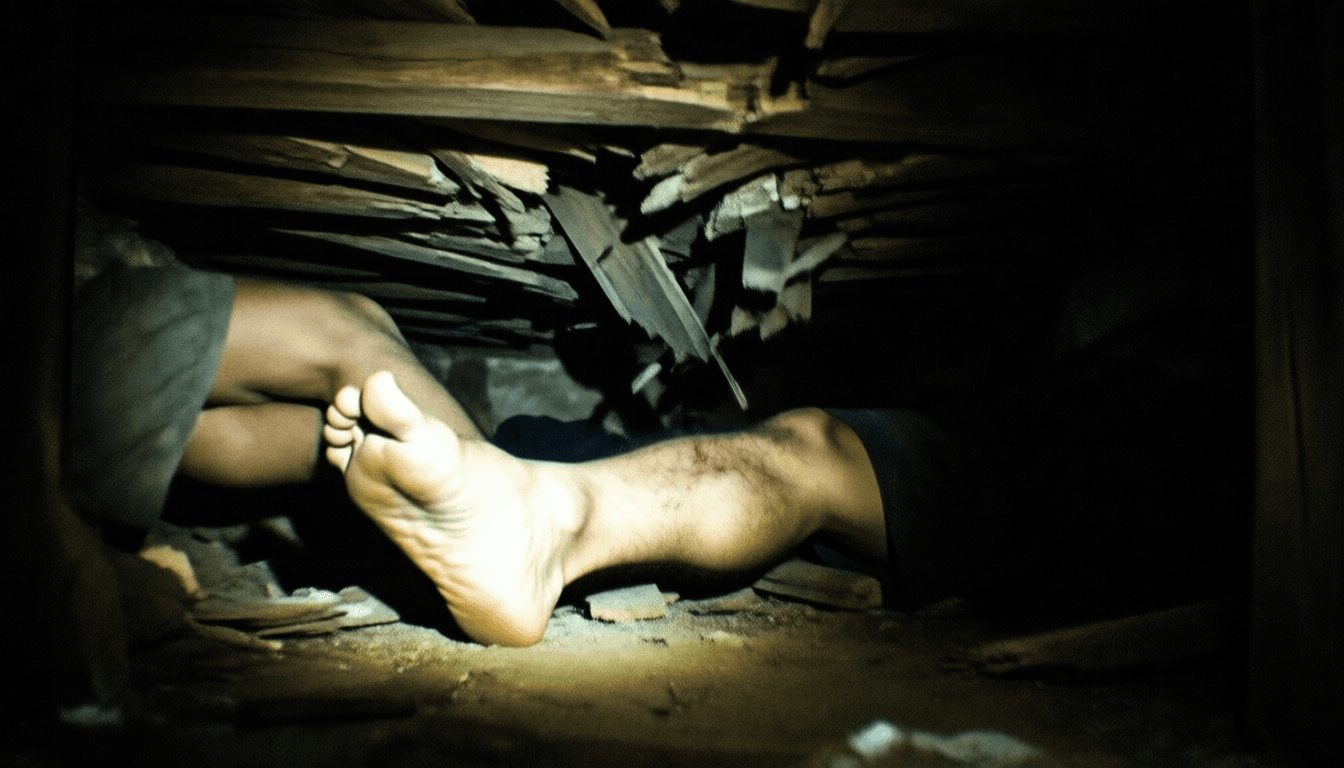
My twisted leg screamed in pain, but spurred by the sounds of splintering wood and furious movement above, I blindly crawled through the crawl space. Finding a gap in the dilapidated wooden outer wall, I managed to squeeze out into the night air. I gasped for breath, the cold still clinging to me like a shroud. I didn't stop until I reached my car, fumbling with trembling hands to start it and drive away. I dared not look back at the Hanok, standing silhouetted under the moonlight.
The next morning, in the sterile comfort of my office, the full weight of the previous night's encounter finally hit me. My left ankle was severely sprained and throbbing, swollen evidence of my fall. But it wasn't the only physical trace. Deep in my field jacket pocket, I found a rusted Binyeo. It was a traditional ornamental hairpin, seemingly made of dark, polished horn, in a late Joseon Dynasty style – far too old to be an item discarded by a construction worker. I had no recollection of picking it up. It carried the faint metallic scent I had noticed in the crawl space.
Later, I reviewed the audio recorded from the Daecheongmaru. The initial faint 'shhhk' sound grew, eventually dominating the entire recording track, interspersed with the 'thud' and rustling I had heard. But beneath all the breaking sounds and my terrified movements, there was a clear, unmistakable whisper. A single word repeated in old Korean: “Naega (我が家)” – 'My home.' The final chilling realization was not that I had encountered an isolated phenomenon, but that perhaps I had carried a piece of that lingering Han with me. The Binyeo now rests on my desk, a cold, silent sentinel. Sometimes, it catches the light, drawing my gaze, and I wonder if I truly left the abandoned Hanok of Woljeong-ri behind, or if a piece of Woljeong-ri has now found a home with me.

[ CLASSIFIED VERDICT ]
[ACCESS LOG - SOURCE FILE]
This story is based on the Korean concept of 'Han (恨)' and the legend of the Cheonyeo Gwishin (unmarried virgin ghost). It's a modern reinterpretation of an oral tradition where the deep-seated resentment of a woman who died without marrying curses the land, hindering development and bringing misfortune to those who disturb her Han. Traditional Korean elements like the Hanok and Binyeo further reinforce this belief.