
Silent Death Cave: Con Rit
The first credible reports emerged from fragmentary records of 17th-century missionaries. These records detailed indigenous warnings about 'Rít biển'—a sea centipede of impossible size inhabiting deep caves along the Annam coast. These accounts spoke not of a monster in the traditional sense, but of a 'presence' that overturned fishing vessels in calm seas, leaving peculiar, segmented marks on their hulls, accompanied by a distinctive, acrid smell like ozone and saltwater. Recent modern maritime incidents in the Gulf of Tonkin have rekindled these whispers. Internet forums dedicated to unidentified phenomena cite abnormal sonar readings, impossible 'shadows' captured by deep-sea cameras, and the consistent, albeit quiet, local reluctance among Vietnamese fishermen to navigate certain deep-water channels at dusk. They speak of a creature that moves without displacing water, a colossal, armored entity whose very presence warps the natural flow of the sea. It was these impossible physical discrepancies, coupled with ancient dread, that motivated this investigator to personally delve into the legend of Con Rit.
My journey began in a unassuming fishing village nestled among the limestone karsts of Ha Long Bay—a place where natural beauty coexisted with deep-seated superstition. Feigning a geological survey, I secured a sturdy, shallow-draft boat and hired a taciturn local guide named Ông Binh. His weathered face and distant gaze were testament to a lifetime spent navigating the bay’s unpredictable currents. Our destination: a particular unnamed limestone cave. With a narrow, jagged entrance almost submerged at high tide, it was locally known as 'Hang Chết Lặng', the 'Silent Death Cave'. As we navigated the emerald waters, the air hung heavy with humidity, the scent of salt and ancient rock clinging to the atmosphere. Ông Binh, despite his reticence, constantly scanned the water, a deepening unease settling in his eyes as we approached the deeper channels. The distant hum of the sea was replaced by an unsettling, almost palpable silence, as if pressed in by the colossal cliffs. It was not an absence, but a stillness that seemed to anticipate something.

The first anomalies were subtle, almost imperceptible. As we neared the designated coordinates, the sturdy boat began to feel unnaturally heavy, as if an invisible anchor had been dropped, subtly tugging at the keel. The usually reliable depth sounder flickered erratically, detecting impossibly large, moving structures that would then vanish without a trace. The water around the hull, typically ruffled by the bay’s gentle swells, was unnaturally calm, flat, and glassy. There were no ripples, no currents—only an eerie, unnatural tranquility that defied the distant ocean swell. Not from the engine, but a low, resonant hum began to vibrate through the deck, originating from beneath us. It was a deep, organic pulsation that seemed to seep into my very bones. Ông Binh, his face ashen, abruptly cut the engine. With a trembling finger, he pointed towards the half-submerged entrance of Hang Chết Lặng, whispering in a choked voice, "There... where the water sleeps... it waits." He refused to go any closer. His fear was a tangible, suffocating presence in itself. Visibility in the deep water around the cave was not merely poor; it seemed to actively absorb light, creating a void that felt less like water and more like a tear in reality.
Despite Ông Binh’s desperate pleas, my professional detachment drove me onward. I took the helm, guiding our vessel the last few meters towards the obsidian maw of the cave. The moment our bow crossed the threshold of the deepest shadow, the water around us behaved impossibly. Instead of current, a mass of water seemed to recoil from the cave entrance, creating a sudden, silent vacuum. It wasn’t suction, but as if the water itself simply ceased to be, violently pulling the boat forward. The engine roared uselessly, and the boat was drawn into the inevitable black abyss.
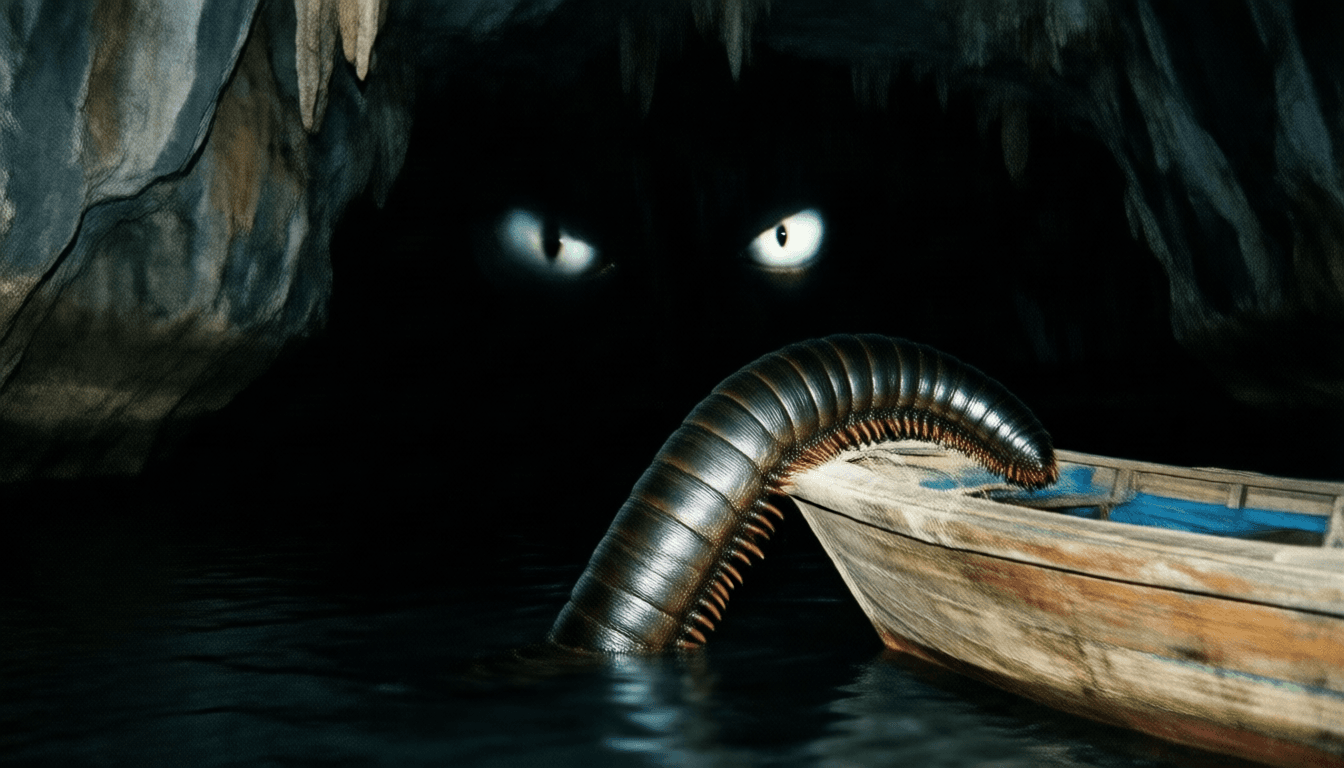
Then the boat stopped. Not run aground, but gripped. Immovable. An unseen, immense, absolute force pressed against the hull, pinning us against the jagged rock face within the cave. The engine screamed in protest, the propeller churning furiously against an impenetrable resistance. In the absolute darkness, an appendage revealed itself. It was segmented, chitinous, and impossibly thick. It didn't move through the water, but parted it as if it were air, gliding from the black gloom without splash, ripple, or spray. Just silent, impossible displacement. It moved with astonishing speed despite its apparent mass, reaching for the port side of the hull. The impact was not external. A deep, internal thud resonated through the entire structure of the boat, vibrating through my teeth, yet no sound escaped into the air.

Deep within the throat of the cave, two faint, phosphorescent plates, the size of dinner plates, ignited. They fixed themselves on the boat like malevolent eyes. They didn't emit light; they seemed to absorb it, creating a perfectly localized absolute black void around themselves. The chitinous appendage began to slowly, deliberately encircle the hull. There was the groaning of wood, the bending of metal, the slow, agonizing creak of the boat being compressed. The humidity remained oppressive, but the air grew impossibly heavy and metallic cold. There was no shriek from the creature, no roar—only the formidable, silent force of its compression. I realized, with chilling certainty, that this was not merely a colossal animal, but a presence operating outside the principles we understood. In desperation, I grabbed the emergency axe and severed the anchor line, which still hung uselessly, hoping that removing the resistance might allow the boat to move even slightly. It was a futile gesture. With a final, explosive crack of tearing wood and metal, the hull completely collapsed, and the boat slowly, surely began to sink into the crushing darkness. I lunged, scrambling onto the nearest jagged rock shelf. My legs screamed, and the absolute silence of the cave was broken only by the mournful gurgle of the dying boat.
Hours later, I was found clinging to a limestone outcrop by a passing fishing vessel—trembling, disoriented, and severely dehydrated. My account of the boat's destruction, a tangled tale of impossible forces and silent impacts, was attributed to striking a dark, poorly lit reef, a common tragedy in these waters. But the truth was in me, and in the fragment of evidence that remained: a small, disturbingly smooth, segmented piece of obsidian-black chitin, like polished black glass, embedded in the sleeve of my jacket, having pierced the fabric and grazed my skin. Impossibly light for its apparent density, yet razor-sharp, leaving a perfectly clean incision. Forensic analysis, later performed in secret, could not confirm its biological origin, only its unparalleled strength and atomic structure, which defied known organic compounds.
The wreckage of the boat was never fully recovered. The few pieces that resurfaced bore impossible marks: bent gouges and punctures that could not be explained by known maritime hazards. The wood and fiberglass were not merely broken, but compressed and melted as if by immense localized pressure and instantaneous, inexplicable heat. Yet, there was no trace of combustion.
I returned from Ha Long Bay with more than physical wounds. The memory of the 'Silent Death Cave' haunts me. I can no longer tolerate absolute silence, for it feels pregnant with an unseen, overwhelming presence. The sight of calm, deep water, once comforting, now instills an irrational dread—a primal understanding of the forces that move beneath its placid surface, forces that defy the very physics of our world. Con Rit is not merely an unidentified organism; it is a profound disruption, a silent, incomprehensible presence in the deep. A predator that moves not through reality, but within a horrifying, adjacent truth. The true horror is not its size or venom. It is the chilling realization that it simply exists, against everything we understand. Leaving only impossible traces and a lingering, suffocating silence.

[ CLASSIFIED VERDICT ]
[ACCESS LOG - SOURCE FILE]
The legendary 'Rít biển' or 'Con Rit' is known as a sea centipede of impossible size inhabiting deep caves along the Annam coast of Vietnam. This entity is said to overturn fishing vessels, leaving peculiar segmented marks and a unique scent on their hulls, accompanied by impossible physical phenomena that distort the flow of water. Ancient dread intertwined with modern maritime incidents has prompted investigations into its existence.