Shadows of Glenade Lake: The Call of the Dobhar-chú
Sligo Bulletin (Online Forum) – Excerpt from October 17th Post, [Current Year]
Subject: Mysterious Disappearances Near Glenade Lake – Is the Old Story Recurring?
User: LakeKeeper
“Another one gone. Liam O’Connell, found last month at the marshland boundary. The police vaguely speak of ‘environmental hazards’, but those who found him described it differently. It wasn't like a fox or a dog. It was like… torn apart. Old Riley at the pub swears it was the Dobhar-chú. My grandmother always warned about it, like Grace Connolly, snatching people from the lakeside. Some things don’t stay buried.”
User: AncientWhispers
“Check the attached file. It’s Grace Connolly’s tombstone from Cornwall. The creature carved on it… not a dog, not an otter. Too big, too powerful. History has a strange way of repeating itself.”
(Attachment: Slightly blurry, low-resolution photo of a tombstone carving depicting a powerful, hybrid-like creature)
The ‘Dobhar-chú’ of Irish folklore was often dismissed as a whimsical local superstition. However, recent disappearances reported around Glenade Lake in County Sligo have brought this myth back to the surface. While such phenomena are common in online forums, this instance warranted attention due to the consistent descriptions of ‘torn’ and ‘mutilated’ trauma found on the victims, distinctly different from a simple predator attack. The direct historical parallels with the case of Grace Connolly, who was reportedly killed by the creature while washing clothes in the 17th century, suggested that this narrative was evolving beyond mere myth into a concerning pattern. Glenade Lake, a secluded body of water with deep, peat-stained hues, warranted direct investigation. Archival records detailed two similar but lesser-known incidents in the late 1980s, noted in local reports with identical mentions of ‘unexplained trauma’. This was not merely a story; it was a recurring phenomenon.
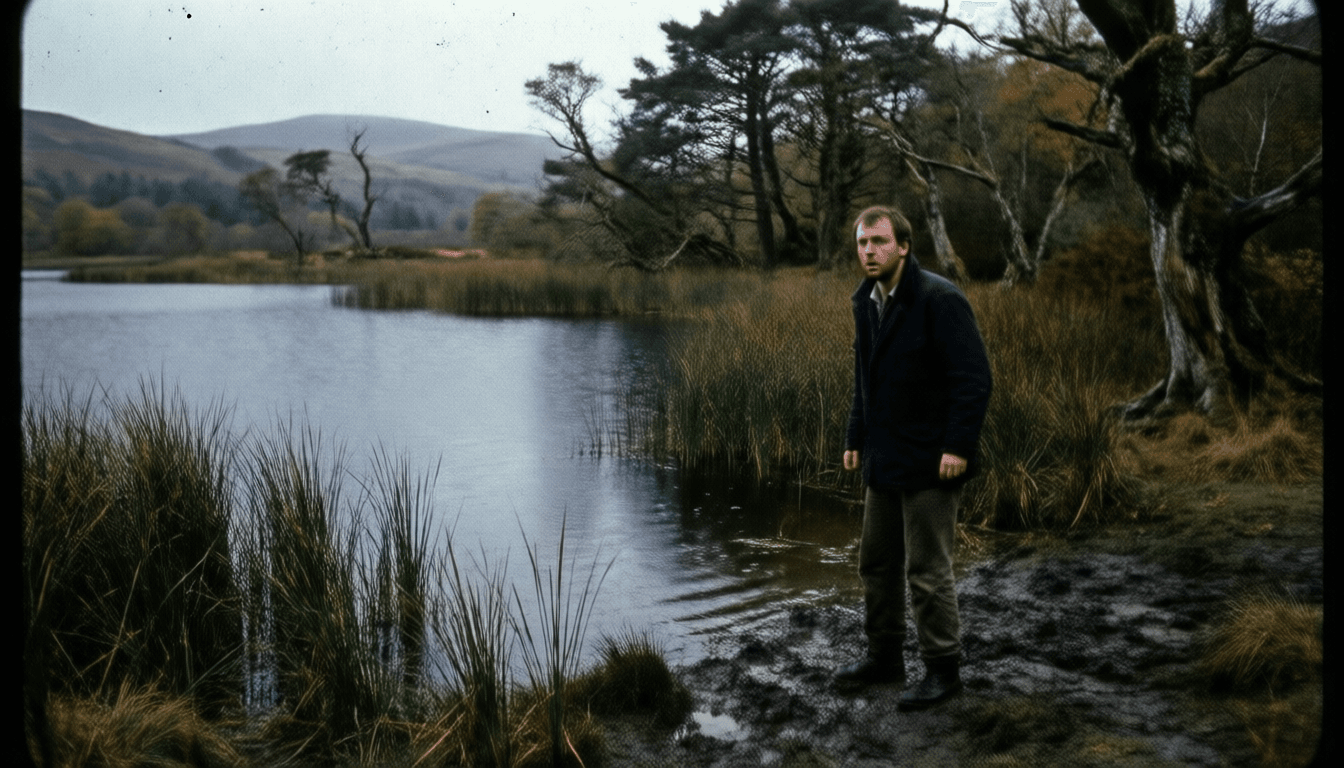
It was late autumn in County Sligo, and the relentless, grey drizzle perfectly suited the atmosphere of Glenade Lake. The air was heavy and damp, carrying the scent of peat and decaying reeds. My sturdy yet inconspicuous 4x4 was silently parked about a kilometer from the northern lakeside, near the rough track where Liam O’Connell’s body had been found. The ground was a desolate bogland, waterlogged, swallowing my boots with every step.
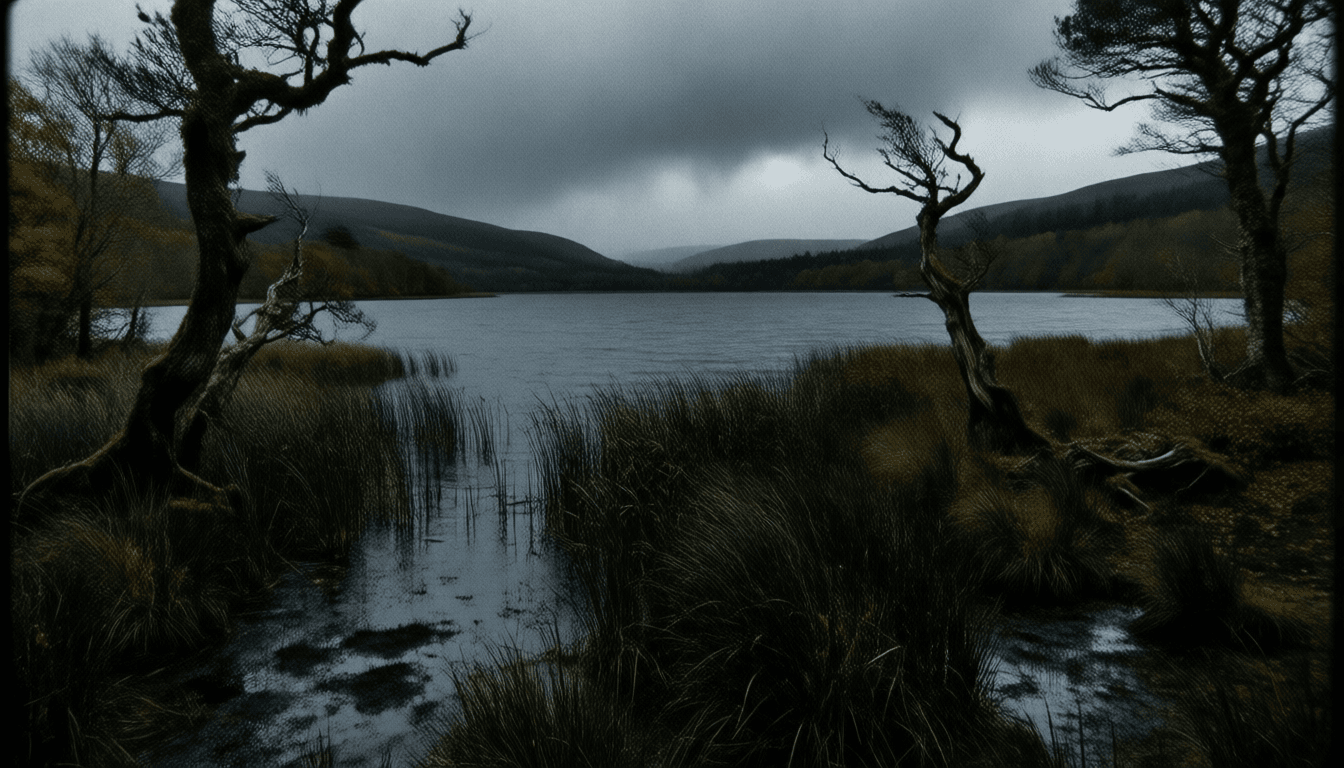
The lake was a vast, dark expanse of water, mirroring the slate-colored sky. It was encircled by ancient, twisted trees clinging precariously to the boggy slopes and dense thickets of reeds. The isolation here was not just a description but a living presence itself. There were no distant farm lights, no sounds of vehicles. Only the incessant lapping of the lake’s edge formed a monotonous rhythm in the profound silence.
My objective was to examine the marshland boundary where O’Connell was found and to meticulously scout the adjacent lakeshore. A GPS, investigative camera, environmental sensors, and a small, sturdy evidence kit were my standard gear. I moved systematically, searching for any anomaly or disturbance. The silence, which I initially attributed to rural desolation, soon began to feel unnerving. Birdsong was entirely absent; not even the hum of insects could be heard. In the overwhelming stillness, only my regular breathing and the squelch of my boots broke the monotony. A faint but persistent, strong, earthy animal odor began to assert itself, mingling with the damp soil.
The first clear anomaly occurred at a small, reed-choked stream. The faint rippling, my only auditory companion, abruptly ceased. The ensuing silence was absolute, suffocating. It was as if the air itself had been vacuumed from the world. Then, a distant bird cry echoed from across the lake, sounding unnaturally close and distorted for its distance.
A little further, where a small brook fed into the lake, I found it. In a patch of firmer, sandier mud, partially obscured by drooping fern leaves, were footprints. They were too large for any dog, too wide for any badger. The distinct impression of a partially webbed foot pointed not away from the water, but *into* it. My normally reliable compass began to spin erratically, without any apparent electromagnetic interference.
The musky animal odor intensified. It was a pungent mix of wet animal, decaying fish, and something subtly putrid. The air grew noticeably colder and heavier. Several small, isolated ripples were visible on the lake’s surface, moving with abnormal propulsion, sometimes against the meager flow of the incoming brook, before vanishing into an ominous stillness.
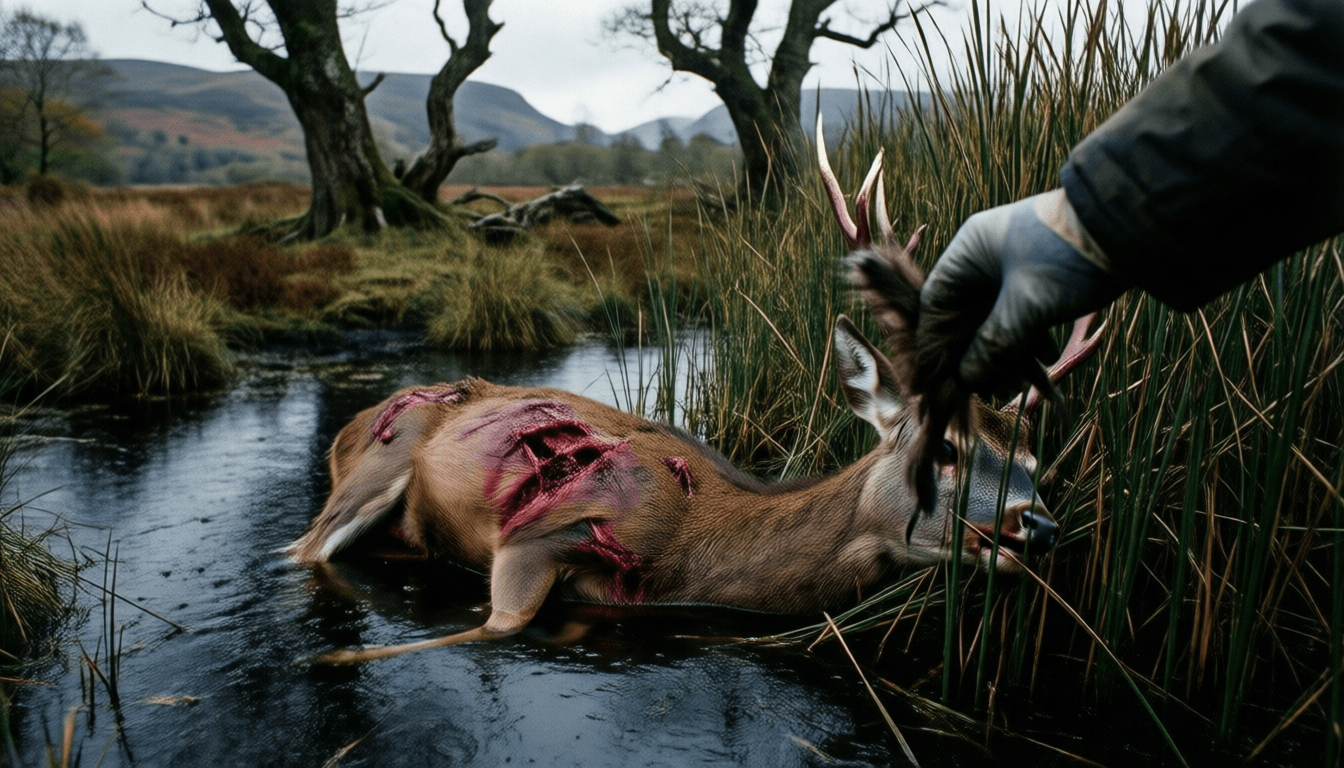
And then, partially submerged within a dense thicket of reeds, I saw it. A small deer, perhaps a fawn. Half-eaten. Its fur was matted, and its body was already distended in the cold water. But the wounds… they were not the clean, precise tears of a fox, nor the crushing bites of a dog. The flesh was not bitten; it was ripped, torn irregularly as if by immense, unrefined power. It was less an act of killing and more one of violent disassembly. A cold dread, a physical pressure, tightened in my chest. This was not the work of local wildlife. And I was standing too close to the water’s edge.
My focus was entirely on the deer carcass. The camera meticulously documented the nature of the wounds, the absence of clean kill marks. I leaned precariously over the icy water, reaching out to grasp a coarse, dark tuft of fur caught on a broken reed. The pervasive silence, the chilling animal musk, the erratic compass needle—all faded into background noise. It was a moment when an investigator’s instincts narrowed, focusing solely on empirical evidence.
That was my mistake.
Just six meters away, from the surface of the water that moments ago had been perfectly still and reflective, the creature erupted. There was no splash, no ripple, no warning sound until it was already upon me. It was a lightning-fast, impossible surge of speed and power, a black, muscular mass bursting from the depths. It was impossibly huge, far larger than any otter, more powerful than any hound. Its fur, black and sleek from the lake’s cold water, clung to a powerful, flexible body. Two pale yellow eyes stared out into the overcast sky, reflecting a cold, predatory intelligence. Its unnaturally wide jaws were packed with jagged teeth, wet and glistening.
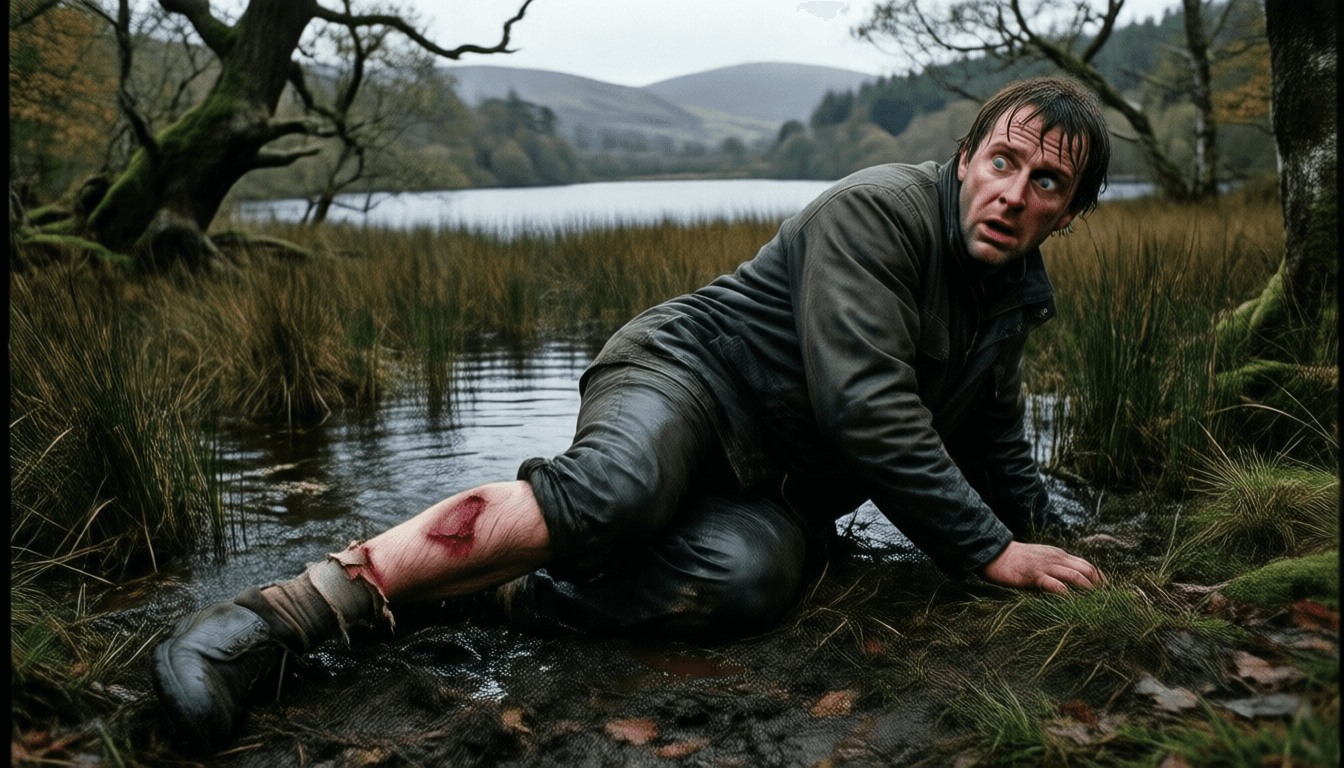
Before I could even register the impossible speed, I was no longer standing on solid ground. An overwhelming force slammed into my legs, violently pulling me into the icy, peat-stained water. My expensive, sturdy camera was ripped from my grasp with terrifying ease, vanishing into the murky depths. The water became a sudden, freezing maelstrom, my limbs flailing uselessly against the creature’s immense strength. It had my left leg, its powerful grip exerting crushing pressure on my hiking boot. A growl reverberated through the water – not just an audible sound, but a primal sound that vibrated in my bones, a sound of territorial rage and predatory hunger.
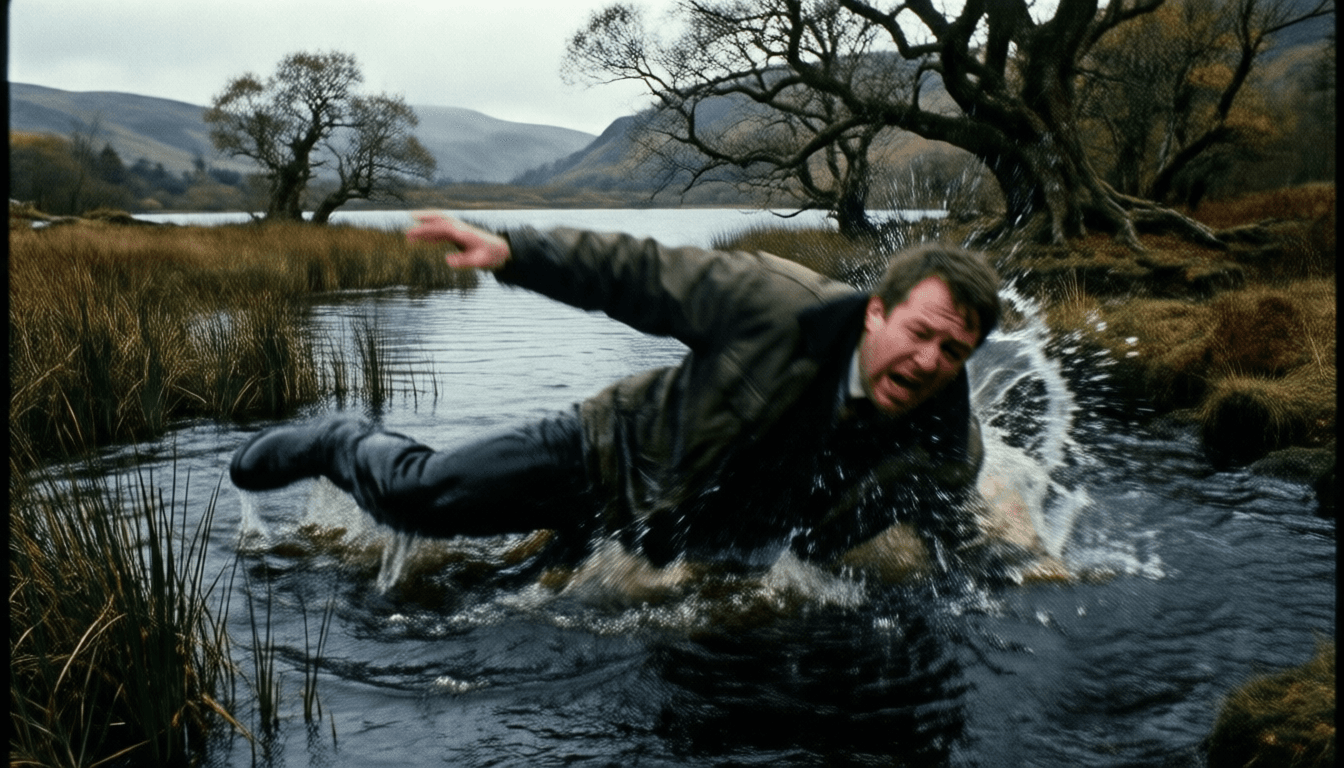
The cold was absolute, paralyzing. Water rushed into my mouth and lungs. I was being pulled deeper, deeper into the lake’s unseen abyss, carried by the current of its movement. The coarse, wet fur of its body brushed against me. It was a horrific physical contact. My vision began to narrow, darkness closing in. Seized by a survival instinct more potent than I’d known, a final desperate surge of adrenaline, I kicked out with my free leg. My boot connected with something hard and bony, perhaps a rib. The creature flinched with a sharp, enraged yelp, and its grip on my leg momentarily loosened. This was my only chance. With a desperate, tearing motion, I twisted my leg free, feeling a sickening pain as my boot ripped off, taking what felt like flesh with it.
Gasping, half-crawling, half-swimming, I made for the marshland boundary. My lungs burned, the icy water a painful weight. In agony, with blurred vision, I dragged myself out. Lying prostrate on the damp earth, panting, I heard it again. This time, not one growl, but two. A second, slightly different growl echoed from deeper within the lake. It was mournful, full of hunger. A call, and a response.
I was found hours later by a local farmer checking a distant boundary fence, miles from my vehicle. Hypothermia had set in, and my left lower leg and ankle were horrifyingly mangled with deep, irregular lacerations and extensive bruising. Local medical teams, noting the wounds didn’t match any known animal attack patterns, vaguely diagnosed it as a “severe multi-impact trauma incident.” My specialized camera, all collected samples, and most personal effects were forever lost to the dark waters of Glenade Lake. The only remaining ‘evidence’ was a single blurry, water-damaged digital photograph recovered from a secondary backup device. A faint, indistinct shape in violently churning water that others could easily dismiss as an optical illusion or a distortion born of panic.
My official report, written weeks later from a hospital bed, was clinical, devoid of personal commentary. It detailed the pervasive environmental anomalies: the unnatural silence, localized surface disturbances, erratic compass deviations, and the escalating animal musk. It presented the precise characteristics of the unidentifiable footprints and the grotesque wounds on the deer carcass. It concluded with a concise, understated note: “Encountered fauna of unprecedented ferocity and atypical morphology presents a grave and poorly understood threat to human life within the lake ecosystem.” No direct mention of the Dobhar-chú. The archives relied on evidence, not folklore.
But the archive of my mind, the one I now carry, is different. The phantom pain in my ankle remains, a constant, chilling reminder. The once-gentle sounds of water now evoke primal terror. Every ripple on a quiet pond, every shadow at dusk, holds a terrifying potential. Sleep is a rare blessing, often shattered by the memory of those pale yellow eyes reflecting cold, predatory cunning.
The truly chilling part isn’t just what I saw. It’s the *intelligence* behind the ambush. It wasn’t a random attack. It was calculated. And in those last desperate moments of escape, just before consciousness completely faded, I clearly heard it. Not one, but two. A call, and a response. The carving on Grace Connolly’s tombstone, once a mere historical curiosity, now feels less like a warning from the past and more like a surveillance photograph from the ongoing present. And the deep, cold waters of Glenade Lake still hold their secrets, and their inhabitants. Waiting.
[ CLASSIFIED VERDICT ]
[ACCESS LOG - SOURCE FILE]
The Dobhar-chú is a legendary creature from Irish folklore, said to inhabit Glenade Lake, described as a predatory hybrid of a dog and an otter. This legend has long terrified locals, notably involving the killing of a woman washing clothes by the lake, whose likeness is said to be carved on her tombstone. The story suggests this ancient legend is eerily repeating with modern disappearances.