Shadow of Mount Manam: The Truth of the Ropen
Whispers of the 'Ropen' in Papua New Guinea have long occupied a peculiar niche in cryptozoological records. Unlike fleeting lake monsters or forest phantoms, reports of the Ropen—a colossal, winged nocturnal creature, often described as strangely luminous—are geographically concentrated and remarkably consistent. For over a century, missionaries, explorers, and local inhabitants on remote islands like Umboi and New Britain have repeatedly testified to encounters with a 'dragon-like' entity, a kor or 'fire-tailed flying creature' that hunts by night. While the official scientific consensus remains skeptical, the sheer volume of independent testimonies, detailing immense wingspans and unique bioluminescent properties, cannot be entirely dismissed. Furthermore, a series of low-resolution aerial photographs taken in the 1990s, later widely circulated in online communities, consistently depict abnormally large, triangular silhouettes, even if dismissed as misidentifications of bats or frigatebirds. These accumulating, albeit unconfirmed, records formed the foundation of my own cautious approach to the Bismarck Archipelago. The question was not *what* was being seen, but how it could remain unrecorded in the modern age.
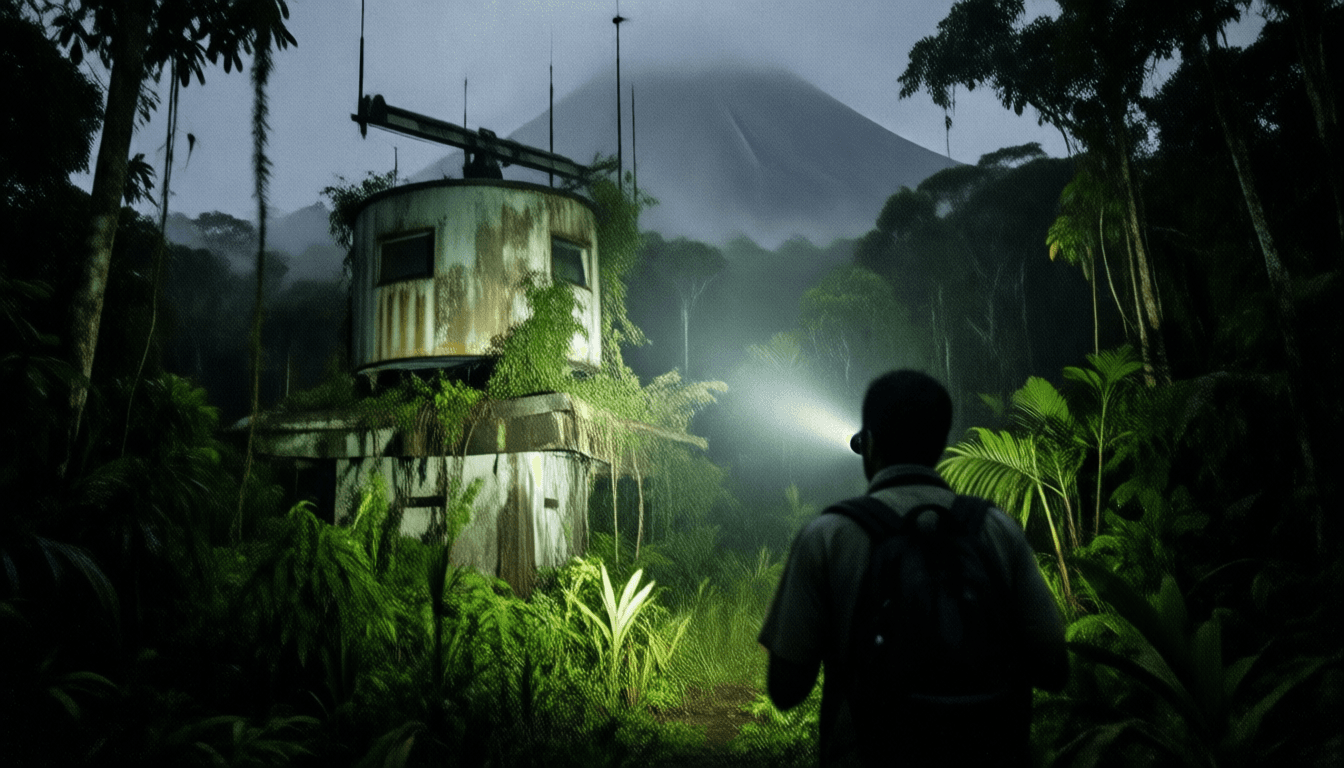
My initial objective was reconnaissance and data collection in the volcanic interior of Umboi Island, specifically near the dormant Mount Manam. This region had historically yielded the most concentrated and compelling reports of the Ropen, particularly concerning the creature's luminous properties. After securing difficult passage, I established a makeshift, camouflaged base camp adjacent to a weather station that had been abandoned for decades and now stood overgrown. The station itself was a testament to failed human persistence—rotting equipment, rusted instruments, and the silent, encroaching jungle. The air was thick and humid, a suffocating blanket descending from the dense canopy. The incessant hum of unseen insects formed a constant backdrop, broken only by the rhythmic crash of unseen waves in the distance and the occasional piercing cry of an exotic bird. I began a systematic grid search, focusing on elevated observation points and natural clearings. Primary targets included the identification of large nesting sites, unusual scat, or any disturbance consistent with a creature of significant mass. The isolation was intense, my only companions the steady whir of a portable generator and the rustling secrets of the jungle itself.
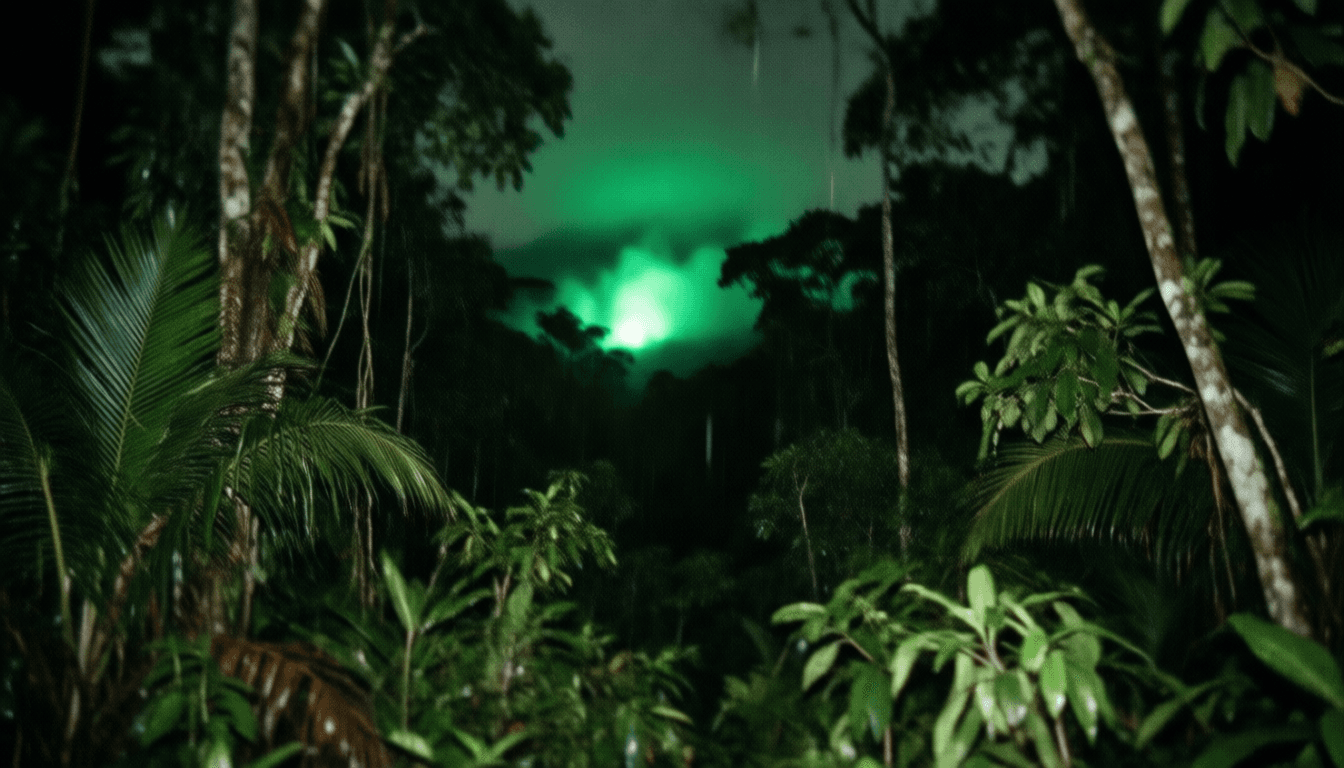
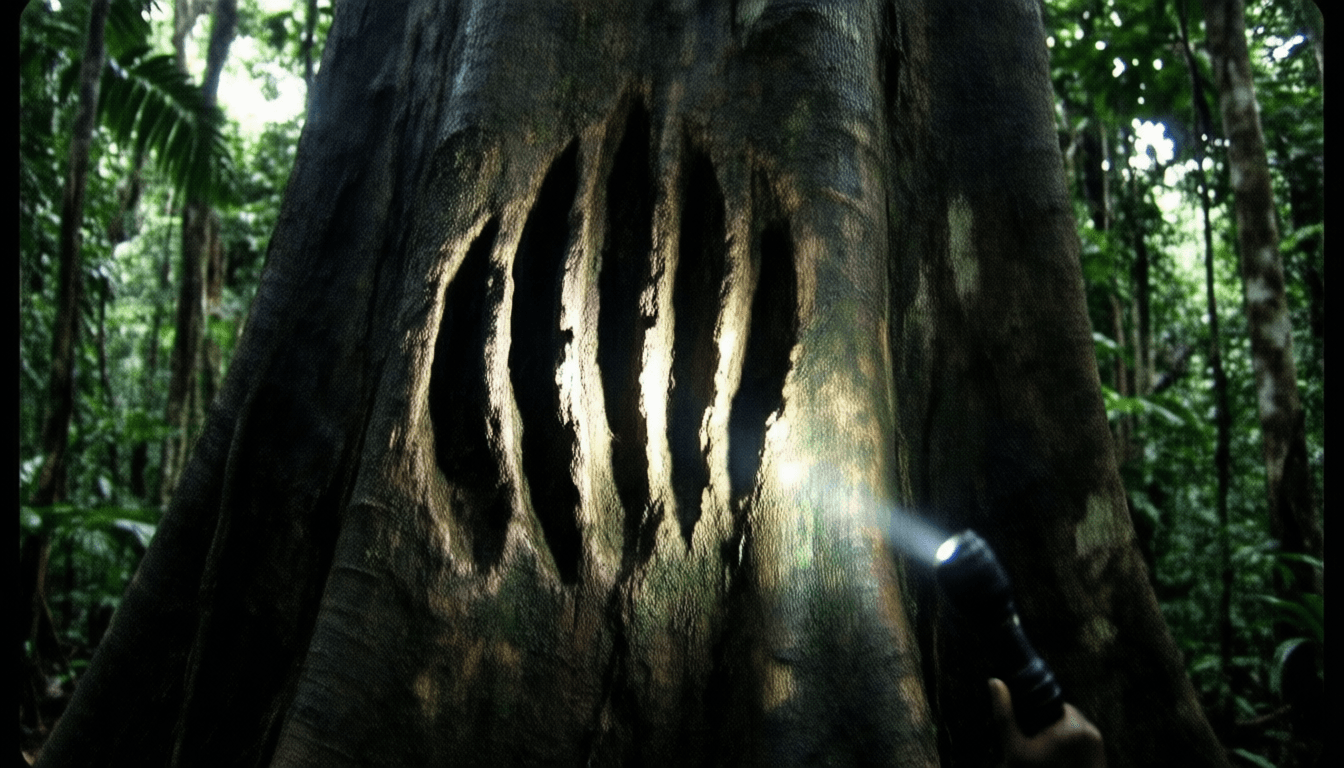
The first anomalies were subtle, easily dismissed as environmental fatigue or an overactive imagination. At night, there was an unnatural cessation of ambient jungle sounds—not a sudden silence, but a slow, deliberate dampening, as if the usual symphony of insects and nocturnal creatures was holding its breath. This was then followed by a faint, distant *humming*—not like thunder, but more akin to a low-frequency vibration transmitted through the ground. My compass began to exhibit inexplicable, intermittent deviations, often pointing subtly north throughout the night, distinct from localized magnetic anomalies. On the fourth day, I discovered deep, irregular grooves in the upper bark of an ancient Kapok tree, too high and wide to have been made by any known arboreal animal. The edges were clean, almost surgically carved. Then, on moonless nights, a faint light flickered in the distance. Intermittent emerald flashes blinked into existence for brief moments on the distant slopes of Mount Manam. Not a distant burning fire, nor the momentary luminescence of bioluminescent fungi. It was too deliberate, too organized, appearing and disappearing with an eerie intelligence, lingering just long enough to confirm its presence before vanishing back into the impenetrable darkness. A faint, metallic, almost ammoniac smell began to permeate the air around my camp—subtle, but persistent, and utterly alien to the usual earthy scent of the jungle.
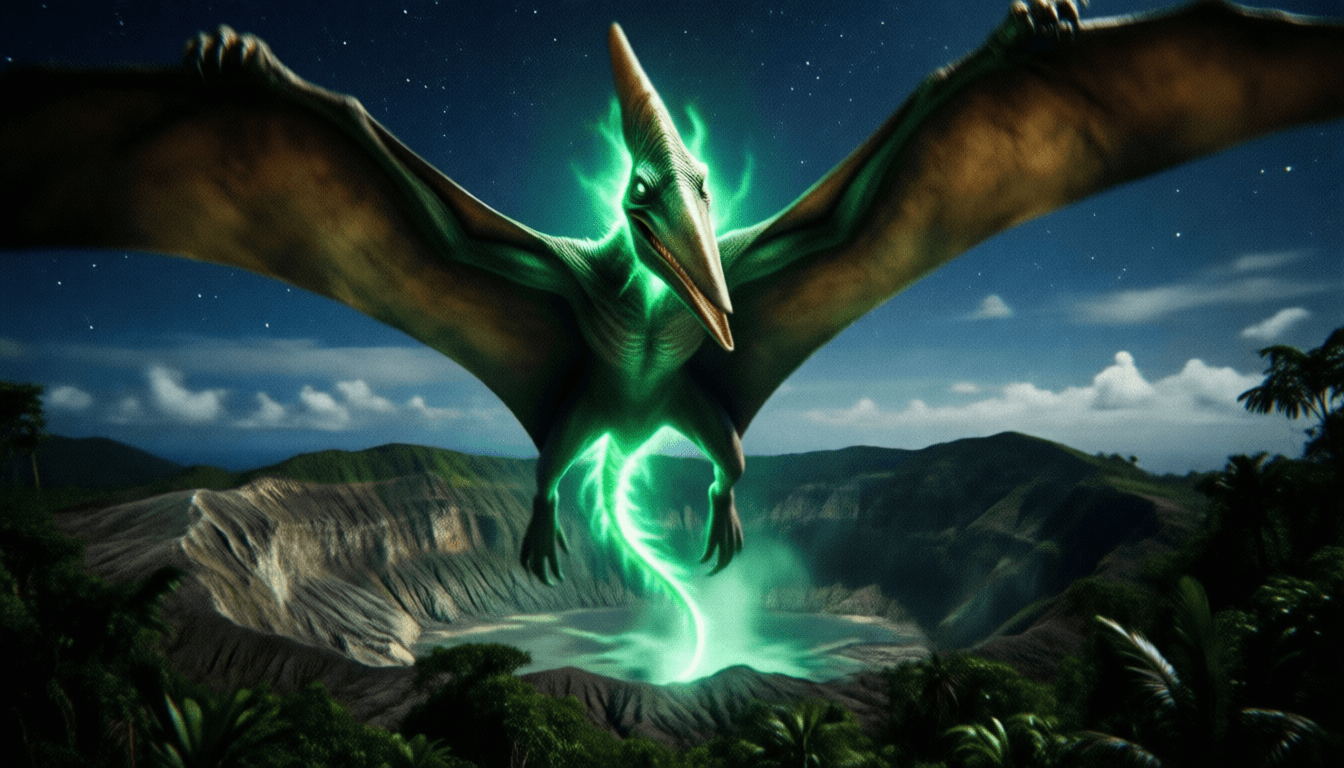
Following the increasingly potent and nauseating odor upwards, I reached a rugged caldera, a natural amphitheater of ancient rock and twisted roots. The air grew heavy and still, the atmospheric pressure almost crushing. Above, the pale stars, like a torn canvas, were revealed for the first time. It was then that the true anomaly began. An impossibly deep, low, guttural scream tore through the silence. It did not echo. Instead, it seemed to *resonate* from the very rock walls around me, vibrating through my teeth, bypassing my ears to invade my skull directly. And a colossal shadow detached itself from the caldera rim. Not flying up, but *descending*. It moved with unbelievable silence. Its massive, leathery wings displaced no air, creating no discernible sound as it dropped. Silhouetted by the faint starlight, its bulk was immense beyond my imagination, its form unmistakably that of an ancient pterosaur. As it drew closer, the emerald flashes I had seen at a distance now burned with intense brilliance at its head and the tip of its tail—not a diffuse luminescence, but a concentrated, burning light that seemed to *absorb* the ambient starlight, generating a mass of absolute, unnatural darkness around it.
Suddenly, a powerful, unseen force struck me from behind and above. I wasn't directly hit, but the sheer velocity of the creature's passage had created a localized storm, an unseen wave that tore at my equipment and slammed me against jagged rock faces. My vision blurred. A searing pain in my ribs accompanied a sickening crack, and the taste of blood filled my mouth. My dislodged headlamp skittered across the ground, its beam spinning wildly before coming to rest on a bizarre, enormous claw print embedded deep in the soft earth, mere inches from my face—each toe thicker than my arm. The creature, now a huge, pulsating emerald blur in the darkness, shrieked again, the sound physically *pushing* against my eardrums. I was trapped, pinned by fallen debris against the rock, my leg twisted. Its immense, webbed foot descended slowly, deliberately towards my position. I could feel the heat radiating from the glowing form, the noxious, metallic scent in the air. This was no bird, no bat, no misidentification. It was an entity that warped the very atmosphere around it, moving with silence and unbelievable grace, now directly above me, its luminous eyes fixed on my prone form. My escape was an act of desperate, almost instinctual savagery. I thrashed, pushing away debris, rolling into a narrow crevice. The massive claw landed inches from my exposed skin, leaving a burning, acrid imprint on the rock where I had lain. The subsequent ascent was likewise soundless, leaving only a sustained internal vibration and the faint smell of burning.
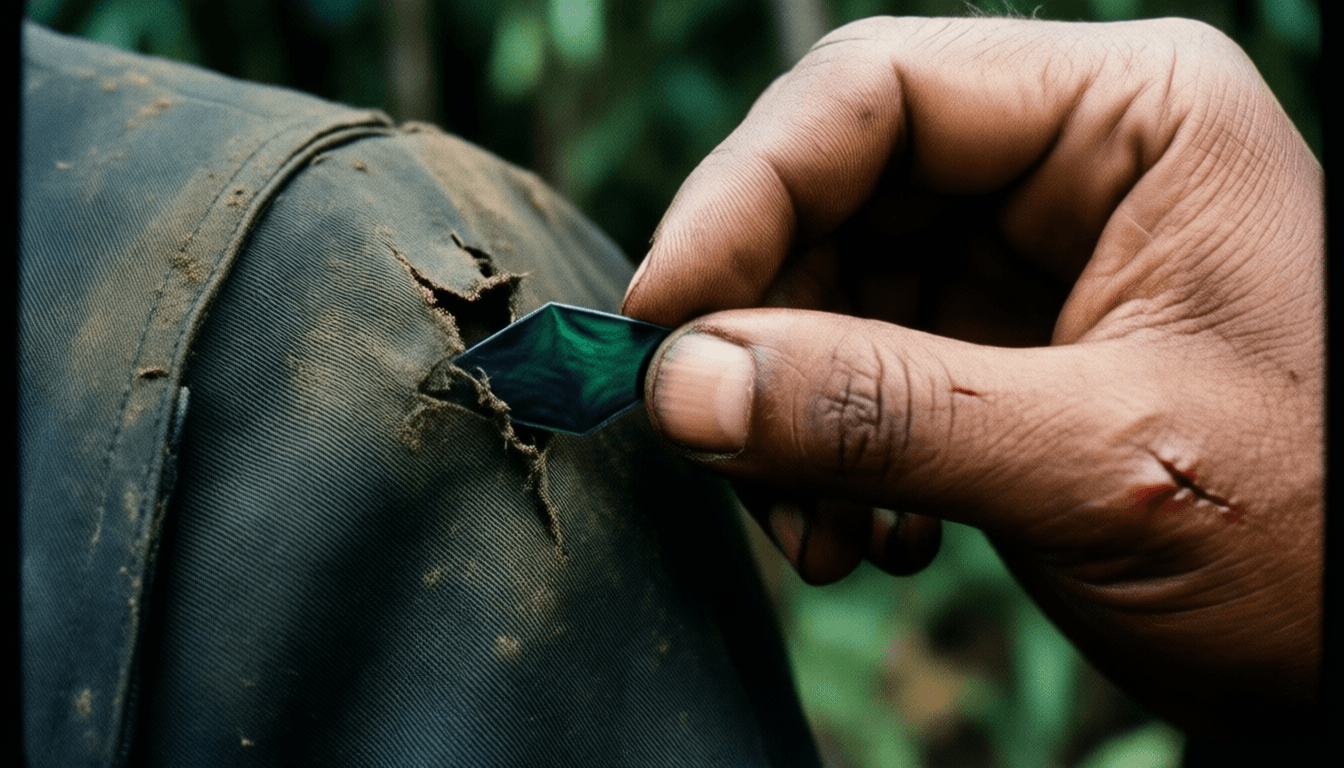
I returned to the coast days later, a broken wreck, barely coherent, consumed by adrenaline and primal terror. The journey was a blur of pain and disorientation. My ribs were fractured, my leg badly sprained, most of my expedition gear destroyed. The most immediate, and perhaps most shocking, evidence was not what I collected, but what was *found* on me. Tucked into a torn jacket sleeve, beneath dried blood and smears of dirt, was an impossibly thin, almost translucent scale. Roughly rhomboid, slightly larger than a thumbnail, it shimmered with an iridescent quality, shifting from deep emerald to obsidian with changes in light. It resembled no known animal's epidermal structure. My field recorder had miraculously survived, albeit cracked and water-damaged. When I finally extracted the data, it yielded long stretches of silence, followed by a raw, unidentifiable audio file—a guttural shriek, overlaid with a strange, low-frequency hum that seemed to distort the recording itself. I listened to it repeatedly, clinically dissecting the impossible harmonics. The sound itself was a physical memory of pressure in my skull. I filed no official report, submitted no urgent findings. Instead, I carefully cataloged the scale fragment into a sealed container for my private archives, placing it alongside the damaged recorder. The incident itself was simply logged as “Exposure to Ancient Atmospheric Anomaly and Subsequent Physical Trauma; Equipment Failure.” The true horror was not just what I had seen, but the realization that our meticulously categorized world is built upon a foundation of ignorance. The 'extinct' are not gone. They are merely beyond our current methods of observation, capable of warping reality for their own incomprehensible existence, indifferent to our precarious hold on truth. The gaps in the fossil record, I now understood, were not gaps in knowledge, but warnings we had failed to heed.
[ CLASSIFIED VERDICT ]
[ACCESS LOG - SOURCE FILE]
The Ropen of Papua New Guinea is an unidentified flying creature that has long been part of cryptozoological records. This giant winged creature, often described as strangely glowing, is sighted in remote areas like Umboi Island and is believed to have characteristics similar to a living pterosaur. While local residents and explorers consistently report sightings, official scientific evidence remains scarce, leaving it a mystery.