Mae Nak's Bone: A Digital Footprint
Digital footprints often linger far more persistently than physical records. In late 2022, a peculiar thread resurfaced on an online forum called ‘Oriental Antiquities Research Society’, frequented by academic historians and Southeast Asian artifact collectors. Originating in 2007, this thread detailed rumors circulating in the black market about ‘Phra-Kraduk-Na-Pak’—a fragment of a forehead bone rumored to belong to Mae Nak Phra Khanong, the legendary ghost of Bangkok’s Khlong Phra Khanong. The thread concluded with a warning from an anonymous user, ‘SiamScholar’, about “the volatile energies surrounding such relics.”
The thread had regained traction due to recent additions:
- “Charoenrat” (December 14, 2022): “The bone has reappeared. Last sighted among merchants near Wat Mahabut. There’s trouble on the Khlong. Boats sinking for no reason, unseasonal localized floods. Be careful.”
- “WatKeeper” (January 2, 2023): “My cousin, a fisherman near Soi 28, says the water next to his house flows *backward* every night. And the reflection on the surface… is never his own.”
- “GhostHunterBKK” (January 18, 2023): “Investigating. A stilt house on the north bank, just before the old industrial port. Owner vanished, locals avoid it. Something is calling… Stay far away.”
These were not mere anecdotes. They were disturbingly specific reports, consistently mentioning anomalous water phenomena and an abandoned stilt house, focusing on a particular bend in Khlong Phra Khanong. However subtle, the pattern demanded observation.
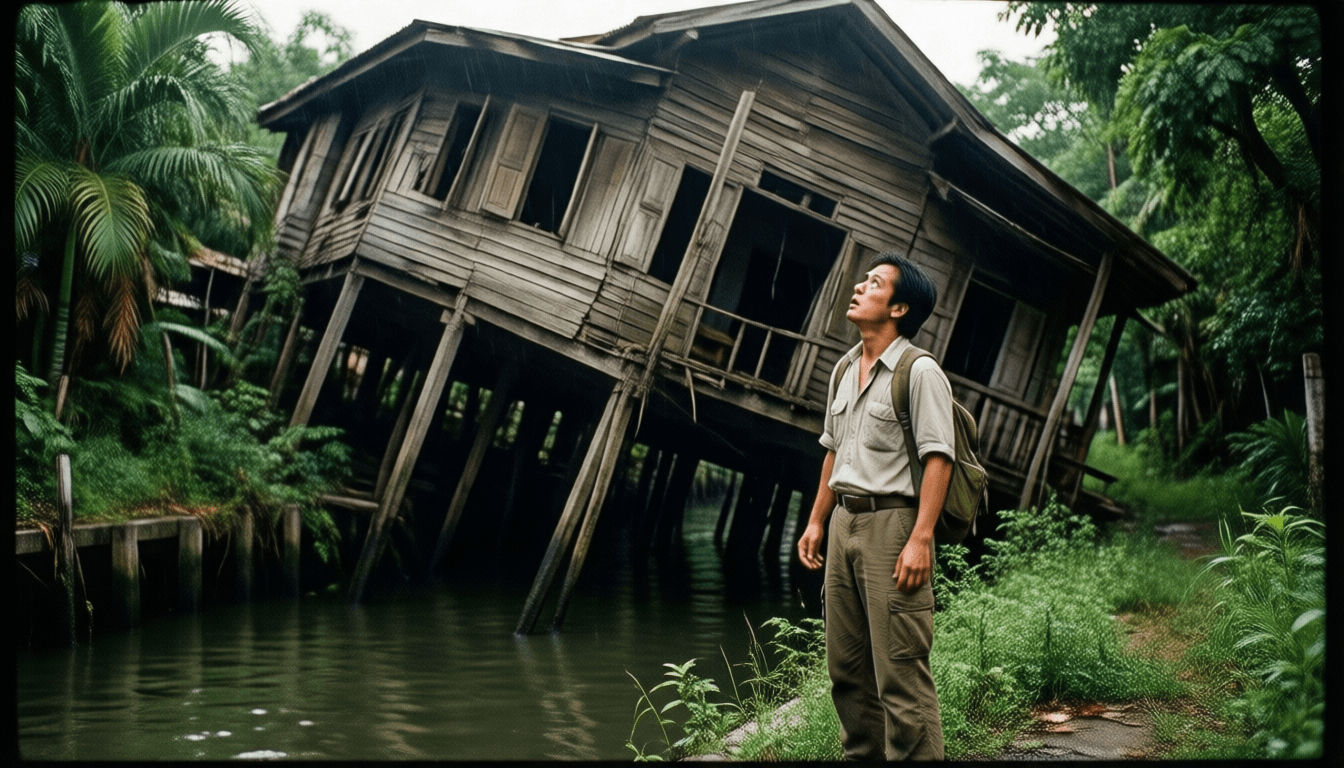
Driven not by superstition but by academic curiosity, I headed to the address in question. It was a rotting wooden stilt house. Its back veranda jutted out over the notoriously murky Khlong Phra Khanong. Bangkok’s suffocating humidity lay like a heavy blanket, thick with damp heat, stagnant water, and the faint, sticky smell of ambiguous organic matter. This stretch of the canal was eerily silent, a stark contrast to the city’s cacophony. Even the distant hum of long-tail boats sounded muffled, as if absorbed by the dense air.
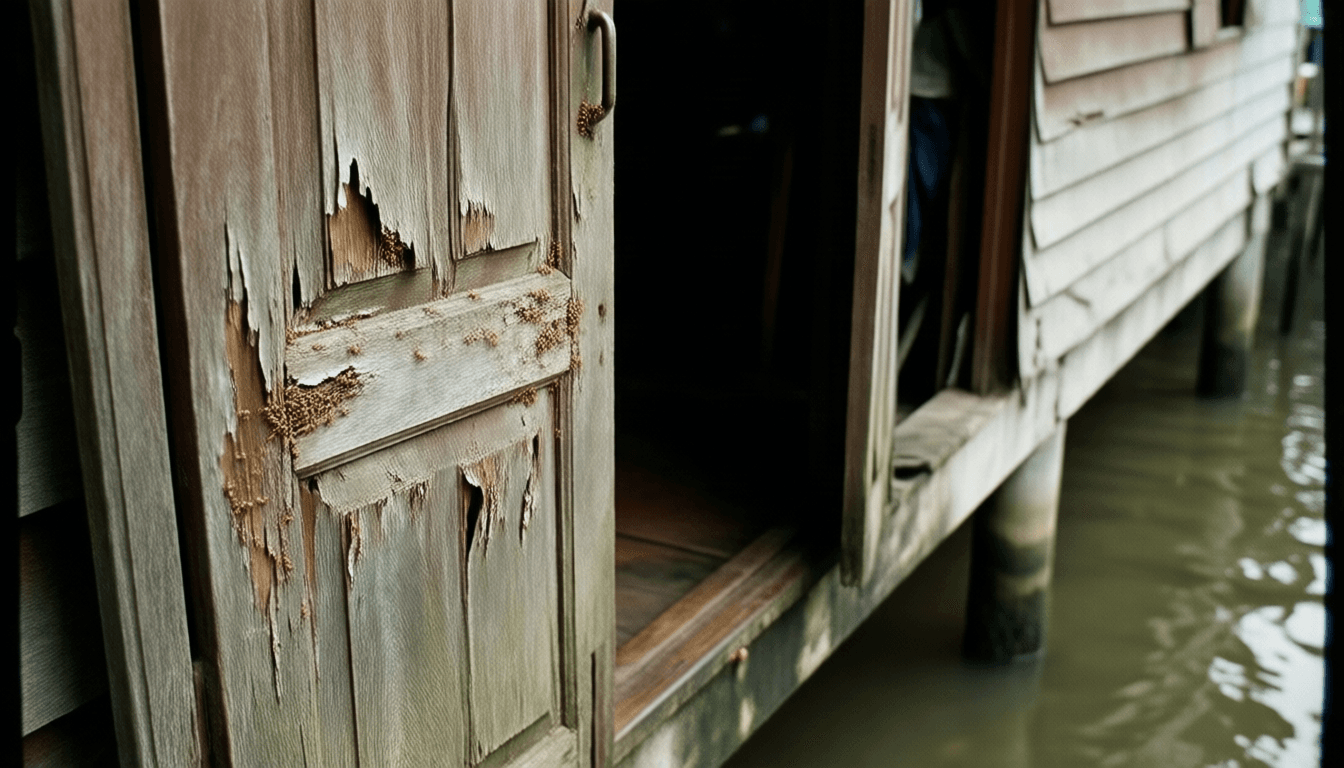
Entry was easy. The front door, half-eaten by termites and age, hung ajar. Stepping inside, dust motes danced in the slivers of sunlight filtering through grimy windows. The house was devoid of valuables, yet not entirely empty. Faint marks on the floor indicated where an altar once stood. The air was thick and still, and despite the oppressive heat outside, a localized chill permeated the central room. My footsteps on the creaking floorboards either echoed unnaturally loudly or, at times, seemed not to echo at all, as if absorbed by the humid air. Through cracks in the floor, I could see the slow, dark green water of the Khlong below. The water was moving. Slowly. But was it flowing *upstream*? I rationalized it away as an illusion, a whim of the current.
In the central room, near the altar’s trace, the chill became more pronounced. A faint metallic scent mingled with the smell of decay. As I surveyed the empty space, a faint rustle, like dry leaves scuttling across a tiled floor, seemed to brush my ears. Indistinct and formless, yet undeniably present. I checked my recorder. Nothing registered.
The reflections in the dark canal water visible through the floor cracks began to waver. Indistinct shapes, like limbs, momentarily coalesced and vanished. Then, a slow, rhythmic ‘drip… drip… drip…’ sound began, emanating from the ceiling. I looked up. No water stains, no visible source. The sound continued. Rhythmic, just out of perceptual reach, as if resonating *within* the wooden planks.
One of the floorboards near the empty altar trace slowly depressed, then rose again, as if no weight had been applied. I approached it, examining the warped wood. As I leaned closer, a sharp gust of wind, cold and faintly smelling of jasmine and decay, suddenly swept through the room. This, despite all windows and doors being closed or undisturbed. The wind carried fragmented sounds: a woman’s drawn-out sigh, and almost unintelligible gurgles, like a baby’s babble. The sounds vanished instantly, and the oppressive silence became even heavier than before. My rational mind struggled. Old house settling, drafts, external sounds carried by the wind. But the localized chill and the specific nature of the sounds defied easy explanation. The air itself seemed to be listening, waiting.
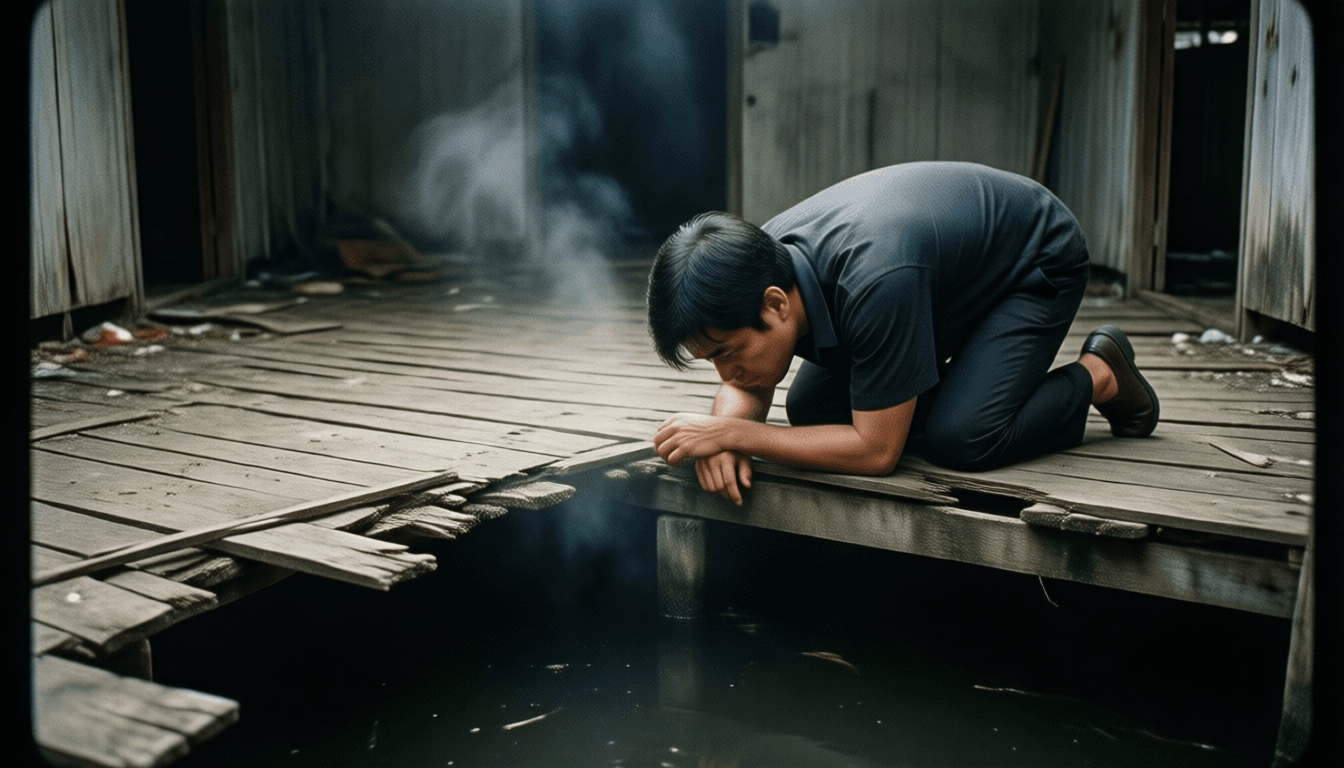
I found it beneath the loosened floorboard near the altar. Not the bone itself, but a small, intricately carved wooden box, the size of a fist. The box was empty. A deep, ancient residue of organic matter clung to the dark wood. The bone had clearly been here. And it was gone.
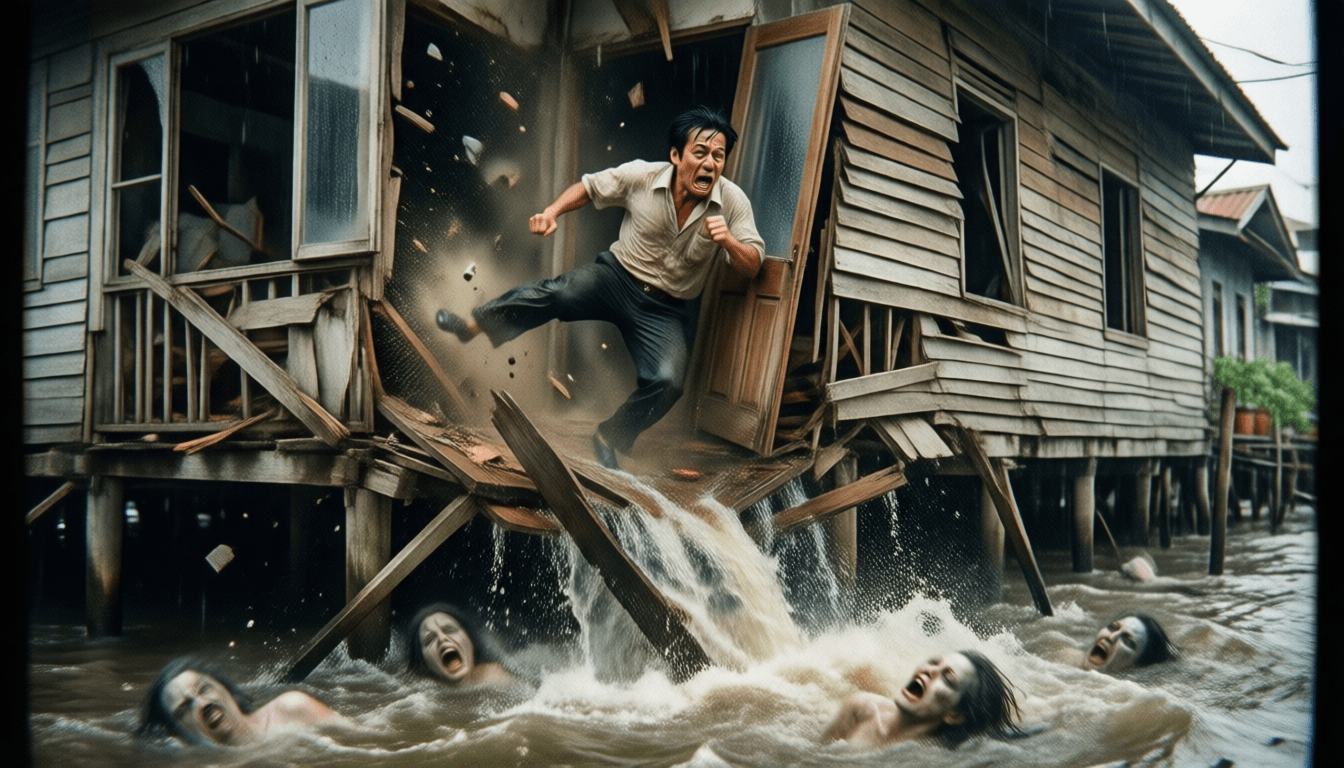
The moment my hand touched the empty box, the entire house seemed to groan with a deep, resonating sound. It vibrated through the floorboards to my feet. The canal water directly beneath the house suddenly began to churn violently. Not the gentle ripples of a passing boat, but a frantic turbulence surging from within. The water rose rapidly, slamming against the wooden pillars, threatening to engulf the lower floor. The reflections on the swirling surface were no longer indistinct. Distorted, pale faces, gaping mouths with silent screams, appeared and vanished in the chaos. As if being pushed up to the surface *from below*.
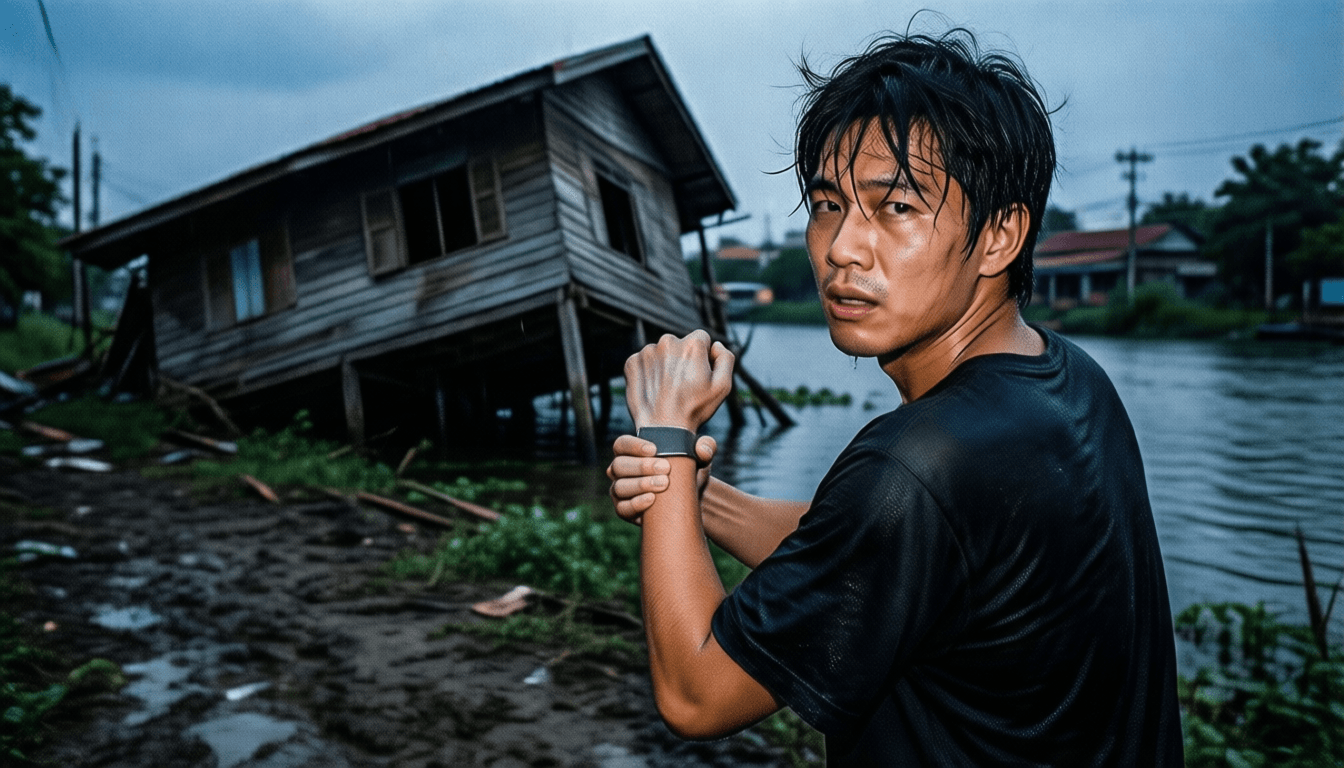
The house began to collapse. A central support beam cracked with a sound like a rifle shot, sending dust and debris showering down. The very physics of the structure seemed to defy reality. The door I had entered through slammed shut with incredible force. The old wood shrieked against the frame, impossibly jammed. I struggled with all my might to push it open. My hand brushed against a splintered piece of wood, and one section was impossibly, intensely cold, like grasping ice. For a fleeting instant, a sensation like a bony grip tightened around my wrist, leaving a searing, freezing trail of pain.
The stairs leading to the back veranda crumbled with a sickening groan. Not under my weight, but as if pulled down by an unseen force. I was trapped on the upper floor as the entire structure twisted and groaned under unseen pressure. I rushed to a window, frantically trying to open it, but it too was sealed, fused. The water below rose even higher, now level with the floorboards, its surface reflecting my terrified face along with grotesque, ephemeral shapes beneath the surface. The house was being deliberately torn apart by something unseen. And I was inside it. I was no longer an observer. I was prey.
In a desperate surge of adrenaline, I kicked out at a rotting window frame overlooking the main Khlong. Glass shattered inwards. The impact on the rotten wood caused a larger section of the wall to give way. Scrambling through the newly formed gap, I tumbled into the dark, churning water below. The impact was jarring, the current fierce. As I gasped and struggled to surface, the house behind me let out one last, deep, resonant sigh.
Having finally dragged myself onto the canal bank a hundred meters downstream, soaking wet, bruised, and shivering despite the heat, I looked back. The old wooden house stood precariously tilted. The front door was still impossibly shut, the shattered window looking like a gaping mouth. But the churning water beneath it was now eerily calm, reflecting the twilight sky in an unnatural stillness. As if the storm had never been.
A deep, bone-chilling cold permeated my right wrist where I had felt the grip. The skin was abnormally pale, almost translucent, as if frozen from within, and the chill spread deep into my bones. Later, when I peeled off my wet shirt, a small, black stain clung to the fabric near the collar. It was organic, brittle, and strangely shaped. Too small to identify, yet unlike any dust or debris from the old house. It carried a faint, indescribable scent.
Days later, back in the quiet, sterile confines of my archive room, the cold in my wrist remained. A steady, dull ache that no heat would dissipate. Then an email notification pinged. Another post on the ‘Oriental Antiquities Research Society.’ It was ‘SiamScholar’ again. “The bone has reappeared. Phuket. Reports of fishing boats disappearing in clear waters, inexplicable fogs at midday, and a pervasive silence over the sea near a specific cove. The cycle continues.” The stain on my shirt was gone. But the bone-deep cold remained. And now, my reflection in windows or polished surfaces, very subtly, momentarily seemed to flicker, then return to its familiar form. I was no longer alone.
[ CLASSIFIED VERDICT ]
[ACCESS LOG - SOURCE FILE]
Mae Nak Phra Khanong is a famous Thai legend from Bangkok about a woman who died during childbirth while her husband was away at war. Her spirit refused to depart, waiting for her husband, and was said to harm anyone who tried to reveal her death to him. Her forehead bone fragment is particularly believed to possess powerful supernatural abilities.