Loch Ness's Abyss: The Curtain of Urquhart
Document Reference: UL-77B-04
Recorder: A. Davis
Subject: Loch Ness Sonar Anomaly, "The Urquhart Veil"
Status: Investigation Ongoing
Most serious exploration of the Loch Ness phenomenon ended on October 10, 1987. During ‘Operation Deepscan’, 24 boats formed a sonar curtain, sweeping the entire lake – a definitive attempt to put the legend to rest. They recorded three significant contacts. The strongest, “Contact 7,” was described by the chief sonar engineer as “far bigger than a seal, bigger than a whale.” This object was tracked for over two minutes before plummeting to a depth of 600 feet and disappearing. The official report noted it as an ‘Unidentified Moving Object.’ For decades thereafter, there were no comparable results.
As a record keeper, the story should have ended there. A historical curiosity.
But three months ago, I received a data file from an informant on a geological survey team studying the Great Glen Fault. They were mapping the lakebed’s sedimentary layers using low-frequency sonar. The file contained a single, corrupted data point recorded from a trench near Urquhart Castle. It wasn't a moving object. It was a section of the lakebed, approximately 50 meters in diameter, from which no signal returned. It wasn't a cave or a fissure. The sonar just… stopped. Like a hole in reality. The original data had a single technician’s panicked annotation: Acoustic blackspot. Impossible.
That is why I am here. The monster legend is merely a smokescreen to divert attention. The truth lies within the very physics of this place.
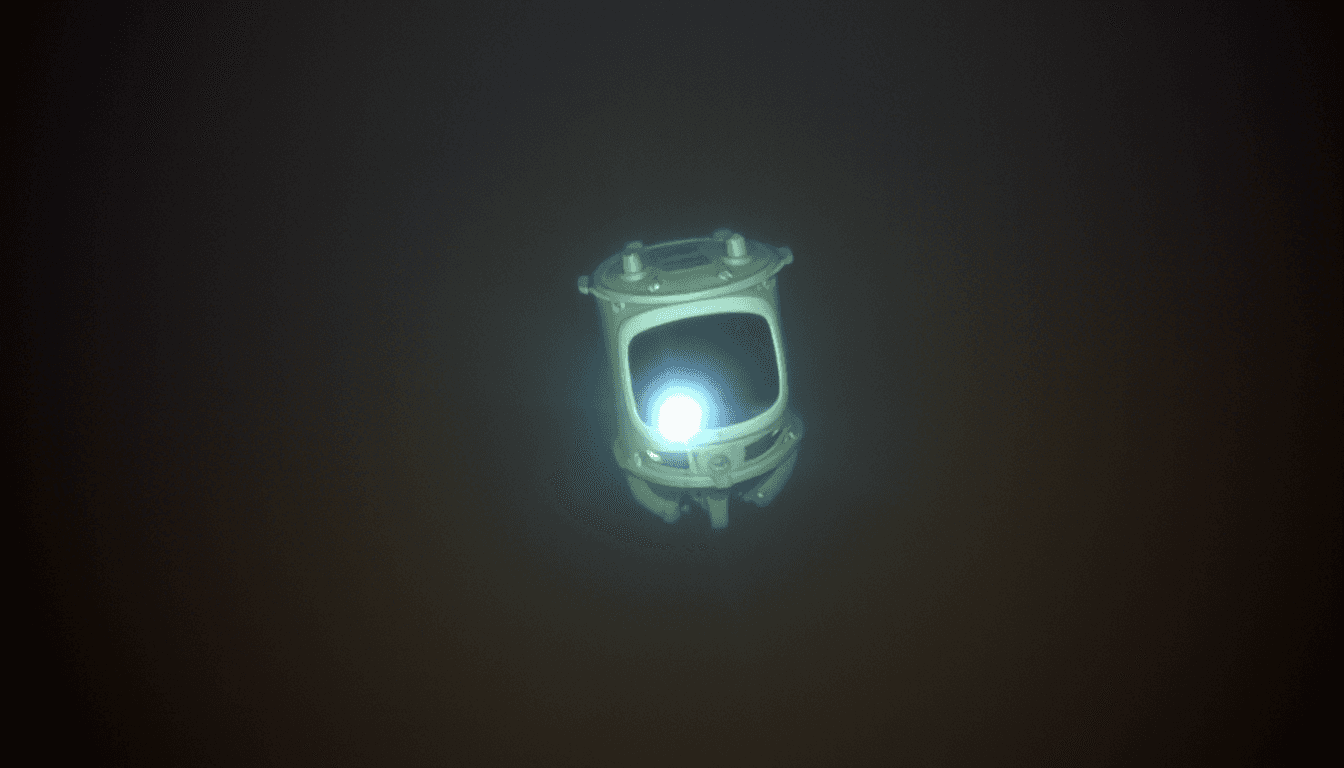
The submersible was a 'Triton 3300/1' model, a cramped acrylic sphere barely accommodating a pilot, myself, and an observer. The descent was disorienting. Surface landmarks like green hills and the gray stones of the castle quickly vanished. The water wasn't blue or green; it was the color of weak tea, stained by millennia of peat. By 100 feet, the external lights merely illuminated swirling clouds of brown sediment. We navigated solely by instruments.
"Pressure equalized. Descending to 650 feet." Pilot Harris’s voice was even – the essential calm of a former naval diver in this claustrophobic space.
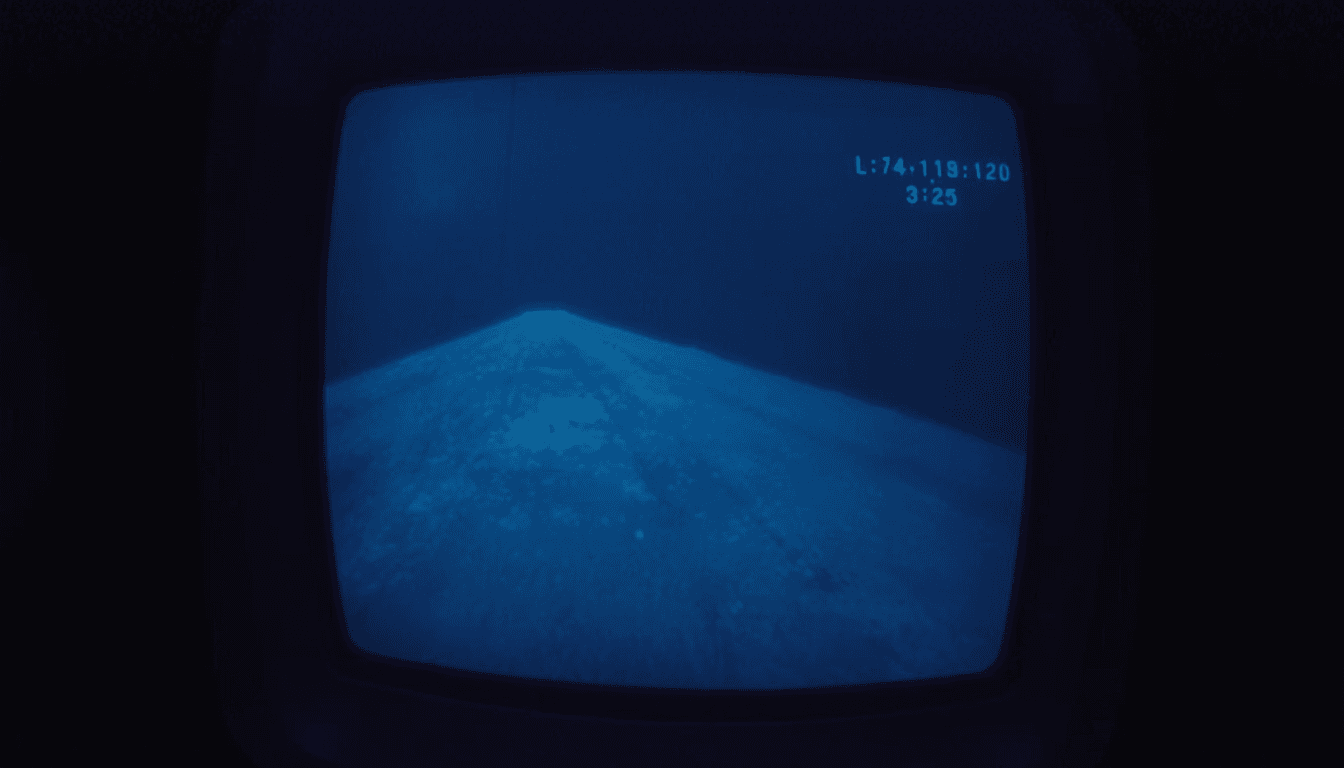
Our target was the coordinates sent by the geological team. The submersible hummed softly, a constant reassurance of life. The sonar screen, our only window, painted the unseen world in green and black phosphorescence. The lakebed was a gentle slope of mud and rock. It appeared barren, devoid of life.
"Approaching coordinates," Harris said. "Forward sonar clear. Nothing unusual on screen."
He was right. The screen showed only a monotonous slope. But according to my research, the acoustic blackspot should have been directly ahead.
"Hold position," I instructed. "And switch off active sonar. Go to passive hydrophone mode."
The rhythmic ping… ping… ceased. The silence that replaced it had a physical presence. The hum of the submersible’s life support felt insultingly loud. There were no clicks of crustaceans, no shifting of rocks. Such perfect silence was unnatural.
We drifted for five minutes in the unnatural quiet. I watched the hydrophone monitor, measuring ambient noise. The baseline was almost zero.
Then, something flickered on the screen. A low-frequency waveform, too regular to be a geological phenomenon. It wasn't a call or a cry. The sound, through my headphones, was like something wet slowly tearing. It lasted three seconds, then vanished.
"Did you hear that?" My voice was strained.
"Nothing on my comms," Harris replied, still focused on his navigation controls.
Before I could play him the recording, the submersible suddenly tilted. Not a violent lurch, but a gentle, sustained pull. I looked at the thruster controls. All read zero.
"We have a current," Harris's voice held confusion. "A very strong one. It's pulling us down the slope."
He engaged the vertical thrusters to compensate. They whined in protest. The depth gauge, which had held steady at 657 feet, began to creep downwards. 658. 659.
"Thrusters at 70 percent," he grunted. "Still descending. The water feels… viscous."
The external thermometer began to drop. Not by whole degrees, but by tenths. A slow, steady absorption of heat that defied physical explanation. Ambient water temperature should have been a uniform 4 degrees Celsius. But now it was 3.8… 3.7… Then the hydrophone picked up the sound again. Closer this time. It was the sonar ping we had sent out minutes ago. A perfect mimicry, yet subtly distorted, as if passing through wet flesh.
Ping… the sound our system had sent.
…Ping… now the water whispered it back.
"Look there," Harris pointed at the forward sonar screen, which he had reactivated. "The bottom."
On the screen, at the exact coordinates of the acoustic blackspot, the lakebed's outline shimmered. It wasn't a creature. It was the mud itself. Moving in slow, concentric ripples, like a vast underwater diaphragm.
As the submersible’s lights illuminated it, the entity became clear. It wasn't mud. It was an enormous membrane, densely interwoven with countless fine, black fibrous strands, perfectly mimicking the lakebed. It was breathing.
"My God," I whispered.
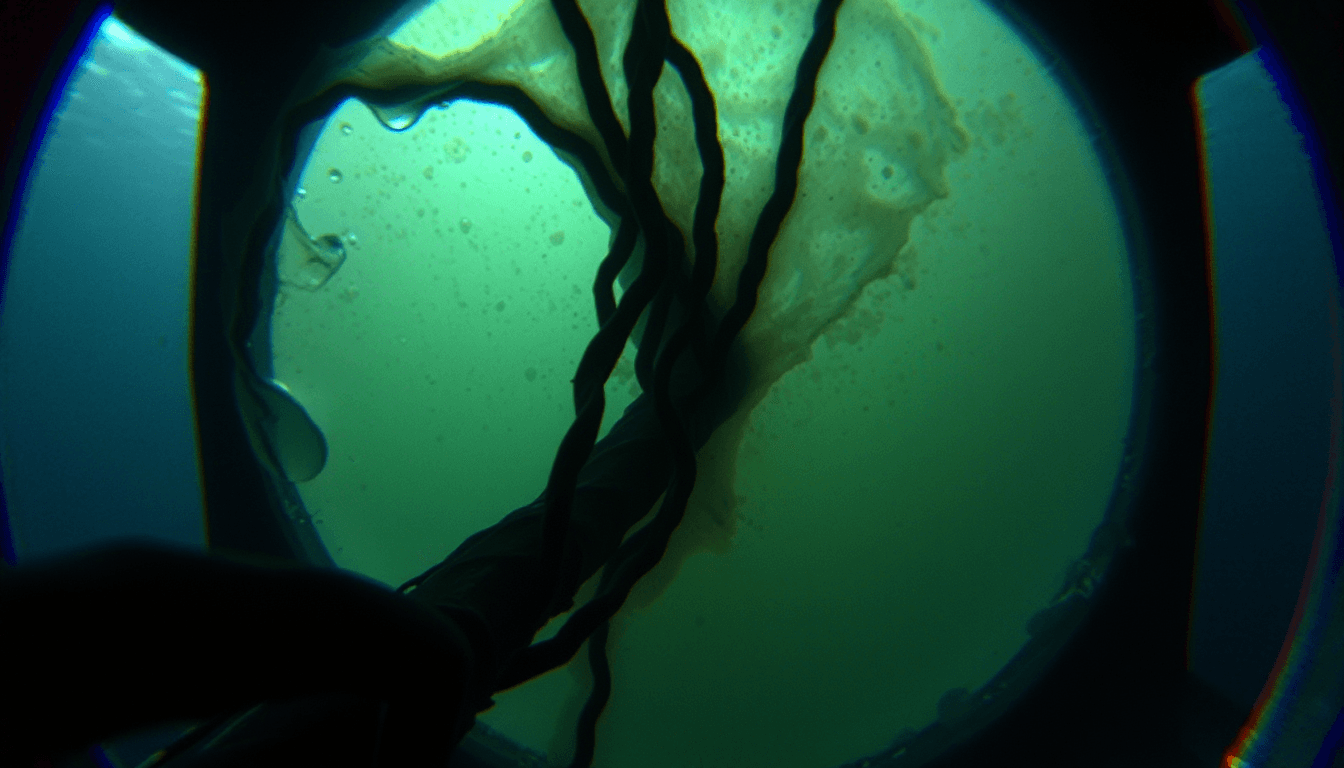
Before Harris could react, a section of the membrane detached. It wasn't violent. It was fluid, like seaweed carried by a current. It wasn't a tentacle. It was a rope, braided from the same black fibrous strands, and it approached our observation viewport with an unnerving calm. It didn't seem hostile. Only curious.
It touched the viewport. No sound, no impact. The braided tendril simply rested against the five-inch-thick acrylic. For a moment, nothing happened.
Then, a single droplet of water formed on the inside of the viewport.
Harris saw it too. "Impossible. The seal is…"
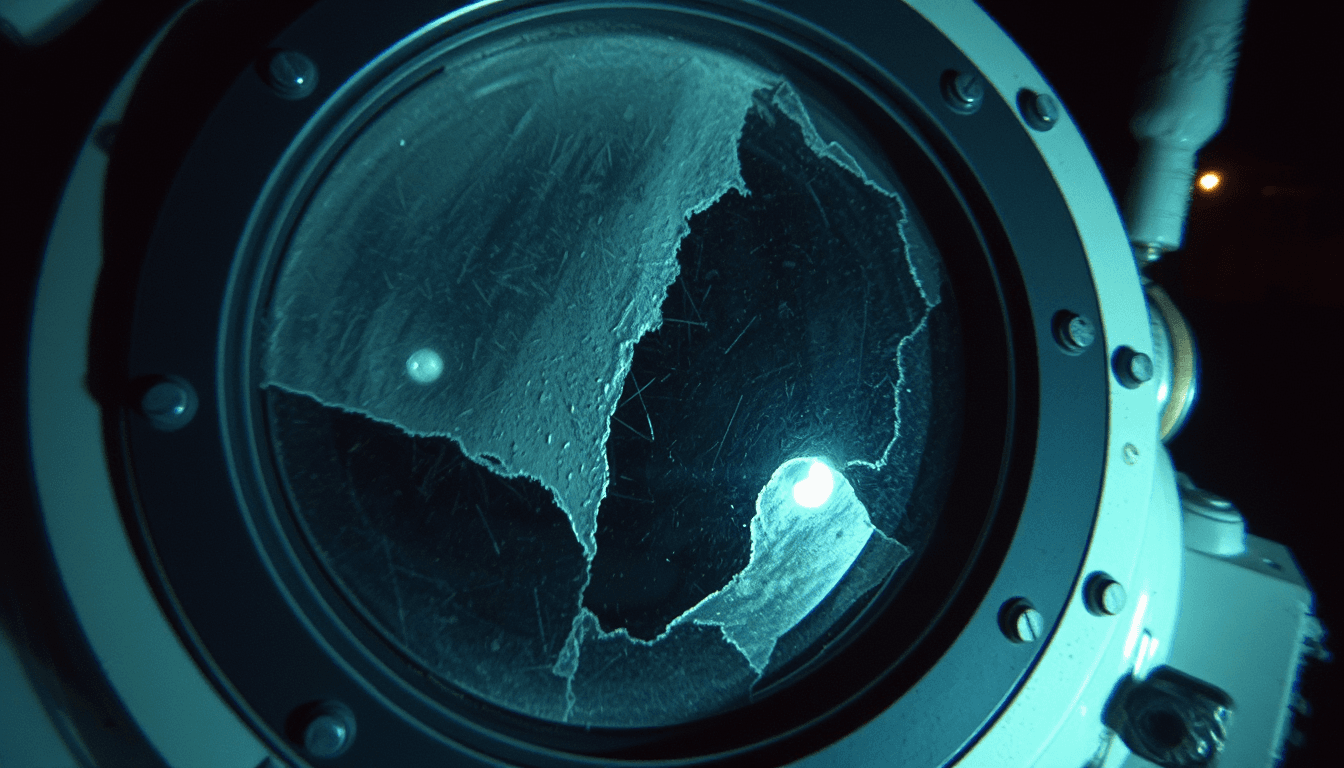
Another droplet formed beside it. I pressed my face against the acrylic, staring. The point of contact was changing. The acrylic wasn’t cracking or fracturing. It was becoming milky, porous, as if its structure was dissolving, turning into something like a spongy material. The external fibrous strands weren't exerting pressure; they were *disassembling* it. A chemical, biological process that defied physics.
A black trickle of water ran down the inside of the viewport. At this depth, the water pressure was over 290 pounds per square inch. A complete breach wouldn't mean a leak; it would mean an implosion, vaporizing us.
"Full ascent! Now!" I screamed.
Harris slammed the controls. The thrusters shrieked. The submersible shook violently, fighting an impossible suction. The tendril did not let go. More of the membrane surged from the bottom, unfolding vast, black, fibrous sheets that reached for us. The water leaking in was now a considerable stream. Hull integrity sensors began to blare a sharp alarm.
The viewport groaned, a sound of molecular bonds tearing apart. I could see individual fibers pulsating with a faint internal luminescence beyond the glass. They weren't creatures *in* the lake. They *were* the lake.
We escaped. The viewport held, barely. The ascent was controlled panic, and it was only Harris’s skill that kept the damaged submersible from capsizing.
Beneath the harsh lights of the dry dock, the evidence was undeniable, yet inexplicable. The viewport was not shattered. The acrylic where the entity had touched was hazy and, to the touch, soft, like half-melted cheese. Microscopic analysis showed a fundamental unraveling of the polymer chains. Not destroyed, but *digested*.
I have the data logs. The phantom sonar. The recording of the mimicked ping. But there’s one last file from the submersible’s internal sensors: cabin atmosphere analysis from the final moments of ascent. As water entered the pressurized cabin, some of it vaporized into the air we breathed. The spectrometer recorded a surge of unknown complex organic compounds.
The official report will document this as an encounter with an unrecorded deep-sea hydrothermal vent, releasing corrosive chemicals. A geological anomaly. But I sit with the files, staring at the analysis of that water. Those black fibrous strands from the bottom… some of them, in microscopic fragments, came through the dissolving acrylic. They were in the water. They were in the air. I can’t stop this dry cough. My skin feels cold. Sometimes, in perfect silence, I think I hear a faint, rhythmic tearing. I’m not sure if it’s a memory, or if it’s coming from inside me.
[ CLASSIFIED VERDICT ]
[ACCESS LOG - SOURCE FILE]
This story is based on the enduring urban legend of "Nessie," the legendary creature believed to inhabit Loch Ness in Scotland. Drawing inspiration from real records of the 1987 'Operation Deepscan,' which detected a massive unidentified object via sonar, it transcends a mere monster legend to focus on a supernatural and unknown phenomenon hidden beneath the lake. It reinterprets the fear and mystery surrounding the abyss of Loch Ness.