Forest of Screaming Silence
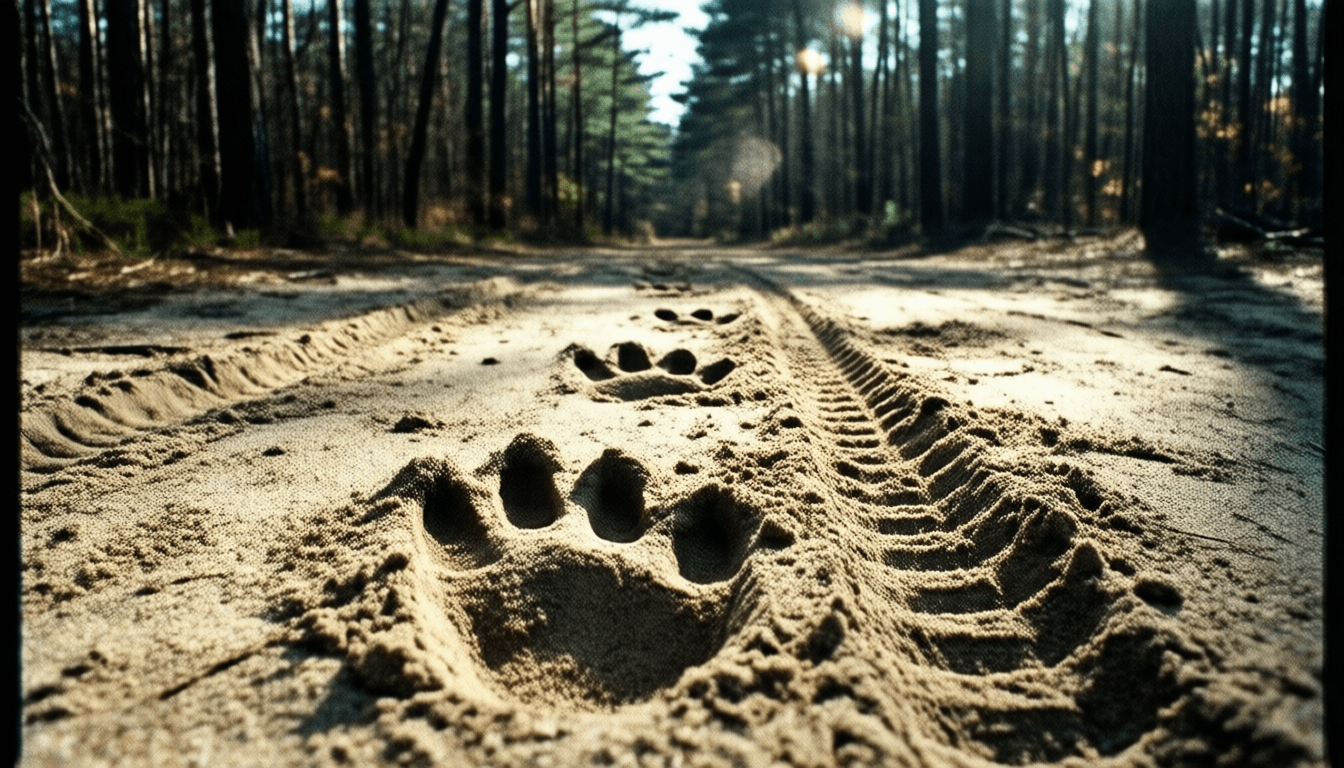
For the past eighteen months, the New Jersey Department of Environmental Protection has reported an inexplicable localized decline in specific pine species within a fifteen-square-mile exclusion zone deep within Brendan T. Byrne State Forest. These trees were not succumbing to disease or pestilence; their internal structures showed rapid, localized desiccation consistent with extreme, sudden shifts in soil pH and moisture content. Concurrently, veterinary forensics in Burlington County documented instances of livestock predation inexplicable by common explanations. Sheep, goats, even small calves—the wounds were precise, almost surgical. Often, despite significant damage, blood loss was remarkably minimal. But the truly remarkable detail surfaced in local hunter forums and police whispers: a recurring footprint pattern, often found near predation sites and tree decay zones, dismissed as misidentified deer or coyote tracks, yet sharing strikingly consistent features. A distinct bipedal stride, three hoof-like impressions far too large for indigenous ungulates, and often faint, parallel drag marks, as if something was being pulled. Yet, it was a recent incident that truly captured my attention. A hunter, missing for three days and found on the outskirts of the exclusion zone, despite severe hypothermia and dehydration at the time of rescue, repeatedly whispered in terror about "water flowing backward" and "screaming silence." He had no head trauma, but a deep, persistent horror.
My objective was clear: corroborate the footprint data and directly investigate the environmental collapse zone. I entered Wharton State Forest at dawn via a known access point near the Wading River, veering off the unpaved path towards the reported anomalous zone. My initial experience of the Pine Barrens was typical: the pervasive humidity, the pungent scent of earth and pine needles, the ochre light filtered through the dense canopy. The ground was deceptive—a mix of soft sand and tightly interwoven roots. I carried standard field recording equipment, GPS, a thermal camera, and a geological survey kit.
The first signs of anomaly were subtle. About two miles in, my GPS signal became erratic, then cut out entirely despite a clear sky. The compass needle spun violently before settling minutes later, pointing almost fifteen degrees off true north, a deviation that persisted even after recalibration. The ambient sounds of the forest—distant birdsong, the rustle of unseen wildlife—receded gradually. The air itself felt heavier, more still.
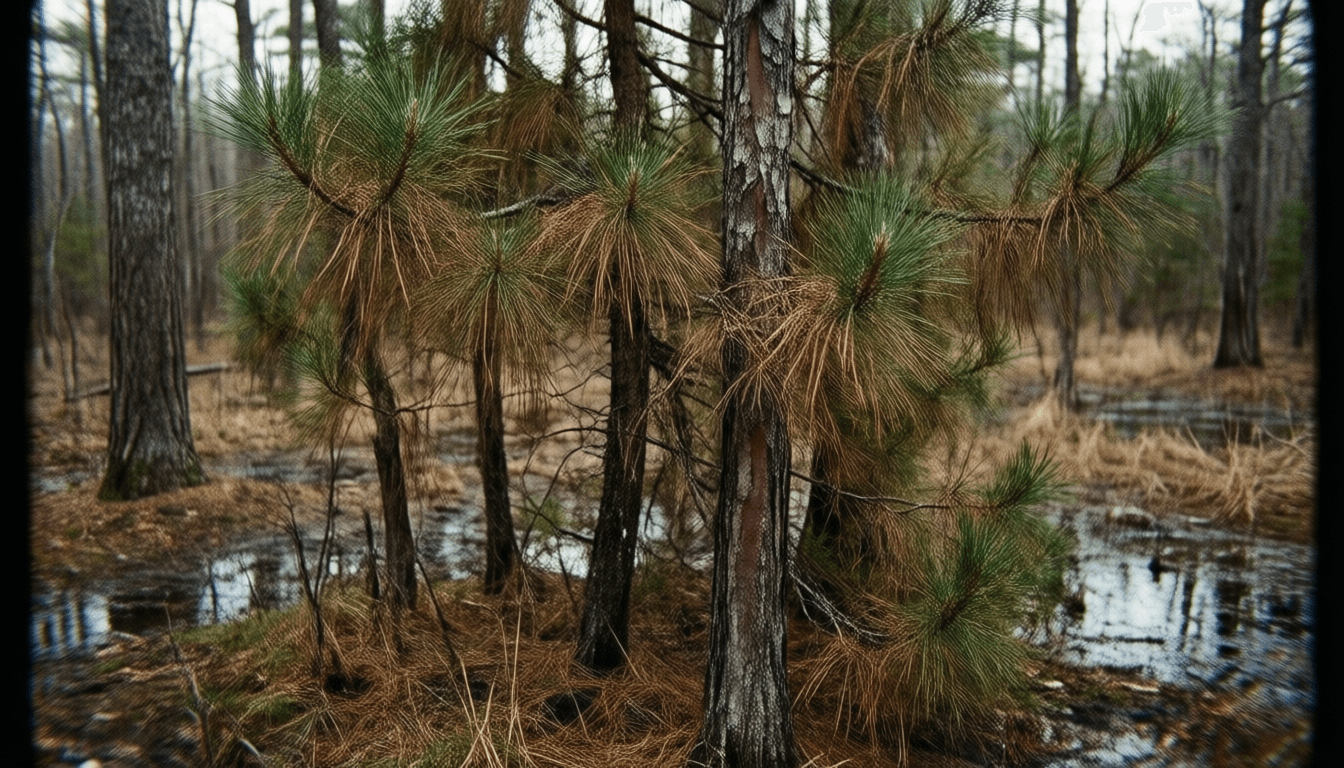
Upon reaching the designated exclusion zone, the visual evidence was immediate and stark. Dwarf pine species, particularly native ones, showed the reported collapse. Needles were brown and brittle, bark was peeling in unnaturally large sheets, and sap oozed from fissures like thin, oily water. The ground beneath was abnormally dry in some places, eerily waterlogged in others, creating bizarre microclimates within feet of each other. And near the most severely affected cluster of pines, I found them. The footprints. Unmistakably bipedal, spaced approximately sixteen inches apart, each impression bore three distinctly separated toes with deep, sharp furrows. The surrounding ground was undisturbed, as if weight had been applied and cleanly lifted, with no soil displacement. There were also faint, but definite, strange parallel drag marks.
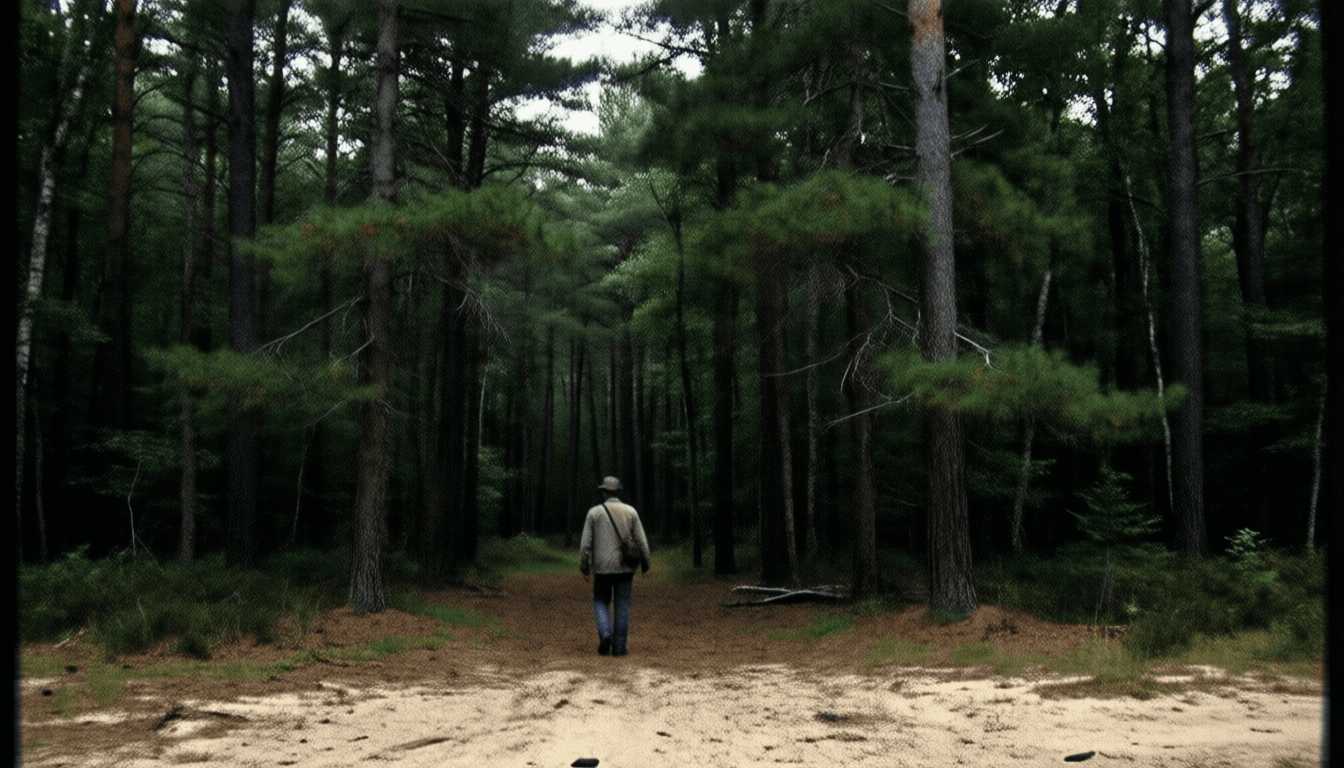
As I ventured deeper, the environmental distortions intensified. An unnatural silence became overwhelming. The ambient forest sounds didn't just recede; they seemed to be absorbed. My heavy, deliberate footsteps made less sound than they should, a dull thud seemingly disconnected from my movement. When I spoke into my recorder, my voice sounded thin and muffled, dying quickly in the heavy air. There were no echoes, no natural resonance. It was as if sound waves themselves were being actively suppressed.
I encountered a narrow, stagnant stream, a typical slow-moving blackwater tributary. Upon closer observation, a patch of water near the bank, about a meter wide, began to ripple against the almost imperceptible current. It was as if something beneath was subtly pulling the water inward. It wasn't a surface disturbance; the entire small volume of water appeared to be obeying a reverse gravitational pull. Then, as quickly as it began, it ceased, leaving the surface flat and dark.
Localized cold spots manifested near dense cedar thickets, dropping the air temperature by nearly twenty degrees Fahrenheit in a matter of seconds. This was confirmed by my thermal camera, which, however, also began to malfunction inexplicably, displaying erratic frozen frames. The scent of pine and damp earth, initially faint, mingled with, then was entirely replaced by, a distinct pungent, metallic, slightly sulfuric odor that would disappear for minutes, only to reappear from a different direction.
The shadows themselves seemed to deepen and extend beyond logical light sources, creating pockets of true darkness that my powerful tactical flashlight struggled to penetrate. Light seemed to be swallowed by these areas rather than illuminating them, reflecting little back, as if shining into a void. I had the undeniable sensation of being watched, of something moving not far off, but just beyond the periphery of my vision, keeping pace with me, always obscured by the dense, dwarf pines. My equipment began to fail systematically. After the GPS and thermal camera, the drone I launched for an aerial view tilted mid-air, spun once, and fell with a soft 'thump' into a deeply hidden bog. The overwhelming sense of isolation reached its peak.
I came upon a narrow, naturally formed clearing, hemmed in on three sides by a solid wall of dense thicket and blocked on one by a shallow, stagnant bog. The already soft ground became more treacherous. I could see what I believed to be the source of the persistent metallic odor: a patch of black earth near the bog's edge, abnormally devoid of vegetation, shimmering faintly as if with residual heat despite the cold. As I knelt to take a soil sample, the ground beneath me abruptly heaved. Not a sinking into a pool, but a deliberate, powerful surge upward from below, knocking me off balance. I landed hard, scraping my arm on abrasive roots, a searing pain shooting through me.
Then, true silence descended. It was not the absence of sound, but the negation of it. My involuntary gasp was swallowed in my throat. My violently beating heart produced no internal vibration. The faint whisper of the wind ceased to exist. The world became a silent film.
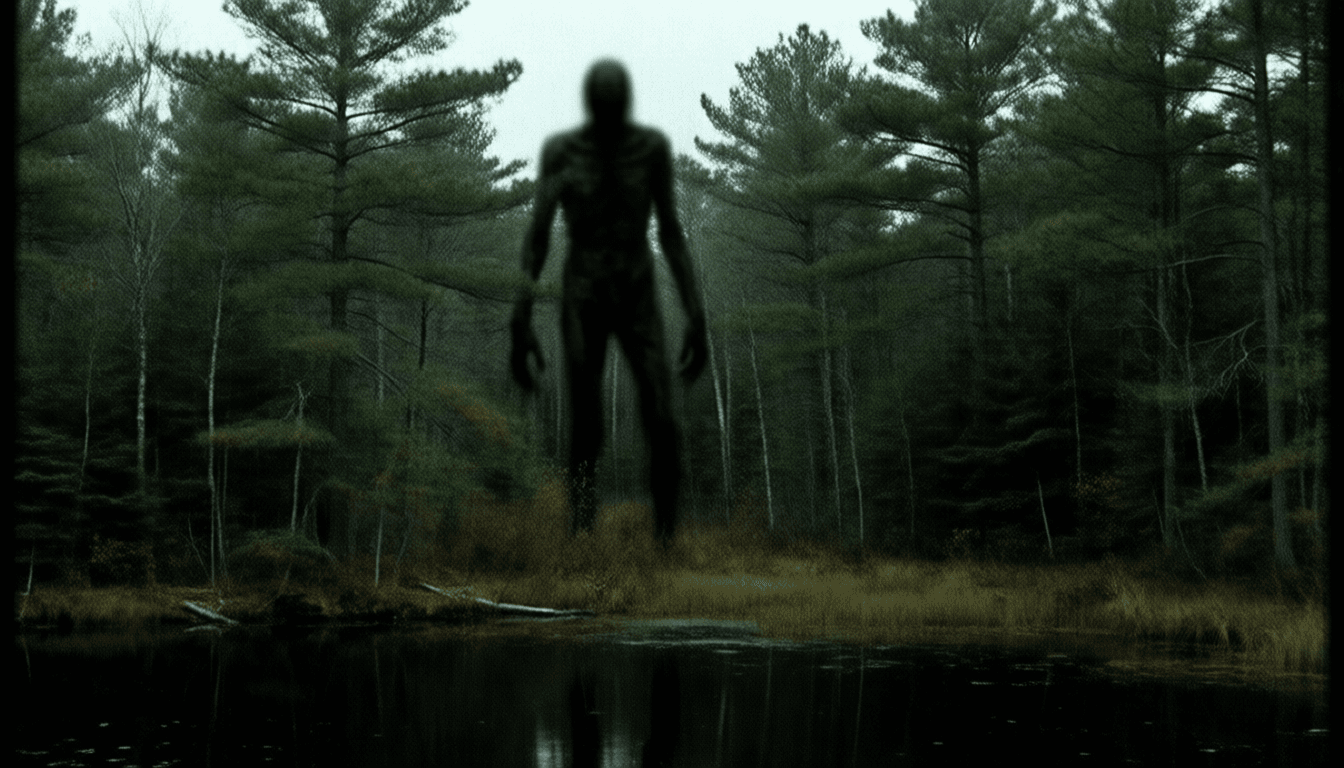
From the oppressive darkness of the pine forest surrounding the clearing, a form began to materialize. It was not a sudden appearance, but a gradual coagulation of shadow, deepening upon itself, gathering mass. It was impossibly tall, its limbs unnaturally long and slender, jointed at angles that defied mammalian anatomy. Its outline was gaunt, and where a face should have been, there was nothing but a horse-like but deeper, darker void. It didn't walk but glided, with a disconcerting fluidity, its long, cloven feet barely disturbing the loose earth.
As it approached, the shallow bog water beside me thrashed violently, defying gravity. Portions of the water rose into impossible conical spires, only to collapse back down with a soundless splash. The air pressure in the clearing dropped sharply, making my lungs burn. It was as if the atmosphere itself was being drawn away.
Now impossibly close, the enormous, dark form loomed over me. Its presence was a physical force, pressing down on me, radiating an unnatural cold. I scrambled backward desperately, tumbling into the bog. The moment my legs hit the water, something impossibly strong, cold, and rough coiled around my ankle. Not a root, not an animal. It pulled me deeper into the cold, black water with immense, unyielding force. I thrashed, reaching for my utility knife, but to no avail. As I struggled, a long, slender, almost skeletal appendage extended from the entity's form. Ending in three sharp, precise digits, it moved towards my face with a speed that blurred the edges of perception. I felt a burning cold pressure on my temple, and as its outermost digit made contact, the cold seeped into my skull, followed by a sudden, blinding flash of pure, unadulterated terror and a silent internal scream that threatened to shatter my mind. And just as suddenly, the grip on my ankle released. The entity's form blurred, distorted, seemed to dissolve back into the deepening shadows, leaving only a profound, suffocating silence.
Disoriented, I clawed my way out of the bog, the unnatural silence gradually receding, replaced by a ringing in my ears. I don't recall the entire duration of my escape, only a desperate, aimless flight through the dense pines, guided by an instinct beyond rational thought. I stumbled out onto desolate Route 563, miles from my entry point, nearly eight hours later than expected.
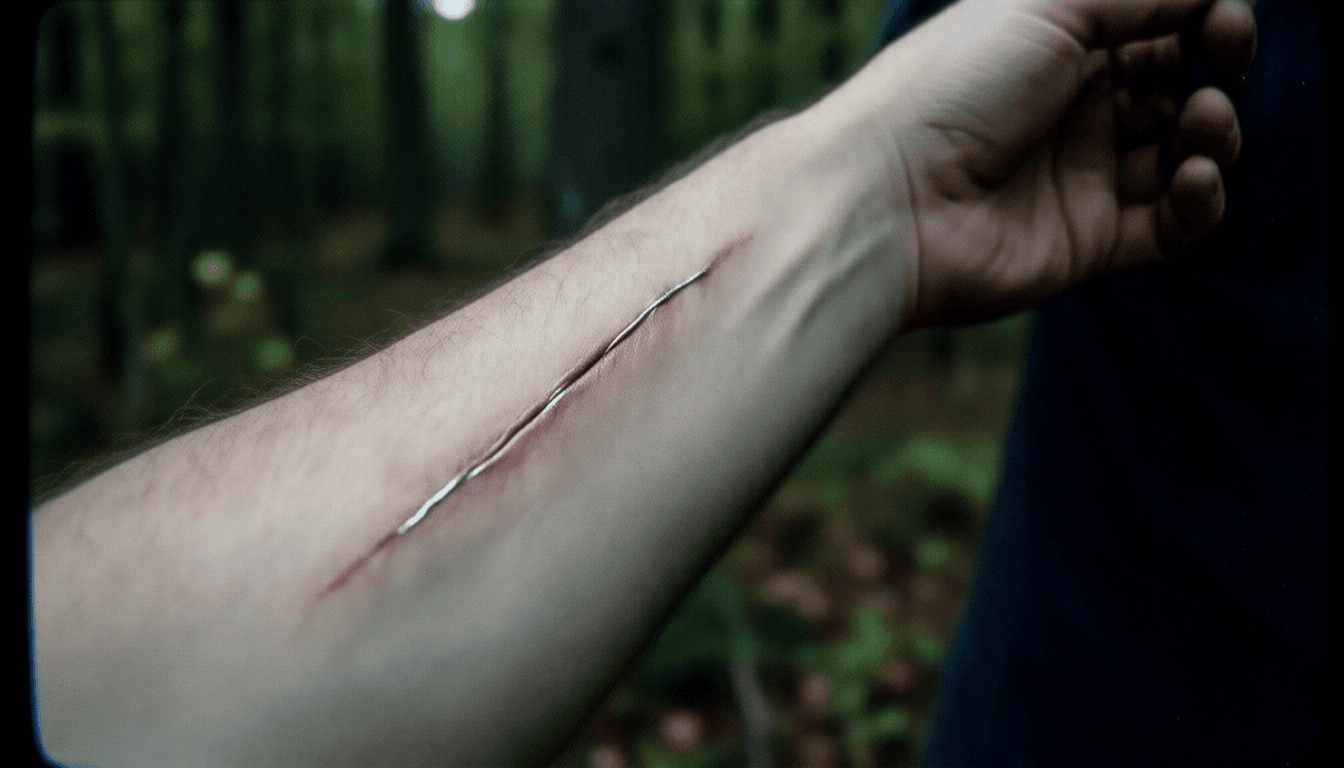
On my left forearm was a peculiar wound. A thin, precise laceration, about six inches long, extending from my wrist to just below the elbow. It wasn't like a scratch from a thorn or branch. It was clean, almost surgical, as if etched by a razor-sharp, non-biological instrument. Despite antiseptic treatment, it never healed properly, festering and eventually leaving a faint, silvery scar that often felt eerily cold to the touch.
My recording equipment was useless; circuit boards burnt, cases warped. But one old, waterproof audio recorder, forgotten in a side pocket, had survived. Playback revealed only static for the first few hours, followed by a period of profound, unnatural silence, and then, abruptly, a single, horrifying sound. It wasn't a roar or a scream. It was a deep, wet, resonant bass thrum, followed by a series of precise, high-frequency clicks, and a sound like fabric tearing, then perfect silence again. Later acoustic analysis determined the bass thrum was outside the known frequency range of any terrestrial animal, and the clicks, while akin to echolocation, possessed an unnatural harmonic complexity.
I have never directly recounted the full details of what I experienced in that exclusion zone. The hunter's whispers of "water flowing backward" now held an chilling clarity. The Pine Barrens is not merely home to an unidentified creature; it is a place of anomaly. Something within its sphere of influence actively manipulates the fundamental principles of physics. Not through magic, but through an inexplicable agency that distorts reality. The decline of specific pine species, the inexplicable soil chemistry shifts, the precise livestock excisions—these are not merely the actions of some creature, but the residual effects of its impossible presence, a phenomenon that slowly and subtly warps its surrounding environment. The true horror isn't the creature itself, but the realization that our understanding of the natural world, of physics, and of "reality" is terribly incomplete, that there are points where reality itself is permeable. And sometimes, one returns from such a place, not branded by a monster, but by the indelible, chilling imprint of an impossible truth.
[ CLASSIFIED VERDICT ]
[ACCESS LOG - SOURCE FILE]
Amidst rumors of strange environmental changes and livestock predation deep within the New Jersey Pine Barrens, a researcher ventures into the exclusion zone to investigate unidentified footprints. There, he confronts impossible phenomena where the laws of physics are warped, sounds are absorbed, and reality itself is distorted. This story is a chilling record of a terrifying presence that defies the ordinary laws of nature and the indelible marks it leaves behind.