
Capiz, Night of the Tik-Tik Sound
Reports, seemingly disparate yet chillingly consistent, from the remote barrios (villages) of Capiz Province, Philippines, have been accumulating in my archives. Over the past 18 months, a pattern distinctly outside the standard categories of rural crime or wildlife activity has emerged. Local news outlets have sporadically reported a series of unusual occurrences:
Cattle Mutilations: Numerous instances of livestock – pigs, chickens, even small water buffalo – found completely drained of blood. Crucially, there were no visible predator bite marks, only small, precise puncture wounds near major arteries. The carcasses were otherwise intact. This was not the work of wild dogs or pythons.
Unexplained Miscarriages: Three confirmed cases of sudden, late-term miscarriages among pregnant women in isolated communities. All three women testified to vivid, terrifying nightmares preceding the events, involving "shadows getting too close" or "a chilling presence in the house." Medical examinations found no clear physiological cause for the fetal deaths.
Digital Whispers: Dozens of posts on a private community Facebook group, "Old Tales of Capiz," detailing "something moving at the periphery of vision at night," "strange scratching noises on the roof," and most commonly, a "'tik-tik' sound that seems distant but fades as it approaches." This inversion of acoustics is a consistent feature.

The recent disappearance of Maria Santillan, a seven-month pregnant woman from Sitio Gulod – a region particularly vulnerable to these phenomena – became the unavoidable catalyst for direct investigation. Local authorities closed her case due to "personal matters" and "no witnesses," but the villagers know the truth. So do I. Anecdotal as it may be, the accumulated evidence paints a compelling and dark picture.
My journey into the Capiz hinterlands was one of ever-deepening isolation. From the provincial capital, it took several jeepney changes, then a motorcycle ride down roads that progressed from gravel to muddy tracks. The humid air thickened, and the jungle pressed in from all sides. My taciturn driver, Ricardo, claimed he wouldn't wait past dusk, a statement that felt more like a pretense than a promise. When I confirmed Sitio Gulod as the destination, a flicker of unease crossed his eyes.
Sitio Gulod was a sparse collection of simply built stilt houses. Connected by rough planks and dirt paths, the village was eerily quiet. Children, normally boisterous, were absent from yards. Windows were firmly shuttered long before the sun began its descent. The pervasive atmosphere was not merely rural quietude, but a stifling vigilance and dread. I spoke cautiously with a few villagers, avoiding direct mention of Maria. Their responses were guarded. Aling Nena, an older woman with a face creased by sun and hardship, pointed with gnarled fingers towards the village's overgrown, vine-choked perimeter and whispered hoarsely, "The old sugar mill. It likes the quiet, it likes to hide." I learned it was a relic of a bygone era, abandoned for decades, a skeleton of rusted metal and decaying wood. No one went near it after sundown. That was my target.
I set up a clandestine observation post within the tangled undergrowth at the mill's perimeter. My equipment – a high-sensitivity microphone, thermal camera, night-vision monocular, and a robust tactical flashlight – felt like woefully inadequate defenses against the taut apprehension of the coming night.
As the last vestiges of twilight drained from the sky, the jungle's usual nocturnal symphony began to unravel. The chirping cicadas, the croaking frogs, the distant calls of unseen birds – they didn't just fade; they ceased. An unnatural, almost perfect silence descended over the mill. The already humid air turned inexplicably cold, a damp chill seeping into my clothes. I activated my recorder. The silence registered as a flat line, an auditory void more disquieting than any sound. And then, it began. A faint, almost imperceptible 'tik-tik' sound. Like a gecko's call, yet elongated and distorted, it resonated from deep within the mill's rusted interior. As I strained to pinpoint its source, it seemed both impossibly distant and, for its faintness, too close. It played havoc with my perception of distance and proximity.

Through my night-vision monocular, the shadows within the mill seemed to possess a subtle, independent movement. Not the flutter of bats or the scurry of rats. This was something fluid and deliberate. Silhouettes flickered into and out of existence, stretching impossibly thin, then contracting into abnormally hunched forms before vanishing entirely. It was like smoke, yet disturbingly dense. My thermal camera, scanning where movement was detected, registered only 'cold spots' where I expected heat signatures – an utter absence of residual warmth.
Then the smell started. Faint at first, then growing more distinct. A sickly, metallic sweetness, like stagnant water and something decaying yet nauseatingly floral, permeated the windless air. The 'tik-tik' sound intensified its unnatural behavior, growing fainter yet overwhelmingly present. It was no longer a distant sound. It was here. My rational mind struggled to dismiss the inverted acoustics, the impossible movements, the unsettling stench. But my primal brain screamed. I was being watched, evaluated. The sensation was a tangible weight on my shoulders.
Lured by the increasingly distant 'tik-tik' – now accompanied by a soft, sibilant hiss just beyond my immediate perception – I risked moving closer to a gaping breach in the mill's outer wall. As I rounded a section of collapsed corrugated iron, the ground beneath me gave way. A hidden pit, obscured by years of vines and debris, swallowed me whole. I fell hard, my leg twisting, a searing pain exploding in my ankle. The flashlight, still clutched in my hand, tumbled away, rolling into the darkness, its beam flickering out. The metallic sweetness now choked the air, overwhelming, pungent.
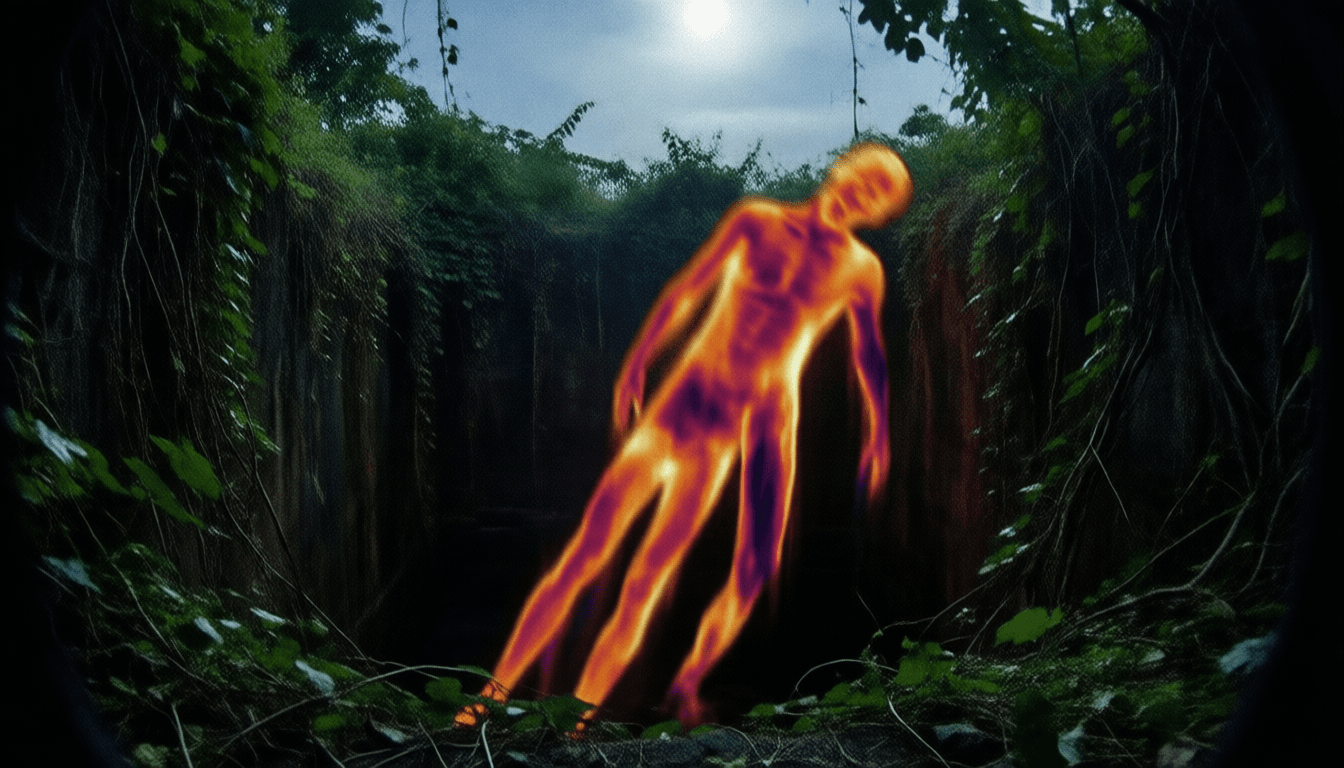
In the absolute blackness of the pit, the 'tik-tik' sound vanished. Its place was taken by a wet, gurgling sucking sound, directly above me. My thermal camera, miraculously still in my grasp, flickered to life for a single, chilling instant. It captured an impossibly tall and slender form silhouetted against the faint moonlight filtering through a high crevice in the mill's roof. The form seemed to shimmer and waver, as if struggling to maintain a singular shape. It leaned into the pit, its head bent at an impossible angle. I saw no eyes, no identifiable features, just a distorted void of contours that refused to solidify.
Then, a cold, wet force clamped around my injured leg. It wasn't a hand. It was a suction-like grip, pulling me further into the darkness, towards the sound of that sickening suck. I screamed, flailing instinctively, my free leg kicking wildly into the void. Something soft yet firm brushed against me from above. A low, inhuman hiss erupted from the darkness.
The grip tightened, pulling with unimaginable force. A sharp, piercing pain, not like teeth, but like needles sinking deep into flesh. A jolt of intense agony, followed by an immediate emptiness, as if something vital was being drawn out. The sucking sound intensified, now impossibly close, wet and vile, right next to my ear.
With a desperate surge of adrenaline, I kicked blindly. My foot connected with something solid and metallic – a loose rebar from the collapsed factory structure that I'd accidentally found. I grabbed it, thrusting it upwards, aiming to dislodge whatever clung to me. With a sickening thud, a sharp, inhuman shriek tore through the night – a sound of pure pain and enraged hunger. The grip on my leg faltered just enough. Using the rebar as a makeshift lever, dragging my bleeding, numbed leg, I scrambled out of the pit, leaving a torn piece of my trousers behind. A repulsive scurrying sound – a swift retreat – followed, and the 'tik-tik' began again, growing louder as it moved away, deeper into the darkest parts of the mill.
I stumbled out of the mill's oppressive shadows, limping badly, my heart hammering against my ribs. The jungle's sounds slowly, cautiously returned, as if the brief, terrifying void had suddenly refilled. I gasped, collapsing to examine my leg. The wound was deep, circular, not jagged but smooth, like a perfectly bored hole. Blood flowed, but it seemed to ooze sluggishly, and a distinct, unsettling coldness radiated from the injury. It defied any conventional animal attack.
Despite the fall, my audio recorder was still running. Reviewing it later, amidst my panicked breaths and the sounds of my tumble, was an indistinguishable blend of static, the wet, gurgling suction, that chilling inhuman shriek, and the 'tik-tik' sound growing louder as it receded. My thermal camera, in its final, damaged frame, showed a distorted, heat-drained outline. An impossibly tall, impossibly slender form disappearing into the darkness. It was an almost non-presence, a negative impression, an absence of heat where a living being should be.
I am alive. But the experience is etched deep into my being. The wound on my leg continues to baffle medical professionals. Though superficially healed, it remains strangely cold, the flesh around it eerily numb. I returned to civilization, but I made no official report. How could I? I had medically unexplainable anomalies, a static-laced audio file, and a single, unearthly thermal image. No official body would believe the truth – that the 'tik-tik' is no myth, that the whispers of Capiz are not mere superstition, and that something hungry roams the darkness, defying the physics of sound and sight. The silence, the smell, the impossible speed, the precise, blood-draining puncture. It was all real. And sometimes, even now, in the deep quiet of my own home, I swear I can hear it. Faintly. And it always sounds closer than it should.

[ CLASSIFIED VERDICT ]
[ACCESS LOG - SOURCE FILE]
This story is based on the "Aswang" legend passed down in the Capiz province of the Philippines. This legendary vampiric monster is known to be active at night, sucking the blood of livestock and targeting pregnant women to harm their fetuses. A distinguishing characteristic is its "tik-tik" sound, which seems to recede as it approaches.