Bunshinsaba: The Curse of the Pencil
For ages, the ritual known as 'Bunshinsaba' has been whispered about in Korean schools and online communities. Performed with a pencil, paper, and an incantation to summon spirits, this crude game was often dismissed as a mere prank or mass hysteria. However, the repetitive pattern of reported bizarre phenomena demanded closer investigation.
My archive holds hundreds of reports: students exhibiting sudden aggression or severe lethargy after the ritual, objects vanishing from locked rooms, chilling wounds appearing overnight on participants' bodies. Most chillingly, isolated incidents surge around periods believed to have heightened ancestral worship and spiritual activity, such as Seollal (Lunar New Year). One consistent detail repeats across these reports: the pencil, meant to be a conduit for a spirit, moves with an eerie, independent force, leaving not divination but malicious messages.
The most recent and compelling reports originated from an abandoned goshiwon (cram school dormitory) in Pocheon. Rumors, starting from local residents and quickly spreading online, claimed that teenagers who entered the building to attempt the ritual returned severely traumatized. Some sustained minor injuries, others psychological distress. Common to all these accounts were descriptions of an "abnormal chill" and a feeling of "eyes watching from everywhere" inside the building, even in broad daylight. A recent, discreet police report mentioned inexplicable damage to internal walls – scratches too deep for human hands, deliberate marks that couldn't be attributed to natural decay. This wasn't just a game gone wrong. It indicated an escalating situation, prompting my direct intervention.
I entered the abandoned goshiwon at 2:37 PM on a Tuesday, choosing a time when human interference would be minimal. The building stood in silence, as if remembering the anxious hours of countless students. A chill, far colder than the late autumn air outside, pervaded the space, mingling with the damp scent of mold and a faint, metallic odor like old blood.
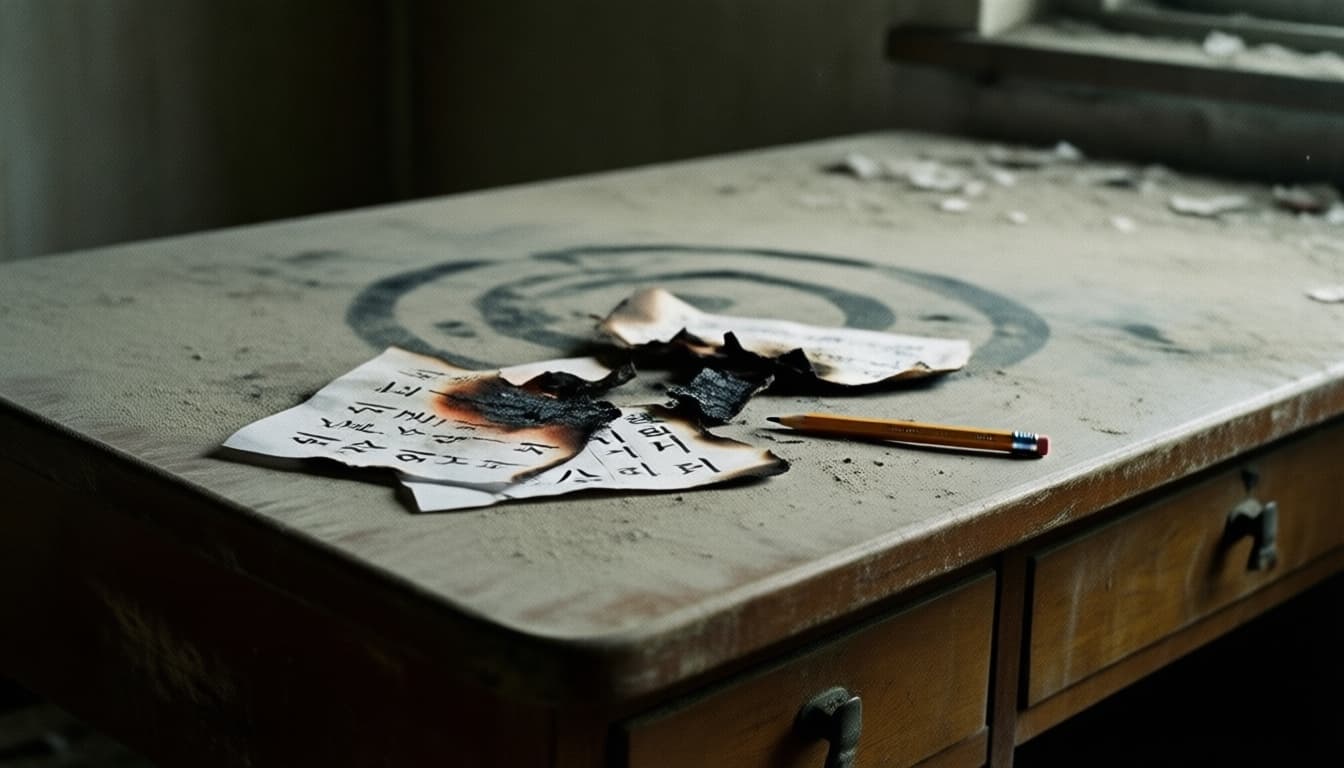
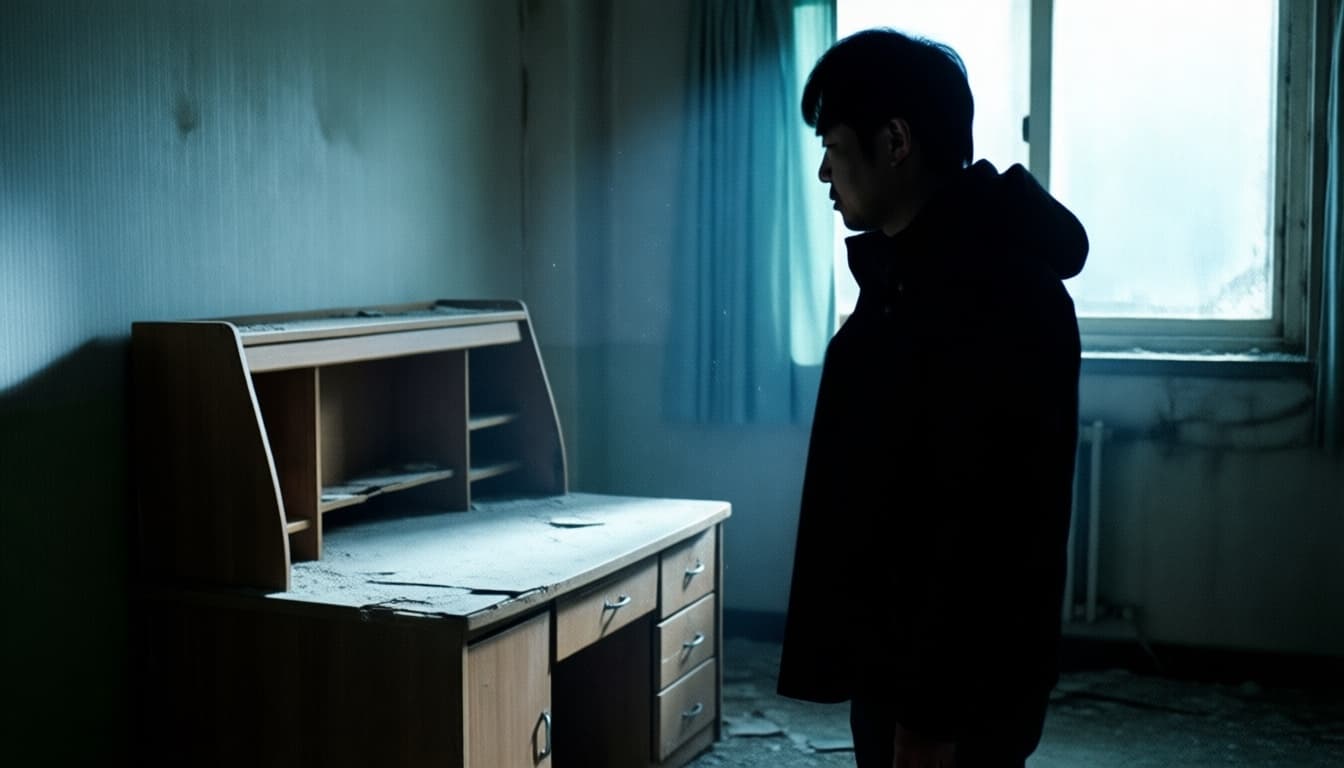
In the main hallway, dust motes danced in the dim light filtering through cracked windows. Room 302, specifically mentioned in the Pocheon reports, was my target. The door was ajar, revealing a cramped space containing only a dilapidated desk and a collapsed chair. Faint circular marks were visible in the dust on the desk, surrounded by scattered, burnt paper fragments with some Korean characters. An ordinary pencil, broken at the tip, lay on the floor. It was a textbook scene: the remnants of a Bunshinsaba attempt. I began my documentation, taking measurements and photographs, careful not to disturb the traces of the ritual. The silence here wasn't merely an absence of sound; it felt like an active, oppressive presence, swallowing even the faint creak of my boots.
As I worked, the silence began to subtly morph. My breathing sounded abnormally loud, and the soft click of my camera shutter resonated for too long, echoing back from an impossible direction – behind me. A distinct cold emanated from around the desk, a chill that raised the hairs on my entire body.
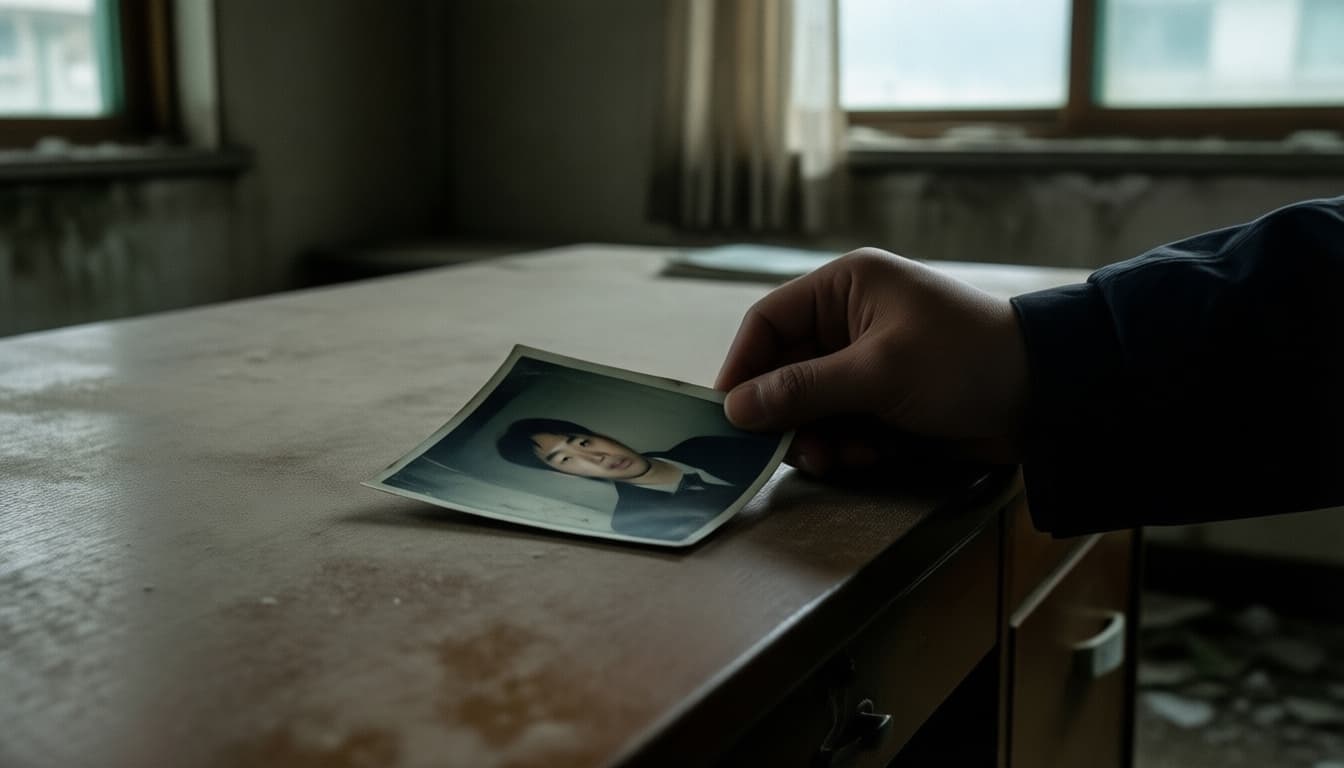
Then, the first anomaly. A faded small photograph, which I had placed on the desk for size comparison, depicting the goshiwon during its operation, moved. It didn't slide. It rotated minutely to the left, as if subtly nudged. I put it back in place, but a minute later, it had moved again, returning to the exact same position as before.
Faint scratching sounds began. Barely audible, they seemed to originate from within the walls. They were irregular, not consistent like a rat gnawing. More like fingernails scraping plaster, with a rhythm but no clear pattern. I examined the walls, but found no cracks or visible damage. When I held my breath, the scratching stopped, as if in response, only to resume with greater intensity.
The most chilling phenomenon occurred when my gaze fell upon the broken pencil. As I watched, one of the pencil fragments on the floor rolled. It wasn't a tremor or vibration. It was a deliberate, smooth movement, as if pushed from beneath. It came to a stop directly under the desk, within the faint circle. The air became noticeably heavier, each breath requiring conscious effort. The metallic odor intensified, accompanied by a new, sickening smell of decay. The cold expanded, enveloping the entire desk, and now reached my hands, chilling my fingertips.
The scratching intensified, now echoing from *all* the walls simultaneously, converging in the room. The pencil fragments scattered on the floor began to rattle and vibrate against the concrete. Without warning, the door to room 302, which I had left ajar, slammed shut with violent force. The sound resonated with an impossible resonance throughout the dead building. I pulled on the handle, but it wouldn't budge. I was trapped.
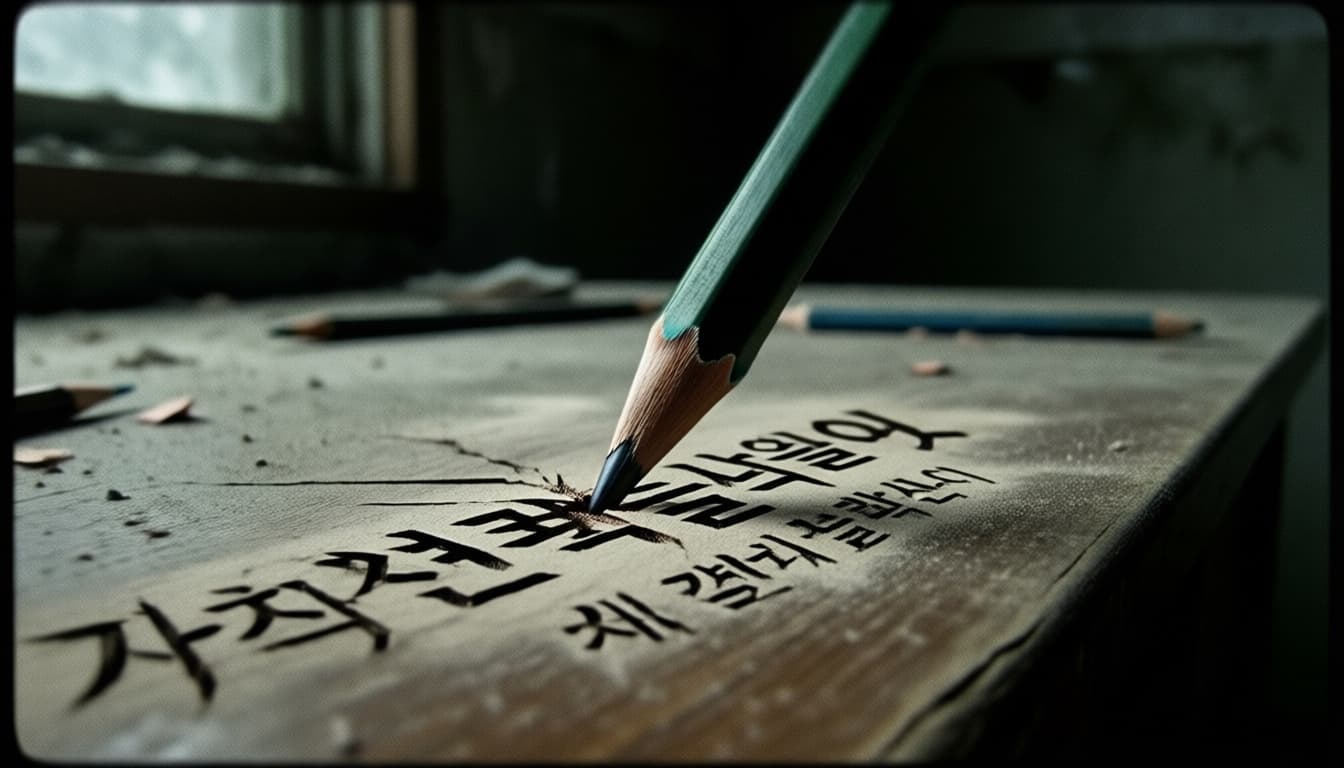
The small pencil fragment under the desk suddenly shot across the floor, hitting the wall with a sharp crack. Then, the other half of the pencil, resting on the desk, lifted into the air. It hung there for a moment, slowly rotating, before descending with terrifying speed, embedding its broken tip into the desk surface, creating a deep, fresh gash. It then began to move. It wasn't sliding. It was dragging itself across the desk, carving rough, jagged Korean characters. It wasn't writing. It was scarring.
An impossibly strong, icy gust of wind swirled through the sealed room, scattering my notes everywhere. The scratching devolved into a cacophony, and faint, chilling whispers seemed to insinuate directly into my ears. They were incoherent syllables, yet conveyed clear hostility. The temperature plummeted further, and the air became sticky and suffocating with the metallic stench.
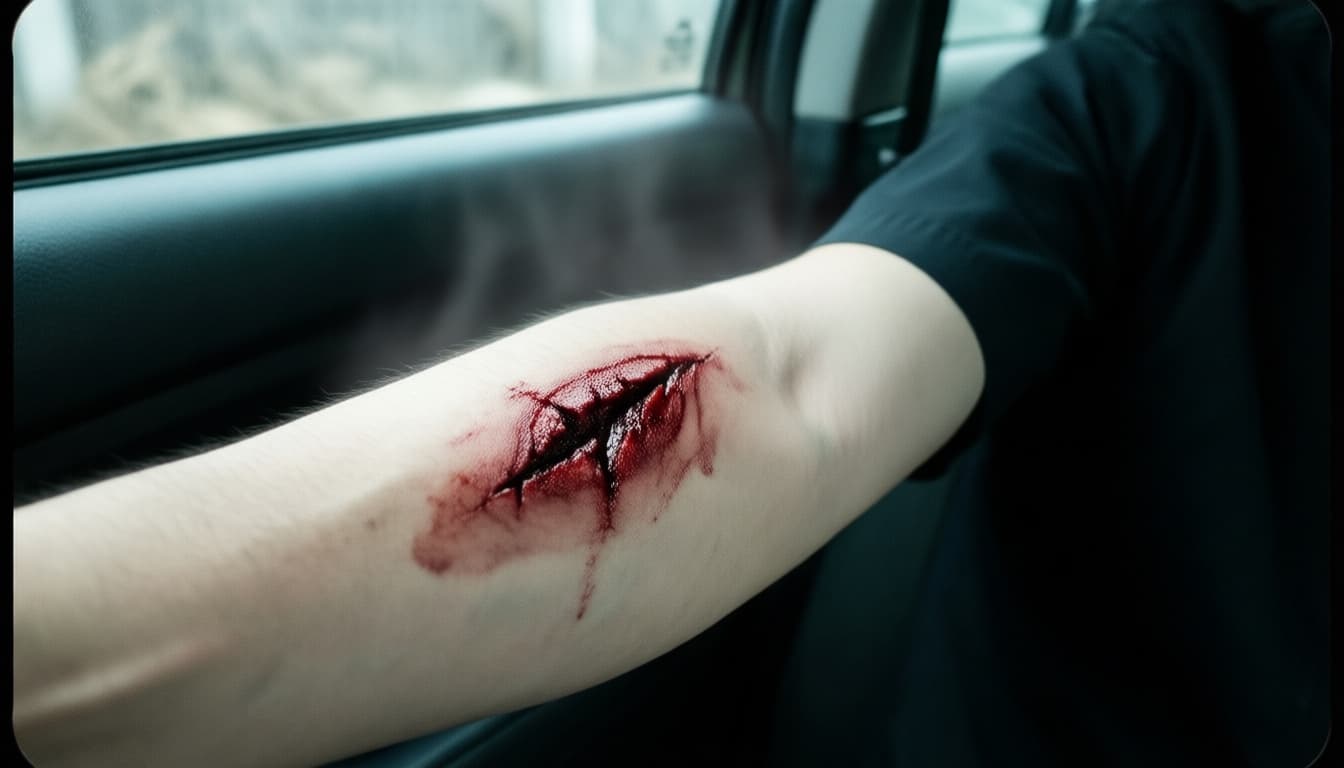
Suddenly, the pencil dislodged from the desk and flew at me, carving a jagged line across my left arm. The pain was immediate, a cold burning sensation. It wasn't a mere scratch; it was a gash deep enough to bleed. As I flinched, an unseen force struck my chest, throwing me against the opposite wall. The impact knocked the breath out of me, and I felt dizzy. My vision blurred.
Through my hazy vision, I saw the pencil rise again, hovering menacingly. This was no game. It was an active, malevolent entity that had trapped me, and perhaps… sought possession. The whispers sharpened, forming a chilling phrase: "You sought me out, now stay."
I don't remember the exact sequence of my escape. Only a blur of desperate struggles against the unyielding door, the splintering wood, and a final burst of adrenaline propelling me out. I stumbled outside, gasping for air. The goshiwon's chill seemed to cling to my clothes and skin.
Blood continued to flow from the wound on my left arm. It wasn't a simple scratch; it was a deeply etched line, almost a symbol. Too precise for a randomly wielded object. I only managed to take a photograph once I reached my vehicle, the stark blood vivid against my pale skin. Later, examining the photo, a chilling detail emerged: a faint, almost imperceptible distortion in the air just above the wound. Like a heat haze, but cold.
Days later, the wound healed, but a scar remained. It often throbs, especially during the quiet hours of the night. More unsettling is a new sensitivity to silence. In absolute stillness, I sometimes hear it again: a faint, distant scratching, like fingernails on plaster, coming from nowhere and everywhere. It feels like a hallucination, yet it is profoundly real.
I am also inexplicably drawn to pencils. I collect them, arrange them, and occasionally find one or two standing upright on my desk without reason. Colleagues have noticed a subtle shift in my demeanor: a constant wariness, and a certain… weariness in my eyes. The goshiwon in Pocheon remains abandoned. Later, indirect confirmation of the damage in room 302 was found through splintered wood around the doorframe and the deep, inexplicable gashes on the desk.
The truly horrifying realization wasn't just that the Bunshinsaba ritual *works*. It was that the spirits it summons aren't content with merely responding. They linger. They watch. And sometimes, they choose to possess a piece of those who dared to play with them. The game doesn't end when the pencil stops. It only truly begins when you try to leave.
[ CLASSIFIED VERDICT ]
[ACCESS LOG - SOURCE FILE]
Bunshinsaba is a classic Korean school urban legend and divination ritual that uses a pencil and paper to summon spirits, ask questions, and receive answers. It is mostly popular among curious teenagers and often performed as a prank, but it is believed that strange and dangerous phenomena, like in this story, sometimes occur. It is said that spirits write or move the pencil.