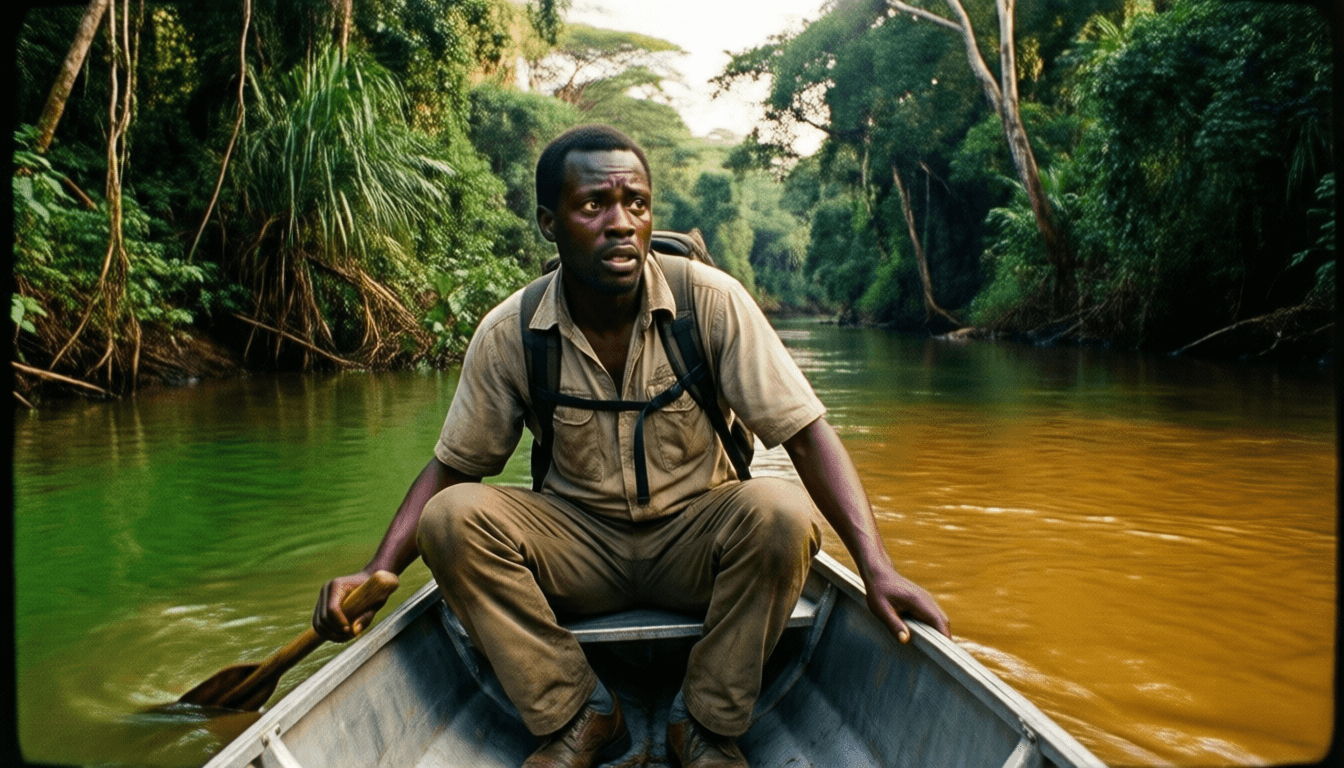
Black Scales of the Tana River
When the name "Dingonek" first appeared in modern records, Western scholars largely dismissed it with ridicule. Described as a scaled reptilian monster with a leopard's head, elephant's tusks, and a scorpion-like tail, an unconfirmed creature said to inhabit the rivers and lakes of Central Africa. It was simply categorized as a fantasy and a mere folk tale. However, early 20th-century accounts, particularly those related to a creature allegedly hunted by a 'Mr. Fitzwilliam' in 1907 (later proven to be a hoax), often overlooked a crucial fact: the persistent belief in this creature among communities living along Kenya's Tana River.
It wasn't the fantastical descriptions that captivated my interest. It was the series of disappearances and capsized boats reported over the last two decades by local fishing cooperatives near Garsen. These weren't isolated incidents attributable solely to crocodiles or hippos. The destroyed boats often bore strange, deep gouges inconsistent with typical river animals, and the victims were almost without exception adult men, highly skilled swimmers, who vanished without a trace of struggle. Locals uniformly described a creature they called 'Ngojoi' – another name for the Dingonek – silently dragging its victims beneath the water. Authorities dismissed these as "strong currents" or "unexpected accidents," yet the whispers continued, and local fishermen, despite the promise of good catches, dared not approach certain overgrown bends of the Tana River. They spoke of a sudden, complete silence that fell upon these spots, a sense of being watched from beneath the water, and an eerie, deep humming resonating through the boat's hull just before an attack. My objective was to ascertain whether these whispers held any truth beyond superstition.
Approximately three kilometers upstream from Garsen Bridge, a particular stretch of the Tana River presented an ominous landscape of emeralds and ochres. The air was thick and humid, a mixture of earthy scents and a distant, metallic smell of iron ore. Juma, my usual local guide who navigated these waters casually, dropped me off downstream, citing a sick relative, but his lingering gaze towards the dense mangrove thickets lining the river spoke volumes. Alone in a borrowed aluminum skiff, I steered upstream, the small outboard motor humming a steady rhythm. The jungle pressed in like a barrier of tangled roots and vines, forming a suffocating tunnel. The brutal sun overhead struggled to penetrate the canopy, casting ever-shifting patterns of shadow and dull light on the river. The usual jungle cacophony of cicadas and distant monkey calls faded here, replaced by the hypnotic sound of the Tana River's incessant flow. I deployed my hydrophone, logged GPS coordinates, measured water temperature, and meticulously documented the riverbed topography with a sonar. My goal was purely scientific: to establish environmental baseline data, then look for anomalies.
The first anomaly was subtle, almost imperceptible. The steady hum of the outboard motor seemed to be swallowed by the environment. It didn't vanish entirely, but its sound became absorbed, muffled, as if the air itself had thickened. Then, the steady, slow-moving river began to behave strangely. About 50 yards ahead, a silent whirlpool, approximately two meters in diameter, formed, churned for a minute, and then vanished abruptly. My sonar detected no obstructions, no sudden drops in the riverbed.
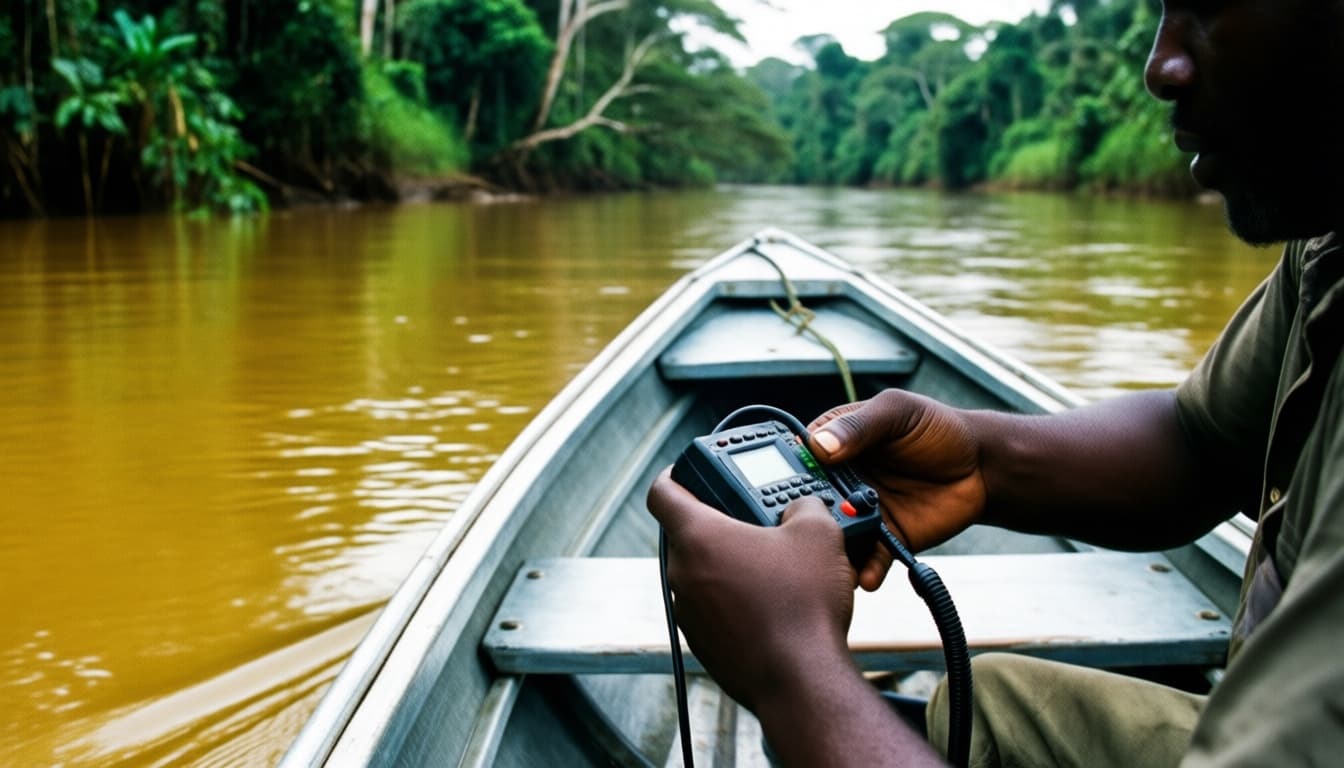
I cut the engine and allowed the skiff to drift. The silence that descended was deep and unnatural. The already diminished jungle sounds vanished completely. Even the buzzing of insects ceased. Only the faint lapping of water against the hull was audible. I deployed the hydrophone, expecting the usual underwater hum, but instead picked up a low-frequency vibration originating directly beneath the boat and resonating through the fiberglass, an intermittent, resonant 'thrum-thrum-thrum.' It wasn't an organic sound; it was too uniform and powerful, yet it felt like a pulse.
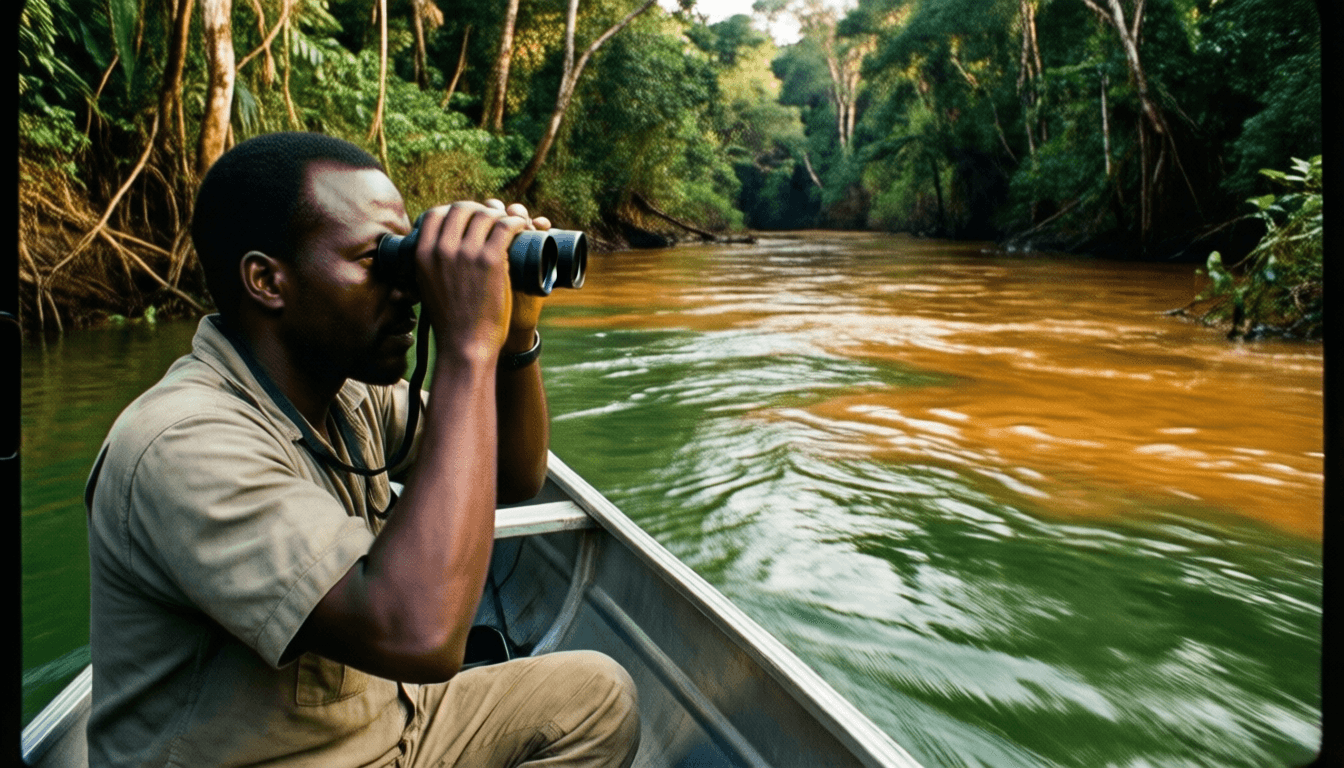
Then came the smell. A faint, acrid odor, reminiscent of ozone and stagnant marsh water, but with an inexplicable musky undertone. It was fleeting but distinct. I scanned the riverbanks with binoculars. Nothing. Just an overwhelming green, dark water, and an unsettling, heavy silence. The surface of the water near the banks began to ripple, not from wind, but from a strong, deep current *against* the main flow, dragging debris and small branches towards the hidden bank with alarming speed before they vanished as quickly as they appeared. A shiver ran down my spine. I wasn't merely observing. I was being observed.
I started the engine, its sudden roar shattering the oppressive silence. I decided to retreat. The moment the propeller bit into the water, a massive disturbance erupted about 20 yards behind the skiff. The water didn't merely break; it *boiled*. A massive upheaval, like an underwater explosion, sent a colossal wave washing over the stern, drenching me. The skiff lurched violently.
My heart hammered. I saw nothing, only churning water. Then, a huge, dark mass briefly surfaced far ahead. It wasn't the back of a crocodile; it was much larger, mottled brown and gray, covered in what looked like scales and ridges, like ancient armor come alive. It vanished in an instant, its wake sweeping around and physically striking the skiff, twisting it. The engine sputtered and died.
Now the amplified thrumming reverberated through the entire boat, accompanied by a giant, deep sigh from beneath the surface, a 'shhhiiik' like a ship's horn. The skiff began to tilt violently to starboard, pulled by an unseen force. I grabbed an emergency oar, struggling to right myself. The water around the boat resisted the river's own physical laws, forming a powerful, localized whirlpool, dragging downwards.
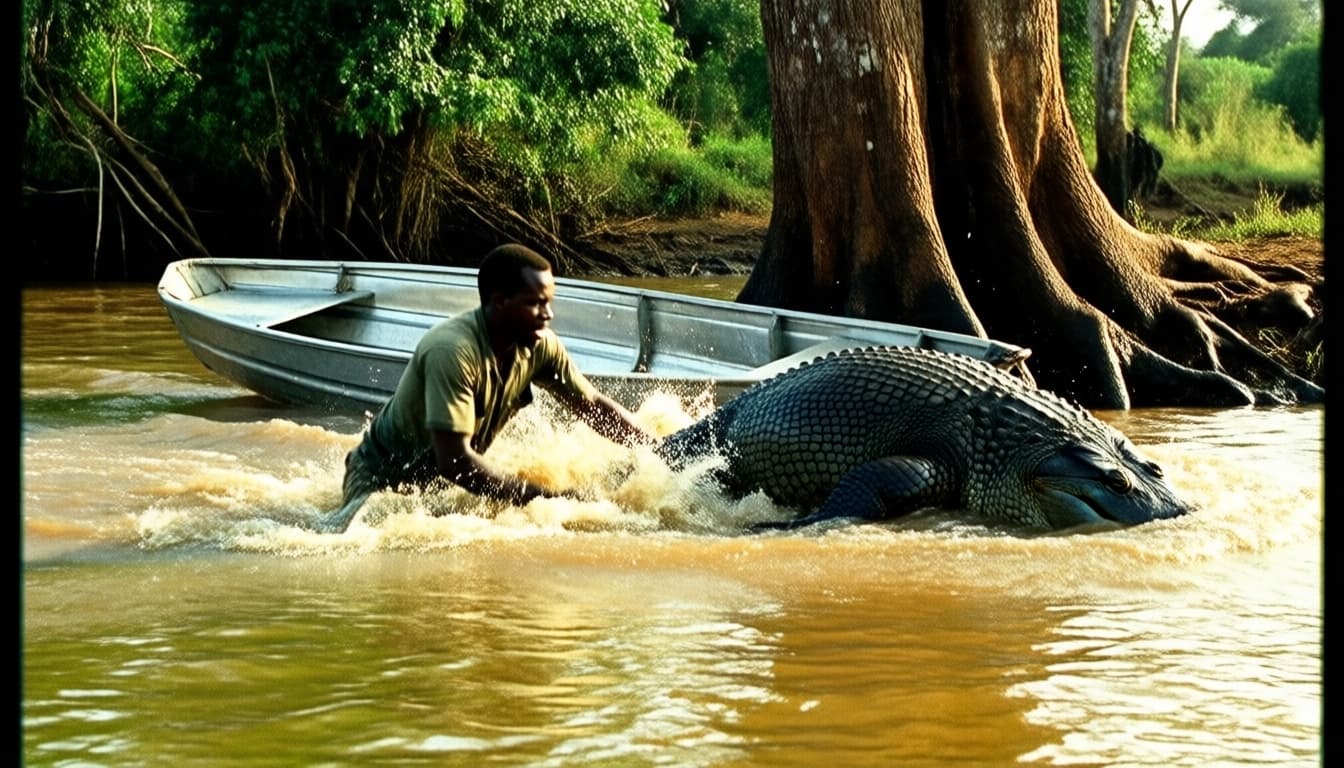
Then, a massive, opaque form surged out of the dark water right beside me. Not a head or tail, but a section of body as thick as a tree trunk, covered in grotesque, overlapping plates. It moved with unnatural speed, slamming into the side of the skiff. The fiberglass groaned sickeningly, bending inward. Heavy, barbed protuberances, like obsidian claws, raked across the hull, leaving not smooth cuts but deep, tearing gouges. The air was now overwhelmingly filled with the acrid stench.
With a violent lurch, the skiff capsized, throwing me into the warm, murky water. Disoriented and gasping for air, something powerful and serpentine brushed against my leg – thick and chillingly cold. Terror seized me. I thrashed, struggling to reach the surface. The taste of salt and fear filled my mouth. The pressure around me was immense, as if the river itself was churning and pulling me down. I glimpsed thick, dark, plated skin undulating just beneath the surface. Then, a flash of a large, dark eye. It was smooth as obsidian, without pupil or iris, reflecting only the overwhelming darkness of the water. It was *seeing* me.
With a desperate surge of adrenaline, I kicked towards a submerged log, using its slippery surface to propel myself towards the dense mangrove roots of the riverbank. Something brushed my foot, a powerful tug. I scrabbled onto the muddy bank, hearing the sounds of splintering wood behind me as the creature crushed the sinking skiff. I barely made it to solid ground, collapsing, hyperventilating, the world spinning.
I lay there, soaked and trembling despite the heat, for what felt like an eternity, listening as the ship-horn-like splashes faded into the ominous silence of the river. When I finally dared to open my eyes, the skiff was gone. The river was calm and impassive, showing no trace of the violence that had just occurred. Only the freshly torn riverbank, where the mangroves were ripped away, bore witness to the encounter.
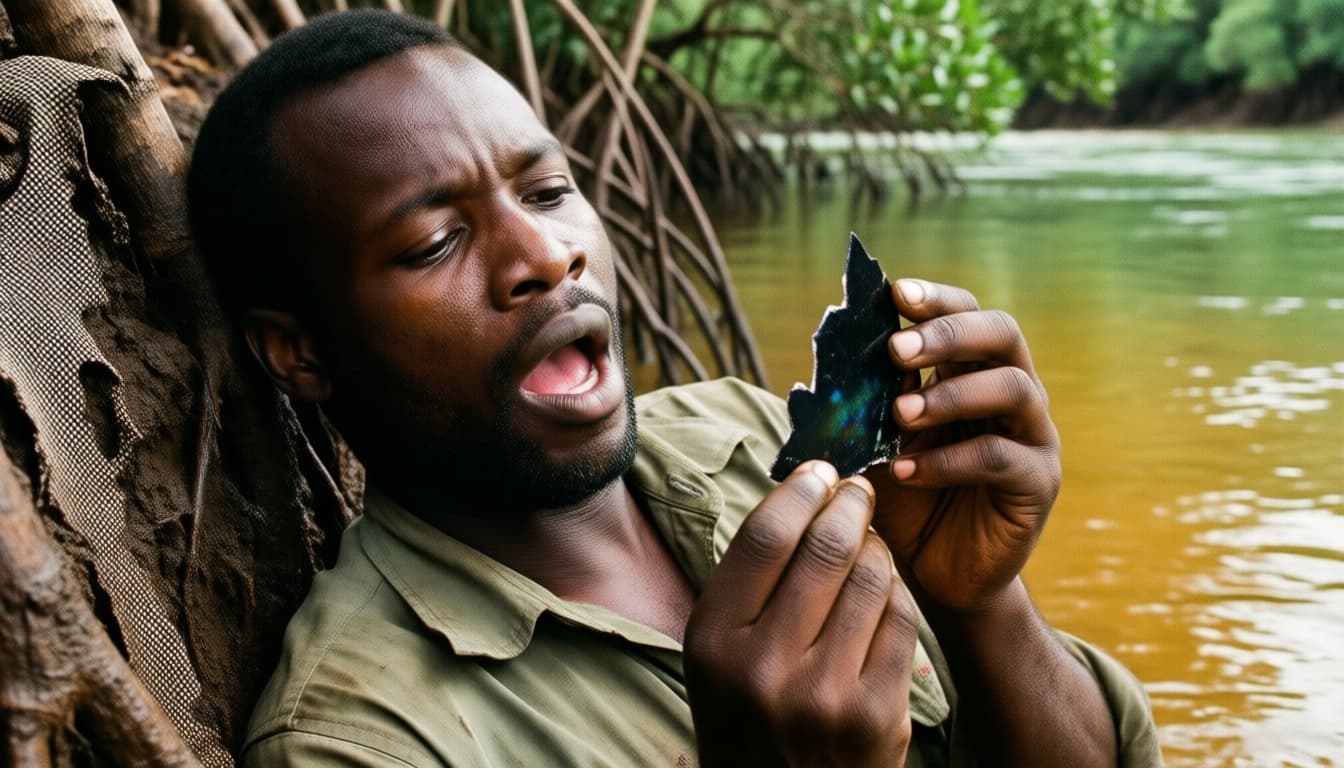
My arm, which had struck the hull, throbbed. More unsettling was a deep, burning pain just above my ankle. I pulled up my trousers to examine it. There, embedded in my skin, were a few small, black fragments. Not thorns, not wood splinters. They were hard, perfectly symmetrical pieces, black as obsidian with a faint iridescent sheen, shaped like miniature serrated scales. They were alien, organic yet incredibly dense, and possessed a strange, almost magnetic coldness. They were unlike anything I had ever seen, certainly not from any known fish or reptile.
I never filed a report with local authorities. It was pointless. My research equipment lay at the bottom of the Tana River. Camera, hydrophone, sonar – all gone. What remained were fragmented memories, indelible terror, and the strange, dark fragments still embedded in my flesh. Back in my archives, the meticulously organized files on "Dingonek" now read differently. The dismissed descriptions of "armored skin" and "unseen claws" took on an eerie weight. The urban legend wasn't just a story; it was a warning whispered from the dark, cold depths of the river, a horrifying truth. Now, that truth resided beneath my skin, a tangible, unsettling presence, irrefutable proof that this unidentified creature not only existed but was utterly, lethally indifferent. I realized my greatest fear wasn't the encounter itself, but the chilling certainty that the creature had simply chosen to let me go. For now.
[ CLASSIFIED VERDICT ]
[ACCESS LOG - SOURCE FILE]
The Dingonek is an unconfirmed creature said to inhabit the Tana River in Kenya, Africa, described as a scaled reptilian monster with the head of a leopard, tusks of an elephant, and a scorpion-like tail. Although often dismissed as mere folklore, belief in this creature persists stubbornly among local communities along the Tana River, where it is frequently blamed for the disappearances of fishermen and boat capsizing incidents.