
Voices Swallowed by the Sands
Altyn-Emel National Park in Kazakhstan is home to the 'Singing Sand Dune,' Akkum-Kalkan, which has for centuries offered visitors a deep, resonant hum. The sound has been likened to an organ, a low growl, and even a distorted human voice. Science explains this as the triboelectric effect and resonance of sand grains under specific humidity and wind conditions. However, online forums and local Kazakh whispers tell a different story. Geological enthusiast boards often report complex and unique waveform patterns, far exceeding natural sand vibrations, discovered in Altyn-Emel's sounds recorded by solitary explorers. It’s not merely harmonic; it hints at intricate, repetitive sequences, almost like language.
More unsettling are the disappearances reported to Kazakh police and park rangers over the last decade. Amateur acoustic recorders, venturing deep into the dunes alone, have vanished without a trace. Official explanations cite 'getting lost in the vast, shifting landscape,' but local guides speak of the 'screaming sands' taking offerings. The case of Dr. Alix Petrosian, a prominent acoustician who disappeared six months prior, adds weight to these whispers. Dr. Petrosian's last satellite phone message was filled with static, containing only a single, deep, distorted syllable just before it cut out.
Elara Reynolds, an investigator specializing in mysterious phenomena with a background in environmental acoustics, arrived at Altyn-Emel. Her goal was to cross-analyze the known acoustic properties of the 'singing sands' with the anomalous patterns found in the 'screaming sands' recordings linked to Dr. Petrosian's disappearance. She prepared high-performance parabolic microphones, seismographs, and ground-penetrating radar. The vast, ochre-colored dunes stretched to the horizon under a scorching sky, breathtakingly beautiful. The sand was almost powdery in some areas, firm in others. Setting up her initial equipment beside a smaller dune, a gentle breeze started, bringing the expected deep hum. It was magnificent, a low sustained note vibrating subtly through the ground and up through her boots. Just as science described, a powerful yet innocuous natural wonder. This initial encounter filled her with awe and momentarily calmed her apprehension.
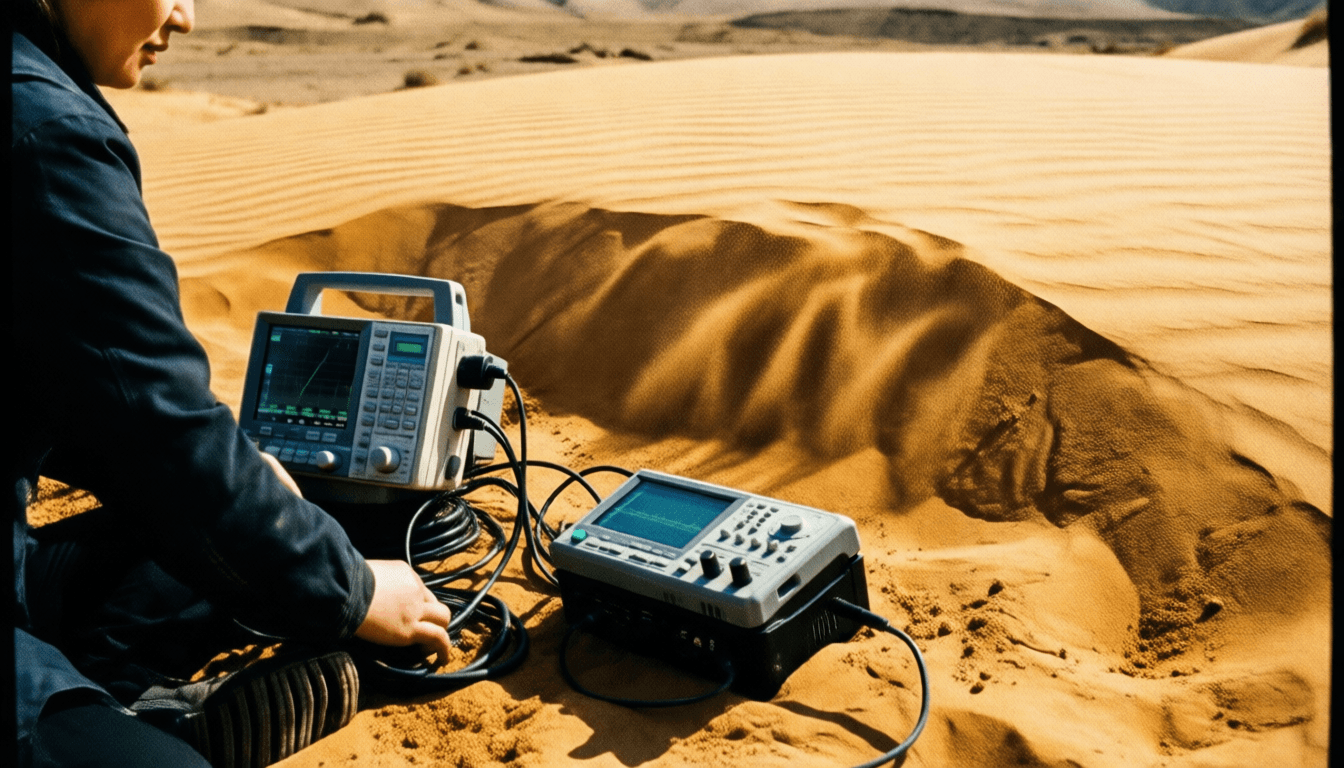
However, as she ventured deeper into the dunes, following a pre-planned grid towards the presumed area of Dr. Petrosian's last transmission, the natural hum began to subtly change. The consistently sustained hum fluctuated irregularly. It wasn't a steady bass tone, but subtly modulated, as if 'following' her movements. When she paused, it subtly intensified; when she moved, it receded again. The parabolic microphone picked up intermittent high-frequency 'clicks' buried within the low hum. Too regular for insect sounds, too deep for natural sand friction.
Her footprints, usually clear for some time, seemed to 'fill in' or smoothly disappear at an alarming rate despite minimal wind. The sand was abnormally cold in some areas, despite the intense sun. Her seismograph registered faint, sporadic internal vibrations unrelated to wind speed or her own movements. The vast, featureless landscape disoriented her. Near the highest point of the dune, her compass needle swung far more erratically than expected. Her own voice, used to test acoustic dispersion, returned strangely delayed or distorted, sometimes repeating syllables she hadn't uttered. The solitude transformed from serene peace into something ominous. She tried to rationalize it all as magnetic interference, wind patterns, psychological fatigue, but the anomalies accumulated, pressing at the edges of her professional skepticism. The 'clicks' became clearer, like a slow, deliberate rhythm emanating from beneath the shifting dunes.
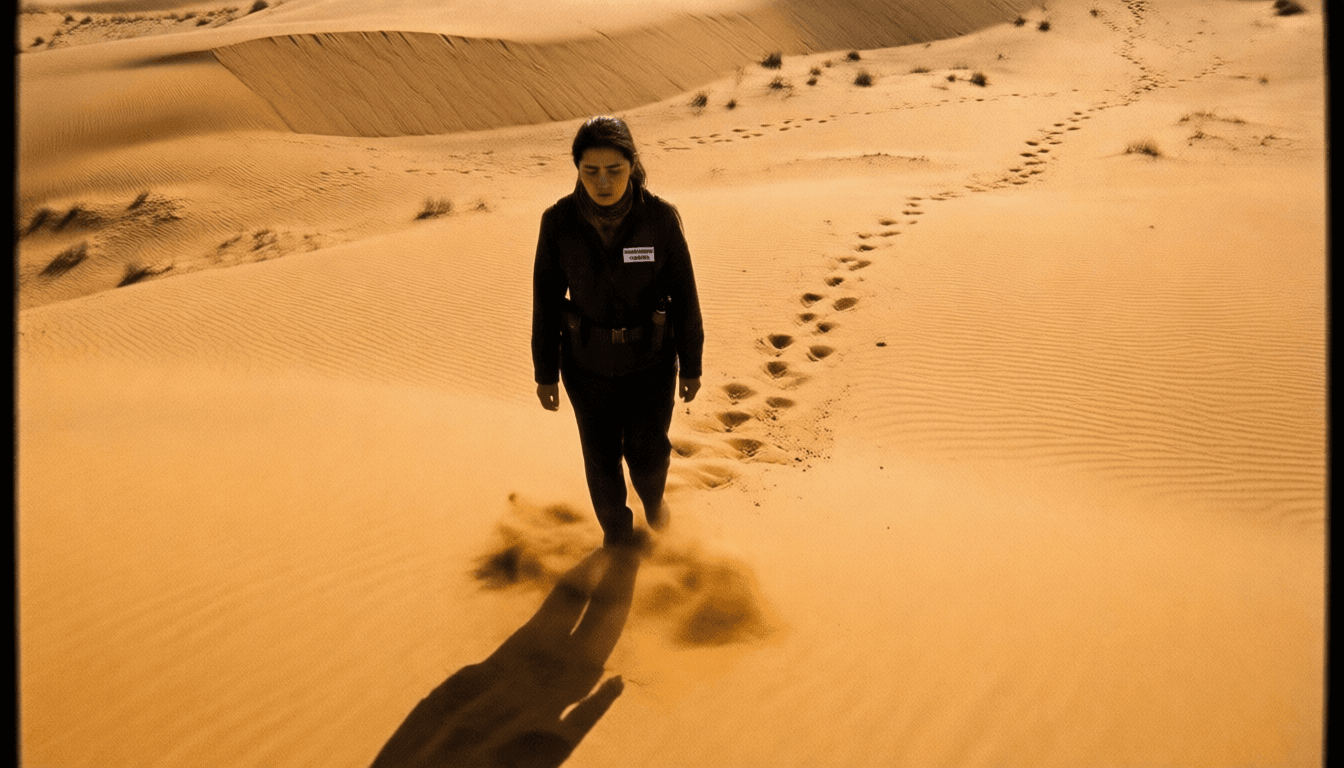
Elara reached the deepest point of her investigation, locating a residual signal from Dr. Petrosian's beacon embedded in the sand. The sun made its final descent, casting long, stark shadows that stretched and twisted. The hum dramatically intensified, no longer a majestic bass note. Instead, it became a cacophony of deep, resonant sounds, now clearly punctuated by regular clicks rising directly from 'beneath' and 'around' her.
Suddenly, the ground beneath her gave way. It was not quicksand, but something that seized her legs with a powerful suction. The fine sand grains around her began to slowly and deliberately swell, forming a rapidly deepening pool. It was no natural collapse. The surface of the surrounding dunes seemed to 'ripple' upwards like liquid, defying their granular nature. Within the surging sand, the hum coalesced. It deepened, vibrating through her entire body, finally transforming into a mournful, multi-tonal sound that was unmistakably attempting 'vocalization.' It wasn't human speech. It was a massive, drawn-out 'wail,' now amplified by the eerie clicks, like grinding stones or clashing teeth, echoing a percussive rhythm.
The surging sand began to slowly but inexorably engulf her, pressing against her chest and arms. It wasn't merely collapsing; it was actively 'compressing' her with immense pressure, crushing her ribs. Her desperate attempts to escape were thwarted as the sand tightened its grip on her body. The parabolic microphone, still recording, captured the chilling 'wail' growing louder. It seemed to come from all directions yet was terribly focused on her, vibrating through her very bones. She felt a distinct sense of the sand itself—not merely sand, but something cold and dense—moving with malevolent intent, pressing against her. She struggled desperately, the weight becoming unbearable. The 'voice' consumed her, and the sand surged towards her face. In a desperate last effort, she activated an emergency beacon and, in a surge of adrenaline, flung her recording device away. At that moment, the pressure became intolerable, and the wail swallowed her completely.

Hours later, Elara was found by park rangers. Half-buried, unconscious, her body covered in deep bruises and abrasions, with sand grains seemingly embedded in every pore of her exposed skin. She survived, but her professional career was over, and her mind deeply broken. She developed a permanent, profound aversion to loose granular surfaces, experiencing phantom pressure on her chest and legs. Medically, there was no explanation for the faint, shimmering, almost crystalline residue that regularly formed in microscopic amounts on her skin, especially where the sand had pressed most intensely. It resisted analysis, appearing silicious but with an abnormal internal structure that defied known geological formations.
Her recovered recorder offered the most chilling evidence. For the last minute before its battery died, the audio continuously documented the dune's 'wail.' More precise spectral analysis confirmed the same complex, non-random waveform patterns previously dismissed as statistical anomalies. But now, after the wail subsided, a faint, persistent echo could be heard beneath the static. It was not an echo of sand or wind. It was distorted, repetitive, and now undeniably 'human-like' syllables. A low, drawn-out moan, followed by faint, almost inaudible 'click-click' sounds, and when played backward and amplified, a clear, distorted whisper that seemed to utter fragments of Dr. Petrosian's last incoherent message. It was an echo of consciousness. Or rather, an absorbed and repeated echo. The singing sands do not merely sing. They absorb and reverberate. The last agonies of those they have swallowed, creating a persistent chorus to lure the next curious soul. Elara now knows that the natural hum of Altyn-Emel is merely the surface of something far older, deeper, and inherently predatory, a desert that holds its victims not just in its depths, but within its very voice.

[ CLASSIFIED VERDICT ]
[ACCESS LOG - SOURCE FILE]
The 'singing sand dunes' of Altyn-Emel National Park in Kazakhstan are a scientifically explainable natural phenomenon. However, this story portrays these mysterious sounds not merely as friction between wind and sand, but as a living entity that absorbs and repeats the last voices of vanished people, luring new victims. It depicts the horror of the sands themselves possessing a malevolent will, devouring individuals.