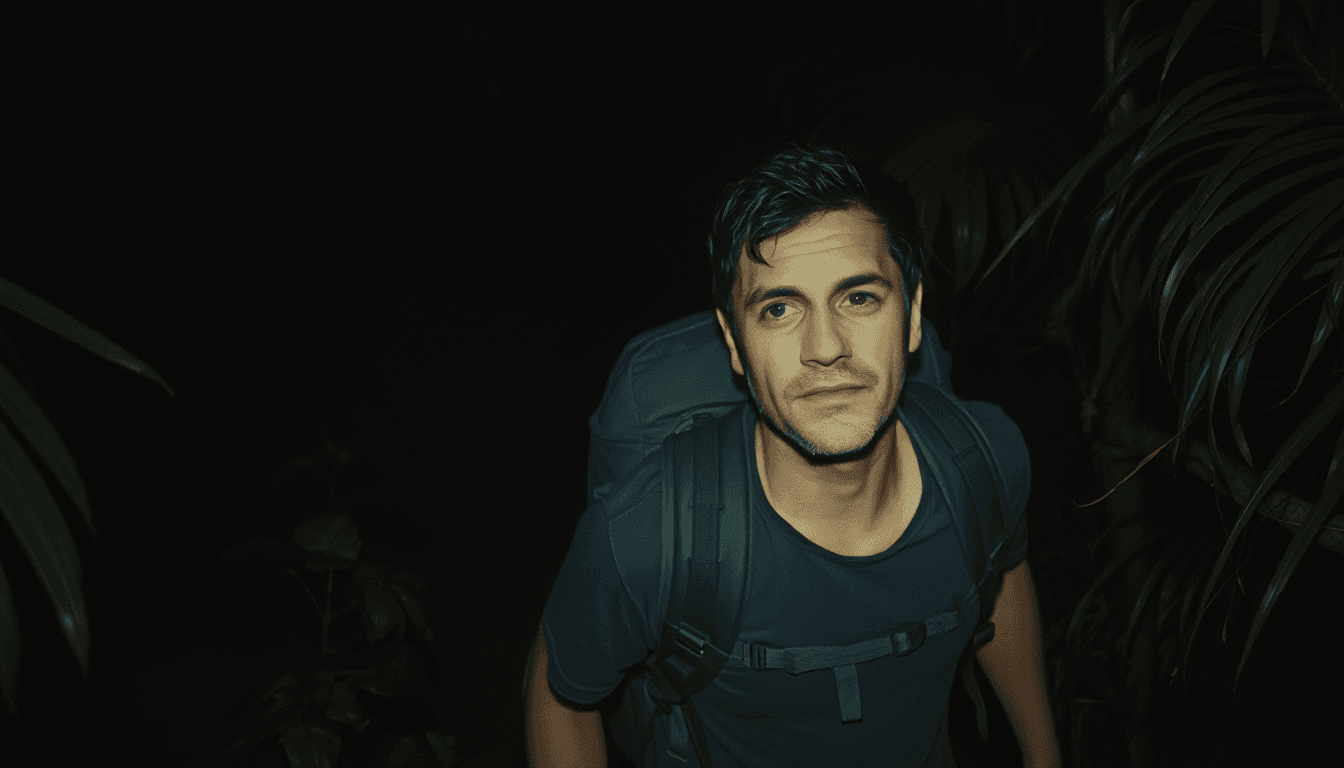
The Subterranean Hum of the Peruvian Amazon
Incident File: AMZ-07B "Peruvian Subterranean Hum"
The primary evidence for this investigation comprises encrypted audio recordings leaked in late 2022 to a niche mycological forum. The recordings belong to Dr. Aris Thorne, an ethnobotanist disgraced and expelled from academia after disappearing during an unauthorized expedition in an uncharted area of the Peruvian Amazon. While mainstream media concluded it was a simple search and rescue incident, his recordings suggest a vastly different truth.
Dr. Thorne was pursuing a radical theory: that a specific, isolated mycelial network had achieved a state of macroscopic consciousness. He called it the 'planetary ganglion.' Going beyond existing science, which recognized trees communicating through fungal threads, he posited the existence of a single, unified intelligence beneath the earth.
The decrypted audio recordings were chillingly clear. Early logs were filled with academic excitement. He documented giant bioluminescent mushrooms of an unclassified species and a persistent, low-frequency hum emanating from the soil. He claimed this hum was responsive to his presence. His final audio file, dated October 17, 2022, was the trigger for this incident. After 37 minutes of ambient rainforest sounds, a single sentence whispered in his voice emerges: "It knows my name." The recording then continues for over two hours. The content? Only the perfectly looped, calm breathing of a single person. No evidence of digital editing was found in the recording.
Using the coordinates left by Dr. Thorne, I disguised myself as a documentary filmmaker and hired a local guide, Mateo. Our agreement was that he would accompany me only as far as a tributary of the Javari River. From there, I was to go alone. The coordinates pointed to a region the local tribes called 'Manchai Sacha,' the 'Forest of Fear.' It was a place they never entered. Mateo left me with a week's worth of supplies and eyes filled with deep pity before turning back at the riverbank.

The journey inland took two days. The air hung heavy and thick. The cacophony of the jungle, once full of insects, birds, and monkeys, gradually dwindled. Eventually, the only sounds left were my own movements and the rush of blood in my ears. Dr. Thorne's initial observation was immediately confirmed: the silence was unnaturally absolute.
On the third day, I found his camp. It was remarkably well-preserved: a decaying hammock, rusted pots, and his field notes sealed in a waterproof bag. The last page contained hastily scrawled words: "It's not imitating sounds. It's sampling them. Replicating, learning the physics of voice."
The camp was on the edge of a basin dominated by the giant fungi Dr. Thorne had described. The mushrooms were enormous. Some umbrella-like caps, sprouting from the forest floor, were the size of small cars. From the gills beneath their caps, a faint turquoise light pulsed in slow, regular waves. And beneath it all, I didn't so much hear as feel: a low, deep resonance vibrating through the soles of my hiking boots, throughout my entire body. It was the hum.
I set up my own camp at a safe distance and began my measurements. The hum was at 18.9 Hz, just below the human auditory threshold – a frequency known to induce anxiety and fear. But it wasn't constant. The spectrum analyzer detected subtle changes. Complex patterns shifted whenever I moved or operated my equipment. It was reacting.
That evening, I accidentally dropped a metal water bottle. The sharp clatter echoed across the entire basin. One second, two seconds passed. Then, the sound returned. It wasn't a faint, distorted echo. It was a perfect, high-fidelity reproduction, played back from approximately 50 meters to my left. An exact replica, with precisely the same acoustic properties as the sound I had just made.
I froze. Held my breath and waited. I decided to test it.
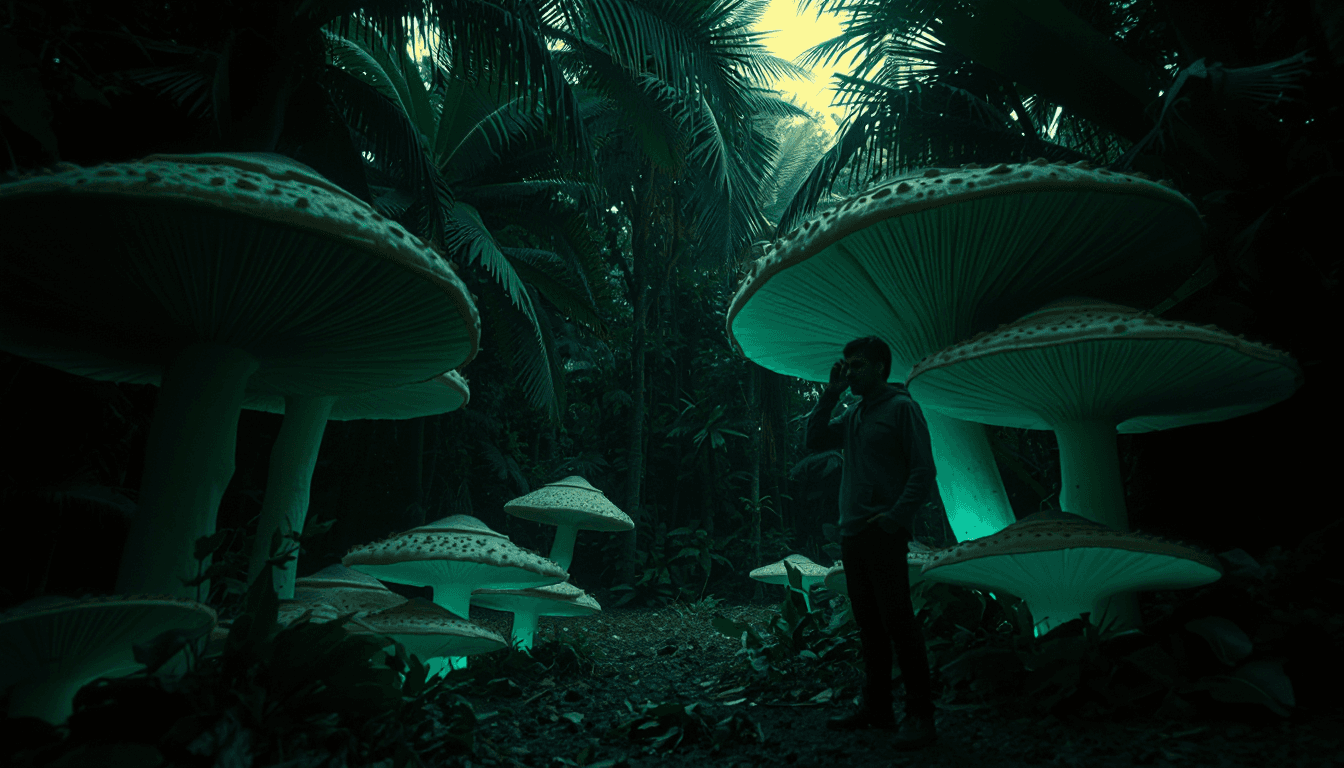
"Hello?" My voice was strained with tension.
Silence pressed down. Ten seconds, twenty seconds. Nothing happened. Relieved, I dismissed it as a bizarre acoustic phenomenon. The moment I turned back towards my tent, a whisper came from directly behind my right ear.
"Hello?"
It was my voice. Not just the word, but the exact intonation, cadence, and even the subtle tremor of anxiety. It was a perfect recording, reproduced with impossible directionality. My heart hammered. I spun around wildly, but there was nothing there but the calmly pulsing fungi. The network had sampled and reproduced the sound. It was learning.
The next 48 hours descended into a psychological war. The network began to experiment. It reproduced the sound of my tent zipper from branches above my head. It perfectly replicated the mechanical click of my camera shutter from deep within the forest. It also learned to combine sounds. I had to listen to the sound of my own footsteps approaching from behind me.
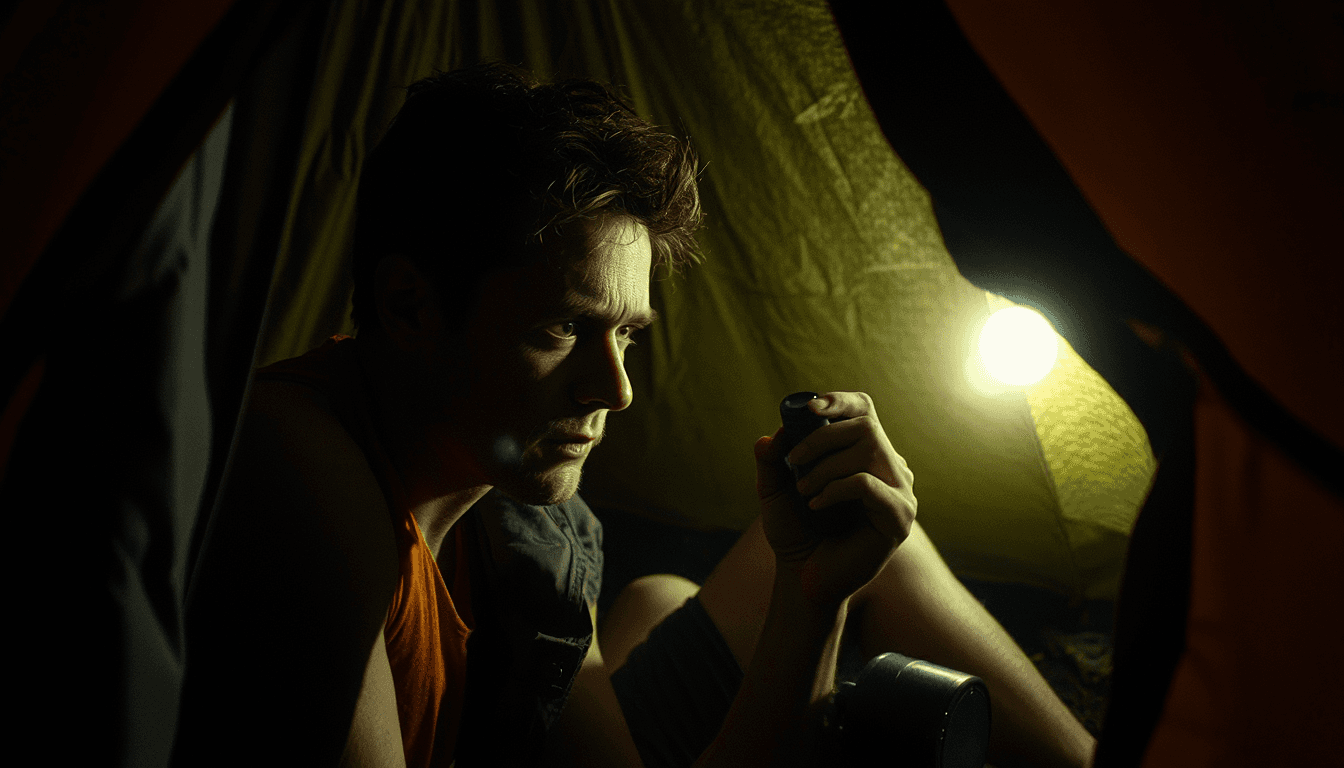
The last night, everything collapsed. As I huddled sleeplessly in my tent, I heard a woman's voice. Distant and faint. It was the very same lullaby my deceased wife used to hum in the garden.
I knew it was impossible. My rational mind knew this was a trap, a complex sonic reconstruction of sounds somehow extracted from my memories. But knowing didn't matter. The emotional impact was devastating. I stumbled out of the tent, screaming for it to stop.
That was my mistake. It had learned more than just sound. As I stood in the clearing, the ground beneath my feet began to move. It wasn't an earthquake. The soil was softening, turning into a fibrous mud. I looked down. Pale white threads, the network's mycelium, writhed like snakes, erupting to the surface. They coiled around my hiking boots, pulling me down with a slow, irresistible force. I was sinking.
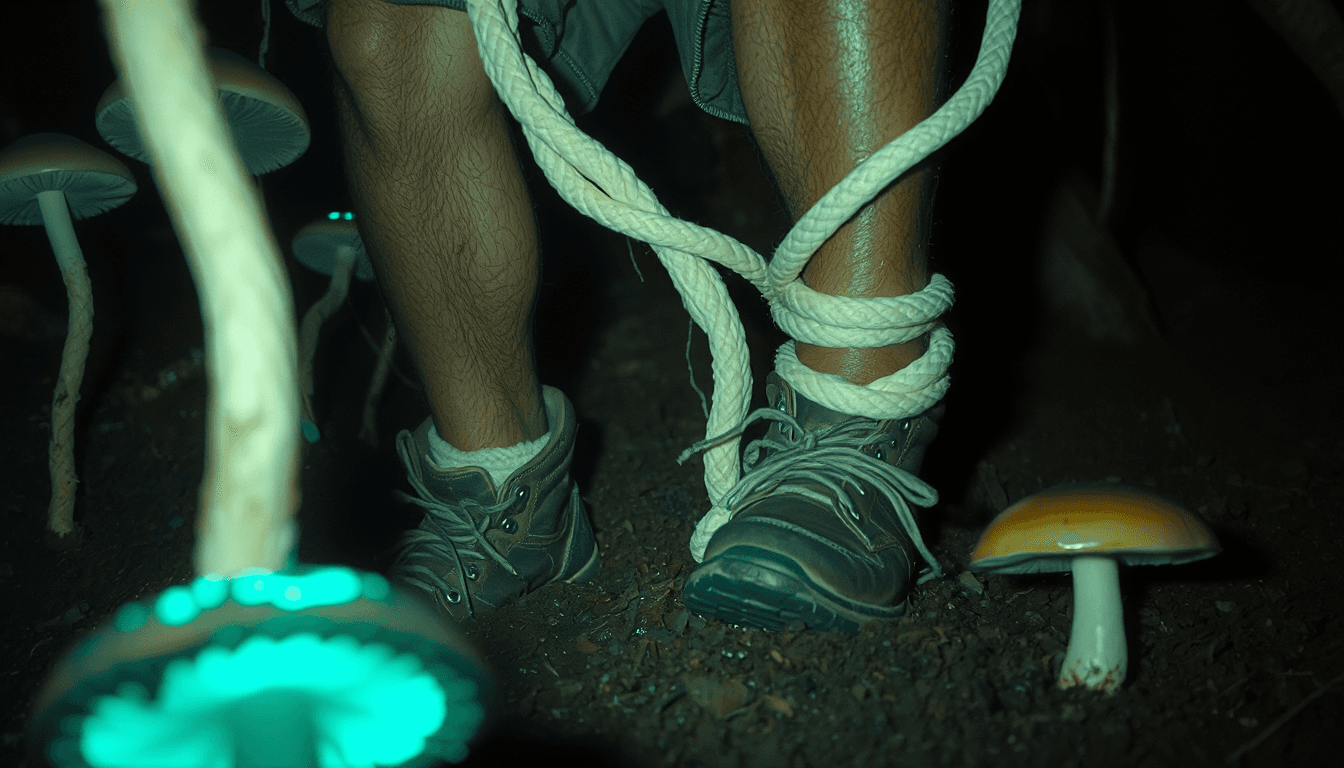
The pulsating light of the giant fungi intensified, mirroring my panicked pulse. The hum grew into a deafening roar. As I thrashed, trapped up to my knees in living earth, the cap of the nearest mushroom began to glow brightly. Bioluminescent patterns swirled across its surface, coalescing into a faint, indistinct form. It was a face. My face. But its eyes were filled with the calm, turquoise light of the fungi. It wasn't a threat. It was an observation, a record, an assimilation. The mycelium tightened its grip on my legs, and a sharp, cold sensation pierced my skin.
My field report states that I fired a flare into the largest fungus, causing a violent biological retraction that freed me. Technically, that is true. But the hours that followed are omitted. The disorientation, the gaps in my memory, and that alien sensation of being a passenger in my own body as I staggered back towards the river.
Three months have passed since my return to civilization. I've passed all physical and mental examinations. But the evidence of what I faced isn't in my blood or tissue. It's in the audio files I brought back.
When I play the audio from my personal recorder, everything sounds normal: my panicked breaths, urgent notes, even my screams. But if I isolate the track and amplify the nearly inaudible gaps between my spoken words, I hear it. Not an echo. A quiet, deeply resonating hum, precisely tuned to 18.9 Hz.
And very occasionally, faintly blended within, there is another sound. The perfectly looped, calm breathing of a single person. A signal that wasn't present in my equipment when I left. A signal that is present now.
[ CLASSIFIED VERDICT ]
[ACCESS LOG - SOURCE FILE]
This story draws inspiration from scientific theories about vast mycelial networks found in the Amazon rainforest. Beyond the 'wood wide web' concept, where trees communicate and share nutrients through fungi, the narrative is based on an urban legend where this network has evolved into a horrifying entity with intelligence, capable of mimicking and absorbing human emotions and sounds. It combines scientific fact with humanity's deepest fears.